In This Article
A connected electric bike for delivery riders is a pedal-assist e-bike that pairs with a smartphone app or smart display to record every shift: distance, speed, battery status, service reminders and, on some models, GPS location. In short, it turns your bike from a silent tool into a work partner that keeps receipts. Done well, a connected electric bike for delivery riders pays for itself in fewer breakdowns and smarter shift planning.

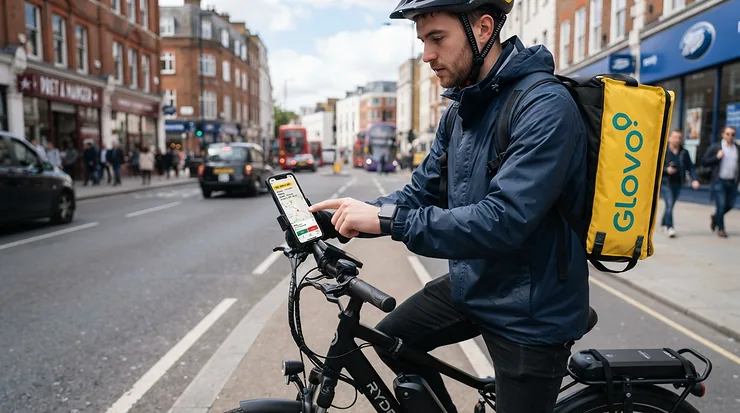
Picture the Friday dinner rush. Three apps pinging, rain on the visor, a bag of curries heavier than your weekend plans. At 9pm your battery bars drop from three to one, and you have no idea whether that’s normal or a warning. This is where a smart electric bike for food delivery work earns its keep. It shows how far you really rode, how hard the motor worked and how your battery behaves week by week.
Legally, the bike must still count as an electrically assisted pedal cycle: a motor of no more than 250W, assistance that cuts out at 15.5mph, and a rider aged 14 or over. Break those limits and you’re riding a moped, with all the paperwork that implies.
A quick honesty note: I haven’t test-ridden any of the seven bikes below. This guide is built from manufacturer specifications, published editorial reviews and owner discussion, and where I couldn’t verify something, I say so. Prices are ranges only, so check the current price before you buy.
We’ll cover the bikes first. Then come the practical bits: ride data logging routines, battery health monitoring and what a high mileage motor really means for your wallet.
Connected Electric Bike for Delivery Riders at a Glance: Quick Comparison
Here’s the whole field on one screen. Battery sizes are in watt-hours (Wh), because amp-hours alone mislead when voltages differ.
| Bike | Connectivity | Battery | Price range | Best For |
|---|---|---|---|---|
| Tern HSD | Bosch Flow app, Kiox 300 display | 545Wh (S00 spec) | Low-£4,000s upward | Heavy loads, maximum durability |
| Specialized Turbo Vado 4.0 | Specialized app, MasterMind display | 710Wh | Premium, £3,000+ | Long shifts, deep diagnostics |
| Cowboy Cruiser | App with ride history and GPS | 360Wh | High-£2,000s upward | Data-first city couriers |
| Tenways CGO600 Pro | App with ride log and GPS | 360Wh | Around £1,800 | Low-maintenance mid-budget riders |
| Fiido C11 Pro | Display, app and optional watch sync | 499Wh | Around £1,000 | Budget ride logging |
| Volt Burlington | Wireless fob (no ride app verified) | 504Wh (larger option) | £2,000-£2,300 range | Easy, well-equipped ownership |
| Eskuta SX-250D | LCD, alarm, immobiliser | Around 1,250Wh | Around £2,000 | High-volume takeaway runs |
Read the table by battery first. The Eskuta SX-250D and Specialized Turbo Vado 4.0 carry the most energy, while the Cowboy Cruiser and Tenways CGO600 Pro are the leanest at 360Wh. The richest app ecosystems sit with the Tern HSD and Specialized Turbo Vado 4.0, but the Fiido C11 Pro delivers app-synced riding at roughly a quarter of the Tern HSD‘s price. Budget couriers should note that the Volt Burlington and Eskuta SX-250D trade app depth for simplicity and ruggedness.
💬 Just one click — help others make better buying decisions too!😊
Top 7 Connected Electric Bike for Delivery Riders: Expert Analysis
Seven bikes, three budgets, one question: which one survives your actual working week? Each entry below covers specs, who it suits, what reviewers report and where it stumbles.
1. Tern HSD — compact cargo bike built for punishing daily mileage
The Tern HSD is what happens when a cargo bike goes on a diet without losing its appetite for weight. Newer versions use Bosch’s fifth-generation drive, while the S00 spec sheet lists a Bosch Performance motor (75Nm of torque), a 545Wh battery, a Kiox 300 display with remote and Flow app connectivity. That torque makes loaded hill starts feel civilised, and the frame’s 180kg approval leaves headroom for rider plus cargo. The Flow app records rides automatically, shows battery status and flags your next service. That makes this the most mature option here for ride data logging on a work bike.
Based on the spec comparison, this is the pick when the bike is your main income tool and the motor will face thousands of miles a year. Bosch mid-drives also benefit from wide dealer familiarity. Reviewers consistently describe the HSD as a practical everyday city machine. Road.cc found its Performance Line motor quieter and less conspicuous than the Cargo Line unit on Tern’s bigger GSD, though the same review questioned the HSD’s price against cheaper Tern models.
Pros:
- ✅ Bosch Smart System with automatic Flow app logging
- ✅ Frame rated well beyond rider-plus-cargo weight
- ✅ Compact mid-tail design stores upright
Cons:
- ❌ Price far above typical courier budgets
- ❌ Awkward to manoeuvre through tight hallways
Expect the latest generation to start in the low-£4,000s (check current price). It only makes financial sense if you ride daily for years.
2. Specialized Turbo Vado 4.0 — biggest battery with the deepest diagnostics
The Specialized Turbo Vado 4.0 is the long-shift specialist. Its 710Wh battery is roughly double the Cowboy Cruiser‘s. The 2026 model pairs Specialized’s 2.0 motor (250W nominal, 70Nm) with a MasterMind display and an app offering range-optimisation tools, tuning and on-ride diagnostics. The rear rack is rated to 27kg, so a full courier bag sits comfortably within limits. Turbo System Lock lets you disable the motor from your phone and arm a motion alarm, which is handy when you pop into a restaurant for ninety seconds. Specialized claims up to 90 miles in eco mode; treat that as a ceiling, not a plan, because stop-start delivery work and heavy loads eat range.
On paper, a bigger battery means shallower daily discharge, which is generally kinder to lithium cells. That makes this a strong candidate for serious battery health monitoring across several seasons. TechRadar’s reviewer praised the smooth, quiet assistance and a battery big enough to go multiple days between charges on ordinary commutes. Owner comments on older reviews suggest real-world range can undershoot headline figures in hilly mixed riding, which is normal for the category.
Pros:
- ✅ 710Wh battery comfortably covers long shifts
- ✅ App diagnostics plus motor-lock anti-theft
- ✅ 27kg rack rating suits courier bags
Cons:
- ❌ Premium pricing makes it a theft target
- ❌ Proprietary drive system narrows servicing options
Sitting in the premium £3,000+ bracket (confirm with your retailer), it’s good value only for full-time riders.
3. Cowboy Cruiser — the most app-native bike in this list
The Cowboy Cruiser treats the app as the dashboard. The brand’s own listing highlights GPS tracking, full ride-history analysis, motion alerts and an automatic call-for-help feature. Underneath sits a 250W rear hub motor with 45Nm of assistance, a Gates Carbon belt drive and a removable 360Wh battery weighing 2.4kg. The belt means no chain grease on your trousers or your schedule. The claimed range is 40-90km; the low end (about 25 miles) is the number to plan with if your shifts run long. At 19.3kg with the battery, it’s also easy to carry up a flight of stairs.
My honest analysis: it’s the best match for a rider who wants an electric bike with ride logging for couriers as a core feature rather than an add-on. One caution applies to any app-dependent bike. Its smart functions rely on the company’s software and support, so verify service continuity before spending premium money. I couldn’t verify a large pool of owner reviews during research, so the points here come from published specs and editorial coverage. New Atlas, for instance, highlighted the adaptive power and the app’s range prediction.
Pros:
- ✅ Full ride history with GPS and ride analysis
- ✅ Belt drive and hub motor keep servicing minimal
- ✅ Removable 2.4kg battery eases charging anywhere
Cons:
- ❌ 360Wh battery limits long delivery shifts
- ❌ Smart features depend on ongoing company support
Prices start in the high-£2,000s, so it’s a lifestyle-priced bike best justified by the data features.
4. Tenways CGO600 Pro — lightweight belt-drive logger at a mid-range price
The Tenways CGO600 Pro is the bike for riders who want a clean, low-maintenance machine without paying Bosch money. It uses a 36V 10Ah (360Wh) battery with LG cells and a Gates belt in single-speed form, and one review put it at 37lb bare and 41lb with the battery. The app logs rides and tracks performance, adds GPS, and includes direct support messaging. Tenways claims up to 53 miles in US testing and up to 100km for the EU version, but an independent max-assist test returned 33.2 miles for a 155lb rider. That gap is why small batteries demand honest maths.
Note that some US-market reviews cite a 350W motor. UK buyers should confirm the model sold here carries the 250W EAPC rating on its plate. Reviewers praise the natural torque-sensor feel and grease-free drivetrain, while criticising the stiff ride on rough roads, quick deceleration when coasting and awkward brake-lever positioning. For hilly cities, the chain-driven Pro-C climbed measurably faster in one hill test.
Pros:
- ✅ Greaseless belt drive suits daily use
- ✅ App logs rides and tracks bike performance
- ✅ Removable battery simplifies indoor charging
Cons:
- ❌ Independent range test fell well below claims
- ❌ Stiff aluminium frame on rough roads
Around £1,800 (£1,700-£1,900 range). It offers decent value for flat-city couriers on moderate shifts.
5. Fiido C11 Pro — cheapest way into app-synced riding
The Fiido C11 Pro is the budget disruptor here. It combines a 250W rear hub motor (55Nm) with a Mivice torque sensor, a removable 499.2Wh (48V, 10.4Ah) battery, hydraulic brakes, front suspension and an IP54 rating. That rating copes with rain splashes and dust but not a pressure-washer blast, so wash it gently. Fiido says riding data syncs across the display, the app and an optional watch, and the claimed range reaches 104km, though sources quote between 90km and 104km. The ring lock and battery lock add basic security.
For a part-time rider needing a logged record without a big outlay, the spec sheet makes a compelling case. What the spec sheet won’t tell you is how detailed the battery diagnostics go, and I couldn’t verify that independently. A French review from Tom’s Guide judged the equipment-for-price ratio excellent, and described the bike as closer to an affordable utility machine than a premium tech object. That is arguably exactly what a courier needs.
Pros:
- ✅ 499Wh battery at a budget price
- ✅ Torque sensor with 55Nm hub motor
- ✅ App, display and watch data sync
Cons:
- ❌ Durability at courier mileage remains unproven
- ❌ Battery diagnostic depth not independently verified
Around £1,000 (£900-£1,100 range); strong value if you ride evenings, less certain for twelve-hour days.
6. Volt Burlington — Deliveroo-trial pedigree with simple ownership
The Volt Burlington earned its delivery credentials when Volt announced a Deliveroo trial offering branded, subsidised Burlingtons to selected riders. It uses a 250W SpinTech x Bafang rear hub motor, a Panasonic 400Wh or 504Wh battery, Shimano Alivio 8-speed gearing and a claimed range of up to 60 miles. The weight is 24.7kg with the battery. A wireless fob unlocks the motor, which adds a theft barrier thieves must work around.
Here’s the honest catch: I found no verified manufacturer app for ride data logging, so connectivity here means the fob, not telemetry. You can still record shifts with a general fitness app on your phone, as you can on any bike. Reviewers like the predictable motor, comfortable step-through frame and good battery life. Move Electric’s rating landed in the three-to-three-and-a-half-star zone, while Volt itself points to a five-star Independent write-up. One review noted the included lights, lock and sturdy rack, which saves accessory spending.
Pros:
- ✅ Lights, lock and rack included in the package
- ✅ Fob start deters opportunist theft
- ✅ Step-through frame eases constant mounting
Cons:
- ❌ No dedicated ride-logging app verified
- ❌ Hub motor torque figure not published
Expect £2,000-£2,300 (check current price). It’s fair value if you prize low-fuss ownership over data.
7. Eskuta SX-250D — moped-style bike purpose-built for takeaway shifts
The Eskuta SX-250D is the delivery version of the SX-250, a moped-styled EAPC that reviewers say is popular with riders for takeaway brands. The Series 4 listing shows a 48V 26Ah lithium battery (around 1,250Wh), a claimed 40-50 miles of range, a 15.5mph assisted limit, an alarm and immobiliser, full suspension and a lockable, removable battery. A full charge takes about 7 hours (roughly 2 hours when 30% remains) and costs pennies. Electrek puts the bike at about 54kg, which is moped heft.
Connectivity is basic: the LCD shows speed and battery level, and I found no verified app. That puts it behind the others for ride data logging. Road.cc concluded that its weight and limited efficiency are inevitable consequences of coaxing moped-style riding from UK e-bike rules. The warranty is 12 months or 8,000 miles. At 30 miles a day, six days a week, you’d pass 8,000 miles in under 45 weeks, so read the small print.
Pros:
- ✅ Huge battery rarely stresses during a shift
- ✅ Alarm and immobiliser built in
- ✅ Moped-style comfort and storage
Cons:
- ❌ Around 54kg is brutal on stairs
- ❌ Warranty mileage cap suits few full-time couriers
Around £2,000 (check current price). It’s superb value for high-volume food runs, if you can live without telemetry.
Ride Data Logging: Turn Every Shift into Evidence
Ride data logging sounds like a gimmick until you need it. Here’s a 30-day routine that product pages never give you.
Week one: set the baseline. Update firmware, grant location permissions and let the app auto-record every shift. Bosch’s Flow app captures rides automatically, and owners mention syncing with Apple Health, Strava and Komoot.
Week two: tag your shifts. Note the platform, weather and load. Most bikes record distance and battery use, not earnings, so jot earnings in a simple spreadsheet beside the miles. Pounds per mile reveals which zones and hours actually pay.
Week three: hunt for patterns. Check battery percentage lost per hour and per mile in each assist mode. If Turbo mode drains you by 8pm, ride data logging has just handed you a free rule: drop to Tour on flats.
Week four: act. Book servicing when the app flags it and compare brake wear against your logged mileage.
The first-month mistakes are predictable. Riders let the phone die mid-shift, so carry a power bank. They forget that changing phones means re-pairing the bike, and a Flow reviewer reported an error saying the bike was already linked to another account. They also ignore firmware prompts. A good electric bike with ride logging for couriers only helps if you open the app weekly.
Real-World Scenarios: Matching a Smart Electric Bike for Food Delivery Work to Your Shift
Specs mean nothing without a shift pattern. Here are four rider profiles, with budget, environment and frequency attached.
The evening part-timer. Fifteen miles per shift, four nights a week, flat suburb, £1,000 budget. The Fiido C11 Pro‘s 499Wh battery covers this with plenty to spare, and the app sync gives you a record without extra spending.
The full-time city rider. Forty miles a day, six days a week, hilly terrain, own income at stake. The Specialized Turbo Vado 4.0 gives battery headroom and diagnostics, while the Tern HSD suits anyone carrying bulky multi-order loads.
The takeaway contractor. Short, constant hops from a single restaurant, and lots of stop-start in all weathers. The Eskuta SX-250D‘s huge battery and built-in alarm suit this, as long as stairs aren’t part of your routine.
The data-driven multi-apper. You juggle platforms and optimise relentlessly. The Cowboy Cruiser and Tenways CGO600 Pro give app-based logs, though both need a spare battery or a charging stop if shifts exceed about 25-30 miles. That’s my planning assumption, not a tested figure.
If you’re unsure whether to buy at all, Zoomo rents delivery-focused bikes with GPS and an app for roughly £35-£50 a week, which is a sensible way to learn what you need before spending real money.
✨ Ready to Pick Your Ride?
🔍 Take your delivery shifts to the next level with these carefully selected bikes. Click on any highlighted product name to check current pricing and availability. The right bike will help you build a reliable, data-backed earning routine your wallet will thank you for!
Battery Health Monitoring: A 30-Day Routine That Protects Your Bike
Battery health monitoring is the cheapest insurance policy in delivery work. The battery is the costliest wearable part of any e-bike, and it’s also the part that matters most for safety. The UK’s Office for Product Safety and Standards says almost 200 e-bike and e-scooter fires were reported in 2023, and its regulatory activity update explains why thermal runaway is the core risk.
Try this routine:
- Log the baseline. Record how much battery a standard route consumes on a fresh month.
- Compare weekly. If the same route eats noticeably more battery each week, that drift is your early warning.
- Avoid extremes. Frequent deep discharges and fully hot batteries are generally harder on lithium cells.
- Charge sensibly. Use the manufacturer’s charger, charge somewhere ventilated and never in an escape route.
- Check physically. Swelling, heat, odd smells or damaged casing mean stop using it and contact the seller.
Not every app offers detailed battery health monitoring. Bosch’s Flow app shows battery status and service appointments, while others show percentage and range. Ask each brand what its app reports before buying.
How to Choose a Connected Electric Bike for Delivery Riders
Choosing well comes down to seven steps.
- Confirm it’s a legal EAPC. The plate must show a 250W-or-lower motor or the maximum speed, with assistance cutting out at 15.5mph.
- Do the battery maths in watt-hours. Work backwards from your longest shift and add roughly 30% as a buffer (my rule of thumb). Wind, hills and cargo all shrink range.
- Pick the drive for your mileage. Mid-drives climb well but wear chains faster, while hubs and belt drives simplify upkeep.
- Audit the app. Ask what it logs, whether you can export, and whether it shows more than a battery percentage.
- Layer in theft protection. Motor locks, GPS and alarms matter because you leave the bike unattended at every drop.
- Check the servicing route. A bike nobody nearby can repair is a bike that costs you earnings.
- Total the cost of ownership. Add insurance, a decent lock, spare battery and consumables to the sticker price.
Electric Bike with Ride Logging for Couriers: What the Apps Actually Record
Marketing says “connected”. The documentation says something narrower. Here’s what each manufacturer’s published material supports.
| Bike | Ride log | Battery info | Theft / location | Export |
|---|---|---|---|---|
| Tern HSD | Automatic via Flow | Status and service reminders | Electronic lock; optional GPS alarm service | Apple Health (owners mention Strava) |
| Specialized Turbo Vado 4.0 | Ride data in app | On-ride diagnostics | Motor lock plus motion alarm | Not verified |
| Cowboy Cruiser | Full ride history | Battery and range prediction | GPS tracking, motion alerts | Not verified |
| Tenways CGO600 Pro | Ride tracking | Performance monitoring | GPS tracking, app unlock | Not verified |
| Fiido C11 Pro | Synced across display, app, watch | Not verified | Ring and battery locks | Not verified |
| Volt Burlington | None verified | Display only | Wireless fob | None verified |
| Eskuta SX-250D | None verified | LCD battery level | Alarm and immobiliser | None verified |
Only the Tern HSD has well-documented third-party sharing, and the Specialized Turbo Vado 4.0 leads on diagnostics. The Cowboy Cruiser and Tenways CGO600 Pro offer rich logs in the app but little confirmation of data export. If you want a proper electric bike with ride logging for couriers, the question is not “is it connected?” but “what can I do with what it records?”.
High Mileage Motor: Hub or Mid-Drive for Daily Courier Use?
A high mileage motor is simply a drive unit that keeps its composure when asked for thousands of miles a year instead of hundreds. Industry guidance typically puts motor life at three to ten years, with at least 10,000km common and 20,000-30,000km reported in many cases. Couriers think in miles, though: 30 miles a day, six days a week, is over 9,000 miles a year.
Owner reports show how demanding that is. One rider reported bearing play after about 15,000 miles on a Bosch Active Line Plus and replaced the motor for £590. Another reached around 18,000 miles on a Performance Line CX before the main bearing failed, then rebuilt it for a similar run. A third riding 10,000km a year had replaced a Bosch drive unit twice. These are anecdotes, not statistics, but they show courier use sits at the harsh end.
The hub versus mid-drive trade-off matters here. Mid-drives like those on the Tern HSD and Specialized Turbo Vado 4.0 climb efficiently by using the gears, though the chain and cassette wear faster. Hub motors, as on the Fiido C11 Pro and Volt Burlington, tend to simplify servicing. Zoomo argues a front hub is the lowest-maintenance choice for delivery use. Belt drives on the Cowboy Cruiser and Tenways CGO600 Pro remove chain servicing altogether. Check warranty mileage caps, such as the Eskuta SX-250D‘s 8,000 miles, before assuming any high mileage motor is covered.

Smart Electric Bike for Food Delivery Work: Features That Actually Matter (And Those That Don’t)
Every brand shouts about features. Few of them matter at 8pm in the rain.
What matters:
- Battery capacity in Wh, because it sets how long you can work before charging.
- Removable battery, so you can charge indoors or carry a spare.
- Rack rating and frame strength, because delivery bags are heavy and constantly bounced.
- Hydraulic brakes, since stopping a loaded bike repeatedly punishes pads.
- Theft deterrents, as you leave the bike at every drop-off.
- Lights and weather protection, such as the Fiido C11 Pro‘s IP54 rating.
What doesn’t:
- Social leaderboards and badges, like Cowboy’s cycle club, which are fun but won’t make you money.
- Headline range claims, because the 33.2-mile independent test of the Tenways CGO600 Pro shows why.
- Watch integrations, unless you actually track your health.
The best smart electric bike for food delivery work is the one that cuts your downtime. Fancy screens can wait. Everything else is marketing.
Connected Electric Bike for Delivery Riders vs Moped-Style and Traditional Alternatives
Is an app-connected bike really better than a moped or a plain pedal bike? It depends on the shift.
| Option | Licence & insurance | Running cost | Ride data | Best For |
|---|---|---|---|---|
| Connected EAPC such as Specialized Turbo Vado 4.0 | None if road-legal | Pennies per charge plus consumables | App logs | All-round couriers |
| Petrol moped | CBT/licence, insurance, tax | Fuel and servicing | Usually none | Longest, fastest routes |
| Standard pedal bike | None | Minimal | Phone app only | Short, flat, low-volume runs |
| Moped-style EAPC such as Eskuta SX-250D | None if road-legal | Pennies per charge | LCD only | High-volume takeaway work |
| Rental such as Zoomo | ID and platform agreements | Roughly £35-£50 weekly | App and GPS | Trying before buying |
A road-legal electric bike sidesteps licence, insurance and tax costs that mopeds carry, while the Eskuta SX-250D gives moped feel within EAPC rules. The connected options win on data and flexibility, though petrol still wins on raw range. Zoomo-style rental removes the upfront cost and includes maintenance, which suits riders who aren’t yet sure about the job.
Long-Term Cost & Maintenance
The sticker price is only the opening bid. Delivery work chews through consumables. One component guide suggests brake pads can need replacing every 500-1,000 miles, and one Bosch owner reports about 2,500 miles from a chain. At courier mileage, that means regular servicing bills.
Illustrative hardware cost, spread over 10,000 miles before resale:
| Bike | Price range | Hardware cost per mile (illustrative) | Value verdict |
|---|---|---|---|
| Fiido C11 Pro | Around £1,000 | About 10p | Strongest value for part-timers |
| Tenways CGO600 Pro | Around £1,800 | About 18p | Fair if belt drive saves servicing |
| Eskuta SX-250D | Around £2,000 | About 20p | Good for dedicated takeaway work |
| Volt Burlington | £2,000-£2,300 | About 20-23p | Fair for ease, not data |
| Cowboy Cruiser | High-£2,000s upward | Around 29p+ | Premium for app features |
| Specialized Turbo Vado 4.0 | £3,000+ | Around 30p+ | Justified for long shifts |
| Tern HSD | Low-£4,000s upward | Around 40p+ | Only for heavy-duty, high-mileage use |
The cheapest bike is the cheapest per mile only if it survives the mileage. A Fiido C11 Pro that needs replacing at 8,000 miles loses ground to a Specialized Turbo Vado 4.0 that lasts three times longer. Budget for spare parts, a quality lock and insurance, and revisit the maths after your first logged month.
Safety, Regulations and Compliance Guide
Three layers of rules apply to a connected electric bike for delivery riders in the UK.
Bike legality. The Association of Cycle Traders summarises the EAPC rules: motors capped at 250W continuous rated power, with assistance cut off at 15.5mph. Anything beyond that is subject to type approval, registration, tax and licensing. The bike should display a plate or sticker showing the motor’s power or the maximum speed. Insurer guidance suggests police scrutiny of illegal e-bikes is rising in 2026, and 750W machines count as mopeds.
Battery safety. Government statutory guidelines from December 2024 set out safety mechanisms lithium-ion e-bike batteries must contain against thermal runaway. Buy from reputable retailers, use the original charger and ignore suspiciously cheap replacement packs.
Platform and insurance rules. Platforms such as Deliveroo, Uber Eats and Just Eat set their own requirements, so check before buying. The government also advises EAPC owners to consider insurance covering theft, damage and liability, and specialist delivery cover exists.
FAQ
❓ Do I need insurance for a connected electric bike for delivery riders in the UK?
❓ Which smart electric bike for food delivery work has the biggest battery?
❓ Can I get an electric bike with ride logging for couriers under £1,500?
❓ How long does a high mileage motor last on a courier e-bike?
❓ Where can I buy a connected electric bike for delivery riders in the UK?
Conclusion
There’s no single winner, only the right fit for your shift. If your bike is your livelihood and you ride heavy loads daily, the Tern HSD has the strongest durability case. The Specialized Turbo Vado 4.0 is the long-shift pick, and the Cowboy Cruiser is the data enthusiast’s choice despite its smaller battery. The Tenways CGO600 Pro suits flat-city riders wanting low maintenance, and the Fiido C11 Pro is the budget route to a logged record. The Volt Burlington offers simple ownership, and the Eskuta SX-250D suits dedicated takeaway work.
Whatever you choose, treat the app as a tool, not a trophy. Start ride data logging on day one, use battery health monitoring monthly, and respect the legal limits. A high mileage motor is only as good as the servicing behind it, so budget for the boring bits. Prices move, so check current pricing and availability before you commit.
Recommended for You
- Electric Bike Five-Year Frame Warranty: 7 Proven Picks (2026)
- Electric Bike Reinforced Frame Warranty: 7 Proven Picks (2026)
- Electric Bike Hi-Vis Visibility Kit: 7 Proven Picks For 2026
Disclaimer: This article contains affiliate links. As an Amazon Associate, I earn from qualifying purchases. If you purchase products through these links, we may earn a small commission at no additional cost to you.
✨ Found this helpful? Share it with your friends! 💬🤗
