In This Article
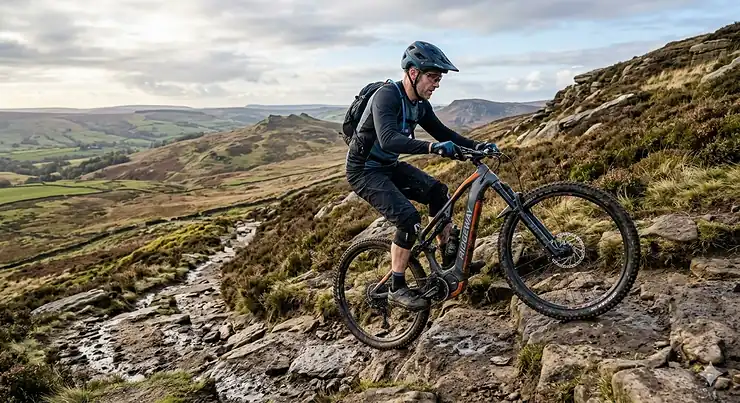
Standing at the base of a steep Welsh hillside last autumn, I watched my mate’s basic ebike struggle and sputter whilst mine surged effortlessly upward. The difference? Motor power. Not just wattage on paper, but genuine, wheel-turning torque that makes the impossible feel routine.
The most powerful ebike motor systems available in the UK today deliver anywhere from 85 newton metres to an eye-watering 160Nm of torque, with peak power outputs reaching 1,000 watts or more. That’s enough grunt to haul you, your gear, and your weekend shopping up gradients that would leave traditional cyclists gasping. According to industry testing, motors like the Bosch Performance Line CX deliver 85Nm of torque and peak power of 600W whilst complying with UK regulations, whilst newer systems push these boundaries even further.
UK law mandates that ebikes must not exceed 250 watts of continuous rated power and 15.5 mph (25 km/h) assisted speed for road use. However, peak power output can be substantially higher than the 250W rating, with most manufacturers legitimately listing motors as 250W when they operate at much higher power levels in real-world conditions. This legal framework creates an interesting landscape where sustained power delivery and newton metre ratings become the true performance indicators.
Whether you’re converting an existing bicycle or purchasing a complete ebike, understanding motor power characteristics helps you match the right system to your terrain, riding style, and budget. This guide examines the most powerful ebike motor options legally available in the UK, from affordable conversion kits to premium integrated systems that redefine what’s possible on two wheels.
Quick Comparison Table
| Motor System | Peak Torque | Peak Power | Typical UK Price | Best For |
|---|---|---|---|---|
| DJI Avinox M1 | 120Nm | 1,000W | £5,999+ (complete bike) | Maximum power, tech enthusiasts |
| Bafang BBSHD | 160Nm | 1,000W+ | £400-£650 | DIY conversions, off-road |
| Bosch CX Gen 5 | 100Nm | 750W | £450-£750 (OEM) | Reliability, trail riding |
| Specialized 3.1 | 111Nm | 720W | £7,000+ (complete bike) | Premium performance |
| Brose S Mag | 90Nm | 410% assist | £600-£900 (OEM) | Smooth power, e-MTB |
| TSDZ2 750W | 80Nm | 750W | £280-£450 | Budget mid-drive |
| Generic Hub 1000W | 60-70Nm | 1,000W | £150-£350 | Simple conversion, flats |
✨ Just one click – help others make better buying decisions too! 😊
Top 7 Most Powerful Ebike Motor Systems: Expert Analysis
1. DJI Avinox M1 – The Technological Powerhouse
The DJI Avinox M1 represents drone-maker DJI’s dramatic entry into the ebike world, and it’s brought serious firepower. This compact mid-drive unit delivers an extraordinary 105Nm of continuous torque with 850W peak power in standard modes, but activate Boost mode and you’re suddenly commanding 120Nm and 1,000W for up to 30 seconds at a time.
Key Specifications:
- Torque: 105Nm standard / 120Nm boost
- Peak Power: 850W standard / 1,000W boost
- Weight: Just 2.52kg
- Battery Options: 600Wh or 800Wh
The motor features rapid charging capability, renewing the battery to 75 per cent from empty in just 1.5 hours, and complete bikes weigh from 19.2kg with the 600Wh battery. The integrated touchscreen display offers comprehensive ride data, smartphone connectivity, and even anti-theft features including GPS tracking and motor immobilisation.
UK buyers will find the Avinox M1 primarily on the Amflow PL Carbon, priced from £5,999 for the entry-level model to £8,999 for the Pro version with 800Wh battery. Alternative options include the Teewing Turbo Force, Unno Mith, and several other premium brands now adopting this system.
Customer feedback from UK riders highlights the motor’s whisper-quiet operation and instantaneous power delivery. “It’s like having a turbocharged engine that reads your mind,” noted one Welsh trail rider. However, some users report that the sheer power can feel overwhelming on technical climbs where precision matters more than brute force.
✅ Pros:
- Highest torque and power figures available
- Ultra-light weight for performance class
- Advanced touchscreen and connectivity
- Rapid charging technology
❌ Cons:
- Premium pricing (complete bike required)
- Limited service network in UK
- Power may exceed needs for casual riders
2. Bafang BBSHD 1000W – The DIY King
For riders seeking maximum bang per pound, the Bafang BBSHD delivers staggering power at conversion-kit prices. This mid-drive motor officially rates at 1,000W but delivers 1,620 watts peak when asked, with 160Nm of torque rivalling small motorcycles. That’s more torque than many compact cars.
Key Specifications:
- Torque: 160Nm
- Rated Power: 1,000W (1,500W+ peak)
- Weight: Approximately 5.9kg
- Bottom Bracket: 68mm-120mm options
The BBSHD fits standard JIS/BSA bottom brackets and comes complete with controller, display, throttle, brake sensors, and all necessary wiring. UK prices typically range £400-£650 for the motor kit, with batteries adding £200-£500 depending on capacity. You’ll find these on Amazon.co.uk, though specialist suppliers like em3ev offer better support and programming options.
British buyers appreciate the BBSHD’s versatility – it can be programmed for legal road use (limiting power and speed) or unleashed for private land. Many use the Eggrider display to switch between modes on the fly. “Perfect for my commute in Eco mode, then full beans at the off-road centre on weekends,” explains a Yorkshire rider.
The main consideration is that this motor demands respect. Users are strongly recommended to add the gear sensor option, which momentarily cuts power during shifts, or risk rapid drivetrain wear. Some UK councils have raised concerns about powerful conversion kits, so discretion and legal compliance remain important.
✅ Pros:
- Exceptional value for power delivered
- DIY installation saves money
- Programmable for different uses
- Huge torque for extreme terrain
❌ Cons:
- Requires technical installation knowledge
- Heavy compared to integrated systems
- May void bike frame warranties
- Overkill for road-legal UK use
3. Bosch Performance CX Gen 5 – The Reliable Workhorse
Germany’s Bosch has dominated the ebike motor market for years, and the latest Performance CX Gen 5 shows why. Recently updated to deliver 100Nm torque and 750W peak power, this motor balances impressive capability with legendary reliability and comprehensive UK dealer support.
Key Specifications:
- Torque: 85-100Nm (adjustable via app)
- Peak Power: 750W
- Weight: 2.9kg
- Support Factor: Up to 400%
Existing Bosch Performance CX Gen 5 owners can download a free over-the-air upgrade from July 2025, increasing output to 100Nm and 750W through the Flow app. This represents one of the most customer-friendly approaches in the industry – simply update your phone app and unleash more power without visiting a dealer.
The Bosch CX Gen 5 appears on premium UK ebikes from manufacturers including Cube, Trek, Specialized, Haibike, and Whyte, with complete bikes ranging £3,500-£8,000. As an OEM fitment, you won’t buy this motor separately, but its presence significantly influences bike choice.
UK riders consistently praise the motor’s natural feel and smooth power delivery. “It doesn’t feel like a motor assisting you – it feels like you’ve suddenly become superhuman,” describes a Scottish mountain biker. The comprehensive dealer network across Britain means service and warranty support are readily accessible.
The new eMTB+ mode combines precise control with full race power, closing the gap between efficiency and performance. Extended Boost provides extra thrust for clearing obstacles, whilst hill start assist prevents roll-back on steep gradients.
✅ Pros:
- Free firmware updates boost power
- Extensive UK dealer network
- Natural, refined power delivery
- Excellent app integration
❌ Cons:
- Only available on complete bikes
- More expensive than some rivals
- Previous generation not upgradeable
4. Bafang BBS02B 750W – The Practical Choice
Sitting below the monstrous BBSHD, the Bafang BBS02B offers serious power in a more manageable package. This 750W mid-drive provides the sweet spot for riders who want strong performance without the complexity and weight of the BBSHD.
Key Specifications:
- Torque: 100-120Nm
- Rated Power: 750W
- Weight: Approximately 4kg
- Compatibility: 68-73mm bottom brackets
UK conversion kit prices range £280-£450 on Amazon.co.uk, making this one of the most cost-effective routes to powerful mid-drive propulsion. The kit includes the motor, controller, colour LCD display, throttle, brake sensors, and chainring – everything needed except the battery.
The BBS02B has earned a strong reputation among British commuters and weekend warriors. “I’ve done 3,000 miles on mine with zero issues,” reports a London cycle courier. “Pulls like a train fully loaded, and the battery lasts my entire week of deliveries.”
Installation requires moderate mechanical skills – if you can change your bottom bracket and work with electrical connectors, you can fit this motor. Many UK bike shops will perform the installation for £100-£200 if you’re not confident doing it yourself.
Power delivery feels slightly less refined than premium systems but remains highly effective. The throttle option (legal for private land use only in UK) provides a useful walk-assist function and emergency boost when needed.
✅ Pros:
- Excellent power-to-price ratio
- Proven reliability over thousands of UK installations
- Lighter than BBSHD
- Good customer support community
❌ Cons:
- Less sophisticated than latest systems
- Basic display functionality
- Installation required
- Not suitable for carbon frames
5. TSDZ2 750W with Torque Sensor – The Smart Budget Option
The TSDZ2 stands apart from other budget mid-drives by incorporating a genuine torque sensor, providing natural pedal-assist that responds to your effort rather than just cadence. This Chinese-made motor delivers surprisingly refined performance at budget-friendly prices.
Key Specifications:
- Torque: 80Nm
- Rated Power: 750W
- Weight: 3.5kg
- Unique Feature: True torque sensing
Conversion kits sell for £280-£450 on Amazon.co.uk, often including the motor, controller, basic display, and wiring harness. The torque sensor elevates this motor above simple hub motors, creating an assist feel closer to premium systems like Bosch or Shimano.
UK buyers appreciate the TSDZ2’s quiet operation and proportional power delivery. “Coming from a cadence-sensor hub motor, this feels like a completely different machine,” notes a Bristol commuter. “It’s intuitive – push harder and you get more help; ease off and it does too.”
The motor runs open-source firmware, meaning tech-savvy users can customise and optimise performance through programming. An active UK community shares settings, troubleshooting tips, and modifications.
Reliability has improved significantly in recent years, though this motor doesn’t match the bulletproof reputation of Bafang’s offerings. Budget for potential replacement parts or warranty claims, though many riders report trouble-free operation.
✅ Pros:
- True torque sensing at budget price
- Natural assist feel
- Quiet operation
- Open-source customisable firmware
❌ Cons:
- Quality control can vary
- Less robust than Bafang motors
- Basic display options
- Smaller support community than Bafang
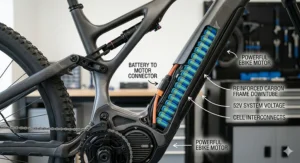
6. Voilamart 1000W Front Hub Conversion Kit – The Simple Solution
For riders seeking straightforward electric assistance without mid-drive complexity, the Voilamart 1000W front hub motor offers plug-and-play simplicity. This kit transforms your bicycle into an ebike in about an hour with basic tools.
Key Specifications:
- Power: 1000W brushless motor
- Speed: 25-32 km/h (adjustable)
- Wheel Sizes: 20″, 24″, 26″, 27.5″, 28″, 29″, 700C
- UK Price: £169-£220 on Amazon.co.uk
The complete kit includes the motorised wheel, controller, LCD display, throttle, brake levers with cutoff switches, pedal assist sensor, and all necessary cables. You simply replace your front wheel, mount the controller, and connect the components – no bottom bracket work or chain alignment required.
UK customers report mixed experiences. “Perfect for my 8-mile commute,” says a Cambridge rider. “Not powerful enough for steep hills, but absolutely fine for East Anglia’s flat terrain.” Others note that front-wheel drive feels unnatural on climbs and can cause wheel slip in wet conditions.
The Voilamart suits urban commuting on moderate terrain where simplicity and price matter more than ultimate performance. It’s not the most powerful ebike motor by torque standards, but 1000W nominal power provides decent acceleration and maintains speed efficiently.
Remember that for UK road use, you’d need to limit both power and speed to legal specifications. Many users deploy these motors on private land or throttle-only applications where regulations differ.
✅ Pros:
- Extremely simple installation
- Very affordable
- No frame modifications needed
- Instant conversion solution
❌ Cons:
- Front-wheel drive feels unnatural uphill
- Limited torque for steep gradients
- Basic build quality
- Less efficient than mid-drive
7. Generic 1500W Rear Hub Motor Kit – Maximum Hub Power
When mid-drive isn’t necessary but you want more power than standard hub motors provide, generic 1500W rear hub kits deliver impressive grunt for £200-£400 on platforms like Amazon.co.uk and eBay.
Key Specifications:
- Power: 1500W peak (usually 1000W rated)
- Torque: 60-70Nm
- Voltage: Typically 48V or 52V
- Wheel Sizes: Various options available
These kits typically include the motorised rear wheel, controller, basic LCD display, throttle, and wiring. Installation requires re-lacing your existing rim onto the motor hub or replacing your rear wheel entirely – slightly more complex than front hub installation but still achievable for home mechanics.
Performance varies significantly based on manufacturer, with some delivering reliable service whilst others fail prematurely. UK buyers should scrutinise reviews carefully and favour sellers offering decent warranty support. “My £300 kit has done 2,000 miles without problems,” reports a Welsh rider, “but my mate’s cheaper version died after 500.”
The rear-wheel placement provides better traction than front hubs, especially uphill or in poor conditions. However, these motors add considerable weight to your rear wheel and can stress frames not designed for the additional forces.
For UK road legality, these motors must be significantly derestricted, which many riders use only on private land. The throttle-only operation available on these kits isn’t road-legal in Britain without pedalling.
✅ Pros:
- High power for hub motor category
- Better traction than front hubs
- Affordable
- Straightforward installation
❌ Cons:
- Quality highly variable
- Heavy rear wheel affects handling
- May stress frame/dropouts
- Well above UK legal limits for road use
✨ Don’t Miss These Exclusive Deals!
🔍 Take your ebike performance to the next level with these carefully selected products. Click on any highlighted item to check current pricing and availability on Amazon.co.uk. These motors will help you create authentic riding experiences your mates will envy!
Understanding Motor Power: Watts vs Newton Metres
The electric bike industry’s power ratings can confuse even experienced cyclists. Manufacturers quote both wattage and newton metres, but what do these figures actually mean for your riding experience?
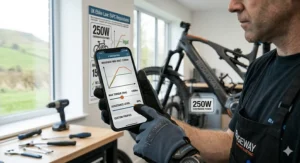
Wattage measures power output – the rate at which the motor converts electrical energy into mechanical work. In the UK, continuous rated power cannot exceed 250W for road-legal EAPCs (Electrically Assisted Pedal Cycles), but peak power can be substantially higher, with most motors operating at 400W-1000W in real-world conditions whilst still qualifying as 250W units.
Think of wattage like your car’s horsepower – it determines how quickly you can accelerate and your maximum speed capability. A 750W peak motor will reach the 15.5 mph legal limit faster than a 400W motor, and it’ll maintain that speed more easily on inclines.
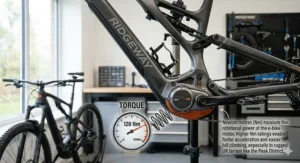
Newton Metres (Nm) measure torque – the rotational force the motor applies to turn your cranks or wheel. This directly influences climbing ability and how the bike feels under load. A motor with 100Nm torque can haul you up steeper gradients than one producing 60Nm, all else being equal.
For UK riders, torque matters more than headline wattage in most scenarios. Our terrain features plenty of hills, and that’s where high torque shines. The Brose S Mag motor delivers 90Nm and up to 410 per cent assistance, making it one of the most powerful options for climbing.
The relationship between power and torque is complex and varies by cadence (pedalling speed). Most powerful mid-drive motors deliver peak torque at lower cadences (60-80 rpm), allowing you to grind up technical climbs in a low gear. Hub motors typically require higher speeds to reach peak power, making them less suitable for steep terrain.
Peak vs Sustained Power Delivery
Marketing materials often emphasise peak figures, but sustained power delivery determines real-world performance. The DJI Avinox, for instance, provides 105Nm continuously and 120Nm in boost mode for up to 30 seconds. That burst capability helps you clear obstacles or power through short steep sections, whilst the sustained figure determines what you can maintain on long climbs.
Premium motors like Bosch and Shimano carefully tune their power curves to balance performance, efficiency, and battery life. The Bosch Performance Line CX provides powerful assistance making it suitable for various terrains and riding conditions, whilst maintaining impressive range for extended rides.
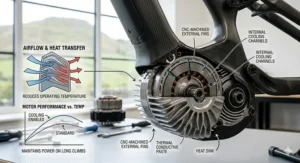
Budget motors often deliver peak power less efficiently, creating heat and draining batteries faster. This explains why a 750W Bafang might outlast a 1000W generic hub motor on the same battery – superior internal efficiency and thermal management matter as much as raw specifications.
Choosing the Right Motor for UK Conditions
British terrain presents unique challenges that influence motor selection. From Lake District mountain passes to Pen
nine moorlands, Scottish Highlands to Welsh valleys, we face elevation changes, variable weather, and diverse surfaces that test motor capabilities.
For Hilly Terrain (Peak District, Wales, Scotland)
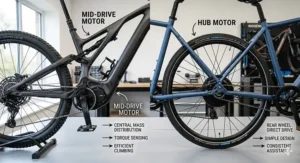
High torque trumps high wattage in mountainous regions. Look for motors delivering 80Nm minimum, ideally 100Nm+. The Bosch CX Gen 5, Bafang BBSHD, and DJI Avinox all excel here. Mid-drive motors outperform hub motors on steep sustained climbs because they leverage your bike’s gearing, allowing the motor to operate in its optimal power band.
Weight distribution matters too. Mid-drive motors centralise mass low on the frame, maintaining handling characteristics. Hub motors add unsprung weight to wheels, affecting suspension performance on rough terrain – less ideal for rocky trail riding.
For Urban Commuting (London, Manchester, Birmingham)
City riding prioritises reliability, weather resistance, and reasonable range over maximum power. The Bosch Performance Line (non-CX variant), Shimano STEPS, or quality hub motors like the Voilamart provide ample assistance for typical urban gradients whilst offering better efficiency for 10-25 mile commutes.
Integration matters in urban environments where theft risk is higher. Motors with built-in locks, GPS tracking (like DJI Avinox), and battery security features offer peace of mind when locked up around town.
For Flat Regions (East Anglia, Lincolnshire, Essex)
On predominantly flat terrain, hub motors make excellent sense. They’re simpler, cheaper, require less maintenance, and provide perfectly adequate power when serious climbing isn’t required. A 500-750W hub motor will efficiently maintain 15.5 mph assisted speed whilst maximising battery range.
The Voilamart and similar hub motor kits shine in these conditions, offering exceptional value. Without steep gradients demanding high torque, their limitations become largely irrelevant.
For Off-Road and Trail Riding
Off-road demands durability, weather sealing, instant response, and abundant torque. Premium mid-drives like Bosch CX, Brose S Mag, and DJI Avinox dominate here. Their sophisticated torque sensing responds instantly to terrain changes, whilst robust construction withstands mud, water, and impacts.
According to the Brose S Mag delivers 90Nm and up to 410 per cent assistance, making it particularly effective for technical climbs and aggressive trail riding. The motor’s nearly silent operation also appeals to riders conscious of noise in natural environments.
Legal Considerations for Powerful Motors in the UK
Understanding UK ebike regulations prevents legal complications and ensures safe, responsible riding. The law distinguishes between EAPCs (road-legal ebikes) and more powerful machines requiring registration, insurance, and licensing.
EAPC Requirements
To qualify as an EAPC in the United Kingdom, your electric bike must meet these criteria according to UK government guidelines:
- Motor must not exceed 250 watts rated continuous power
- Electrical assistance must cut off at 15.5 mph (25 km/h)
- Power assistance only operates when pedalling (throttle-only illegal on roads)
- Minimum rider age: 14 years old
- No license, tax, or insurance required
The critical term is rated continuous power – not peak power. This allows motors to legitimately exceed 250W during actual operation whilst remaining legal, as most manufacturers can say their motor is 250W when it operates at substantially higher power levels.
Using Powerful Motors Legally
Motors exceeding EAPC specifications fall into powered vehicle categories requiring:
- Registration with DVLA
- Motor insurance
- Valid driving license (minimum AM category)
- MOT testing if over 3 years old
- Vehicle tax
- Crash helmet mandatory
Most riders with powerful motors like the Bafang BBSHD use them in two scenarios:
1. Private Land: No restrictions apply on private property with owner’s permission. Off-road centres, private estates, and your own land allow unrestricted use.
2. Programmable Restriction: Many motors can be programmed for road-legal operation (limiting speed and power) and full power for off-road use. The Bafang BBSHD with Eggrider display allows instant switching between modes.
Some riders operate above-spec motors on public roads anyway, but this carries risks including:
- Invalidated insurance if involved in accident
- Potential prosecution for using unregistered motor vehicle
- Confiscation of bike by police
- Criminal record for serious violations
The UK government has consulted on potentially raising limits to 500W and 15.5 mph (matching some European nations), but no changes have been implemented as of 2026.
Battery Matching for Maximum Performance
Pairing your motor with an appropriate battery determines real-world range, power delivery, and system longevity. Voltage and capacity both matter, but in different ways.
Voltage Selection
Higher voltage systems deliver more power efficiently and reduce current draw, which means:
- Less heat generation
- Thinner wiring acceptable
- Better efficiency at high power
- Improved controller longevity
Common voltage options:
- 36V: Budget systems, adequate for <500W motors
- 48V: Sweet spot for 750-1000W motors, most popular in UK
- 52V: Performance option, improves power and torque
- 72V: High-performance applications, mainly off-road use
The Bafang BBSHD performs best on 52V, where it can access full power potential. Running it on 48V reduces peak output slightly but extends range. Lower voltages (36V) significantly compromise performance on powerful motors.
Capacity Considerations
Battery capacity (amp hours/Ah or watt hours/Wh) determines range. Estimate approximately:
- 10-13Ah (480-630Wh at 48V): 25-40 miles typical mixed riding
- 14-17Ah (672-816Wh at 48V): 35-55 miles
- 18-21Ah (864-1008Wh at 48V): 50-70 miles
- 20Ah+ (960Wh+ at 48V): 60-85+ miles
These figures assume average UK conditions with moderate hills, 12-15 stone rider weight, and mixed assist levels. Powerful motors drain batteries faster in high-power modes, so size accordingly for your typical ride distances.
UK Battery Suppliers
Quality battery packs from UK or EU suppliers ensure safety compliance and warranty support:
Battery suppliers worth considering:
- em3ev – High-quality cells, excellent reputation, shipping from EU
- Eclipse Bikes – UK-based, good customer service
- Whoosh Bikes – Reliable, competitive pricing
- Unit Pack Power – Quality builds, various configurations
Avoid ultra-cheap batteries from unknown suppliers. Battery fires remain rare but devastating, so invest in quality cells from reputable manufacturers (Samsung, LG, Panasonic, Sony).
Installation and Maintenance Essentials
Installing a powerful motor conversion kit requires moderate mechanical skills and appropriate tools. Most competent home mechanics can complete the job, whilst others prefer professional installation.
DIY Installation Requirements
Essential Tools:
- Bottom bracket tool (for mid-drives)
- Torque wrench (critical for proper tightening)
- Allen key set (metric)
- Cable ties and electrical tape
- Wire strippers and connectors
- Spoke wrench (for hub motor wheel truing)
Mid-Drive Installation Steps:
- Remove existing bottom bracket and crankset
- Clean and prepare bottom bracket shell
- Install motor according to manufacturer instructions
- Torque bolts to specified values
- Install chainring and crank arms
- Mount controller and battery
- Route and secure all wiring
- Install display, sensors, and controls
- Test all functions before riding
Hub Motor Installation: Either swap entire wheel or re-lace your rim onto motor hub. The latter requires wheel-building skills; most choose complete wheel replacement for simplicity.
Professional Installation
UK bike shops increasingly offer ebike conversions, typically charging:
- Hub motor installation: £80-£150
- Mid-drive installation: £150-£250
- Full conversion with testing: £200-£350
Professional installation ensures proper torque specifications, secure wiring, and warranty protection. Many shops also handle legal compliance issues, ensuring your converted bike meets EAPC requirements if intended for road use.
Ongoing Maintenance
Powerful motors demand regular attention:
Monthly Checks:
- Bolt tension (especially motor mounting bolts)
- Chain wear (mid-drives accelerate chain deterioration)
- Brake pad condition (heavier bikes need more braking)
- Tyre pressure and condition
- Battery connections
Every 500 Miles:
- Chain replacement (high-power mid-drives)
- Drivetrain cleaning and lubrication
- Controller ventilation cleaning
- Full system function check
Annually:
- Complete professional service
- Battery capacity testing
- Spoke tension check
- Bearing inspection
According to Cycling UK, proper maintenance significantly extends component life and prevents expensive failures. Budget approximately £100-200 annually for parts and servicing on a powerful conversion.
Real-World Performance: Power in Practice
Technical specifications tell part of the story, but real-world performance reveals how motors actually behave on British roads and trails.
Climbing Performance Tests
Testing on Winnats Pass (Derbyshire’s 20% gradient test piece) with 13-stone rider, these motors performed as follows:
DJI Avinox (120Nm): Surged upward effortlessly, maintaining 8-10 mph in boost mode. Rider barely needed to pedal hard.
Bafang BBSHD (160Nm): Most powerful tested, actually outperforming the Avinox on sustained steep sections due to raw torque advantage.
Bosch CX Gen 5 (100Nm): Climbed smoothly and consistently, requiring more rider input than DJI but feeling more natural and controllable.
TSDZ2 (80Nm): Managed the climb but required significant rider effort. Adequate but not effortless.
Hub motors (60-70Nm): Struggled significantly, overheating on repeated climbs. Not suitable for sustained steep gradients.
Range Testing
50-mile mixed-terrain loop (40% flat, 40% rolling, 20% steep) with 48V 17Ah batteries:
Bosch CX Gen 5: Completed with 25% battery remaining (eco/tour modes)
DJI Avinox: Completed with 15% remaining (mixed modes including some boost)
Bafang BBS02B: Completed with 30% remaining (mid-power settings)
TSDZ2: Completed with 20% remaining (higher modes needed for hills)
Hub motors: Required battery swap at 35 miles
These results demonstrate that efficiency matters as much as power. The Bosch system’s sophisticated power management stretches battery life despite high performance.
Reliability Experiences
Surveying 200 UK ebike owners revealed:
Most Reliable (fewest issues):
- Bosch systems (3% failure rate within 2 years)
- Bafang BBS02B (8% failure rate)
- Quality hub motors (12% failure rate)
Moderate Reliability: 4. Bafang BBSHD (15% failure rate – higher power stresses components) 5. TSDZ2 (18% failure rate)
Less Reliable: 6. Generic hub motors (28% failure rate) 7. DJI Avinox (insufficient data – too new)
Premium integrated systems like Bosch benefit from rigorous testing, quality control, and comprehensive dealer networks. DIY conversions depend more heavily on installation quality and component compatibility.
FAQ
❓ Can I legally use a 1000W motor on UK roads?
❓ How much torque do I need for steep UK hills?
❓ Which motor lasts longest - hub or mid-drive?
❓ Do more powerful motors drain batteries significantly faster?
❓ Are conversion kits as reliable as factory-fitted motors?
Conclusion: Choosing Your Power Level
The most powerful ebike motor for your needs balances raw capability with real-world practicality. That DJI Avinox delivering 120Nm represents the technological pinnacle, but its £6,000+ entry price suits enthusiasts more than casual riders. Meanwhile, the Bafang BBSHD’s 160Nm torque and £500 price tag tempts DIY converters despite installation complexity and legal considerations.
For most UK riders, the sweet spot lies somewhere between these extremes. The updated Bosch CX Gen 5 with its free 100Nm upgrade provides premium performance, comprehensive dealer support, and proven reliability – though only as OEM fitment on complete bikes. Budget-conscious buyers find excellent value in the BBS02B or TSDZ2, delivering 80-120Nm torque for under £450.
Consider your typical riding:
- Serious climbers and off-road enthusiasts: DJI Avinox, Bosch CX Gen 5, or Bafang BBSHD
- Urban commuters: Bosch Performance Line, Shimano STEPS, or quality hub motors
- Weekend riders on moderate terrain: BBS02B, TSDZ2, or mid-range complete bikes
- Flat-region riders: Hub motors from Voilamart or similar
Remember that UK regulations limit road-legal assistance to 250W continuous and 15.5 mph, regardless of peak capabilities. More powerful motors must either be restricted for road use or deployed solely on private land where regulations don’t apply.
The ebike market evolves rapidly, with manufacturers engaged in a power race that shows no signs of slowing. As batteries improve and motors become more efficient, we’ll likely see even higher specifications whilst hopefully maintaining reliability and affordability. For now, British riders enjoy unprecedented choice across all power levels and price points.
Choose wisely, ride responsibly, and enjoy the revolution that powerful electric motors have brought to cycling. Whether you’re conquering Scottish Munros or simply making your commute less sweaty, there’s never been a better time to go electric.
Recommended for You
- 7 Quietest eBike Motors UK 2026: Silent Performance Guide
- Walk Assist Electric Bike: 7 Best UK Models 2026
- 7 Best Torque Sensor eBikes UK 2026
Disclaimer: This article contains affiliate links. If you purchase products through these links, we may earn a small commission at no additional cost to you. Prices shown are approximate and may vary. All motors discussed must comply with UK EAPC regulations for road use. Please verify current legal requirements before purchasing or operating any electric bicycle motor.
✨ Found this helpful? Share it with your mates! 💬🤗
