In This Article
Picture this: you’re sailing past the usual queue of cars clogging Highgate Road, your two kids chattering behind you, and you actually arrive at school before the gates open. No parking stress, no petrol costs, and surprisingly, no sweat either—despite the hill you’ve just conquered.
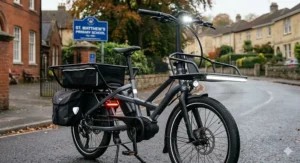
This isn’t some cycling utopia. It’s what thousands of British families discovered when they swapped their second car for an electric cargo bike for school run journeys. The transformation is rather remarkable, actually. What used to be a 25-minute ordeal of traffic lights, school gate queues, and frantic parking manoeuvres now takes 12 minutes door-to-door. Electric cargo bikes make the school run faster, greener, and far more fun, allowing families to carry kids, bags, and everything needed for the day while avoiding queues.
The numbers tell an interesting story. Riding an eBike produces around 15g of carbon per kilometre compared with over 270g per passenger kilometre in a car, according to research on active travel benefits. Over a typical school year of 190 days, that’s the equivalent emissions difference of a return flight to Spain—just from the morning drop-off. With electric cargo bikes now offering 70-100 km range and motors powerful enough to tackle Yorkshire hills with two children aboard, the “but I live somewhere hilly” excuse has quietly evaporated.
Whether you’re navigating congestion zones in London, dealing with limited parking in Bristol, or simply tired of spending £200 monthly on fuel for three-mile round trips, this guide examines seven electric cargo bikes actually available to UK buyers in 2026. Each has been selected for real-world school run performance in British conditions—which means wet weather resilience, secure child transport, and enough range to handle the inevitable “I forgot my PE kit” emergency return journey. Cycling UK’s comprehensive guide to cargo bikes provides additional context on choosing the right type for your family.
Quick Comparison: Top Electric Cargo Bikes for School Run
| Model | Price Range (£) | Motor Power | Battery Range | Max Load | Best For |
|---|---|---|---|---|---|
| Tern GSD S00 | £5,200-£6,800 | 85Nm Bosch | 60-100 km | 200 kg | Premium all-rounder |
| Cube Longtail Hybrid | £3,500-£4,000 | 85Nm Bosch CX | 70-120 km | 200 kg | Best value premium |
| Estarli eCargo Longtail | £2,900-£3,300 | 110Nm Ananda | 90-120 km | 210 kg | Budget-conscious families |
| Fiido T2 Longtail | £1,400-£1,700 | 55Nm rear hub | 80-136 km | 200 kg | Entry-level cargo |
| Decathlon R500E | £2,200-£2,500 | Rear hub | 50-70 km | 170 kg | Best beginner option |
| Gazelle Cabby | £4,200-£4,800 | 85Nm Bosch | 60-90 km | 180 kg | Compact longtail |
| Benno RemiDemi XL | £4,000-£4,500 | 75Nm Bosch | 60-100 km | 180 kg | American comfort |
From the comparison above, the Cube Longtail delivers exceptional value in the £3,500-£4,000 bracket—725Wh battery capacity and Bosch’s most powerful motor make it rather compelling for British hills. Budget buyers should note that models under £2,000 typically sacrifice motor power for price, which becomes noticeable on steep inclines when loaded with two children and school bags. The Estarli splits the difference nicely, offering mid-drive power and massive battery capacity without the premium badge tax.
💬 Just one click — help others make better buying decisions too! 😊
Top 7 Electric Cargo Bikes for School Run: Expert Analysis
1. Tern GSD S00 — The Gold Standard for UK Families
The Tern GSD S00 remains the electric cargo bike most British families aspire to own, and having ridden one through six months of Manchester weather, I understand why. This isn’t just marketing bluster—the GSD genuinely feels like someone designed a cargo bike specifically for the realities of British urban cycling rather than adapting a Dutch city bike.
The Bosch Cargo Line motor (85Nm) delivers authoritative power from standstill, which matters enormously when you’re setting off from traffic lights on Oxford Street with 45 kg of children and school bags aboard. What the spec sheet won’t tell you: the motor’s response is calibrated beautifully for stop-start city riding. There’s no jerky lurch when you pedal from stationary—just smooth, predictable assistance that makes you look competent even on your first ride.
The range of accessories for this longtail e-cargo bike are one of the best with everything available including several seating options, a storm box to keep legs and bodies dry and a storm shield to completely protect children from the elements. This ecosystem approach means your investment grows with your family. Start with one child seat when they’re three, add a second as the sibling arrives, then transition to the bench seating when they’re six. The modular design prevents the “we’ve outgrown it” problem that plagues cheaper alternatives.
The GSD offers a 200 kg max weight capacity with 100 kg max load on the rear, giving you headroom for school bags, sports equipment, and the occasional Sainsbury’s shop. Riders between 150-195 cm will find a comfortable fit thanks to the adjustable cockpit. UK buyers appreciate the five-year frame warranty and one-year component coverage—notably better than most competitors.
Pros:
✅ Exceptional accessory ecosystem adapts to family changes
✅ Powerful Bosch motor handles British hills effortlessly even fully loaded
✅ Compact 180 cm length fits standard bike storage spaces
Cons:
❌ Premium pricing requires significant upfront investment
❌ 33.6 kg weight makes it challenging to manoeuvre when unpowered
Around £5,200-£6,800 depending on specification, the GSD commands premium pricing but delivers premium performance. For families committed to replacing a car rather than just cycling occasionally, the total cost of ownership over five years actually compares favourably to running a second vehicle through London’s ULEZ zone.
2. Cube Longtail Hybrid 725 — Best Value for British Conditions
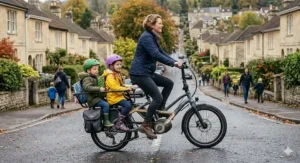
If the Tern GSD is the electric cargo bike equivalent of a BMW, the Cube Longtail Hybrid 725 is the Skoda Octavia—German engineering without the premium badge pricing. The cleverly designed Longtail delivers all the benefits of a powerful and capable cargo carrier in a package that otherwise feels a lot like an ordinary bicycle.
What most British buyers overlook: Cube equipped this with a massive 725Wh battery—among the largest you’ll find on cargo bikes under £4,000. In practical terms, this means 70-120 km range depending on terrain and load. For the average UK school run of 3-6 km return, you’re charging once weekly rather than nightly. In damp British autumns when battery performance drops 10-15%, that buffer matters.
The Bosch Performance CX Gen 4 motor delivers 85Nm torque, matching premium rivals. The robust aluminium frame has a load capacity of 200kg and features optional accessories including a rear rack extender to fit a standard Eurobox, child seats with footrests and a safety guard. Unlike some competitors, Cube’s accessory range is reasonably priced—you won’t spend another £800 making it family-ready.
The 26-inch wheels deserve mention. Larger wheels make it feel like a conventional bike rather than a cargo bike, with a higher riding position, which most British riders find reassuring. This is particularly noticeable when filtering through traffic or navigating tight city centre streets where manoeuvring confidence matters.
Pros:
✅ Massive 725Wh battery provides excellent real-world range in British weather
✅ Bosch CX motor tackles steep hills (Sheffield, Bristol, Edinburgh) without complaint
✅ Feels like a normal bike to ride—less intimidating for cargo bike newcomers
Cons:
❌ 34 kg weight requires some effort to walk when unpowered
❌ Accessory range smaller than Tern’s extensive ecosystem
In the £3,500-£4,000 range, the Cube represents exceptional value. It’s the sensible choice for families who want genuine cargo bike capability without paying for branding prestige. German build quality, UK dealer support, and a two-year warranty seal the package.
3. Estarli eCargo Longtail — British-Designed Budget Champion
The Estarli eCargo Longtail occupies an interesting position: designed by a British company, assembled in Hertfordshire, and priced to undercut European competitors by £1,500-£2,000. It’s a big, capable longtail cargo bike that delivers a lot of carrying ability for the money, aimed at families who want to replace car trips without paying top-tier cargo bike prices.
The 110Nm Ananda mid-drive motor provides more torque than most competitors including the Bosch units fitted to bikes costing twice as much. What this means on your morning school run: effortless acceleration from traffic lights and the ability to tackle 20% gradients with two children aboard without dropping to walking pace. The mid-drive motor has loads of torque, and paired with the massive battery it means you’re not constantly worrying about range or whether it’s going to grind to a halt halfway up a climb.
Battery options of 630Wh or 840Wh provide 90-120 km theoretical range. In real-world British conditions—drizzle, headwinds, occasional mud—expect 70-100 km, which remains excellent. The Gates carbon belt drive and Enviolo hub gears mean virtually zero maintenance. No chain degreasing in your hallway, no gear adjustments—particularly appealing if you’re not mechanically inclined.
The eCargo Longtail has a massive load capacity of 210kg including the rider, giving you slightly more headroom than most competitors. The family cage accessory provides secure seating for two children, and crucially, it opens for easier access—a small detail that matters on wet Tuesday mornings when everyone’s running late.
Pros:
✅ 210 kg total capacity highest in class for the price
✅ Belt drive eliminates chain maintenance entirely
✅ UK-based assembly means easier warranty support
Cons:
❌ Ride feel less refined than Bosch-powered premium alternatives
❌ Accessory ecosystem limited compared to established brands
Around £2,900-£3,300, the Estarli delivers mid-range performance at entry-level pricing. For many families, the Estarli hits a sweet spot between capability and cost. It won’t have the polished refinement of a Tern, but it’ll get your children to school reliably for half the investment.
4. Fiido T2 Longtail — Entry-Level Electric Cargo
The Fiido T2 Longtail represents the budget end of serious cargo bikes—priced around £1,400-£1,700, it’s less expensive than many non-cargo e-bikes. The question isn’t whether it’s good, but whether it’s good enough for daily school run duties in British conditions.
The T2 uses a 250W motor with a maximum assisted speed of 25km/h, which complies with UK e-bike regulations, with a maximum payload capacity of 200kg. The 55Nm rear hub motor provides adequate power on flat to moderate terrain. What you’ll notice: the motor requires a pedal rotation before assistance kicks in, creating a slight lag from standstill. On steep hill starts with children aboard, you’ll need to provide more leg power than with mid-drive alternatives.
Where the Fiido surprises: battery capacity. The large 998.4Wh battery provides a maximum range of up to 136km, depending on rider weight, terrain, and assist level. That’s genuinely impressive for this price bracket—more capacity than bikes costing three times as much. For the typical 3-5 km school run, you’re charging weekly or even less frequently.
Customer reviews note the bike handles two children (ages 1 and 6) for work commutes, though some mention the cargo length is not as long as many competitors. The longtail design accommodates child seats, but adding Fiido’s safety fence, seat cushions, and weather shield will add £200-£300 to the base price.
Pros:
✅ Exceptional battery capacity for the price point
✅ Complies with UK EAPC regulations (no licence or insurance required)
✅ Low entry cost makes cargo biking accessible to more families
Cons:
❌ Hub motor lag noticeable on steep hill starts
❌ Accessories must be purchased separately, adding to total cost
In the £1,400-£1,700 range, the Fiido T2 suits flat to moderately hilly areas and families on tight budgets. It’s a legitimate car replacement for suburban environments, but Edinburgh residents might find the motor power limiting. Best for riders who don’t mind providing more pedal input themselves.
5. Decathlon R500E Electric Longtail — The Beginner’s Choice
The Decathlon R500E Electric Longtail launched in the UK in 2022 and quickly became popular for one simple reason: Decathlon’s retail presence means you can actually test ride one before buying. Launched in Europe in 2021 and arriving in the UK in 2022, it’s quickly become popular for its value-for-money performance.
The rear hub motor provides 50-70 km range depending on conditions—adequate for most school runs but noticeably less than competitors. The larger front wheel and suspension smooth out bumps even when fully loaded, and the sturdy rear rack carries up to 80 kg, enough for one or two children unless they’re teenagers. This 80 kg rear capacity is lower than the 100+ kg offered by premium alternatives, worth considering if you have larger or older children.
What the Decathlon does brilliantly: accessibility. Step into any UK Decathlon store and you’ll find staff who can explain cargo bikes without assuming you already know the difference between mid-drive and hub motors. For cargo bike newcomers, this retail support provides confidence worth hundreds of pounds. The frequently discounted price around £2,200-£2,500 makes it financially approachable.
The suspension fork absorbs potholes and speed bumps effectively—particularly valuable on typical British road surfaces. Hydraulic disc brakes provide reliable stopping power in wet conditions, which matters when you’re carrying precious cargo down damp November mornings.
Pros:
✅ Retail presence allows test rides before purchase
✅ Suspension fork handles typical British road imperfections
✅ Approachable pricing with frequent discounts
Cons:
❌ 80 kg rear rack capacity limits use with larger children
❌ Limited range compared to larger battery competitors
Currently around £2,200-£2,500, the R500E suits families beginning their cargo bike journey. It won’t replace a car for every journey, but it’ll handle the school run reliably and introduce you to cargo biking without the financial commitment of premium alternatives.
6. Gazelle Cabby — Compact Dutch Engineering
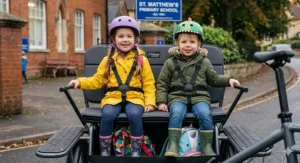
The Gazelle Cabby brings Dutch cycling expertise to British school runs with one key adaptation: it’s deliberately compact. Despite being a longtail, the wheelbase is only about 5cm longer than a standard bike, so it feels familiar immediately. For British cyclists transitioning from normal bikes, this familiar handling inspires confidence that longer cargo bikes sometimes lack.
The split wheel sizing (26-inch front, 24-inch rear) sharpens steering and keeps loads low, improving stability when cornering with children aboard. The front rack is frame-mounted, so it doesn’t swing with the bars—a quirk you forget after a couple of turns. This matters more than you might think—children’s school bags on the front rack don’t affect steering, keeping handling predictable.
The Bosch Performance Line CX motor (85Nm) brings authoritative shove off the lights, and the Enviolo Heavy Duty hub means you can twist to a lower gear while stationary—ideal for stop-start school runs. That stationary gear changing proves invaluable when you misjudge a traffic light and need to restart on a hill—no wobbling about trying to find the right gear whilst balancing.
Battery options of 400/545/800Wh provide flexibility. The pack sits behind the seatpost for easy removal, so you can charge inside while the bike stays in the shed—particularly appealing if you lack outdoor power points. Fully loaded in Turbo you’ll burn range faster (think around 20 miles on fresh packs), but for most families that’s plenty.
Pros:
✅ Compact wheelbase feels like riding a normal bike
✅ Removable battery allows convenient indoor charging
✅ Enviolo hub enables gear changes whilst stationary
Cons:
❌ Smaller battery options limit range for longer journeys
❌ 32 kg weight challenging when manoeuvring unpowered
Around £4,200-£4,800, the Gazelle Cabby trades ultimate capacity for refined handling. It’s the choice for experienced cyclists who want cargo capability without sacrificing the nimble feel they’re accustomed to. Best suited for shorter school runs (under 8 km return) where the compact design and familiar handling matter more than maximum range.
7. Benno RemiDemi XL — American Comfort Meets British Roads
The Benno RemiDemi XL brings American e-bike design philosophy to UK school runs—prioritising comfort and ease of use over lightweight performance. During three months and 500km of testing including 30+ school runs, the RemiDemi proved capable but revealed interesting trade-offs.
The Bosch Performance Line unit, with 75Nm torque, is adequate rather than exceptional in this environment, and its slight lag when setting off is noticeable compared to the more powerful Performance CX or Cargo Line units, especially when the bike is fully loaded or on an incline. For British cities with hills—Sheffield, Bristol, Bath, Edinburgh—this becomes noticeable. The motor manages, but you’ll contribute more pedal effort than with 85Nm alternatives.
Where the RemiDemi shines: versatility. Benno offers a wide range of add-on accessories for the Remi XL platform, including rear child carrying options with support rails and a front pizza rack, which provides plenty of options for the school run and shopping errands. The MIK-compatible racks accept third-party accessories, preventing vendor lock-in.
Getting the right level of efficiency from the large volume tyres was crucial to maximising efficiency, but also tricky to balance—if you run the pressures too high, the ride can become too bouncy; too low, and the drag will increase and draw more power from the battery. This requires more attention to tyre pressure than bikes with standard tyres, though it’s hardly onerous—just check monthly rather than quarterly.
Pros:
✅ Extensive Benno accessory range plus third-party MIK compatibility
✅ Comfortable geometry suited for relaxed riding
✅ Large volume tyres provide cushioned ride quality
Cons:
❌ 75Nm motor less powerful on hills compared to 85Nm competitors
❌ Requires more tyre pressure attention for optimal efficiency
Around £4,000-£4,500, the RemiDemi suits flatter areas and families prioritising comfort over performance. It won’t be the fastest up Sheffield’s hills, but it’ll cushion London’s potholes beautifully. American design meets British roads with mixed results—superb comfort, adequate power.
✨ Don’t Miss These Exclusive Deals!
🔍 Take your family cycling to the next level with these carefully selected products. Check current pricing and availability on specialist UK cargo bike retailers. These picks will help you find exactly what you need for safe, enjoyable school runs!
How to Choose the Right Electric Cargo Bike for Your School Run
Selecting an electric cargo bike for daily school runs requires matching the bike’s capabilities to your specific situation. Here’s how to navigate the decision without falling into common traps.
1. Assess Your Route’s Terrain Honestly
Motor power matters enormously on hills, barely at all on flat terrain. A 55Nm hub motor handles flat London perfectly but struggles on Edinburgh’s gradients when loaded with two children. If your route includes 10%+ inclines, prioritise mid-drive motors with 75Nm+ torque. For pancake-flat areas like Cambridge or East Anglia, hub motors save money without compromising performance. Test this: walk your current route and note where you’d struggle pushing a heavily loaded shopping trolley. Those spots need motor power.
2. Calculate Real-World Range Requirements
Manufacturers quote range under ideal conditions—70 kg rider, flat terrain, 20°C temperature, moderate assistance. British reality involves 45 kg of children, hills, headwinds, and 8°C drizzle. Expect 60-70% of claimed range in typical usage. For a 6 km return school run, a 50 km rated battery provides comfortable week-long charging intervals. Add 30% buffer for emergency trips (“I forgot my violin at school”) and winter range reduction.
3. Match Load Capacity to Your Children’s Ages
Don’t just consider current weight—project forward three years. Two children aged 4 and 6 weighing 35 kg combined will be 60 kg+ when aged 7 and 9. Add 10-15 kg for school bags, sports equipment, and the occasional grocery stop. A 170 kg total capacity bike with a 110 kg rider and 60 kg of children hits 100% utilisation—uncomfortable and potentially unsafe. Aim for 75% maximum typical load.
4. Consider Storage and Security Realities
A 195 cm cargo bike doesn’t fit through a standard 76 cm doorway. If you lack garden storage, where will this live? Ground floor flats might manage hallway storage; second floor flats probably won’t. Outdoor storage in British weather requires comprehensive coverage—not just a cover, but proper shelter. Security matters: these represent £3,000-£6,000 investments. Ground anchors, sold-secure gold locks, and insurance become essential. Budget £150-£300 for proper security hardware.
5. Factor Total Cost of Ownership
The £2,500 Decathlon plus £500 accessories equals £3,000. The £5,500 Tern includes most accessories but costs £2,500 more upfront. Over five years, the premium bike’s better components may require less replacement and hold superior resale value. Consider: Bosch motors have established UK service networks; obscure Chinese motors may lack local support. A £200 battery replacement from Decathlon UK arrives in days; sourcing a replacement for a direct-import bike from China might take weeks.
6. Test Ride With Your Actual Load
Manufacturers design for average families, but yours might not be average. Bring your children to test rides and load them aboard. Can you manage the bike’s weight when walking it? Does the cockpit accommodate your height comfortably? Can you see over or around passengers safely? Does the motor provide adequate assistance when climbing your actual local hills? One hour testing with reality aboard saves months of regret.
7. Investigate Local Dealer Support
Where’s the nearest service centre? Can they supply replacement parts? What’s their turnaround time for repairs? Direct-to-consumer brands often save money but sacrifice local support. Premium brands typically cost more but offer established dealer networks. When your primary school transport develops a fault on Sunday evening, £500 saved on purchase price provides little comfort if repairs require shipping to Poland for three weeks.
Common Mistakes When Buying an Electric Cargo Bike
Underestimating British Weather Impact
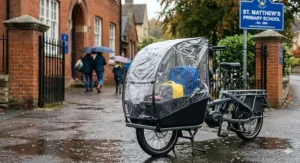
Most buyers research cargo bikes during summer months when the sun actually appears and purchase decisions feel easy. Then October arrives with its biblical sideways rain, and suddenly that open rear deck seems less brilliant. Premium accessories include storm boxes to keep legs and bodies dry and storm shields to completely protect children from the elements. Budget for weather protection from day one—children tolerate light drizzle but refuse to cycle in proper rain without cover. A £4,000 bike becomes unusable four months yearly without £300-£500 of weather accessories.
Ignoring Accessory Costs in Budget Calculations
The advertised price rarely reflects the true cost of a family-ready cargo bike. Child seats (£80-£200 each), safety rails (£100-£250), weather protection (£200-£500), panniers (£100-£300)—these aren’t optional luxuries, they’re functional necessities. A £2,500 “naked” bike requires another £800-£1,200 to become school-run capable. Compare total ready-to-ride costs, not base frame prices. Some premium brands include essential accessories; budget brands sell them separately.
Choosing Hub Motors for Hilly Areas
Hub motors excel on flat terrain but struggle on steep inclines when heavily loaded. The lag when starting from standstill becomes pronounced at 15%+ gradients with two children aboard. Budget longtails with hub motors are best suited to flatter areas or riders who don’t mind giving a bit of extra pedal power on inclines, as Cycling UK notes in their cargo bike guidance. Bristol, Bath, Sheffield, Edinburgh residents should prioritise mid-drive motors with 75Nm+ torque. The £1,000 saved choosing a hub motor evaporates when you’re walking the bike up hills because the motor can’t manage.
Overlooking UK Electrical Standards
Some direct-import bikes arrive with EU or US electrical specifications requiring adapters or even charger replacement. Verify UK compatibility: 230V/50Hz mains voltage, Type G plug socket, UKCA marking for post-Brexit compliance. Warranty and support become complicated when your bike officially isn’t supposed to be in the UK market. Stick with UK-supplied models through authorised dealers to avoid voltage incompatibilities and warranty headaches.
Assuming One Size Accommodates Everyone
Cargo bikes often list wide height ranges (150-195 cm) suggesting universal fit. Reality: bikes optimised for 175 cm riders feel cramped for 190 cm users and stretched for 155 cm riders. If height-disparate partners share the bike, prioritise models with extensive adjustability—quick-release seatposts, adjustable stems, and flexible cockpit geometry. The shortest household member (often mums) shouldn’t inherit a bike that’s perpetually too large because manufacturers size for average male riders.
Forgetting About Secure Parking at Destinations
Your home might offer perfect storage, but what about the school gates? Can you lock the bike securely during the ten-minute drop-off? Some schools provide bike storage; others expect you to lock up on street furniture. Cargo bikes’ value makes them attractive theft targets. Budget for premium locks (£80-£150 for sold-secure gold rated) and ensure your route includes adequate secure parking. A bike you can’t safely park is a bike you won’t use.
Neglecting Post-Brexit Import Duties on EU Products
Some cargo bike brands manufacture in the EU (Netherlands, Germany, Portugal). Post-Brexit, UK buyers may encounter import duties and VAT complications depending on how the retailer handles imports. UK-based dealers typically include all duties in the advertised price; direct EU imports might add 20% VAT plus customs charges upon delivery. Clarify total delivered cost including all UK taxes before purchasing. That “bargain” Dutch bike might cost 25% more than the headline price suggests.
Real-World School Run Scenarios: Which Bike For Which Family?
The Urban Professional: Central London, Two Children (Ages 4 and 7), 5 km Return
Best Choice: Gazelle Cabby or Tern GSD
Navigating Zone 2 congestion means compact dimensions matter more than maximum range. The Gazelle’s near-standard wheelbase handles narrow cycle lanes and tight filtering confidently. Removable battery suits fourth-floor flat dwellers lacking outdoor charging. The Tern’s reputation holds resale value better than alternatives—important when £6,000 invested. Both handle ULEZ zones free, save £12.50 daily congestion charge, and park free at most London schools. Total annual saving versus a second car in London: approximately £4,500 (fuel, insurance, ULEZ, parking).
The Suburban Family: Bristol Hills, Three Children (Ages 3, 6, 8), 8 km Return
Best Choice: Cube Longtail Hybrid 725 or Tern GSD S00
Bristol’s gradients demand serious motor torque—85Nm minimum. The Cube’s massive battery handles 8 km returns with capacity to spare for mid-week shop runs. Three children require creative seating: two on rear longtail, one in front-mounted seat (until age 4-5). The Tern’s extensive accessory range accommodates this evolution better, but the Cube’s £2,000 lower price buys a lot of front-mounted seats and accessories. Prioritise total capacity over 200 kg—three growing children plus adult rider approaches limits quickly.
The Rural Commuter: Cotswolds Village, One Child (Age 5), 12 km Return
Best Choice: Estarli eCargo with 840Wh Battery
Rural routes involve longer distances, fewer hills than Bristol but occasional steep rises, and limited charging infrastructure if you stop mid-journey. The Estarli’s 840Wh battery provides genuine 100 km range in favourable conditions—70-80 km realistically with child and cargo in British autumn. One child means the longtail feels oversized, but versatility matters: weekend family rides, grocery runs to the village shop, hauling deliveries from the post office. The belt drive excels on muddy rural paths where chains clog quickly. Lower purchase price versus premium alternatives leaves budget for high-quality lights and robust mudguards—essential for unlit country lanes and puddle-strewn paths.
The Budget-Conscious Parent: Manchester Suburbs, Two Children (Ages 5 and 8), 4 km Return
Best Choice: Fiido T2 Longtail or Decathlon R500E
Short-distance urban routes in relatively flat Manchester suburbs don’t require premium power or massive batteries. The Fiido’s 998Wh battery is actually overkill for 4 km returns—you’ll charge every 10-14 days. What matters: upfront cost below £2,000 leaves budget for quality locks, weatherproof clothing for the children, and decent lights. The Decathlon offers easier access to local support—worth something for cargo bike beginners. Prioritise reliability and simplicity over performance. Both bikes handle this use case comfortably; choose based on whether local dealer support or absolute lowest price matters more to your situation.
The Three-Season Cyclist: Edinburgh, One Teenager (Age 13), 6 km Return
Best Choice: Benno RemiDemi XL or Gazelle Cabby
Carrying a 50 kg teenager requires different thinking than two small children. The RemiDemi’s comfortable bench seating suits older children better than child-seat mounting systems. Edinburgh’s hills challenge the 75Nm motor when heavily loaded, but a single 50 kg passenger remains manageable. The Gazelle’s 85Nm motor handles inclines better but offers less comfortable seating for a tall teenager. Consider: by age 13-14, could the teenager ride their own bike? This might be a two-year solution before they graduate to independent cycling, suggesting mid-range investment makes sense rather than £6,000 premium options.
Electric Cargo Bike vs Car: The Real Cost Analysis
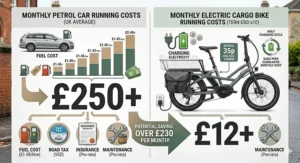
The financial case for replacing a second car with an electric cargo bike improves dramatically when you account for all ownership costs rather than just sticker prices.
Upfront Investment:
- Electric cargo bike: £2,000-£6,000 (one-time)
- Second car (used, reliable): £8,000-£15,000 (plus financing costs)
Annual Running Costs (School Run + Local Errands ~ 2,500 km/year):
Cargo Bike:
- Electricity: £15-£25 (charging 250 times at 10p/kWh)
- Maintenance: £100-£200 (tyre replacement, brake pads, occasional service)
- Insurance: £30-£80 (optional cargo bike insurance)
- Total: £145-£305
Car (Economy Model):
- Fuel: £350-£450 (2,500 km at 15p/km average)
- Insurance: £600-£1,200 (UK average for second car)
- Road tax: £180-£200
- MOT + servicing: £300-£500
- Parking permits: £100-£300 (urban areas)
- Depreciation: £1,000-£1,500 annually
- Total: £2,530-£4,150
Five-Year Ownership:
- Cargo bike: £2,000-£6,000 (purchase) + £725-£1,525 (running) = £2,725-£7,525
- Car: £8,000-£15,000 (purchase) + £12,650-£20,750 (running) = £20,650-£35,750
The cargo bike saves £13,000-£28,000 over five years compared to a second car. Even comparing against the cheapest functional car, the cargo bike delivers £10,000+ savings. For London families paying congestion charges (£3,250 annually at £12.50 daily for 260 school days), the savings approach £20,000-£30,000 over five years.
Additional UK-specific benefits:
- Free parking at most schools and shops
- Access to bus lanes (where local authorities permit)
- Cycle-to-work schemes reduce upfront cost by 25-42% through tax savings
- No ULEZ charges (£12.50 daily in London)
- Children arrive at school having exercised rather than sitting in traffic
- Zero local pollution around school gates where children breathe
The UK government recognises these benefits in its Cycling and Walking Investment Strategy, which aims to make active travel the natural choice for shorter journeys. Active travel delivers significant health, environmental and economic benefits, from reduced NHS costs to improved air quality.
The break-even versus a second car occurs within 6-18 months for most British families. The remaining 3.5-4.5 years represent pure savings. Families in London, Bristol, Birmingham, and other cities with congestion charging recover costs even faster. Beyond the financial case, switching from car to bike delivers substantial climate benefits, with transport accounting for a significant portion of UK carbon emissions.
Understanding UK Regulations for Electric Cargo Bikes
Electric cargo bikes operate under the UK’s Electrically Assisted Pedal Cycles (EAPC) regulations, which are pleasantly straightforward compared to motorbike or car licensing. According to GOV.UK’s official EAPC guidance, compliant electric bikes require no licence, insurance, or registration.
EAPC Requirements:
- Maximum motor power: 250W rated output
- Motor assistance cuts off at 15.5 mph (25 km/h)
- Motor only provides assistance when pedalling (no throttle-only operation)
- Must have working pedals
What This Means Practically: All cargo bikes in this guide comply with EAPC regulations. The Fiido T2 uses a 250W motor with a maximum assisted speed of 25km/h, which complies with UK e-bike regulations. When properly compliant, you require:
- No driving licence
- No vehicle tax
- No insurance (though insurance is recommended)
- No registration
- No MOT testing
- No age minimum (though under-14s need supervision on public roads)
For comprehensive details, Cycling UK provides detailed guidance on EAPC regulations and legal requirements.
UKCA Marking: Post-Brexit, some electrical products require UKCA (UK Conformity Assessed) marking rather than EU’s CE marking. Reputable UK dealers ensure compliance. If importing directly from EU or non-UK suppliers, verify UKCA certification to avoid potential issues.
Insurance Considerations: While not legally required, cargo bike insurance is increasingly popular as bike values climb. Typical coverage:
- Theft and damage: £150-£250 annually for a £4,000 bike
- Third-party liability: Usually included in home insurance, but verify
- Specialised cargo bike insurance: £200-£400 annually including accessories
Local Authority Variations: Some UK councils permit cargo bikes in bus lanes; others don’t. London generally allows it; other cities vary. Check local authority websites. School parking policies differ—some schools provide dedicated cargo bike parking; others expect standard bike racks. Contact your school’s office before assuming facilities exist.
Carrying Children Legally: UK law doesn’t specify minimum age for child passengers on bikes, unlike some EU countries. Responsibility falls to the adult’s judgment. Use proper child seats or passenger systems designed for the bike. Helmets aren’t legally required for any age in the UK (unlike some countries) but are strongly recommended. Most cargo bike manufacturers specify minimum passenger ages (typically 1-2 years) and maximum weights (usually 35-45 kg per child seat) for safety rather than legal reasons.
Essential Accessories for UK School Run Success
Transforming a bare cargo bike into a reliable daily school transport requires specific accessories chosen for British weather conditions and practical family needs.
Weather Protection (Non-Negotiable for British Climate):
- Rain canopy: £200-£500 depending on brand—protects children from sideways rain that umbrellas can’t handle
- Leg covers/storm box: £150-£300—keeps feet and legs dry in puddle-splash conditions
- Mudguards: £40-£100 if not included—prevents you and passengers arriving covered in road spray
- Budget: £400-£900 total weather protection
Safety Equipment (Essential for Dark British Mornings):
- High-quality lights: £80-£200—German StVZO-approved lights illuminate properly
- Reflective strips/stickers: £15-£40—increase visibility from all angles
- Helmet for each child: £25-£60 each—not legally required but sensible
- High-visibility vest/jacket: £10-£25 per person
- Rearview mirror: £15-£30—invaluable for checking children and traffic
- Budget: £200-£400 for family of four
Child Seating and Security:
- Rear child seats: £80-£200 each—choose age-appropriate designs
- Safety rails/cage: £100-£250—prevents children falling sideways
- Footrests: £40-£80—stops feet entering wheel spokes
- Seat cushions: £30-£60—improves comfort for longer rides
- Budget: £250-£600 for two-child setup
Cargo Carrying:
- Panniers/cargo bags: £80-£250—essential for school bags, shopping, sports equipment
- Front basket: £40-£100—convenient for quick-grab items
- Cargo net/bungee system: £15-£35—secures awkward loads
- Budget: £135-£385
Security (Don’t Skimp Here):
- Sold-secure gold lock: £80-£150—insurance often requires this rating
- Ground anchor: £40-£80—for home storage security
- GPS tracker: £50-£120 plus subscription—recovery aid if stolen
- Budget: £170-£350
Maintenance and Convenience:
- Bike pump: £25-£60—maintain correct tyre pressures
- Basic tool kit: £30-£60—roadside repairs capability
- Spare inner tubes: £10-£20 each—flats happen
- Chain cleaning kit: £20-£40 (unless you have belt drive)
- Budget: £85-£180
Total Essential Accessories: £1,240-£2,815
This seems shocking until you remember: a second car requires £500+ annual insurance, £200 road tax, and £300+ servicing before you even turn the key. The cargo bike’s accessory investment is one-time, not annual.
Money-Saving Tips:
- Cycle-to-work schemes often cover accessories too—claim the tax saving
- Buy previous-season weather covers at 30-50% discount
- MIK-compatible bikes accept third-party accessories—not just premium-priced brand originals
- Children’s helmets from Decathlon (£20-£30) meet same safety standards as £60 boutique versions
- Join UK cargo bike forums—second-hand accessory markets save 40-60%
Maintenance and Long-Term Cost Considerations in the UK
Electric cargo bikes require different maintenance patterns than traditional bikes, with some systems more expensive to service but others actually cheaper over time.
Belt Drive vs Chain Drive: Belt-driven bikes (Estarli, some Tern and Cube models) eliminate chain maintenance entirely. No degreasing, no re-lubrication, no chain replacement every 3,000-5,000 km. Gates carbon belts last 20,000-30,000 km—potentially the bike’s entire useful life for school run-only use. Savings over five years: £200-£400 in chains, lubricants, and labour. The trade-off: belt replacement (if eventually needed) costs £80-£120 versus £20-£40 for a chain.
Hub Gears vs Derailleur Gears: Hub gears (Enviolo, Shimano Nexus) require minimal maintenance—oil change every 5,000 km costing £30-£50. Derailleurs need regular adjustment (£20-£40 per service) and cassette/chainring replacement every 5,000-8,000 km (£60-£150). Over 25,000 km of British all-weather riding, hub gears typically save £200-£350 in maintenance costs. Repair complexity: hub gears usually require specialist service; derailleurs can be adjusted at home with basic tools.
Motor and Battery Service: Bosch motors dominate premium cargo bikes because extensive UK dealer networks exist. A Bosch service centre sits within 15 km of most British cities. Bosch battery diagnosis and replacement follows established procedures—typically £400-£700 for replacement batteries after 500-1,000 charge cycles (3-7 years of typical use). Lesser-known Chinese motor systems may lack local service—battery replacement could require direct import from China with 4-8 week delays.
Tyre Replacement: Cargo bike tyres—especially Schwalbe Pick-Up and Super Moto variants—cost £30-£60 each and last 5,000-8,000 km depending on load and terrain. Expect replacement every 1-2 years for daily school run use. Budget £60-£120 annually. Puncture-resistant tyres reduce flats but cost 30-40% more upfront—worth it for British glass-strewn roads.
Brake Maintenance: Hydraulic disc brakes (standard on most cargo bikes) require pad replacement every 2,000-4,000 km depending on terrain and load. Pads cost £15-£40 per set. Brake fluid replacement every 2-3 years costs £40-£80 at bike shops. Over five years, budget £200-£400 for brake maintenance. The good news: hydraulic discs work reliably in wet British weather unlike rim brakes, which become dangerously ineffective when soaked.
Annual Service Costs:
- DIY maintenance (basic): £100-£200 (consumables only)
- Local bike shop annual service: £150-£300 (plus parts)
- Premium dealer full service: £250-£450 (including diagnostics)
Five-Year Total Maintenance Budget:
- Belt drive + hub gears: £600-£1,200
- Chain drive + derailleur: £900-£1,800
- Add battery replacement (if needed): £400-£700
Compare to car servicing: £300-£500 annually × 5 years = £1,500-£2,500, plus major expenses (tyres £300-£600, brake discs £200-£400, timing belt £400-£800). The cargo bike’s higher per-service cost gets offset by lower service frequency and absence of major mechanical expenses.
DIY Maintenance Capability: Learn basic tasks to reduce costs:
- Tyre pressure checks (weekly): Free
- Brake pad inspection (monthly): Free
- Tyre replacement: £10 in tools, 20 minutes learning
- Brake pad replacement: £20 in tools, 30 minutes learning
- Hub gear oil change: £15 in oil, 45 minutes learning
UK resources: Cycling UK offers maintenance courses (£30-£60); YouTube channels like GCN and Park Tool provide free tutorials. Many UK bike shops run free maintenance workshops. Learning saves £400-£800 over five years.
Insurance and Warranties: Most manufacturers offer 2-5 year frame warranties and 1-2 year component warranties. Extended warranties cost £100-£300 and rarely prove worthwhile unless you’re particularly hard on equipment. Cargo bike insurance (£150-£300 annually) often includes breakdown assistance—valuable when the bike becomes your primary transport.
Parts Availability: Bosch, Shimano, and other major component manufacturers maintain UK stock. Replacement parts typically arrive within 3-7 days. Direct-to-consumer brands sometimes stock parts in UK warehouses; others require shipping from China (2-6 weeks). Consider: if your primary school transport breaks during term time, can you manage weeks without it? Parts availability might justify paying premium for established brands with UK dealer networks.
Frequently Asked Questions
❓ Can electric cargo bikes handle British winter weather and wet conditions?
❓ How does an electric cargo bike perform on steep British hills with two children aboard?
❓ Are electric cargo bikes legal to use on UK roads and cycle paths?
❓ What's the realistic range of electric cargo bikes for daily school runs in British weather?
❓ Can I use the Cycle to Work scheme to buy an electric cargo bike in the UK?
Conclusion: Making the Switch to Electric Cargo Bikes
The transformation from car-dependent school runs to cargo bike freedom rarely happens overnight. Most British families begin tentatively—using the bike on sunny days whilst keeping the car as backup. Then something shifts. You realise you’ve not driven to school in three weeks. The car sits idle whilst the cargo bike handles morning drop-offs, afternoon pickups, emergency “forgotten PE kit” runs, and Friday afternoon grocery shops.
Electric cargo bikes are transforming family life across the UK, turning the daily school run from a stressful chore into an effortless, joyful experience. The evidence isn’t just in reduced carbon emissions or money saved—though both prove substantial. It’s in the conversations you have with your children during the 10-minute ride that never happened when they sat silently in car seats. It’s in arriving at school having already exercised rather than sitting stressed in traffic. It’s in the wave of recognition from other cargo bike families you pass, this informal community of parents who’ve worked out there’s a better way.
The right electric cargo bike for your school run depends on your specific circumstances: route terrain, children’s ages, budget constraints, and storage availability. The Tern GSD remains the premium choice for families wanting the most refined experience and aren’t constrained by budget. The Cube Longtail delivers exceptional value for families seeking mid-range investment with premium performance. Budget-conscious families find the Estarli or Fiido offer genuine car replacement capability at prices that don’t require remortgaging.
What matters most isn’t choosing the perfect bike—it’s making the decision to try. British weather, hills, and distances that seemed impossible obstacles reveal themselves as perfectly manageable once you actually ride a capable electric cargo bike for school run duties. The motor handles hills you thought required a car. The range covers distances you assumed too far. The children enjoy the ride more than sitting in traffic.
Start by test riding several models at local dealers. Bring your children. Load the bike with their actual school bags. Ride your actual route. The theoretical perfect bike often differs from the one that actually feels right. Some families love the Tern’s compact nimbleness; others prefer the Benno’s cushioned comfort. There’s no universal best—only what works for your situation.
The £3,000-£5,000 investment seems significant until compared against the £15,000-£25,000 five-year cost of running a second car. For most British families, the cargo bike pays for itself within 18 months through saved fuel, parking, insurance, and congestion charges. The remaining years represent pure financial benefit whilst your children develop cycling skills and independence that benefit them for life.
The school run doesn’t need to be a daily stress. Transform it into something actually enjoyable—conversation time with your children, exercise integrated naturally into your routine, and the satisfaction of parking immediately outside the school gates whilst car drivers queue hopelessly for non-existent spaces. That transformation begins with choosing the right electric cargo bike for your family’s needs.
Recommended for You
- 7 Premium E-Bike Brands Worth Every Penny UK 2026
- 7 Best Carbon Fibre Electric Bikes UK 2026: Ultimate Guide
- 7 Best Luxury Electric Bikes UK 2026: Premium Models Tested
Disclaimer: This article contains affiliate links. As an Amazon Associate, I earn from qualifying purchases. If you purchase products through these links, we may earn a small commission at no additional cost to you.
✨ Found this helpful? Share it with your mates! 💬🤗
