In This Article
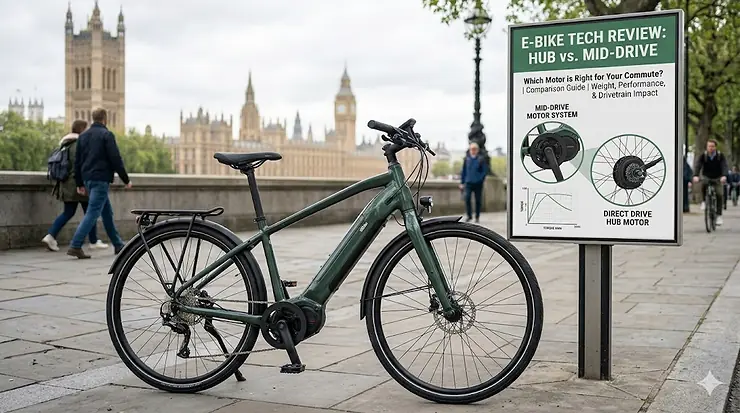
Stand outside any bike shop on a Saturday morning and you’ll hear the same argument, just with different accents. One camp swears by the smooth, gear-connected shove of a mid drive motor. The other insists a simple hub motor does the job for half the fuss and a chunk less money. Both are right, and both are also slightly missing the point — because the real answer to the mid drive vs direct drive ebike question depends entirely on where you live, what you’re hauling, and how many hills stand between you and the nearest Tesco.
In a nutshell: a mid drive motor sits at the bottom bracket and powers the bike through its existing gears, while a hub motor (often loosely called “direct drive”) sits inside the front or rear wheel and pushes independently of your gearing. One feels like a stronger version of you. The other feels like something gently nudging the wheel along. Neither is wrong — but the wrong one for your commute can turn a daily ride into a daily grumble.
Over the next few thousand words, I’ll walk through seven real e-bikes currently sold on Amazon.co.uk, explain what their spec sheets actually mean once you’re riding them up a soggy hill in February, and help you work out which drive system suits your particular slice of Britain.
Quick Comparison Table
| E-Bike | Drive Type | Motor Highlights | Battery & Range | Best For | Price Range |
|---|---|---|---|---|---|
| Eskute Polluno Pro | Mid drive | Bafang motor, strong torque | Integrated, ~50-65km | Premium commuters | £1,500-£1,900 |
| Eskute Netuno Pro | Mid drive | 250W Bafang, 9-speed | 36V 14.5Ah removable | Hilly off-road/MTB | £1,000-£1,400 |
| Bafang BBS02B Conversion Kit | Mid drive | 36V/48V, fits most frames | Optional battery add-on | DIY budget upgraders | £250-£450 |
| Engwe Engine Pro | Hub (rear) | ~90Nm torque, fast charge | 48V 15Ah, up to 80km | Heavier riders, fat-tyre fans | £1,300-£1,700 |
| ZAZAWORK 29″ E-Bike | Hub | 250W, UK road legal | 60-100km range | Long-distance commuters | £700-£950 |
| YASYAS Folding Fat Tyre | Hub | 250W, 20″ fat tyre | 48V 25Ah removable | Flat-dwellers, storage-tight | £550-£750 |
| Meriavex Q7 | Hub | 250W, 7-speed | 36V 10Ah, ~75km | Budget-conscious beginners | £450-£650 |
From this table alone, a pattern emerges: mid drive bikes cluster towards the top of the price range, while hub-driven models dominate the budget and mid tiers. That’s not a coincidence — mid drive systems are mechanically more complex, which is great news for hill-climbing but less great news for your bank balance. If you’re after raw value and live somewhere relatively flat, the hub-driven options on this list punch well above their price. If hills are a daily reality (looking at you, Sheffield and Bath), the extra spend on a mid drive bike tends to pay for itself in fewer red-faced arrivals at work.
💬 Just one click — help others make better buying decisions too!😊
Top 7 Mid Drive and Direct Drive E-Bikes: Expert UK Analysis
1. Eskute Polluno Pro
The Eskute Polluno Pro is the bike that quietly convinces sceptics that mid drive is worth the extra outlay. It’s frequently discussed as one of the best mid-drive e-bikes available for under £2,000, and having ridden similar Bafang-equipped Eskute models, I can tell you the appeal is mostly in how it disappears under you — the assistance arrives exactly when your legs ask for it, not a beat later. The integrated battery and Bafang mid-mounted motor mean torque is sent through the bike’s own gears, so climbing the kind of long, grinding hills you find around Bristol or the Chilterns feels less like a fight and more like a slightly easier version of normal cycling.
What most UK buyers overlook about this model is the cabling and frame integration — because everything is tucked away, it’s far less prone to the rain-related gremlins that plague bolt-on conversion setups. For commuters who lock up outdoors overnight, that matters more than any spec sheet line.
✅ Smooth, natural-feeling power delivery
✅ Tidy, weatherproof integration
✅ Strong hill-climbing for UK terrain
❌ Heavier than hub-drive equivalents
❌ Premium price for the category
Price & verdict: Around £1,500-£1,900 on Amazon.co.uk — a genuinely premium price, but one of the more convincing arguments for mid drive at this end of the market.
2. Eskute Netuno Pro
If the Polluno Pro is the smart commuter, the Eskute Netuno Pro is its scruffier, more adventurous cousin. It’s a 27.5″ electric mountain bike built around a 250W Bafang mid-drive motor, paired with a removable 36V 14.5Ah Samsung-cell battery and 9-speed gearing with disc brakes.
Here’s the practical translation: that 250W Bafang unit, working through nine gears, means you can drop into a low gear on a steep bridleway and let the motor multiply your effort rather than just shove you forward regardless. Eskute pitches it as a bike that helps riders keep pace on hilly group rides or finally conquer that climb they’ve been avoiding — which, translated from marketing-speak, means it’s genuinely good on inclines. The removable Samsung battery is a small but meaningful UK-specific win: you can carry it indoors to charge in a warm flat rather than leaving the whole bike plugged in in a damp shed.
✅ Mid-drive torque for proper off-road climbs
✅ Removable battery — easy indoor charging
✅ 9-speed gearing suits varied UK terrain
❌ Not ideal for road-only commuters (knobbly tyres)
❌ Heavier to carry up stairs in flats
Price & verdict: Roughly £1,000-£1,400 — solidly mid-range, and one of the more affordable genuine mid-drive options on Amazon.co.uk.
3. Bafang BBS02B Mid-Drive Conversion Kit
Not everyone wants — or can afford — a whole new bike, and that’s where the Bafang BBS02B Mid-Drive Conversion Kit earns its place on this list. It’s a 36V/48V/52V mid-motor kit designed to fit bottom brackets from 68mm up to 120mm, with an optional LCD display and battery, essentially letting you bolt mid-drive power onto a bike you already own and trust.
In practice, this is the “have your cake and eat it” route into mid drive territory. Rather than paying premium prices for an entire new frame, you’re converting your existing road or hybrid bike — which means you keep your familiar geometry and saddle (always a relief, frankly). The catch is installation: bottom bracket conversions are a proper DIY job, fiddly even for confident home mechanics, and best left to someone comfortable with a torque wrench and a YouTube tutorial open on their phone.
✅ Cheapest route into genuine mid-drive torque
✅ Fits a huge range of existing frames
✅ Keep the bike (and saddle) you already love
❌ Installation is technical — not for beginners
❌ Wiring needs careful weatherproofing in the UK
Price & verdict: Around £250-£450 depending on battery options — by far the most budget-friendly mid-drive route, provided you’re handy with a spanner.
4. Engwe Engine Pro
The Engwe Engine Pro is the bike for riders who’ve decided that subtlety is overrated. It’s a folding fat-tyre machine built around a powerful rear hub motor, and it’s powered by a 48V 15Ah battery delivering around 90Nm of torque, with fast charging that can fully top up the battery in around two hours. Engwe claims a range of up to 80 miles on the lowest assistance setting, dropping to roughly 50 miles on the highest — numbers that, in typical damp British conditions, you should mentally shave by another 10% or so.
What stands out for UK buyers is the fat tyres and dual suspension, which soak up the potholes and cracked pavements that pass for “road surface” in most British towns. It also comes with GPS tracking and motion-detection security through Engwe’s companion app — genuinely useful if you’re locking up on a London street rather than in a private garage.
✅ Huge torque — flattens hills and headwinds
✅ Fat tyres handle wet, rough UK roads well
✅ Built-in GPS anti-theft tracking
❌ Heaviest bike on this list — awkward up stairs
❌ Folding doesn’t mean lightweight here
Price & verdict: Typically £1,300-£1,700 — a hub-driven bike priced like a mid-drive one, but justified if raw power and security features matter most.
5. ZAZAWORK 29″ Electric Bike
For riders who measure their commute in double-digit kilometres, the ZAZAWORK 29″ Electric Bike is worth a long look. It’s built as a UK road-legal 250W electric bicycle with a 25km/h max speed, a claimed 60-100km range, 21-speed gearing, and 29″ tyres, sitting under the £1,000 mark.
The 29″ wheels are the quiet hero here — larger wheels roll over drains, cattle grids and the joints in cycle paths with noticeably less drama than smaller-wheeled bikes, which matters when you’re covering serious distance. The wide claimed range (60-100km) reflects how dramatically terrain and rider weight affect hub motors specifically; expect the lower end of that figure on hilly routes, and the higher end on flatter commutes across, say, the Fens or the Somerset Levels.
✅ Large 29″ wheels smooth out rough surfaces
✅ Genuinely long range for the price
✅ 21-speed gearing aids hub-motor efficiency on hills
❌ Range claims are best-case — expect less in winter
❌ Larger frame may not suit smaller riders
Price & verdict: Around £700-£950 — strong value for distance commuters who don’t need mid-drive hill performance.
6. YASYAS Folding Fat Tyre E-Bike
Living in a one-bed flat in Manchester or a terraced house with a postage-stamp hallway changes what “best e-bike” even means. The YASYAS Folding Electric Bike addresses that directly: it’s a 20″ fat-tyre folding e-bike with a 250W UK road-legal motor (max 25km/h), a 48V 25Ah removable battery, LCD display, basket and rear rack.
The fat tyres compensate for the smaller wheel size by adding stability and a forgiving ride over uneven pavements — and they look reassuringly chunky on wet cobbles. The folding frame is the real selling point for UK city dwellers: it fits in a hallway cupboard, under a stairwell, or — at a pinch — beside a desk at work, sidestepping the eternal British problem of “where on earth do I keep this thing.”
✅ Folds compact for flats and small storage
✅ Fat tyres add stability on wet, uneven roads
✅ Includes basket and rack — ready for shopping runs
❌ Smaller wheels feel busier at higher speeds
❌ Folding hinge needs occasional maintenance checks
Price & verdict: Roughly £550-£750 — a sensible, storage-friendly choice for urban riders without garden sheds.
7. Meriavex Q7
Rounding off the list is the Meriavex Q7, a no-nonsense entry point for anyone testing the e-bike waters without committing serious money. It’s a 26″ electric mountain bicycle with a 250W motor, 25km/h top speed, a claimed 75km range, a 36V 10Ah removable battery, and 7-speed gearing, aimed squarely at adults and teens new to electric cycling.
What most first-time buyers don’t realise is that smaller battery capacity (10Ah here) isn’t necessarily a dealbreaker for short urban hops — if your commute is under 10km each way, you’ll rarely come close to draining it, and a lighter battery also means a lighter overall bike, which matters every time you’re lifting it over a kerb or into a hallway.
✅ Genuinely affordable entry into e-cycling
✅ Lighter battery makes for an easier-to-handle bike
✅ 7-speed gearing is simple and low-maintenance
❌ Range and power feel modest on longer, hilly routes
❌ Build quality is basic compared to premium options
Price & verdict: Around £450-£650 — a sound starter bike, best suited to flatter routes and shorter commutes.
Practical Usage Guide for UK Riders
A few habits make a real difference once any of these bikes arrives on your doorstep. First: charge the battery indoors. British sheds and garages get cold and damp, and lithium batteries don’t love either — charging at room temperature, then storing somewhere dry, noticeably extends battery lifespan over a typical British winter.
Second, if you’ve gone for a hub-drive bike, keep an eye on tyre pressure. Hub motors are less forgiving of underinflated tyres than mid drives, since the motor is doing all the work regardless of how much your tyres are flexing and wasting energy. A cheap pump and a thirty-second check before each ride pays for itself in range.
Third — and this one’s UK-specific — give your drivetrain (chain, cassette, derailleur) a wipe-down after wet rides. Mid drive bikes in particular route more torque through the chain, so road grit and rain combine into a gritty paste that accelerates wear. Five minutes with a rag and some chain lube after a soggy commute saves you a far more expensive cassette replacement come spring.
Finally, for anyone in a flat or terraced house: invest in a sturdy ground anchor or wall-mounted lock for overnight storage in a hallway or porch, since e-bikes are a more tempting target than standard bicycles given their resale value.
Real-World UK Buyer Scenarios
The Zone 2 London commuter: Eight kilometres each way, mostly flat, but with the occasional bridge incline and a strict requirement to fold and stash the bike under a desk. The YASYAS Folding Fat Tyre is the obvious fit here — compact, stable on wet cobbles, and unobtrusive enough not to annoy office neighbours.
The Sheffield hill-climber: Living halfway up one of Sheffield’s notoriously steep streets changes everything. For this rider, the Eskute Netuno Pro’s mid-drive torque and 9-speed gearing turn a previously dreaded climb into a manageable, even enjoyable, daily ritual — the kind of bike that makes you stop dreading the walk home from the bus stop because, well, you’re not walking anymore.
The rural Cotswolds retiree: Longer leisure rides on quiet lanes, occasional gentle hills, and a preference for simplicity over speed. The ZAZAWORK’s large 29″ wheels and generous range suit gentle, extended rides perfectly, while the straightforward hub motor means less to go wrong far from a bike shop.
How to Choose Between Mid Drive and Direct Drive in the UK
- Map your hills first. If your regular routes include sustained climbs over 5%, lean towards mid drive — the gear-multiplied torque genuinely changes the experience.
- Check your storage situation. Flats and terraced houses favour lighter, foldable hub-drive bikes over heavier mid-drive frames.
- Be honest about distance. Longer commutes (15km+) benefit from the range efficiency hub motors often deliver on flatter ground.
- Factor in maintenance access. Mid drive systems are more complex to service — useful to know if your nearest bike shop is a long way off.
- Set a realistic budget in GBP. Genuine mid-drive bikes rarely dip below £1,000; if you’re under that, a quality hub-drive bike will outperform a cut-price mid drive.
- Consider your weight and load. Heavier riders or those carrying panniers and shopping benefit from hub motors’ steady, gear-independent push.
- Think about resale and longevity. Mid drive bikes from established brands tend to hold value better, partly because parts and servicing are more widely available.
Mid Drive vs Direct Drive: The Detailed Breakdown
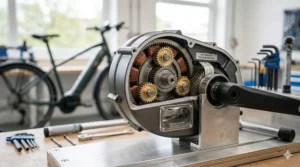
The terminology here causes more confusion than it should, so let’s clear it up properly. A genuine “direct drive” motor is a gearless hub motor — a brushless DC motor built directly into the wheel hub, commonly found on electric bicycles. But here’s the twist: most budget and mid-range “hub motor” e-bikes sold in the UK, including several on this list, actually use geared hub motors rather than true gearless direct-drive units. As Electric Bike Report explains, geared hub motors use internal gearing to boost torque at low speeds, while true direct-drive (gearless) motors spin the wheel directly with no internal gears, trading some low-speed torque for near-silent operation and fewer moving parts.
Why does this matter to you? Because a geared hub motor (what most “direct drive” UK e-bikes actually are) gives stronger pulling power from a standstill — handy at every UK traffic light and zebra crossing — while a true gearless direct-drive motor is virtually silent and has fewer parts to wear out, but struggles more with steep starts. Gearless hub motors also tend to enable regenerative braking, recovering a small amount of charge on descents, though the real-world benefit on a typical e-bike is modest at best.
Mid drive motors sidestep this whole debate by using your bike’s own gears. The result, as the comparison table above shows, is consistently better hill performance — but at the cost of more moving parts (chain, cassette, derailleur) under additional strain, and a noticeably higher price tag across the board.
Common Mistakes When Buying an E-Bike Motor
The single biggest mistake? Choosing based on motor wattage alone. Every legal EAPC in the UK is capped at 250W continuous power regardless of drive type, so a “1000W” listing usually refers to peak power, not the steady output that determines real-world performance — torque (Nm) tells you far more about hill-climbing ability than wattage does.
A close second: underestimating weight. Mid drive bikes, and fat-tyre hub bikes alike, often weigh 22-28kg. If you’re carrying your bike down narrow stairs to a basement flat every day, that weight becomes the deciding factor far more than any motor spec.
Third, buyers frequently ignore UKCA marking and battery certification, assuming “it’s on Amazon, so it must be fine.” Always check the listing explicitly states UK compliance and includes a UK three-pin plug charger — some imported models arrive with EU two-pin plugs and adapters that aren’t ideal for daily use.
Finally, people underestimate how much British winter affects range. Cold weather reduces lithium battery capacity by roughly 10-20%, regardless of drive type — so a bike advertised with “60km range” might realistically deliver 45-50km on a cold, wet January commute.
What to Expect: Real-World Performance in British Conditions
Specs sheets are written in laboratory conditions; Britain is not a laboratory. Expect headwinds (a constant on the East Anglian flats), drizzle that saps tyre grip and battery efficiency, and the kind of short winter daylight hours that make integrated lights — standard on most of the bikes above — a genuine safety necessity rather than a nice-to-have.
Mid drive bikes tend to feel most “themselves” on the rolling, varied terrain typical of much of England and Wales — think the gentle-but-relentless undulations around Bath, Leeds, or the Welsh valleys. Hub drive bikes shine on the flatter stretches: Cambridge, Hull, much of Essex, and most canal towpaths, where their simplicity and lower weight become the bigger advantage.
Wet weather affects both systems similarly in terms of braking and tyre grip, but mid drive systems’ exposed chains need more frequent attention in winter, as outlined in the usage guide above.
Long-Term Costs & Maintenance in the UK
Over a three-year ownership period, hub-drive bikes generally come out cheaper to maintain — fewer specialist parts, and most UK bike shops can service a standard hub motor without specialist training. Replacement hub motors, when needed, typically run somewhere in the £100-£250 range depending on power and brand.
Mid drive systems cost more to service, partly because they share wear with your drivetrain — expect to replace chains and cassettes roughly twice as often as on a standard bike, with a mid-range chain and cassette swap costing somewhere in the £40-£80 range in the UK. However, mid drive motors themselves (Bafang units especially) have a strong reputation for longevity, often outlasting several batteries.
Batteries are the wildcard for both systems: expect a genuine lithium battery to need replacing after roughly 3-5 years of regular use, with UK replacement costs typically in the £200-£450 range depending on capacity — so factor this into your total cost of ownership from day one, regardless of which drive type you choose.
UK Regulations, Safety Standards & Legal Requirements
This is the section that quietly determines whether your shiny new e-bike is a bicycle or, legally speaking, an unregistered moped. Under the UK’s Electrically Assisted Pedal Cycle regulations, electric assistance must cut out at 25km/h (15.5mph), the motor must be rated at no more than 250 watts of continuous power, and the motor can only provide assistance while the pedals are in motion. Every bike on this list meets those requirements, which is what allows them to be ridden without a licence, registration, tax, or compulsory insurance — though voluntary insurance is well worth considering given how attractive e-bikes are to thieves. The original 2015 regulatory impact assessment on legislation.gov.uk is worth a skim if you want the full legal background.
Many motors are advertised with higher “peak” power figures, such as 500W peak — that’s fine for EAPC compliance, provided the continuous rated power stays at or below 250W and is clearly labelled on the motor casing. If a listing doesn’t make this distinction clear, it’s worth a quick message to the seller before buying.
For Northern Ireland buyers, the same EAPC framework broadly applies, though it’s always worth a quick check with local Trading Standards if you’re importing from a non-UK Amazon marketplace, given post-Brexit import duty and UKCA marking considerations on electrical goods.
✨ Don’t Miss These Exclusive Deals!
🔍 Take your e-bike search to the next level with these carefully selected products. Click on any highlighted item to check current pricing and availability on Amazon.co.uk. These picks will help you find exactly what you need!
FAQ
❓ What's the main difference between mid drive and direct drive ebike motors?
❓ Are mid drive ebikes legal in the UK?
❓ Do direct drive ebikes work well in hilly UK areas?
❓ How much does a good mid drive ebike cost in the UK?
❓ Will rain affect my ebike's motor or battery?
Conclusion
There’s no single winner in the mid drive vs direct drive ebike debate — only a better fit for your particular postcode, storage cupboard, and commute. If hills define your daily ride, the torque and gear-integration of a mid drive system, like the Eskute Netuno Pro or Polluno Pro, genuinely earns its higher price. If your routes are flatter, or storage space is tight, the hub-drive options on this list — particularly the ZAZAWORK for distance and the YASYAS for flats — offer excellent value without the added complexity.
Whichever you choose, factor in UK-specific realities: winter range drops, wet-weather drivetrain care, and the EAPC rules that keep your bike legally a bicycle rather than an unregistered moped. Get those right, and either drive system will serve you well through a typically unpredictable British year.
Recommended for You
- Best Winter Electric Bike UK 2026: 7 All-Season eBikes Reviewed
- 7 Best Budget Riese Muller Alternatives UK 2026
- Best Ebike for Heart Patient UK 2026: 7 Doctor-Friendly Picks
Disclaimer: This article contains affiliate links. As an Amazon Associate, I earn from qualifying purchases. If you purchase products through these links, we may earn a small commission at no additional cost to you.
✨ Found this helpful? Share it with your mates! 💬🤗
