In This Article
There’s a particular cruelty to knee pain. It doesn’t announce itself dramatically like a broken wrist or a dislocated shoulder. It simply whispers — on every staircase, every hill, every grey British morning when you’d otherwise quite fancy a gentle ride along the canal. For millions of people living with osteoarthritis, recovering from injury, or managing the slow-burn irritation of worn cartilage, the idea of “going for a bike ride” sounds less like recreation and more like a punishment.
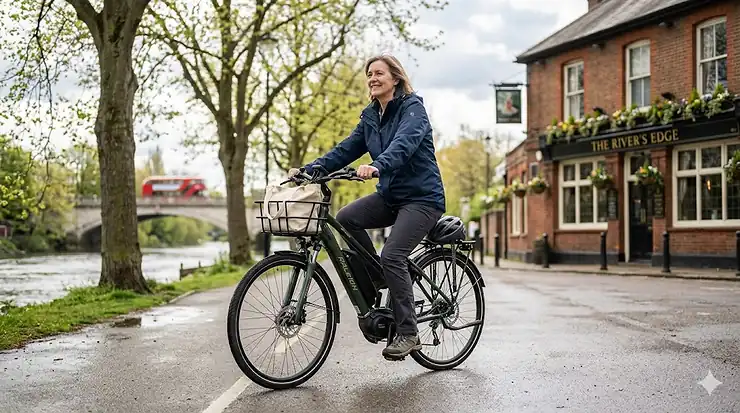
Here’s the thing though: the right ebike for bad knees doesn’t just make cycling tolerable — it can actively help. Research published in Medicine & Science in Sports & Exercise found that people who cycled regularly were 17% less likely to experience frequent knee pain and 21% less likely to develop symptomatic osteoarthritis. The smooth, circular motion of pedalling loads the joint gently, pumps synovial fluid through the cartilage, and builds the quadriceps and hamstring strength that protects your knee in the first place — all without the grinding impact of running or the awkward angles of tennis.
An ebike for bad knees takes this a step further. The motor handles the moments your joints hate most: standing starts, steep inclines, headwinds on the way home when you’re already tired. You still move, still pedal, still get the therapeutic benefit — you just decide how much of the work to share with the battery. If you’re post-surgery or managing a flare, you can dial the assist up to maximum. On a good day, you can barely use it. That flexibility is genuinely rare in exercise equipment.
This guide covers the seven best ebikes for bad knees currently available to UK buyers, alongside everything you need to know about setup, saddle height, and riding technique to protect your joints for the long haul.
Quick Comparison Table: 7 Best Ebikes for Bad Knees (UK, 2026)
| Model | Frame Type | Motor | Approx. Price (GBP) | Best For |
|---|---|---|---|---|
| ESKUTE Polluno Pro | Step-through | 250W Bafang | Under £600 | Budget commuters |
| ESKUTE Polluno Plus | Step-through | 250W Bafang + torque sensor | £600–£800 | All-round daily use |
| Ancheer 26″ City Step-Through | Step-through | 250W | Under £400 | First-time buyers |
| Engwe EP-2 Pro | Step-through folding | 250W | £500–£700 | Urban storage-limited riders |
| Tenways CGO800S | Step-through | 250W + torque sensor | £900–£1,100 | Comfort-focused commuters |
| Fiido C1 Pro | Step-through | 250W torque sensor | £700–£900 | Smooth city riding |
| Dallingridge Harlow V3 | Low-step | 250W | £500–£700 | Leisure & recovery rides |
Reading this table: torque sensor models (ESKUTE Polluno Plus, Tenways, Fiido) deliver noticeably smoother power delivery — more important for knee health than most buyers realise. A cadence sensor simply fires the motor when the pedals turn; a torque sensor adjusts output to match exactly how hard you’re pushing, which means far less sudden jolt on the joint. If budget stretches, go torque. If it doesn’t, the frame type and saddle setup matter more than the sensor anyway.
💬 Just one click — help others make better buying decisions too! 😊
✨ Don’t Miss These Exclusive Deals!
🔍 Take your joint-friendly cycling to the next level with these carefully selected ebikes. Click any highlighted product to check current pricing and availability on Amazon.co.uk. Happy riding! 🚴♂️
Top 7 Ebikes for Bad Knees: Expert Analysis
1. ESKUTE Polluno Pro — The Sensible British Choice
The ESKUTE Polluno Pro has become something of a cult favourite among UK commuters — and with good reason. The step-through frame sits genuinely low, which means no awkward leg swing that puts lateral stress on the knee before you’ve even started pedalling. It’s the small details that matter here.
The 250W Bafang rear hub motor is well-regarded in the industry: quiet, reliable, and smooth enough for urban use. Coupled with a 36V 14.5Ah battery, you’re looking at a real-world range of around 60–75 km, though in British autumn conditions — damp roads, headwinds, the general meteorological chaos of a Tuesday in Leeds — expect something closer to 55 km. The five levels of pedal assist mean you can graduate from near-full motor support on a bad day to minimal assistance when you want a gentle workout.
ESKUTE dispatch from UK warehouses, which means delivery in days rather than weeks, and their UK customer service team gets consistently decent reviews. One Amazon.co.uk reviewer with mobility issues noted it “completely transformed my morning commute — I’d given up cycling for two years.”
✅ UK warehouse dispatch — fast delivery
✅ Genuine low step-through frame
✅ Bafang motor: a reliable industry name
❌ Cadence sensor rather than torque — less nuanced for knees
❌ Heavier at around 24 kg — trickier to carry upstairs in a flat
Price range: Under £600. Very solid value for a first joint-friendly ebike.
2. ESKUTE Polluno Plus — The Upgrade Worth Making
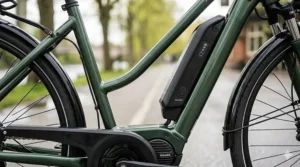
Everything good about the Polluno Pro, with one crucial difference: torque sensor technology. The Polluno Plus uses a 250W Bafang G020 motor paired with a torque sensor that reads your pedalling effort and adjusts assistance in real time. For knees, this distinction is substantial. No sudden lurch of power when you start pedalling; instead, a seamless increase that mirrors your own effort. It’s the difference between a helpful colleague and one who keeps bumping into you.
The 36V 20Ah Samsung/LG battery is genuinely impressive — the claimed 120 km range is optimistic, but 80–100 km in mixed British conditions is credible. The removable internal battery charges in around 5 hours, which matters if you live in a flat without a garden and need to bring it indoors. Available on Amazon.co.uk with Prime delivery in many postcodes.
UK reviewers praise the build quality and, notably, the customer support follow-through. One customer mentioned a delivery issue that was “fully resolved” by Eskute’s team — not something every brand can claim.
✅ Torque sensor: superior knee protection
✅ Samsung/LG battery cells: reliable and long-lasting
✅ Removable battery — important for flat/terraced house storage
❌ Slightly higher price point than the base Polluno
❌ Bluetooth connectivity can be temperamental with some Android phones
Price range: £600–£800. The torque sensor alone justifies the step up.
3. Ancheer 26″ Step-Through City Ebike — The Accessible Entry Point
Ancheer divides opinion. Some find the build a touch agricultural; others point out that for the price, it’s remarkable it works at all. The truth sits somewhere in the middle. For someone who needs an ebike for bad knees on a tight budget — recovering from surgery, trying the concept before committing — the Ancheer step-through city model is a genuinely reasonable starting point.
The 250W motor handles flat terrain and gentle inclines without complaint. The 36V 8Ah battery gives around 40–50 km, which is plenty for a leisure ride or a short commute. The step-through frame is the main attraction here: low, easy, no joint strain getting on and off. The Shimano 7-speed gearing allows you to find a comfortable cadence rather than grinding through high resistance, which matters enormously for knee protection.
The spec sheet won’t win awards, but for riders cautiously re-entering cycling after injury, the low price means a bad day doesn’t feel like a catastrophic investment.
✅ Very affordable entry price
✅ Shimano gears — reliable brand
✅ Low step-through frame
❌ Cadence sensor only — less smooth for joints
❌ Smaller battery limits range
Price range: Under £400. Best as a starter bike, not a forever bike.
4. Engwe EP-2 Pro — Folding Practicality for the Knee-Conscious Urban Rider
The Engwe EP-2 Pro occupies a clever niche: it folds down to manageable dimensions for storage in a hallway, under a desk, or in a car boot (UK living spaces being what they are), whilst delivering a genuinely capable ride. The step-through frame and front suspension fork are the features knee sufferers should focus on.
The suspension matters more than many buyers expect. UK roads — particularly urban routes — are riddled with potholes, speed bumps, and poorly-maintained surfaces that transmit shock directly to your joints. The EP-2 Pro’s front fork absorbs the worst of this, keeping the impact out of your knees and hips. The 250W motor manages inclines well for its class, and the 15.6Ah battery comfortably covers most urban commutes.
UK availability on Amazon.co.uk is confirmed, with a growing body of British customer reviews praising its ease of use. Worth noting: the fat 20×4-inch tyres provide additional cushioning and are particularly forgiving on cobblestones — a feature the residents of many UK city centres will appreciate.
✅ Folds for compact storage — excellent for terraced houses and flats
✅ Front suspension reduces joint shock
✅ Fat tyres add cushioning on rough UK roads
❌ Heavier than a standard folder at around 27 kg
❌ 20-inch wheels feel less planted at speed than 26-inch or 700c models
Price range: £500–£700. Superb for riders short on storage space.
5. Tenways CGO800S — The Premium Choice for Serious Knee Protection
If budget allows, the Tenways CGO800S is the bike that most closely resembles what a physiotherapist might design if given free rein. The step-through Dutch-style frame positions the rider in a genuinely upright posture — spine straight, shoulders relaxed, weight centred over the saddle rather than pitched forward onto the wrists. The SR Suntour suspension fork smooths out the inevitable British road surface surprises.
The real standout, though, is the Gates Carbon Belt Drive. No chain means no maintenance — no greasing, no rusting, no seized links after six months of wet-weather commuting in Manchester or Edinburgh. The belt is silent and lasts significantly longer than a standard chain. For someone managing a long-term condition, “zero maintenance drivetrain” isn’t a marketing phrase; it’s a practical relief.
The 250W MiVice torque sensor motor delivers exceptionally smooth, natural assistance. UK cyclists describe it as feeling like a very fit invisible friend cycling alongside you and occasionally giving you a helpful push. Range is around 95–100 km. The Tektro hydraulic disc brakes are excellent — crisp, confident, and weatherproof.
✅ Gates Carbon Belt Drive — maintenance-free and weatherproof
✅ Dutch upright posture: ideal for spinal and joint comfort
✅ Torque sensor: the smoothest power delivery in this list
❌ Premium price point — not for budget buyers
❌ Single-speed setup struggles on steeper UK hills (Sheffield, Bristol, Bath)
Price range: £900–£1,100. An investment, but a deeply considered one.
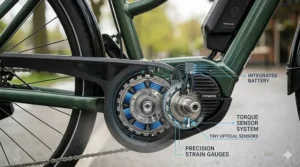
6. Fiido C1 Pro — The Torque-Sensor City Bike That Gets the Details Right
The Fiido C1 Pro is worth serious attention if you want torque sensor smoothness without Tenways prices. The step-through frame is well-proportioned, the saddle is notably comfortable straight out of the box (a detail Fiido gets more credit for than most), and the non-contact torque sensor technology responds within a claimed 0.01 of a second. In practice, this means the motor always feels like your legs’ natural extension rather than an afterthought bolted on.
The bike includes a pannier rack and front basket option — useful for anyone using the ebike for bad knees to replace short car journeys, collecting groceries, or light errands. UK availability on Amazon.co.uk is confirmed. A walk-assist throttle up to 6 km/h (road-legal under UK regulations) is a thoughtful touch for moments when you’d rather push than pedal — getting off on a steep hill, for instance, without stressing the knee.
UK reviews particularly mention the comfortable saddle and the natural ride feel. For city commuters in London, Bristol, or Birmingham managing chronic knee issues, this is a very well-rounded package.
✅ Fast-responding torque sensor — excellent joint protection
✅ Comfortable saddle included as standard
✅ Walk-assist throttle — useful on steep dismounts
❌ Shorter battery range than some rivals at around 60 km real-world
❌ Slightly heavier than comparable models
Price range: £700–£900. Competitive with the Tenways at a somewhat lower price.
7. Dallingridge Harlow V3 — The Low-Step British Leisure Bike
The Dallingridge Harlow V3 is a UK brand that understands its market: comfortable, unhurried leisure cycling for riders who want reliable, easy riding rather than tech-forward features. The low-step frame (not quite step-through, but close) and upright seating position make it particularly comfortable for older riders or those in knee rehabilitation. Available on Amazon.co.uk with Prime eligibility.
The 250W rear hub motor and integrated battery (typically 36V 10Ah) provide adequate range for leisure rides — around 45–60 km depending on terrain and assist level. The aluminium frame keeps weight manageable at around 22 kg. No torque sensor, but the gentle cadence-assist system is smooth enough for leisure use where you’re unlikely to be attacking sharp inclines.
What most UK buyers overlook about this model is its sheer approachability. There’s no app to configure, no complex display to navigate. Switch on, select assist level, ride. For anyone intimated by technology or simply recovering their cycling confidence after a period of injury, that simplicity has genuine value.
✅ UK brand with Amazon.co.uk Prime eligibility
✅ Simple, approachable setup — no tech overwhelm
✅ Upright posture ideal for comfort rides
❌ Smaller battery limits longer rides
❌ No torque sensor — less refined for frequent knee issues
Price range: £500–£700. An excellent leisure and rehabilitation choice.
Getting the Setup Right: Saddle Height, Cadence, and Posture
This is the section Amazon product listings will never give you — because it’s not about the bike. It’s about you on the bike.
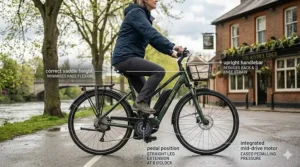
Saddle height is everything. The single biggest mistake knee-pain sufferers make when getting back on a bike is sitting too low. It feels safer; it isn’t. A saddle that’s too low forces excessive knee flexion (the joint bends sharply) on every pedal stroke, which concentrates stress on the patella and surrounding cartilage. The correct position: when your pedal is at its lowest point, your knee should have a slight bend — roughly 10 to 15 degrees. Completely straight is too high; visibly bent is too low. Adjust incrementally and spend five minutes riding after each adjustment.
Pedal cadence matters more than power. A slow, grinding cadence (pushing hard in a high gear) puts enormous pressure on the knee joint. A faster, lighter cadence — around 70–90 revolutions per minute — distributes the work more evenly across muscle groups and reduces joint loading. On an ebike, this is easy to achieve: use the motor to maintain resistance at a level where a faster spin feels comfortable. Versus Arthritis, the UK’s leading arthritis charity, specifically recommends gentle aerobic cycling as a first-line exercise for managing joint pain.
Handlebar height affects the whole kinetic chain. Bars that are too low force you to lean forward, shifting weight onto your wrists and transferring tension through the shoulders and down the back — which subtly alters your pedalling mechanics and increases knee torque. The Dutch-style bikes (Tenways, Dallingridge) handle this well by design. On other models, most handlebars are adjustable at the stem.
British weather note: Wet roads change your contact patch with the ground, which subtly changes your balance and how you push off. Give yourself 10% more braking distance and reduce your cadence slightly on wet mornings — the calmer, more even effort is better for the joints anyway.
Who Should Buy What: UK Rider Profiles
The Post-Surgery Commuter (London, Zone 2): You’ve had a partial knee replacement or meniscus repair six months ago. Your physio has cleared cycling but wants you to avoid heavy resistance. You commute 7 km each way, park the bike at the office. → Tenways CGO800S or Fiido C1 Pro. Torque sensor smoothness is non-negotiable here. The belt drive on the Tenways means zero maintenance — your commuting life is already complicated enough. Prime eligibility means next-day delivery.
The Retired Leisure Rider (Peak District Village): You’re 68, your knees are grumbling with mild osteoarthritis, and you want to get back to exploring the countryside without a car. Hills are involved. Storage is a garage, not a flat. → ESKUTE Polluno Plus. The torque sensor handles hills cooperatively, the battery range covers longer rides, and the 36V 20Ah Samsung battery is reliable through cold winter mornings. The step-through makes mounting and dismounting simple on uneven ground. Check with your GP first — the NHS guidance on exercise and osteoarthritis actively encourages low-impact cycling.
The Space-Strapped City Dweller (Manchester, Flat Without a Lift): Your hallway is the width of a slightly optimistic architect’s imagination. You need something that folds, weighs under 28 kg, and handles the potholes on your route without transmitting the vibration of a small earthquake into your knees. → Engwe EP-2 Pro. The fat tyres and front suspension absorb what the road throws at you; the fold makes storage genuinely manageable.
The Budget-Conscious Beginner (Suburban Birmingham): You’re not sure yet if cycling is going to work for your knees — understandably cautious after a few painful previous attempts. You don’t want to spend £1,000 before you know. → Ancheer Step-Through or Dallingridge Harlow V3. Lower investment, lower risk. If cycling helps (and there’s strong evidence it will), you can upgrade later with confidence.
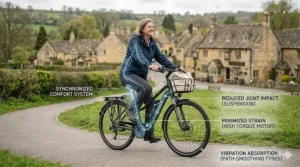
How to Choose an Ebike for Bad Knees in the UK: 6 Expert Criteria
- Frame type — step-through is not optional. Getting on and off a traditional diamond-frame bike requires lifting your leg over a high crossbar, which creates a rotational stress on a compromised knee. A step-through frame eliminates this entirely. Do not compromise on this point.
- Torque sensor vs cadence sensor. As discussed: torque sensors cost more and deliver gentler, more joint-protective assistance. If budget permits, prioritise this over most other specifications.
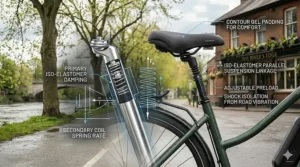
- Suspension. UK roads in 2026 are not, to put it diplomatically, in peak condition. Front suspension (ideally, front and rear on rougher terrain) absorbs the impact that would otherwise travel directly up through your legs and into the knee joint. It’s not a luxury for knee sufferers — it’s almost essential.
- Saddle adjustability. A wide height range on the seatpost allows proper knee-angle setup. Check the manufacturer’s minimum and maximum saddle heights before purchasing if you’re on the shorter or taller end of the range.
- Battery capacity and real-world range. Larger batteries allow lower assist levels for longer — a 20Ah battery at level 2 will put far less stress on your joints than a 10Ah battery at level 4 achieving the same distance. Think of battery capacity as your joint-protection reserve.
- Weight and handleability. An ebike that’s difficult to manoeuvre while stationary — lifting over a kerb, shuffling around a shed — can produce the awkward sudden loads on a knee that cycling itself avoids. Under 23 kg is preferable for solo handling; under 27 kg if you have help.
Ebike vs Other Low-Impact Exercise Options for Bad Knees
| Option | Joint Impact | Cardiovascular Benefit | UK Practicality | Cost |
|---|---|---|---|---|
| Ebike for bad knees | Very low | High | Excellent (commuting too) | £400–£1,100+ |
| Swimming | Minimal | High | Moderate (pool access needed) | £30–£60/month |
| Stationary cycling | Very low | Moderate | Good (home use) | £150–£500 |
| Walking | Low-moderate | Moderate | Excellent | Free |
| Running | High | Very high | Good | Low |
The ebike wins on practical grounds that the table can’t fully capture. Swimming is therapeutically excellent, but it requires a pool, a bag, wet hair on the way to work, and a changing room that smells vaguely of chlorine. A stationary bike keeps you fit but parked in your spare room, staring at a wall. An ebike gets you outside — and there’s a growing body of evidence, including research from Bournemouth University presented to the NHS, that outdoor cycling has measurable advantages for both physical and mental wellbeing compared to indoor alternatives.
Common Mistakes When Buying an Ebike for Bad Knees
Prioritising speed over smoothness. A 500W motor that fires at full power the instant you touch the pedal is not your friend. Smooth, progressive assistance is what protects joints. Always check the assist system type before purchasing.
Ignoring fit in favour of features. A torque sensor does very little good if the saddle is set at the wrong height. Spend the first week after purchase perfecting the setup before judging the bike.
Buying a US-market model without checking UK compliance. This applies particularly to eBay and non-Amazon platforms. UK-legal ebikes must have a maximum of 250W continuous power and speed-limit assist to 15.5 mph (25 km/h). Models sold for the US market — which often have 500W motors or throttle-only modes — are not road-legal in Great Britain under current DVLA and Department for Transport regulations. Riding an illegal ebike invalidates your insurance and could result in prosecution. Worth noting: Northern Ireland follows slightly different rules, so NI-based buyers should double-check local requirements.
Underestimating the impact of British winters on maintenance. Knee sufferers often ride year-round because stopping in winter sets back rehabilitation progress. Chain-driven bikes that aren’t regularly cleaned will seize up in damp conditions; the Tenways’ belt drive sidesteps this entirely. If you buy a chain-driven model, budget time for monthly maintenance.
Choosing on price alone. A £300 ebike that requires £150 of repairs after 18 months of riding is a worse value than a £600 model that runs reliably for five years. Factor in replacement parts availability in the UK — some budget brands have poor supply chains for UK servicing.
Long-Term Cost and Maintenance in the UK
An ebike for bad knees is a healthcare investment as much as a transport one. The numbers make sense when you look at the full picture.
A mid-range model (around £600–£800) will cost roughly £15–£25 per year in electricity to charge — at current UK electricity rates, a full charge costs approximately 15–25p depending on your tariff. Annual maintenance on a chain model (cable adjustment, chain replacement, brake pads) runs to around £50–£80 at an independent bike shop; belt-drive models like the Tenways need barely anything.
Compare this to a monthly gym membership (£25–£60 per month), or the physiotherapy sessions that untreated knee degeneration might eventually require. The ebike pays for itself quickly. On the NHS, knee replacement surgery has a waiting list that, as of 2026, can stretch to 18 months or more in many areas. There is genuine clinical sense in investing in the prevention.
✨ Don’t Miss These Exclusive Deals!
🔍 Check current prices on Amazon.co.uk for all seven joint-friendly ebikes above — stock and pricing change frequently, and Prime members can often get next-day delivery on many models. 🚴♂️⚡
Battery replacement will eventually be necessary — typically after 500–800 full charge cycles, usually 4–7 years of regular use. Replacement batteries for ESKUTE, Engwe, and Ancheer are available on Amazon.co.uk in the £80–£200 range. Always buy from the original manufacturer’s official source to ensure UK voltage compatibility (230V/50Hz, UK plug type G).
UK E-Bike Regulations, Safety, and Legal Requirements
Understanding the rules keeps you safe and legal. In the UK, an electrically assisted pedal cycle (EAPC) is road-legal in England, Scotland, and Wales without requiring registration, insurance, road tax, or a driving licence, provided it meets these criteria:
- Maximum continuous motor output: 250W
- Maximum assisted speed: 15.5 mph (25 km/h) — the motor must cut out above this
- The rider must be 14 years or older
- Pedal assist only (throttle is permitted up to 6 km/h as walk assist)
All seven bikes in this guide comply with UK EAPC regulations. UKCA marking (which replaced CE marking following Brexit for products sold in Great Britain) should be present on compliant bikes; EU CE marking remains valid in Northern Ireland under the Windsor Framework. If purchasing via Amazon.co.uk, products listed as “ships from and sold by Amazon” or by established UK-registered sellers will generally comply.
Helmet use is strongly recommended, though not legally mandated for adults. Given that knee problems often correlate with balance and stability challenges, a quality helmet is particularly worth investing in.
Frequently Asked Questions
❓ Is an ebike for bad knees actually better than a regular bike for arthritis?
❓ What is the correct saddle height on an ebike for knee pain?
❓ Are ebikes legal to ride on UK roads without a licence?
❓ Can I use Amazon Prime next-day delivery for ebikes to the UK?
❓ How should I care for an ebike for bad knees during UK winter weather?
Conclusion: Move More, Hurt Less — The Right Ebike Makes It Possible
Knee pain has a habit of convincing you that stillness is the answer. It isn’t. Movement — the right kind, at the right intensity, with the right equipment — is what keeps joints functional, reduces stiffness, and builds the muscular support that protects cartilage over the long term. An ebike for bad knees puts you in control of precisely how much work your joints do on any given day.
For budget-conscious buyers, the ESKUTE Polluno Pro and the Dallingridge Harlow V3 are solid, accessible starting points. If you can stretch to a torque sensor model, the ESKUTE Polluno Plus or Fiido C1 Pro offer meaningfully better joint protection. For those prepared to invest properly in their long-term mobility, the Tenways CGO800S is genuinely one of the best low-impact urban bikes available in the UK today.
Whatever you choose, spend time on the saddle height before judging the bike. Ride gently for the first fortnight. And if you’re managing osteoarthritis or post-surgical rehabilitation, it’s worth having a conversation with your GP or physiotherapist first — Versus Arthritis offer excellent evidence-based guidance on exercise and joint health if you’d like to read more before your appointment.
The canal towpath, the park circuit, the 3 km commute you’ve been driving because your knees hurt — they’re all still there waiting for you.
✨ Don’t Miss These Exclusive Deals!
🔍 Ready to ride? Click any highlighted product above to check live pricing and availability on Amazon.co.uk. A joint-friendly ebike could be at your door as soon as tomorrow with Amazon Prime. 🇬🇧⚡
Recommended for You
- Battery Swap System Ebike: 7 Best UK Picks for 2026
- Best 2 Hour Charge Ebike UK 2026: 7 Fast-Charging Picks
- Best Sub 15kg Electric Bikes UK 2026: 7 Lightweight E-Bikes That Won’t Break Your Back
Disclaimer: This article contains affiliate links. As an Amazon Associate, I earn from qualifying purchases. If you purchase products through these links, we may earn a small commission at no additional cost to you.
✨ Found this helpful? Share it with your mates! 💬🤗
