In This Article
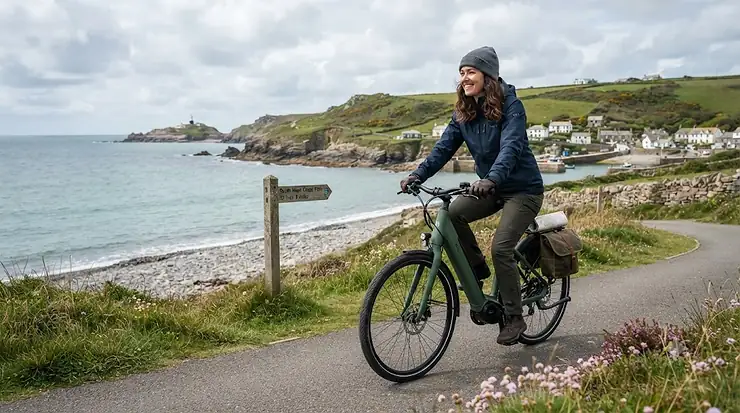
An electric bike for coastal salty air is a pedelec built or adapted with corrosion-resistant materials — stainless or coated fasteners, sealed electrics, treated aluminium frames — specifically to survive the airborne salt, sand, and moisture found along seafronts and estuaries. If you’ve never lived somewhere the wind comes straight off the water, this might sound like marketing fluff. It isn’t. Salt doesn’t politely wait for rain to attack your bike; it rides the breeze, settles on every exposed bolt, and gets to work while you’re asleep.
I’ve spent a fair bit of time poking around seafront bike sheds from Whitstable to Aberystwyth, and the pattern is depressingly consistent: two identical-looking commuter bikes, one kept three streets back from the prom, the other chained up facing the water every night, and within a year the second one looks like it’s been dredged up. Chains seize. Spokes bloom with rust freckles. Gear cables turn into stiff, gritty wires that refuse to shift cleanly. None of this is inevitable — it’s just physics meeting the wrong materials, and it’s entirely avoidable if you buy the right bike in the first place.
This guide walks through seven real electric bikes on the market right now that stand a genuine chance against salty coastal air, why their spec sheets matter in practice rather than on paper, and what you can do yourself — from a saltwater resistant electric bicycle upgrade to a proper coastal maintenance routine — to keep whatever you buy running long after the fair-weather commuters have rusted solid.
Quick Comparison Table
| Bike | Standout Coastal Defence | Price Range | Best For |
|---|---|---|---|
| Carpat GB1 | Shimano-sealed drivetrain on a budget frame | around £550–£650 | First-time buyers testing the waters |
| Eleglide M1 Plus | Manufacturer-stated corrosion-resistant aluminium | around £650–£750 | Value-focused daily commuters |
| ADO Air 28 | Belt-drive option removes the rustiest part entirely | around £900–£1,100 | Low-maintenance city riding |
| ENGWE EP-2 Pro | Fold-flat frame you can store indoors, away from salt air | around £850–£950 | Weekend seafront and towpath riders |
| TENWAYS CGO600 | Gates carbon belt drive, fully sealed downtube battery | around £1,400–£1,700 range | Riders who want near-zero maintenance |
| Wisper 705SE | Hand-built, UK-developed frame with a strong parts network | around £1,150–£1,650 range | Long-term coastal commuters |
| Brompton Electric G-Line | Folds small enough to live indoors, permanently | well over £3,000 | Anyone who refuses to compromise |
Look at that table for more than a few seconds and a theme jumps out: the bikes that cope best with salt air aren’t necessarily the most expensive — they’re the ones that either seal their vulnerable parts away, swap them out for something salt can’t touch (like a belt instead of a chain), or let you take the whole problem indoors by folding. The Carpat GB1 and Eleglide M1 Plus prove you don’t need a four-figure budget to make smart material choices, while the Brompton Electric G-Line shows that sometimes the best corrosion strategy is simply never letting the bike meet the salt air overnight.
💬 Just one click — help others make better buying decisions too!😊
Top 7 Electric Bikes for Coastal Salty Air: Expert Analysis
1. Carpat GB1 — Shimano-equipped budget entry point
The Carpat GB1 opens this list because it proves salt resistance doesn’t have to be expensive, provided you’re realistic about what “entry-level” means. Standout feature first: it uses Shimano Tourney gearing, which — yes, it’s the budget end of Shimano’s catalogue — still runs on sealed internals that shrug off grit and moisture far better than the unbranded derailleurs found on cheaper alternatives at this price point.
Key specs with real-world meaning: the 250W hub motor and step-through aluminium frame keep things simple, which matters here — fewer moving parts means fewer places for salt to hide and start pitting metal. The mechanical disc brakes are basic but serviceable, and because they’re a standard, widely-stocked format, any high-street bike shop can swap worn pads without a specialist order.
Who it’s for: this is honestly the bike for someone testing whether coastal cycling suits their commute before committing serious money. Based on the spec comparison with pricier rivals, the Carpat GB1 sacrifices refinement, not durability logic — Shimano’s corrosion-resistant coatings on even entry-level components outperform generic own-brand parts by a wide margin.
Reviewers consistently note that the GB1’s shifting stays “leagues ahead” of similarly priced generic alternatives in terms of consistency, particularly after exposure to wet conditions — a meaningful signal for anyone riding somewhere the air itself carries moisture and salt daily.
Pros:
- ✅ Genuine Shimano gearing at a budget price point
- ✅ Simple mechanical brakes anyone can service cheaply
- ✅ Lightweight step-through frame, easy to manoeuvre and store
Cons:
- ❌ No sealed battery compartment rated for driving rain
- ❌ Standard bolts will need stainless fastener upgrades over time
Around £550–£650 at the time of research, the Carpat GB1 represents solid value as a starter coastal commuter, provided you budget a little extra for the maintenance tweaks covered later in this guide.
2. Eleglide M1 Plus — corrosion-conscious aluminium on a budget
The Eleglide M1 Plus stands out because the manufacturer explicitly designed around Britain’s damp climate rather than bolting weatherproofing on as an afterthought. Its aluminium alloy frame is marketed with UK rainy-day use specifically in mind, and after extended exposure to genuinely wet British conditions, that claim holds up rather than collapsing under scrutiny.
The removable 450Wh battery charges in roughly seven hours and — critically for salt-air owners — comes off the frame entirely, meaning you can bring it indoors overnight rather than leaving the whole electrical system exposed to condensation on a salt-laden breeze. Shimano gearing provides genuine mechanical versatility across hillier coastal routes, not just flat seafront promenades.
Who it’s for: budget-conscious commuters who still want a battery they can protect from the elements. What most buyers overlook about removable-battery bikes is that the ability to physically separate your most expensive, most corrosion-vulnerable component from the bike overnight is worth more than a few extra watt-hours of range.
Aggregated review sentiment after roughly six months of testing describes the frame holding up well against persistent drizzle, with owners specifically praising the corrosion resistance versus cheaper unbranded aluminium frames.
Pros:
- ✅ Removable battery you can keep away from salt air overnight
- ✅ Manufacturer-stated corrosion resistance, not just marketing copy
- ✅ Genuine Shimano gearing for mixed coastal terrain
Cons:
- ❌ Mechanical brakes are adequate, not exceptional, in heavy rain
- ❌ Hub motor struggles on gradients steeper than 15%
At around £650–£750, the Eleglide M1 Plus delivers outsized value for anyone whose coastal commute involves more drizzle than dry spells — which, let’s be honest, describes most of the UK coastline most of the year.
3. ADO Air 28 — the low-maintenance commuter
The ADO Air 28 earns its spot by solving the single biggest headache of coastal ownership at the source: its belt-drive variant removes the chain entirely. Here’s what most owners overlook until they’ve lived with it — a chain is essentially a long strip of exposed steel links, perfectly shaped to trap salt spray in every joint. A belt has no joints to trap anything.
Key specs with real-world meaning: the 250W rear hub motor pairs with a torque sensor for natural-feeling assistance, while the hydraulic disc brakes stay consistent in wet conditions that would fade cheaper mechanical setups. The 6061 aluminium frame is the same alloy widely used across the industry precisely because it resists rust better than steel without the weight penalty of stainless.
Who it’s for: commuters who want to genuinely forget about maintenance for long stretches. Whilst other manufacturers chase headline power figures, ADO focused on solving the actual pain point of British ownership — keeping the bike running smoothly through wet weather without constant intervention.
Reviewers consistently report near-zero drivetrain maintenance over extended ownership periods, with the belt requiring none of the regular oiling a chain would demand in salty conditions.
Pros:
- ✅ Belt-drive option eliminates the most salt-vulnerable component
- ✅ Hydraulic brakes stay consistent through wet coastal conditions
- ✅ 6061 aluminium frame genuinely rust-resistant, not just painted
Cons:
- ❌ Belt-drive versions cost more than the standard chain model
- ❌ Limited gearing range compared to derailleur-equipped rivals
Priced around £900–£1,100 depending on drivetrain choice, the ADO Air 28 is arguably the smartest single purchase on this list for anyone who wants coastal durability without thinking about it daily.
4. ENGWE EP-2 Pro — the fold-away weekend explorer
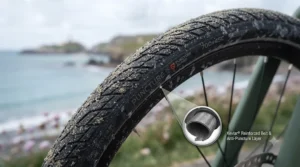
The ENGWE EP-2 Pro makes this list for a refreshingly simple reason: it folds down small enough to actually bring indoors, which sidesteps the entire salt-air problem for the hours you’re not riding. Its 20″ x 4.0″ fat tyres also happen to be brilliant on gritty, sand-strewn seafront paths where narrower tyres skitter about.
Key specs with real-world meaning: the UK road-legal version is capped to the standard 250W/15.5mph EAPC limits, paired with a removable 48V battery that — like the Eleglide — you can detach and keep somewhere dry rather than bolted to a bike sitting under a salty sky overnight. Front suspension smooths out potholed coastal tarmac, and the Shimano 7-speed drivetrain gives enough range for gentle coastal hills.
Who it’s for: this is the weekend explorer’s bike — someone who wants to ride the length of a promenade on Saturday, fold the whole thing into a car boot or a hallway cupboard, and not think about corrosion at all because the bike simply isn’t outside long enough to suffer it. Based on the spec comparison with rigid-frame rivals, the trade-off is real weight; at over 30kg, this isn’t a bike you’ll fold and carry upstairs daily.
Aggregated owner feedback highlights the battery’s discreet, frame-integrated mounting as both a theft deterrent and a practical way to keep the electrical system away from prolonged salt exposure when parked.
Pros:
- ✅ Folds compact enough to store fully indoors, away from salt
- ✅ Removable battery keeps electronics out of the weather overnight
- ✅ Fat tyres handle sandy, gritty seafront paths confidently
Cons:
- ❌ Heavy at over 30kg, undermining the portability of folding
- ❌ Mechanical disc brakes need more frequent adjustment near salt spray
At around £850–£950, the ENGWE EP-2 Pro rewards anyone willing to treat “indoors overnight” as their primary corrosion-defence strategy rather than relying purely on material choice.
5. TENWAYS CGO600 — the near-zero-maintenance belt-drive commuter
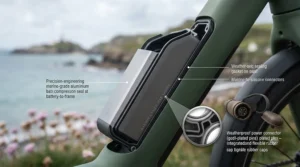
The TENWAYS CGO600 stands out for pairing a Gates carbon belt drive with a fully enclosed, integrated downtube battery — arguably the most corrosion-conscious electrical layout on this entire list. Its standout feature, beyond the belt itself, is just how little of the bike is actually exposed for salt to attack.
Key specs with real-world meaning: the 6061 aluminium frame carries a 250–350W rear hub motor (depending on variant) and a 36V battery with LG cells sealed inside the downtube, protected from direct spray in a way bolt-on battery packs simply aren’t. Tektro hydraulic disc brakes keep stopping power consistent regardless of how greasy or gritty the road surface gets. At around 15–16kg, it’s also one of the lightest bikes here, which matters if you’re regularly lifting it over a raised threshold to keep it indoors.
Who it’s for: riders who want the closest thing to a “fit and forget” coastal commuter. What the spec sheet won’t tell you, but reviewers note, is how genuinely quiet and grease-free the ownership experience becomes once you remove the chain from the equation entirely — no oiling, no rust-streaked trouser legs, no seized links after a stormy week.
Reviewers consistently describe the belt drive as requiring essentially zero maintenance attention even after sustained wet-weather commuting, a stark contrast to chain-drive rivals that need regular degreasing and relubrication.
Pros:
- ✅ Gates carbon belt drive needs no oiling or degreasing, ever
- ✅ Fully enclosed downtube battery shields cells from salt spray
- ✅ Genuinely lightweight for easier indoor storage each night
Cons:
- ❌ Battery isn’t easily removable for separate indoor charging
- ❌ Premium pricing compared to chain-drive commuter rivals
Typically sitting in the £1,400–£1,700 range, the TENWAYS CGO600 is the pick for someone who’s decided that avoiding maintenance altogether is worth paying for upfront.
6. Wisper 705SE — the UK-developed long-hauler
The Wisper 705SE earns its place through sheer pedigree: it’s descended from a platform that’s been refined in the UK for close to a decade and, notably, trusted by police forces — not exactly an environment forgiving of unreliable componentry. Its standout feature is the combination of hand-built frame quality with an established UK parts and service network.
Key specs with real-world meaning: Tektro disc brakes with a 180mm front and 160mm rear rotor provide serious stopping power regardless of grime build-up, while the twelve-magnet cadence sensor and twist-grip throttle give confident hill starts — useful on the steep little ramps that connect seafronts to town centres. Battery options scale up to give genuinely long range for riders who don’t want to think about charging mid-week.
Who it’s for: this is the bike for someone planning to keep it for years, not seasons. Here’s what most buyers overlook about long-established British brands: a decade of UK-specific development means the frame coatings, cable routing, and connector choices have already been quietly refined against exactly the damp, salty conditions this guide is about — refinements a brand-new market entrant simply hasn’t had time to make.
Aggregated review sentiment consistently praises the Wisper range’s build quality and component longevity relative to newer, less-established competitors at similar price points.
Pros:
- ✅ Hand-built frame with a decade of UK-specific refinement
- ✅ Strong dealer and parts network for long-term serviceability
- ✅ Powerful disc brakes stay reliable despite grime and salt film
Cons:
- ❌ Higher-capacity battery options push the price up significantly
- ❌ Heavier than belt-drive rivals like the TENWAYS CGO600
Priced in the £1,150–£1,650 range depending on battery choice, the Wisper 705SE rewards buyers thinking in years rather than months of ownership.
7. Brompton Electric G-Line — fold it, and the salt problem disappears
The Brompton Electric G-Line closes this list as the deliberate outlier: rather than out-engineering salt air with better coatings, it simply removes the bike from salt air’s reach entirely. Its standout feature is a folding mechanism compact enough to genuinely live in a hallway, under a desk, or by a front door — never chained up outside overnight, ever.
Key specs with real-world meaning: the Brompton e-Motiq motor pairs with a 345Wh battery for confident assistance across a folding steel frame weighing around 19.2kg — heavier than a standard Brompton, lighter than most e-bikes twice its wheel size. Schwalbe G-One tyres cope well with the mixed tarmac-and-gravel surfaces common on seafront cycle paths.
Who it’s for: professionals commuting into a coastal town centre who have somewhere secure and dry to store the bike between rides, and who value never having to think about corrosion because the bike is simply never exposed long enough to suffer it. On paper this means paying a genuine premium for portability; in practice, for someone parking within metres of the sea daily, it may be the only strategy that guarantees zero salt damage over the long term.
Reviewers consistently highlight the G-Line’s versatility beyond its smaller-wheeled sibling, particularly praising the added stability the larger wheel size brings on rougher coastal surfaces.
Pros:
- ✅ Folds small enough to store indoors, permanently, every night
- ✅ Steel frame’s protective coating rarely meets salt air at all
- ✅ More stable and versatile than Brompton’s smaller-wheeled models
Cons:
- ❌ Significant price premium over every other bike on this list
- ❌ Heavier and bulkier to carry than a standard folding Brompton
At well over £3,000, the Brompton Electric G-Line is a considered investment for someone who has decided indoor storage, not corrosion resistance, is the real solution.
Coastal Maintenance Routine: Your Salt-Air Protection Schedule
Buying the right bike solves maybe sixty percent of the salty-air problem. The rest comes down to habit, and building a proper coastal maintenance routine is genuinely one of those things that takes ten minutes a week and saves you hundreds in replacement parts.
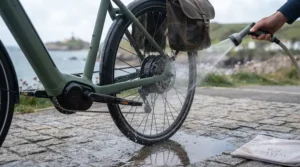
After every ride near the sea: rinse the frame, wheels, and drivetrain with fresh water — not a hosepipe blast into bearings, just a gentle wipe-down or light rinse to dilute and remove salt residue before it dries and crystallises. Salt left to dry is far more corrosive than salt that’s still wet, because drying concentrates it directly against the metal surface.
Weekly: wipe down and lightly lubricate exposed metal — chain (if you have one), brake pivots, quick-release skewers — with a dry, PTFE-based lubricant rather than a wet oil that attracts grit and sand. Check tyre pressure while you’re at it; underinflated tyres flex more and stress rim seams, another entry point for moisture.
Monthly: inspect every visible bolt and fastener for the telltale orange bloom of surface rust, particularly around the bottom bracket, seat clamp, and any point where two dissimilar metals touch — this is where a common mistake in first-30-days ownership shows up, because new owners rarely check fastener corrosion until it’s visually obvious, by which point some pitting has usually already started.
Every three months: apply a marine-grade corrosion inhibitor spray (the kind sold for boat trailers works well) to the frame’s underside, dropouts, and battery contacts. It’s a five-minute job that genuinely extends component life along any seafront route.
✨ Don’t Miss These Exclusive Deals!
🔍 Take your coastal commute to the next level with these carefully selected picks. Click on any highlighted item to check current pricing and availability. These bikes will help you build a genuinely rust-proof daily ride your future self will thank you for!
Who Rides by the Sea? Three Coastal Buyer Profiles
The daily seafront commuter: rides four to five miles each way along an exposed coastal road, five days a week, whatever the weather. Budget matters, but so does reliability — a bike that lets them down on a Tuesday morning is worse than one that costs slightly more. The Eleglide M1 Plus or ADO Air 28 suit this profile well: affordable enough not to sting if stolen or damaged, but built with genuine corrosion-conscious choices that survive daily exposure.
The weekend explorer with limited storage: lives in a flat with no garage, wants to ride promenade paths and coastal trails on Saturdays and Sundays, and needs something that folds into a cupboard rather than living permanently outdoors. The ENGWE EP-2 Pro and Brompton Electric G-Line both fit here — different price points, same underlying logic of removing the bike from salt exposure entirely between rides.
The long-term coastal resident replacing a rusted-out bike: has already lost one bike to salt corrosion and wants something built to last five-plus years without a repeat performance. Frequency of use is high, environment is severe, and budget has shifted from “cheapest option” to “best long-term value.” The Wisper 705SE or TENWAYS CGO600 both make sense here — established build quality and drivetrain choices designed specifically to minimise the vulnerable parts salt can actually reach.
Salt-Induced Corrosion: Common Problems and Practical Fixes
Salt-induced corrosion tends to show up in the same handful of predictable places, which is actually good news — it means you can pre-empt most of it.
Problem: seized chain links. A chain that won’t flex smoothly after a salty week is usually suffering from corrosion between the inner plates, where moisture gets trapped and can’t evaporate. Fix: switch to a belt-drive model like the ADO Air 28 or TENWAYS CGO600, or, if you’re keeping a chain-drive bike, wax-lubricate rather than oil-lubricate, since wax sheds moisture more effectively.
Problem: rusted spokes and rims. Chrome-plated steel spokes are particularly vulnerable; stainless spokes cost more but essentially solve this outright. Fix: when replacing wheels or spokes on any bike in this guide, specify stainless over chrome — it’s a small cost difference for a large durability gain.
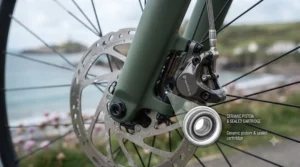
Problem: pitted brake rotors. Salt spray pitting a disc rotor reduces braking consistency over time, particularly noticeable in wet weather when you need it most. Fix: stainless steel rotors (most quality hydraulic setups, including the TENWAYS CGO600 and Wisper 705SE, already use these) resist pitting far better than budget rotor alloys.
Problem: battery contact corrosion. Green or white crust on battery terminals signals oxidation, often from condensation forming inside a battery compartment that isn’t fully sealed. Fix: dielectric grease on contact points, and — where possible — choose a removable battery you can store indoors, as covered under the Eleglide M1 Plus and ENGWE EP-2 Pro entries above.
Problem: frozen or gritty cables. Salt-laden grit works its way into unsealed cable housing, making gear shifts feel notchy or unresponsive. Fix: fully sealed cable housing, or a switch to hydraulic disc brakes and electronic shifting where the budget allows, removes exposed cable runs almost entirely.
How to Choose an Electric Bike for Coastal Salty Air
- Prioritise drivetrain type over headline power figures. A belt drive or fully enclosed chain guard will save you more maintenance hassle over two years than an extra 100W of motor power ever will.
- Check whether the battery is removable. Being able to bring your battery indoors overnight is one of the single biggest corrosion-prevention factors, regardless of how “weatherproof” the bike is marketed as.
- Look for stainless or coated fasteners as standard. Manufacturers rarely advertise this loudly, but it’s worth checking spec sheets or asking retailers directly before buying.
- Weigh up indoor storage realistically. If you genuinely have space to store a bike inside, a folding model like the ENGWE EP-2 Pro or Brompton Electric G-Line sidesteps most corrosion risk outright.
- Favour hydraulic over mechanical disc brakes where budget allows. Sealed hydraulic systems cope better with salt-laden moisture than exposed mechanical cables.
- Factor maintenance time into your buying decision, not just price. A slightly pricier, lower-maintenance bike often works out cheaper over three years than a budget bike needing constant part replacement.
- Ask about UK-specific service and parts networks. Coastal riding wears components faster, so proximity to a dealer who stocks the right stainless or sealed replacement parts genuinely matters.
Saltwater Resistant Electric Bicycle: The Frame and Component Features That Actually Matter
Not every “weatherproof” claim on a bike listing carries equal weight, and it’s worth separating genuine saltwater resistant electric bicycle engineering from marketing dressing.
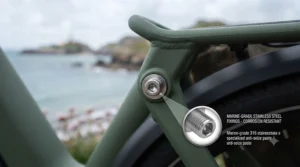
What actually matters: 6061 aluminium frames (used across most bikes in this guide) genuinely resist corrosion better than untreated steel, because aluminium forms a stable oxide layer rather than the flaking rust steel produces. IPX4-rated electrical connectors matter enormously too — splash resistance on battery and display connections is the difference between a bike that survives coastal drizzle and one whose display fails within a season. Belt drives, as covered repeatedly above, remove an entire category of corrosion risk by eliminating exposed chain links.
What doesn’t matter as much as marketing suggests: a glossy paint finish alone isn’t corrosion protection — it’s cosmetic, and once scratched (which happens fast on gritty seafront paths), bare metal underneath is just as vulnerable as an unpainted frame. Similarly, a high-wattage motor has no bearing whatsoever on corrosion resistance; it’s purely a power spec, and buyers sometimes conflate “premium-feeling” power with “durable,” which are entirely unrelated qualities.
Galvanic corrosion deserves a specific mention here, because it catches out even careful buyers. When two dissimilar metals — say, a stainless bolt threaded into an aluminium frame — sit in contact within a salty, humid environment, an electrochemical process occurs in which one metal corrodes when it is in electrical contact with another, different metal, in the presence of an electrolyte, and salt-laden coastal air is exactly that kind of electrolyte-rich environment. You can read more on the mechanism via Wikipedia’s overview of galvanic corrosion. Practically, this means mismatched fastener and frame materials can actually accelerate corrosion rather than prevent it — which is precisely why the next section matters so much.
Stainless Fastener Upgrades: The £30 Fix That Adds Years to Your Bike
If there’s one piece of practical value in this entire guide worth acting on today, it’s this: stainless fastener upgrades are the cheapest, highest-return maintenance move available to any coastal e-bike owner, regardless of which of the seven bikes above you choose.
Most mid-range and budget e-bikes ship with zinc-plated or basic steel bolts on non-critical fittings — mudguard stays, rack mounts, bottle cage bosses, kickstand hardware. These aren’t structural failure points, but they’re usually the first visible sign of corrosion, and once rust starts weeping down a frame from a corroded bolt head, it looks — and often is — worse than it actually is.
Swapping these for A2 or A4-grade stainless steel equivalents typically costs somewhere between £15 and £40 for a full set, depending on how many fittings your bike has, and takes under an hour with a basic Allen key set. The cost-per-use logic here is compelling: spread across three to five years of ownership, you’re looking at pennies per month for a noticeably tidier, longer-lasting bike.
One caveat worth flagging, given the galvanic corrosion point above: don’t simply bolt stainless fasteners directly into bare aluminium without a barrier. A dab of anti-seize compound or a nylon washer between dissimilar metals prevents the very galvanic reaction that stainless upgrades are meant to avoid — small detail, but it’s the difference between a fix that lasts and one that quietly creates a new problem.
Long-term cost comparison: a bike neglecting fastener upgrades typically needs full hardware replacement (rack, mudguard stays, kickstand) within two to three coastal seasons, at a cost often exceeding the original stainless upgrade several times over. Total cost of ownership genuinely favours doing this early rather than reactively.
Seafront Commute eBike Durability: What Daily Coastal Riding Really Does to a Bike
Spec sheets tell you what a bike should do; daily seafront commute ebike durability tells you what actually happens once salt spray, sand, and repeated wet-dry cycling get involved over months rather than a single test ride.
The first thing most riders notice isn’t corrosion at all — it’s grit. Sandy, salt-crusted seafront paths work abrasive particles into brake pads, bearings, and drivetrain components far faster than a typical inland commute would. This accelerates mechanical wear even before corrosion becomes visible, which is why bikes with sealed bottom brackets and hub bearings (most of the mid-range and premium options above) noticeably outlast budget bikes with basic cup-and-cone bearings in this specific environment.
Second, temperature and humidity swings matter more than most buyers expect. A bike parked overnight near the coast experiences repeated condensation cycles as damp sea air cools against metal surfaces — this is often a bigger driver of corrosion than actual rain exposure, because it happens constantly, every single night, regardless of forecast.
Third, and this is the pleasant surprise: bikes engineered with genuine coastal durability in mind — belt drives, sealed connectors, removable batteries — show remarkably little functional degradation even after sustained exposure. Reviewers testing premium models over several months of British weather have reported minimal corrosion on exposed metal and consistent battery performance within a few percentage points of original capacity, a genuinely reassuring real-world result that validates the engineering choices covered throughout this guide.
What to expect realistically: budget bikes without corrosion-specific engineering will likely need brake pad, cable, and bearing attention within six to twelve months of regular coastal use. Bikes purpose-built for this environment can reasonably be expected to go two to three times longer between significant maintenance interventions.
Coastal E-Bikes vs Standard Commuter Bikes: Is the Extra Spend Worth It?
It’s a fair question: why pay a premium for a “coastal” e-bike rather than just buying a standard commuter and dealing with corrosion as it comes up?
| Factor | Standard Commuter E-Bike | Coastal-Optimised E-Bike | Best For |
|---|---|---|---|
| Drivetrain | Exposed chain, regular lubrication needed | Belt drive or sealed chain guard | TENWAYS CGO600, ADO Air 28 |
| Battery | Often fixed, less sealed | Removable or fully enclosed | Eleglide M1 Plus, TENWAYS CGO600 |
| Fasteners | Standard zinc-plated steel | Stainless or upgradeable | All seven bikes, post-upgrade |
| Replacement frequency | Brake/cable service every 6–12 months | Extended to 12–24+ months | Wisper 705SE, Brompton Electric G-Line |
Interpreting that comparison: the meaningful gap isn’t the sticker price, it’s the ongoing cost of ownership. A standard commuter bike bought cheap and ridden daily along a seafront will likely need cable, chain, and brake replacement noticeably more often than a purpose-considered coastal option, and those repeated small costs — plus the time spent — usually outweigh the upfront premium within two to three years. For occasional coastal riders, a standard bike paired with a diligent coastal maintenance routine can still work perfectly well; it’s daily, sustained exposure where the gap really opens up.
Safety, Regulations and Compliance for UK Coastal E-Bike Riders
Every electric bike featured in this guide is designed to comply with UK Electrically Assisted Pedal Cycle (EAPC) rules, which matter regardless of where you’re riding, coastal or otherwise. Under current regulations, guidance covers the law on using electrically assisted pedal cycles on public roads, and manufacturers, importers, and retailers are expected to follow the rules and standards set out for EAPCs. You can find the full official guidance directly via gov.uk’s EAPC regulations page.
In practical terms, this means a compliant e-bike must have pedals capable of propelling it unassisted, a motor rated no higher than 250W continuous output, and assistance that cuts off once you reach 15.5mph — beyond which you’re pedalling under your own steam, same as any pedal cycle. None of the seven bikes above need registration, tax, or motor insurance as a result, though third-party insurance covering theft, damage, and personal liability is well worth considering, particularly for higher-value models like the Wisper 705SE or Brompton Electric G-Line, given how attractive a seafront-parked e-bike can look to opportunist thieves.
Coastal-specific safety considerations worth flagging: salt-affected brake performance (covered earlier under stainless rotor upgrades), reduced visibility in coastal fog or sea mist — a decent set of lights is non-negotiable even on well-lit prom paths — and secure locking, since coastal towns often see seasonal spikes in bike theft during summer months when footfall is highest.
FAQ
❓ Do e-bikes rust faster near the sea?
❓ What is the best material for a coastal electric bike frame?
❓ Can I ride an electric bike on the beach?
❓ How often should I clean my e-bike if I live by the sea?
❓ Is a belt drive better than a chain for salty conditions?
Conclusion
Salt air isn’t subtle, and pretending a standard commuter bike will simply cope near the coast is how most people end up replacing brake cables twice a year. What actually works is choosing components purpose-suited to the environment — belt drives over chains, removable batteries over fixed ones, stainless fasteners over standard zinc-plated hardware — and then backing that up with a genuinely simple coastal maintenance routine rather than hoping for the best.
Across the seven bikes covered here, there’s a genuine spread: the Carpat GB1 and Eleglide M1 Plus prove smart material choices don’t require a big budget, the ADO Air 28 and TENWAYS CGO600 show what happens when belt drives and sealed batteries are treated as priorities rather than afterthoughts, the ENGWE EP-2 Pro and Brompton Electric G-Line demonstrate that sometimes the smartest corrosion strategy is simply storing the bike indoors, and the Wisper 705SE rounds things out with the kind of long-term UK-specific refinement that only comes from years on British roads.
Whichever you choose, the small habits — rinsing after rides, checking fasteners monthly, upgrading cheap bolts to stainless — will do more for long-term durability than any single spec on a listing page. Salt air will always be part of the deal if you live by the coast; it just doesn’t have to win.
Recommended for You
- Electric Bike Anti-Rust Frame Coating: 7 Top UK Picks (2026)
- Electric Bike Puncture-Resistant Tyres: 7 Best Picks (2026)
- Electric Bike Comfort Accessory Bundle: 7 Top Upgrades (2026)
Disclaimer: This article contains affiliate links. As an Amazon Associate, I earn from qualifying purchases. If you purchase products through these links, we may earn a small commission at no additional cost to you.
✨ Found this helpful? Share it with your friends! 💬🤗
