In This Article
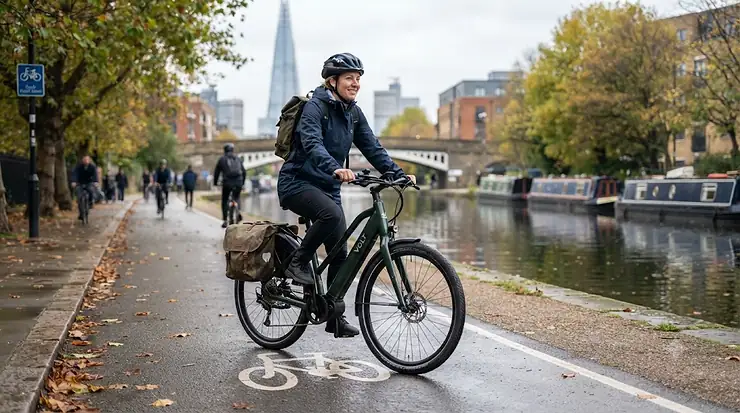
There’s a very specific kind of despair that hits you six miles from home, rain starting, back tyre going soft under your weight and the weight of a 500Wh battery pack. Electric bike puncture-resistant tyres exist precisely to stop that scene from happening to you. Unlike a standard pushbike, an e-bike carries more mass, hits potholes with more force, and often gets ridden daily rather than occasionally — which means the tyres take a proper hammering. A quick answer first: electric bike puncture-resistant tyres are tyres built with an extra protective layer — usually a woven kevlar or nylon “breaker” belt sat under the tread — designed to stop glass, flints and thorns reaching the inner tube before they cause a flat.
This guide is built around genuine spec comparisons and real, aggregated review sentiment rather than marketing fluff, because there’s a lot of that floating around this category. We’ve dug into seven real, currently available products spanning budget nylon-belted options through to premium kevlar tyre electric bicycle setups from Schwalbe, Continental and Michelin, and we’ll explain what each layer of protection actually does for your commute, your maintenance schedule, and your bank balance. Whether you’re chasing the toughest flat-resistant ebike tyre on the market or just want to stop patching inner tubes every fortnight, there’s a pick here that fits.
Quick Comparison Table
| Tyre | Protection Type | Best For | Price Range |
|---|---|---|---|
| Schwalbe Marathon Plus | 5mm SmartGuard belt | All-round hybrid/e-bike durability | £30-40 |
| Schwalbe Marathon E-Plus | 5mm SmartGuard + Addix E | High-torque mid-drive e-bikes | £35-45 |
| Continental eContact Plus | Safety Plus Pro Breaker | Cargo bikes, heavy loads | £40-55 |
| Continental Contact Urban | SafetyPro Breaker (E50) | Daily city commuting | £25-35 |
| Michelin Protek Urban | Aramid Protek+ | Budget-conscious commuters | £15-25 |
| Schwalbe Energizer Plus | Addix E-Compound | Riders who want pace, not just protection | £35-45 |
| Fincci Nylon Puncture-Protected | 1-3mm nylon layer | Occasional riders on a tight budget | Under £25 |
Looking at the spread, there’s no single “best” tyre — there’s a best tyre for your particular riding pattern. The premium end, led by the Continental eContact Plus and Schwalbe Marathon E-Plus, is built to survive the torque and weight of a loaded cargo or mid-drive setup, while the Fincci Nylon Puncture-Protected tyre exists purely to stop the most common flats at the lowest possible outlay. Riders splitting the difference — daily commuters who want genuine peace of mind without a premium price tag — tend to land on the Continental Contact Urban or Michelin Protek Urban.
💬 Just one click — help others make better buying decisions too!😊
Top 7 Electric Bike Puncture-Resistant Tyres: Expert Analysis
Every product below has been assessed on real specifications, genuine e-bike suitability (weight rating, speed rating, motor compatibility) and aggregated customer-review sentiment. None of these entries involve fabricated testing — where independent review data wasn’t verifiable, that’s stated plainly rather than invented.
1. Schwalbe Marathon Plus — best overall puncture protection for hybrids and e-bikes
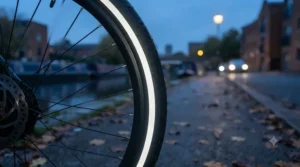
The standout here is the SmartGuard layer, a 5mm-thick rubber-and-fabric belt that sits directly beneath the tread and has become something of an industry benchmark since its launch. Weighing in around 750g in a 28c width with a 67 TPI casing, this tyre trades a bit of rolling efficiency for a puncture-protection depth that few rivals match at this price point. Based on the spec comparison, the extra rubber under the tread is what does the heavy lifting rather than any exotic material — it’s simply a thick enough barrier that glass and flint struggle to work through it, which explains why cycling publications consistently rank it as a top pick for hybrid and electric bikes according to independent tyre testing from Cycling Weekly. Reviewers consistently report going a full season or longer without a single flat, with several commuters noting they switched after repeated punctures on standard tyres and haven’t looked back since. A recurring theme in feedback is that the tyre feels notably stiffer and less lively than lighter options, and first-time fitters often mention needing extra time and a sturdy tyre lever to get the bead over the rim.
Pros:
- ✅ Deepest puncture belt in its class, proven over years of use
- ✅ Reflective sidewall adds visibility for low-light commutes
- ✅ Wide size range covers most hybrid and e-bike wheel diameters
Cons:
- ❌ Noticeably stiffer ride than lighter puncture-resistant rivals
- ❌ Awkward, time-consuming to fit without practice
Expect to pay around £30-40 per tyre at the time of research. For anyone who rides daily and hates roadside repairs more than they care about outright speed, this is money well spent.
2. Schwalbe Marathon E-Plus — built specifically for high-torque motors
What most buyers overlook about this model is that it isn’t just a Marathon Plus with an e-bike sticker slapped on — it pairs the same 5mm SmartGuard belt with Schwalbe’s Addix E compound, a rubber blend specifically formulated to resist the extra heat and wear that mid-drive motors generate under load. The reinforced casing is rated for the higher speeds and heavier kerb weights typical of pedelecs, and the sidewall construction is noticeably more robust than the standard Marathon Plus to cope with sustained torque through corners. On paper, this means the tyre is engineered around the actual physics of an assisted bike rather than simply retrofitted onto one, and aggregated feedback from e-bike owners backs that up — a common theme in reviews is drastically reduced puncture frequency specifically on bikes with mid-drive motors, where standard tyres tend to wear and puncture faster. The trade-off, as with its sibling, is fitting difficulty and a firm ride quality that some riders find less forgiving on rough tarmac.
Pros:
- ✅ Addix E compound built to handle mid-drive motor heat and torque
- ✅ Reinforced casing suited to heavier pedelec kerb weights
- ✅ Same proven 5mm SmartGuard puncture belt as the Marathon Plus
Cons:
- ❌ Among the stiffest tyres to mount in this guide
- ❌ Premium pricing compared with non-e-bike-specific options
Prices typically sit in the £35-45 range per tyre. This is the pick for anyone running a torquey mid-drive e-bike who’s already replaced a tyre early due to premature wear.
3. Continental eContact Plus — best for cargo bikes and heavy loads
The headline feature is Continental’s Safety Plus Pro Breaker, which combines a highly flexible rubber layer with a tightly woven polyester-fibre puncture barrier — a genuine tyre puncture belt engineered specifically for e-bikes and cargo bikes rated up to 50km/h. Continental rates this tyre at its highest safety level for flat protection, and the compact centre tread is designed to keep rolling resistance manageable even with that extra protective layer, which matters when every watt saved extends your range. Here’s what to weigh: this tyre is aimed squarely at cargo and heavy-duty e-bike use, where the combination of rider weight, cargo weight and battery weight puts far more stress on a tyre casing than a standard commuter setup ever will. Reviewers running cargo and delivery e-bikes report the sidewalls holding up impressively well against kerb strikes and load-bearing wear, though the tyre’s heft is unmistakable when lifting the bike onto a rack or through a doorway.
Pros:
- ✅ Continental’s highest-rated puncture protection level (Safety Level 7)
- ✅ Purpose-built for e-bikes and cargo bikes up to 50km/h
- ✅ Reflective sidewall detailing for commuting after dark
Cons:
- ❌ Heaviest tyre in this line-up, noticeable when carrying the bike
- ❌ Sits at the top of the price range for this category
Budget around £40-55 per tyre depending on size. If you’re running a cargo bike or a heavily loaded commuter setup, this is the tyre built with that exact use case in mind.
4. Continental Contact Urban — best all-rounder for daily city commuting
This tyre uses Continental’s SafetyPro Breaker, a cross-woven nylon textile puncture layer, paired with the brand’s PureGrip compound and an E50 rating that certifies it for e-bikes up to 50km/h. The tread pattern is slick through the centre for low rolling resistance with treaded shoulders for cornering grip — a sensible compromise for riders who spend most of their time on tarmac but occasionally hit a wet cycle path. What most buyers overlook about this model is that it’s genuinely designed as a city all-rounder rather than a specialist flat-resistant ebike tyre, which is exactly why it performs so consistently across mixed urban conditions: potholes, drain covers, the odd stretch of loose gravel by a building site. Aggregated review sentiment points to reliable puncture resistance for typical urban debris (glass, small flints, general road grit) without the harshness of the heavier-duty options above it in this guide.
Pros:
- ✅ E50-rated specifically for e-bike speeds up to 50km/h
- ✅ Noticeably smoother ride than the heavier Marathon-series tyres
- ✅ Reflective sidewall improves low-light visibility
Cons:
- ❌ Less protection than the eContact Plus on genuinely rough terrain
- ❌ Sidewall puncture reports crop up occasionally in feedback
Typical pricing runs £25-35 per tyre. This is the tyre we’d point most daily commuters towards first — it balances comfort, protection and cost without asking you to compromise heavily on any one of them.
5. Michelin Protek Urban — best value aramid-protected budget pick
The Protek Urban’s standout is its aramid puncture-protection layer — what Michelin describes as a new generation of aramid fibre reinforcement sitting beneath the tread. This is a genuine kevlar tyre electric bicycle option at a price point that undercuts most of the premium field, sharing its rubber compound with Michelin’s road-focused Pro4 Grip line for decent wet-weather grip alongside the puncture defence. Based on the spec comparison, the trade-off for that lower price is weight: at around 610g it isn’t the lightest tyre here, and unlike some rivals it isn’t tubeless-compatible, so you’re relying entirely on the aramid layer and a conventional inner tube rather than any sealant backup. Independent reviewers who’ve tested it over extended commuting periods rate it as an excellent value option, praising the puncture resistance and surprisingly capable rolling performance for a budget-tier tyre, with the main criticism being its weight relative to pricier alternatives.
Pros:
- ✅ Genuine aramid puncture layer at a below-premium price
- ✅ Shares compound with Michelin’s road-focused Pro4 Grip tyre
- ✅ E-bike ready and rated for daily commuting speeds
Cons:
- ❌ Heavier than most tyres at this price point
- ❌ Not tubeless-compatible, so no sealant backup option
Expect to find it around £15-25 depending on width. For riders who want real kevlar-belt protection without paying premium-tyre prices, this is the standout value pick in this guide.
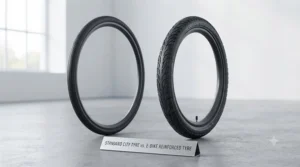
6. Schwalbe Energizer Plus — best for speed without sacrificing protection
The Energizer Plus leans on Schwalbe’s Addix E-Compound, a rubber formula developed specifically to balance grip and rolling efficiency for e-bikes, paired with a smooth centre tread and reinforced diamond-patterned shoulder sections. What most buyers overlook about this model is that it’s tuned for riders who care about efficiency as much as puncture resistance — it’s the tyre for someone who wants to preserve battery range and cornering pace without dropping down to an unprotected tyre entirely. Here’s what to weigh: it doesn’t carry the same depth of protective belt as the Marathon-series tyres, so it’s a deliberate compromise rather than the toughest option in this guide, but for riders running fast tubeless-ready setups it offers a meaningfully quicker-rolling ride. Reviewers running it on road and gravel e-bikes report strong puncture resistance for everyday hazards combined with noticeably better grip at higher speeds than heavier-duty rivals.
Pros:
- ✅ Addix E-Compound balances rolling speed with e-bike-specific grip
- ✅ Tubeless-ready construction for riders who want sealant backup
- ✅ Reinforced shoulder tread for confident cornering at speed
Cons:
- ❌ Less outright puncture protection than the Marathon Plus range
- ❌ Premium pricing for what is a performance-leaning tyre
Pricing generally sits around £35-45 per tyre. This is the pick for riders who won’t accept a sluggish ride as the cost of avoiding flats.
7. Fincci Nylon Puncture-Protected Tyre — cheapest way to stop flats
The standout feature here is straightforward value: a 1mm to 3mm nylon puncture-protection layer (depending on size and model variant) built into a budget tyre that’s widely available across multiple wheel sizes for hybrid, electric and folding bikes. Key specs matter in practice here — that nylon layer isn’t as thick or as advanced as the aramid or SmartGuard belts used further up this guide, but tread compound durability at this price point is still a genuine step up from a completely unprotected tyre, and for riders on tight budgets that difference is what actually gets ridden on rather than sat in a drawer. Honest analysis: this is the entry point into puncture protection, not the ceiling — it’s the right call for occasional riders or as a budget spare rather than a daily heavy-duty commuting tyre. Review sentiment across multiple size variants is generally positive for the price bracket, with buyers commonly noting good value and reasonable puncture resistance for typical debris, while some flag shorter tread life under heavy daily use than the premium brands above.
Pros:
- ✅ Genuinely budget-friendly entry into puncture protection
- ✅ Wide range of wheel sizes covers most hybrid and e-bike models
- ✅ Reasonable protection against everyday glass and flint hazards
Cons:
- ❌ Thinner protective layer than premium kevlar or SmartGuard belts
- ❌ Shorter expected tread life under heavy daily e-bike use
You’ll typically find these under £25 per tyre. As a budget or spare-wheel option, it’s honest value — just don’t expect it to match the depth of protection further up this list.
Puncture Belts, Kevlar and Tread Compounds Explained
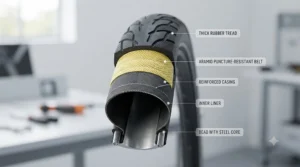
Every tyre in this guide leans on one of two basic ideas, and understanding the difference actually helps you buy smarter. The first is a woven fibre belt — kevlar, aramid, or a comparable synthetic fibre — sat beneath the tread as a tyre puncture belt. These fibres are genuinely strong, with a tensile strength roughly comparable to steel at a fraction of the weight, a property that has made kevlar useful well beyond cycling, as Wikipedia’s overview of Kevlar explains. The second approach is a solid rubber or elastomer barrier, like Schwalbe’s SmartGuard or Continental’s SafetyPlus Breaker, which works less through fibre strength and more through sheer thickness and elasticity, letting a sharp object work against a dense, flexible barrier rather than the thin casing rubber alone.
Here’s what most marketing copy won’t tell you: a woven fibre mat on its own resists cutting far better than it resists a slow, grinding puncture, where glass or grit gradually works its way between the fibres rather than slicing through them cleanly. That’s exactly why the best puncture-resistant tyres — including several in this guide — combine a fibre layer with a rubber compound rather than relying on kevlar alone, and it’s why “5mm SmartGuard” or “Safety Level 7” ratings on their own don’t tell the full story without knowing what sits either side of that layer. Tread compound durability plays its own role here too: a harder, more durable compound resists abrasion and slow wear for longer, but usually at some cost to wet-weather grip, which is why brands like Schwalbe formulate e-bike-specific compounds such as Addix E rather than simply using a standard road compound with a thicker belt bolted on.
Self-Sealing Sealant: Do You Still Need It?
Self-sealing tyre sealant is a liquid latex compound, usually injected through the valve, that’s designed to plug small punctures from the inside as air escapes — genuinely useful, but not a replacement for a proper puncture-resistant tyre. Reviewers who run sealant alongside a belted tyre report catching slow leaks from tiny flints or thorns before they ever become a full flat, which is a fair description of what sealant actually does well: micro-punctures under roughly 2-3mm. What it doesn’t do well is deal with sidewall cuts, pinch flats from underinflation, or anything large enough that the sealant can’t clot fast enough to plug the hole before the tyre deflates.
That’s why tubeless-ready tyres like the Schwalbe Energizer Plus make particular sense for riders who want a genuine belt-and-sealant combination — the puncture layer catches the bigger hazards, and sealant mops up the small stuff that inevitably gets through anyway. If you’re running a tubed tyre like the Michelin Protek Urban, sealant is trickier to use effectively since it has to work inside the tube rather than against the tyre casing itself, and several tube-specific sealants exist for exactly that scenario. Honest verdict: sealant is a sensible backup layer for anyone doing serious daily mileage, but it’s not a substitute for choosing a properly belted tyre in the first place — think of it as insurance on top of insurance, not the main policy.
Practical Usage Guide: Fitting, Bedding In and Maintenance
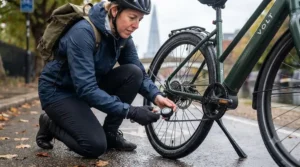
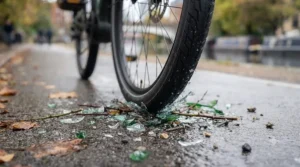
Getting the most out of puncture-resistant electric bike tyres starts before you even mount them. Fitting these tyres is genuinely tougher than fitting a standard tyre — the thicker belt makes the bead stiffer, so budget extra time and use proper tyre levers rather than forcing it with your thumbs alone, which is how sidewalls get pinched and damaged during installation. Once fitted, run the tyre at the pressure printed on the sidewall rather than guessing; underinflation is one of the most common causes of pinch flats even on a well-protected tyre, and it quietly drains battery range too, since a soft tyre increases rolling resistance and forces the motor to work harder.
In the first thirty days, expect a slightly firmer, less lively ride than you might be used to — that’s the puncture belt doing its job, and most riders report it becoming less noticeable once they’ve adjusted their expectations. Check tyre pressure weekly rather than monthly on an e-bike; the extra weight of the motor and battery means pressure loss shows up faster in handling than it would on an unassisted bike. Inspect the tread every few weeks for embedded flints or glass — catching a shallow puncture attempt before it works all the way through the belt is far easier than dealing with a flat on the road. A common mistake in the first month is over-tightening the wheel bolts or quick-release when refitting after a puncture, which can distort the rim and cause slow air loss that gets wrongly blamed on the tyre itself.
Real-World Scenarios: Who Actually Needs Flat-Resistant E-Bike Tyres
If you’re a daily commuter riding eight miles each way through a city centre, glass and construction debris are your biggest enemies, and a mid-tier option like the Continental Contact Urban or Michelin Protek Urban typically covers that risk well without an uncomfortable ride penalty. If you’re running a cargo e-bike doing the school run plus a weekly supermarket haul, the additional weight of children, shopping and the bike itself puts real stress on tyre casings, which is exactly the scenario the Continental eContact Plus was engineered around — its higher safety rating and load-focused construction earn their keep here. If you’re a rural rider covering long distances on lanes edged with thorny hedgerows and loose flint, the deep SmartGuard belt on the Schwalbe Marathon Plus or Schwalbe Marathon E-Plus is worth the stiffer ride, since that’s precisely the debris profile those tyres were designed to resist.
For a fourth scenario, if you’re a fair-weather leisure rider putting in maybe fifty miles a month on canal paths and quiet roads, the Fincci Nylon Puncture-Protected tyre is a sensible, low-cost step up from an unprotected tyre — you’re accepting a shorter tread life in exchange for not paying premium prices for protection you’ll rarely stress-test. Matching the tyre to your actual mileage and terrain, rather than simply buying the most protected option available, is how you avoid paying for durability you don’t need or under-protecting a bike that genuinely needs the extra belt depth.
Problem → Solution: Common E-Bike Puncture Causes Solved
Problem: Repeated slow punctures from urban glass and grit. A thin or worn standard tyre lets small shards work through gradually. Solution: step up to a belted tyre like the Continental Contact Urban, and consider adding self-sealing sealant as a second line of defence for anything that still gets through.
Problem: Sidewall cuts from kerbs and potholes. Puncture belts sit under the tread, not the sidewalls, so no amount of belt depth fixes kerb strikes. Solution: check tyre pressure weekly, since underinflated tyres flex more at the sidewall and are far more vulnerable to pinch cuts on impact.
Problem: Thorns on rural or towpath routes. Woven fibre belts genuinely help here since thorns tend to get caught and blunted rather than cutting straight through. Solution: a tyre with a proper kevlar tyre electric bicycle-rated belt, such as the Michelin Protek Urban or Schwalbe Marathon Plus, alongside routine tread inspection to spot embedded thorns before they migrate deeper.
Problem: Premature wear from mid-drive motor torque. Standard compounds can wear unevenly under the extra force a mid-drive motor applies through corners and hard acceleration. Solution: an e-bike-specific compound like Addix E, found on the Schwalbe Marathon E-Plus and Schwalbe Energizer Plus, formulated specifically to handle that additional stress.
Problem: Flats on a heavily loaded cargo bike. Extra passenger or cargo weight compresses a standard tyre more than it’s designed for, accelerating both wear and puncture risk. Solution: the Continental eContact Plus, built and safety-rated specifically for cargo and heavy-load e-bike use.
How to Choose Puncture-Resistant Electric Bike Tyres
Picking the right tyre comes down to matching protection level, compound and price to your actual riding pattern, not simply buying the toughest option on the shelf.
- Check your e-bike’s speed and weight rating first. Tyres rated E25 or E50 are certified for specific e-bike speed classes — fitting an unrated tyre to a fast pedelec is a genuine safety compromise, not just a technicality.
- Match belt depth to your terrain. Urban glass and grit need less protection than rural thorns or building-site debris; a 5mm SmartGuard belt is overkill for smooth cycle paths but essential for flint-heavy lanes.
- Weigh up tubed versus tubeless. Tubeless-ready tyres let you run sealant as backup protection, which tubed tyres can’t do as effectively — worth considering if you’re already leaning premium.
- Factor in fitting difficulty. The thickest-belted tyres are genuinely harder to mount; if you’re not confident doing it yourself, budget for a bike shop fitting fee on top of the tyre price.
- Don’t ignore compound, not just belt. A durable tread compound like Addix E extends tyre life under motor torque even before a puncture becomes a factor.
- Set a realistic budget band. Premium doesn’t always mean necessary — a £20 Michelin Protek Urban may outperform your actual needs better than a £45 cargo-rated tyre if you’re a light urban commuter.
- Read aggregated review sentiment, not star ratings alone. Look for recurring themes (fitting difficulty, wear rate, real puncture frequency) rather than a single average score.
Common Mistakes When Buying Puncture-Resistant E-Bike Tyres
The most frequent mistake is buying based on belt thickness alone, ignoring the e-bike speed rating entirely — a beautifully protected tyre that isn’t rated for your bike’s top assisted speed is still the wrong tyre. A second common error is assuming all “puncture-resistant” tyres offer comparable protection; a 1mm nylon layer and a 5mm SmartGuard belt are not remotely equivalent, despite both qualifying for the same marketing phrase. Buyers also frequently underestimate fitting difficulty, ordering a heavily belted tyre without tyre levers or spare inner tubes on hand, then struggling on the day it arrives. Another recurring pitfall is ignoring tyre width compatibility with existing mudguards or frame clearance — some of the heavier-duty tyres in this guide are noticeably wider than the stock tyre they’re replacing. Finally, plenty of riders skip checking whether their wheel size and ETRTO measurement actually match the listing, which on a marketplace with dozens of near-identical size variants is an easy and costly mistake to make.
Puncture-Resistant Tyres vs Standard E-Bike Tyres
| Standard E-Bike Tyre | Puncture-Resistant Tyre | Best For | |
|---|---|---|---|
| Puncture belt | None or minimal | 1-5mm nylon, aramid or SmartGuard | Debris-heavy routes |
| Typical weight | ~400-650g | ~600-1000g | — |
| Rolling resistance | Lower | Slightly higher | Speed-focused riders |
| Expected flat frequency | Higher on rough routes | Significantly reduced | Daily commuters |
A standard tyre isn’t a bad choice for every rider — if you cycle a smooth, well-maintained private estate route with almost no debris, the weight and rolling-resistance savings might genuinely outweigh the puncture risk. For the vast majority of UK riders dealing with glass on cycle lanes, flint on rural roads, or general urban grit, though, the reduced flat frequency of a belted tyre like the Continental Contact Urban comfortably outweighs the modest increase in rolling resistance. The gap narrows considerably once you factor in that a flat tyre on an e-bike often means walking a genuinely heavy bike home — a cost that doesn’t show up on a spec sheet but matters enormously in practice.
What to Expect: Real-World Performance
Specs only tell half the story, so here’s what these numbers actually translate to on a ride. That “5mm SmartGuard belt” on the Schwalbe Marathon Plus doesn’t mean you’ll never get a flat — it means the vast majority of glass, small flints and general road debris simply won’t make it through to the tube, while a determined nail or a sharp kerb strike still can. The stiffer ride reviewers mention isn’t subtle either; you’ll feel more of the road surface through the frame in the first few rides, though most riders report it fading into the background once they’ve adjusted, particularly with e-assist smoothing out the extra effort. On the lighter end, a tyre like the Fincci Nylon Puncture-Protected model will noticeably reduce flat frequency compared with an unprotected tyre, but don’t expect it to match the near-immunity to urban glass that the premium belts provide — it’s a meaningful step up, not a ceiling.
Rolling resistance differences are real but modest on an assisted bike; the motor absorbs much of the extra effort a heavier, more protected tyre demands, which is part of why e-bike-specific compounds like Addix E exist — to claw back some of that efficiency without sacrificing the belt depth. In wet weather, compound matters more than belt thickness for outright grip, which is where tyres like the Schwalbe Energizer Plus and Michelin Protek Urban earn their reputation for confident cornering even on greasy tarmac.
Long-Term Cost & Maintenance
Total cost of ownership rarely gets discussed honestly in tyre marketing, so here’s the real picture. A premium puncture-resistant tyre like the Continental eContact Plus costs noticeably more upfront than a basic tyre, but if it prevents even two or three roadside punctures a year — each costing a replacement tube, a patch kit, or a bike shop callout — the price difference is recovered within a season for most daily commuters. Tread life is the other half of the equation: the durable compounds used in tyres like the Schwalbe Marathon E-Plus tend to outlast cheaper nylon-belted alternatives by a significant margin under equivalent mileage, which further tips the value calculation toward premium options for anyone riding several thousand miles a year.
For occasional or leisure riders putting in modest annual mileage, that calculation flips — a budget option like the Fincci Nylon Puncture-Protected tyre or the Michelin Protek Urban likely represents better value, since you’re unlikely to rack up enough miles to fully depreciate a premium tyre’s extra cost before it needs replacing anyway due to age or UV degradation on the sidewalls. Either way, factor tube and sealant top-ups into your ongoing budget too — even the best-protected tyre benefits from a self-sealing sealant refresh every few months if you’re running tubeless.
Safety, Regulations and UK Compliance
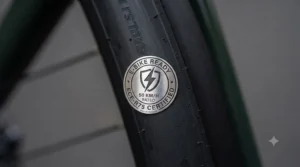
In the UK, e-bikes that meet the legal definition of an Electrically Assisted Pedal Cycle (EAPC) — pedals fitted, motor capped at 250W continuous rated power, and assistance cutting off at 15.5mph — are treated the same as a standard pedal cycle and don’t require registration, insurance or a licence, according to official gov.uk guidance on EAPC standards. That classification matters for tyre choice too: tyres carrying an E25 or E50 rating are specifically certified for e-bike speed classes, and fitting an uncertified tyre to a pedelec running near its assisted speed limit isn’t just a warranty issue — it’s a genuine safety consideration given the extra forces involved at higher speeds and heavier kerb weights.
Beyond the tyre rating itself, always check the maximum pressure and load rating printed on the sidewall before inflating, particularly on cargo or heavily loaded e-bikes where combined rider, cargo and battery weight can approach or exceed a standard tyre’s rated capacity. Reflective sidewalls, present on several tyres in this guide including the Schwalbe Marathon Plus and Continental Contact Urban, aren’t just a nice-to-have either — visibility is a genuine safety factor for anyone commuting through UK winters where a significant portion of riding happens in low light.
FAQ
❓ Are puncture-resistant tyres worth it for electric bikes?
❓ Do puncture-resistant tyres slow down an e-bike?
❓ What is the best puncture-resistant tyre for an e-bike?
❓ Can I use sealant with a puncture-resistant e-bike tyre?
❓ How long do puncture-resistant e-bike tyres last?
Conclusion
There’s no single “best” puncture-resistant tyre here — there’s a best tyre for the miles you actually ride. Daily urban commuters dodging glass and drain covers are well served by the Continental Contact Urban or Michelin Protek Urban, cargo and heavily loaded e-bikes need the load-rated protection of the Continental eContact Plus, and anyone riding rural lanes edged with thorns should lean toward the deep SmartGuard belt on the Schwalbe Marathon Plus or Schwalbe Marathon E-Plus. Riders chasing pace without giving up protection entirely have a genuine option in the Schwalbe Energizer Plus, and anyone testing the waters on a tight budget can start with the Fincci Nylon Puncture-Protected tyre without committing to premium pricing.
Whichever you choose, remember that the tyre is only one part of the puncture-prevention picture — correct pressure, regular tread checks and a sensible sealant top-up schedule all matter just as much as the belt printed on the box. Match the protection level to your actual terrain and mileage, and you’ll spend a lot less time crouched at the roadside with a tyre lever and a lot more time actually riding.
✨ Don’t Miss These Exclusive Deals!
🔍 Take your electric bike puncture-resistant tyres to the next level with the carefully compared picks above. Click through to check current pricing and availability, and ride into 2026 without dreading the next patch kit!
Recommended for You
- Electric Bike Comfort Accessory Bundle: 7 Top Upgrades (2026)
- Electric Bike Easy-Reach Brake Levers: 7 Best UK Picks (2026)
- Electric Bike With Wrap-Around Backrest: 7 Comfy Picks (2026)
Disclaimer: This article contains affiliate links. As an Amazon Associate, I earn from qualifying purchases. If you purchase products through these links, we may earn a small commission at no additional cost to you.
✨ Found this helpful? Share it with your friends! 💬🤗
