In This Article
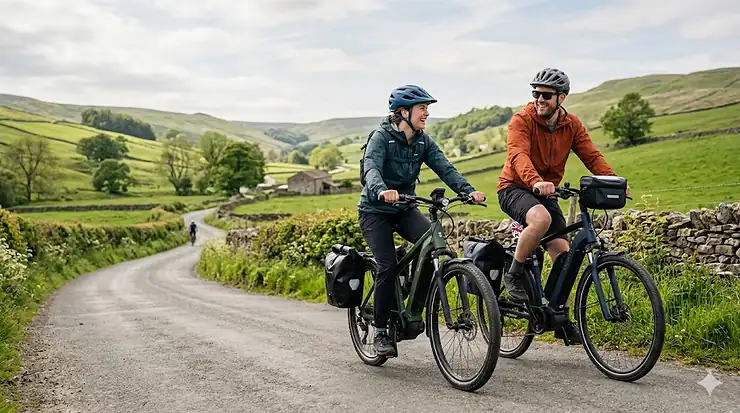
There’s a particular kind of freedom that comes from leaving on a Friday evening with panniers packed, a full battery humming quietly beneath you, and absolutely no idea how far you’re going to get. That’s the promise of a proper weekend touring range ebike — not just a commuter with ambitions, but a genuinely capable machine built for 60, 80, even 100+ kilometres of continuous British adventure.
And in 2026, that promise has become surprisingly affordable.
A weekend touring range ebike is, in plain terms, an electrically assisted pedal cycle with sufficient battery capacity (typically 500Wh+), a comfortable touring geometry, and the structural robustness to carry luggage across varied terrain. Under UK law, these bikes qualify as Electrically Assisted Pedal Cycles (EAPCs) provided the motor outputs no more than 250W and assistance cuts off at 25 km/h (15.5 mph) — meaning no licence, tax, or insurance required. A detail worth knowing before you start clicking “Add to Basket.”
What most manufacturers won’t tell you, however, is that their advertised range figures are tested on a velodrome-flat surface in 20°C sunshine with a 70kg rider barely touching the pedals. Take that same bike up the Pennines in October drizzle with 10kg of camping gear strapped to the rack, and you’re looking at roughly 60–70% of the claimed figure. That’s not a design flaw — it’s physics. And it’s exactly why choosing the right weekend touring range ebike for British conditions requires more than just comparing battery sizes on a spec sheet.
This guide cuts through the marketing noise. Seven real models, all available on Amazon.co.uk, with honest analysis of what they actually deliver when the road gets hilly and the clouds get serious.
Quick Comparison: Weekend Touring Range Ebikes at a Glance
| Model | Battery | Real-World UK Range | Motor Type | Weight | Price Range |
|---|---|---|---|---|---|
| ENGWE P275 Pro | 36V 19.2Ah (691Wh) | 100–160 km | Mid-drive (Bafang) | ~23 kg | £900–£1,100 |
| ENGWE Engine Pro 2.0 | 52V 16Ah (832Wh) | 80–120 km | Hub + torque sensor | ~32 kg | £800–£1,000 |
| Eleglide M2 (Mopride 2) | 36V 15.6Ah (562Wh) | 70–100 km | Rear hub | ~26 kg | £650–£800 |
| ENGWE EP-2 Pro | 48V 13Ah (624Wh) | 70–90 km | Rear hub | ~29 kg | £900–£1,100 |
| DUOTTS C29 | 48V 15Ah (720Wh) | 65–90 km | Rear hub | ~27 kg | £550–£700 |
| HITWAY BK7S Plus | 36V 12.8Ah (461Wh) | 50–70 km | Rear hub | ~22 kg | £450–£600 |
| ADO Air 20 Pro | 36V 10Ah (360Wh) | 60–90 km | Rear hub + belt | ~18 kg | £700–£900 |
Best for budget: DUOTTS C29 | Best for range: ENGWE P275 Pro | Best for hills: ENGWE Engine Pro 2.0 | Best lightweight: ADO Air 20 Pro
The table tells an interesting story at a glance. Notice how the ENGWE P275 Pro’s 691Wh battery — the largest here — doesn’t automatically translate to the highest weight. That’s the mid-drive motor doing its job more efficiently. Budget buyers eyeing the DUOTTS C29 should note that its real-world UK range (factor in those Pennine climbs and autumn headwinds) sits meaningfully below premium options, though for weekend trips along flatter routes like the Thames Path or the Camel Trail in Cornwall, it remains genuinely capable. More on that below.
💬 Just one click — help others make better buying decisions too! 😊
✨ Don’t Miss These Exclusive Deals!
🔍 Take your weekend touring range ebike adventures to the next level with these carefully selected models. Click any highlighted product to check current pricing and availability on Amazon.co.uk — and always verify stock, as these popular bikes sell out quickly.
Top 7 Weekend Touring Range Ebikes: Expert Analysis
1. ENGWE P275 Pro — The Long-Distance Benchmark 🏆
If there’s one bike on this list that genuinely redefined what a sub-£1,100 touring machine can do, it’s the ENGWE P275 Pro. The headline figure — 260 km maximum range — sounds like marketing hyperbole until you read the Electroheads real-world test, where a journalist rode from London to Bath (roughly 140 miles via cycle routes and towpaths) on the step-through sibling model and hit over 85 miles before the battery gave out. On the highest assist setting. That’s not shabby for a £1,000 bike.
The engineering behind those numbers is straightforward: a Bafang 250W mid-drive motor delivering 65 Nm of torque, paired with a 36V 19.2Ah Samsung cell battery. Mid-drive matters here — instead of dragging a hub motor through every gear change, the Bafang sits at the bottom bracket and multiplies your pedalling effort mechanically, meaning it’s far more efficient on hills than an equivalent hub motor. For touring in hilly terrain like the Lake District, Peak District, or the Scottish Borders, this translates directly into more kilometres before you’re hunting for a B&B with a spare plug socket.
The Gates Carbon Drive belt is a quietly brilliant addition for UK touring. No chain grease on your waterproofs. No rusting during six consecutive days of Welsh drizzle. No roadside chain repairs at kilometre 80 when your fingers are already cold. The belt runs whisper-quiet and, according to Gates, lasts roughly three times longer than a standard chain. For British touring conditions, that’s not a luxury — it’s practically a necessity.
Expert opinion: Best suited to riders planning multi-day routes (Hadrian’s Wall Cycleway, Sustrans NCN routes, Coast to Coast) who want genuine range confidence without paying boutique brand prices. Less ideal if you need aggressive off-road capability.
UK reviewers consistently praise the build quality, with a Surrey cyclist reporting regular 160 km+ charges on mixed terrain. A small note: the CE certification rather than full UKCA marking may be worth checking for Northern Ireland buyers specifically.
✅ Exceptional real-world range for the price
✅ Gates belt drive — zero maintenance, no rust
✅ Torque sensor for smooth, natural assist
❌ 23 kg makes train-combined travel slightly awkward
❌ Limited off-road capability on rough trails
Price range: Around £900–£1,100 on Amazon.co.uk — excellent value given what mid-drive bikes at this range cost just two years ago.
2. ENGWE Engine Pro 2.0 — The Hills Specialist ⛰️
Some weekends, the destination is deliberately brutal. The Brecon Beacons. Dartmoor. The Trossachs. For those weekends, you need the ENGWE Engine Pro 2.0.
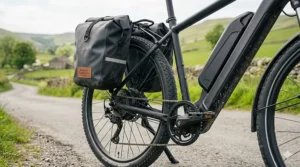
The 52V 16Ah battery (that’s 832Wh — the highest capacity in this entire comparison) combined with full front and rear suspension makes this the touring choice for riders who don’t consider a route worth doing unless there’s at least one climb that makes conventional cyclists wheeze. The 52V system provides notably more torque than standard 36V or 48V bikes, which manifests as confident, sustained power on 20%+ gradients rather than that anxious “will it, won’t it” feeling on steep lanes.
Real-world UK range sits around 80–120 km depending heavily on terrain. A Yorkshire Dales rider reviewing the bike reported completing 100 km+ through genuinely challenging terrain without range anxiety — a meaningful endorsement given those particular roads seem designed specifically to humiliate battery-powered vehicles.
The full suspension setup means you’re not white-knuckling the bars on rocky bridleways, but it does add weight — at roughly 32 kg, this is the heaviest bike on our list. Getting it into a car boot requires a strategy. Lifting it upstairs is a workout in itself. If your touring involves regular loading onto trains or navigating steep cottage staircases, think carefully.
Expert opinion: Perfect for adventure tourers targeting hilly, mixed-terrain UK routes. Less ideal for lightweight urban touring or anyone who frequently combines cycling with rail travel.
✅ Massive 832Wh battery for hilly terrain
✅ Full suspension handles rough British bridleways
✅ Shimano 8-speed gearing handles varied terrain
❌ At ~32 kg, it’s a two-person lift into a car boot
❌ Bulk makes urban storage challenging
Price range: Around £800–£1,000 on Amazon.co.uk — remarkable given the specification.
3. Eleglide M2 (Mopride 2) — The All-Rounder for British Roads 🇬🇧
The Eleglide M2 occupies that sweet spot between “budget compromise” and “mid-range capable” with surprising elegance. The 36V 15.6Ah battery (562Wh) delivers a claimed 125 km range — more realistically 70–100 km across typical British mixed terrain — which comfortably handles Friday-to-Sunday touring with nightly charges.
What genuinely sets this bike apart at its price point is the dual hydraulic disc brakes. Mechanical disc brakes — standard on most sub-£800 bikes — work adequately in dry conditions. Add a loaded rear rack, a descending Welsh lane, and steady autumn rain, and “adequate” starts feeling optimistic. Hydraulic brakes modulate consistently in wet conditions, and in Britain’s climate, that’s not a performance upgrade — it’s a safety consideration.
The 21-speed Shimano drivetrain gives you genuine flexibility: low gears for grinding up Exmoor climbs under load, higher gears for cruising along the flat coastal paths of Norfolk or Lincolnshire. UK Amazon reviewers are largely enthusiastic, with one commuter noting it performs like bikes costing three times the price after six weeks of ownership. One recurring note: check the crank arm bolt torque after initial assembly — a minor assembly quirk that Eleglide’s UK customer service has reportedly handled well under warranty.
Expert opinion: The ideal choice for riders wanting a capable, no-drama all-rounder for UK weekend tours without crossing the £800 mark. Excellent for flatter touring routes; handles moderate hills confidently.
✅ Hydraulic disc brakes — genuine safety benefit in wet UK conditions
✅ 21-speed Shimano for versatile gearing
✅ Corrosion-resistant aluminium frame
❌ Hub motor less efficient on sustained climbs than mid-drive
❌ 125 km range figure optimistic for hilly UK terrain
Price range: £650–£800 on Amazon.co.uk — strong value proposition at this tier.
4. ENGWE EP-2 Pro — The Train-Friendly Touring Folder 🚂
Here’s a genuinely clever idea: a fat-tyre folding bike with touring-level range. The EP-2 Pro’s 48V 13Ah battery (624Wh) delivers legitimate 70–90 km real-world range — enough for a full day’s touring — whilst the folding mechanism opens up a style of UK adventure that a full-size bike simply can’t offer.
Combine cycling with rail travel. Ride out from Manchester Piccadilly, explore the Cheshire countryside for 70 km, fold the bike, take the train home. Or tour the Yorkshire coast by cycling between towns and hopping on Northern Rail when the weather turns properly horrible. The 20″ × 4.0″ fat tyres provide remarkable stability on canal towpaths, coastal shingle paths, and the kind of slightly-ambiguous bridleways that dot Ordnance Survey maps.
The Shimano 7-speed gearing is functional rather than expansive, and at 29 kg the EP-2 Pro is at the heavier end for a folding bike — “folding” here means it takes up less space in a train vestibule or car boot, not that you’d carry it over your shoulder for long. UK buyers have consistently praised the combination of fat tyre grip and range, with one Manchester commuter reporting 70+ miles on a single careful charge. The folding mechanism works reliably, though it takes a minute or two rather than the ten-second snap of a Brompton.
Expert opinion: Best suited to explorers who want to combine cycling with public transport — a genuinely viable touring strategy in the UK, where rail networks (however variable in reliability) connect most interesting destinations.
✅ Folds for train travel — uniquely versatile UK touring approach
✅ Fat tyres handle towpaths and coastal paths brilliantly
✅ Strong battery at this price point
❌ Heavy for a folding bike — not truly portable
❌ 7-speed gearing limiting on steep climbs
Price range: Under £1,100 on Amazon.co.uk — check Prime availability for next-day delivery.
5. DUOTTS C29 — The Budget Touring Workhorse 🔧
At under £700, the DUOTTS C29 shouldn’t work as well as it does. And yet. The 48V 15Ah battery (720Wh) is, purely on paper, the second-largest capacity on this list, delivering a claimed 100 km range that real-world UK testing suggests lands at 65–90 km depending on terrain and load. The 29″ wheels — uncommon at this price point — roll over road imperfections with noticeably more confidence than the 26″ tyres found on most budget competitors.
The Polish design team’s decision to include hydraulic disc brakes as standard on a sub-£700 bike is quietly significant. UK Amazon reviews are striking in their positivity for the price: “rides like a proper bike,” notes one London buyer, who described the delivery as faster than expected. A separate reviewer achieved roughly 35 miles off-road on PAS level 5, noting the bike handles light trails confidently.
The caveats are real. The brand is relatively young, UK spare parts availability is patchy compared to established names, and local bike shops (many of whom are increasingly servicing e-bikes) may struggle with proprietary components. The warranty — one year on motor, battery, and frame — is adequate but not generous. For a confident DIY mechanic or someone content to source parts online, these are manageable trade-offs for the money saved.
Expert opinion: An honest choice for budget-conscious UK tourers tackling relatively flat routes — the Thames Path, the Tarka Trail, the Lon Las Cymru’s gentler southern stretches. Not recommended as your sole transport for week-long mountain adventures.
✅ Generous battery capacity for the price
✅ 29″ wheels improve rolling comfort on roads
✅ Hydraulic brakes included — unusual at this price
❌ Spare parts harder to source in UK
❌ Heavier than claimed; build quality variable
Price range: Around £550–£700 on Amazon.co.uk — the best pure value-per-kilometre on this list.
6. HITWAY BK7S Plus — The Smart Commuter-Tourer 📱
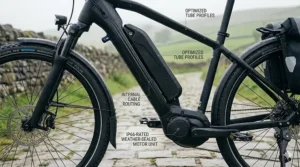
The HITWAY BK7S Plus does something clever: it bridges the gap between daily commuter and weekend tourer without fully compromising either role. The 36V 12.8Ah integrated battery (461Wh) delivers 50–80 km of realistic range — the smallest on this list, but more than adequate for Friday-evening-to-Sunday-afternoon tours in areas like the Cotswolds, the North Downs Way, or the New Forest.
The NFC tap-to-unlock feature and smartphone app connectivity feel like genuinely useful additions rather than gimmicks. Being able to track your actual range consumption in real time (rather than staring anxiously at a battery bar) fundamentally changes how you plan a day’s riding. The lockable front suspension fork — switchable between soft and firm modes — lets you optimise for towpath comfort or road efficiency depending on the day’s route.
The hydraulic disc brakes perform well in wet conditions, and the integrated battery design means no battery removal required for overnight charging at a B&B — a small practical detail that makes multi-day touring considerably less faff. UK buyers consistently report the bike arrives well-assembled with a standard UK plug charger included.
Expert opinion: Ideal for riders who tour most weekends within a moderate 50–70 km daily range, typically commuting on the same bike during the week. Not the right tool for multi-day, high-mileage expeditions.
✅ NFC unlock and app connectivity — genuinely useful touring tools
✅ Integrated battery — aesthetically clean and weatherproof
✅ Lockable suspension fork for road/trail flexibility
❌ 461Wh battery limits multi-day ambitions
❌ 7-speed Shimano restricts options on serious climbs
Price range: Around £450–£600 on Amazon.co.uk — Prime-eligible, typically arriving within two days.
7. ADO Air 20 Pro — The Lightweight Touring Surprise 🪶
At 18 kg, the ADO Air 20 Pro is the featherweight of this comparison, and that number matters more than any spec sheet suggests. Every kilogram you’re not carrying is a kilometre further you travel. Every flight of stairs to your flat becomes slightly less of an ordeal. Getting it onto an Avanti train rack without an engineering degree becomes genuinely feasible.
The carbon belt drive (shared with the much more expensive ENGWE P275 Pro) means maintenance stays minimal — no chain lube on long trips, no drivetrain rust during week-long damp conditions. The 36V 10Ah battery (360Wh) is the smallest here, but the torque sensor technology means power delivery is exceptionally efficient: the motor only works as hard as your pedalling demands, rather than pumping out a fixed wattage regardless. UK riders report achieving 60–90 km consistently, which is notably strong for a 360Wh pack.
The 20″ wheel size raises the only real flag for long-distance UK touring — smaller wheels feel busier on rough roads and are more sensitive to crosswinds on exposed coastal routes. That said, for riders primarily touring on tarmac and well-maintained cycle paths, this matters less than the weight saving.
Expert opinion: Perfect for urban-based tourers who store their bike in a flat, combine cycling with trains, and prioritise lightweight handling over raw battery capacity. London-based riders in particular tend to love this model.
✅ Lightest bike on this list at 18 kg
✅ Carbon belt drive — zero maintenance, rust-proof
✅ Efficient torque sensor extends range beyond battery size expectations
❌ 360Wh battery not suited to ambitious multi-day routes
❌ 20″ wheels less comfortable on rough surfaces
Price range: £700–£900 on Amazon.co.uk — check availability, as stock can be intermittent.
How to Choose a Weekend Touring Range Ebike in the UK: 6 Key Criteria
Picking the right weekend touring range ebike isn’t complicated, but it does require honest self-assessment before you start looking at spec sheets. Here’s the framework that actually matters.
1. Match battery size to your ambitions, not your budget. The single most common mistake UK buyers make is underestimating how much a loaded bike, British terrain, and headwinds eat into claimed range figures. If you’re planning 80 km days, start your search at 600Wh+. For 50 km days or flatter routes, 400–500Wh is adequate.
2. Understand the mid-drive vs hub motor difference. Mid-drive motors (like the Bafang on the ENGWE P275 Pro) are more efficient on hills because they leverage your gears. Hub motors are simpler, cheaper, and easier to maintain. For flat touring routes, the difference is modest. For hilly British terrain, it’s significant.
3. Prioritise hydraulic disc brakes for loaded descents. A 25 kg bike carrying 10 kg of luggage descending a wet Welsh lane is a substantially different vehicle from an unloaded commuter. Hydraulic brakes are not a luxury upgrade — they’re a practical safety consideration for loaded touring in Britain’s climate.
4. Factor in total weight, including your load. Most ebike motors start to struggle perceptibly above about 130 kg combined (bike + rider + luggage). Check manufacturer load limits before purchasing.
5. Consider spare parts and servicing. Established brands with UK service networks — or models popular enough that parts are widely stocked on Amazon.co.uk — will save you frustration at kilometre 400. According to CyclingUK, the number of cyclists touring multi-day routes has grown significantly, driving better parts availability, but budget Chinese brands still lag behind.
6. Think about charging logistics. Every B&B, hostel, and campsite in Britain has a standard Type G socket. Confirming your charger uses a UK plug (not a Euro adapter) saves a small but meaningful faff at the end of a long day.
Real-World UK Touring: Which Bike for Which Route?
The spec sheet comparison is useful. The real question is which bike suits which weekend.
The Hadrian’s Wall Cycleway (NCN Route 72) — 174 km total. This three-to-four-day route through Northumberland and Cumbria involves moderate climbing, mixed surfaces, and occasional exposed moorland. Best match: ENGWE P275 Pro — the extended range means you’re covering 50–60 km daily stages without anxiety, even on blustery days near the Solway coast. The belt drive also handles the occasional moorland track without protest.
The Thames Path Cycling Route — flat, urban, mixed surfaces. A weekend ride from Oxford to London (roughly 130 km) on well-maintained riverside paths. Best match: ADO Air 20 Pro or HITWAY BK7S Plus — the flat terrain neutralises the battery size disadvantage, and the lightweight handling is a pleasure on busy towpaths.
The Sustrans Camel Trail and North Cornish Coast. Relatively flat but with short, punchy climbs and exposed coastal headwinds. Best match: Eleglide M2 — the 21-speed gearing handles coastal variability well, and the hydraulic brakes manage the occasional steep descent into harbour villages.
A weekend in the Peak District (Sheffield to Bakewell circuit, ~100 km with significant elevation). This is where the budget bikes genuinely struggle. The terrain demands mid-drive efficiency or a very large battery. Best match: ENGWE Engine Pro 2.0 — the 832Wh battery and full suspension turn a potentially exhausting route into something actually enjoyable. Worth noting: the National Cycle Network in the Peak District includes some technical surfaced sections where suspension genuinely earns its weight.
Battery Optimisation on UK Touring Routes: What the Manual Won’t Tell You
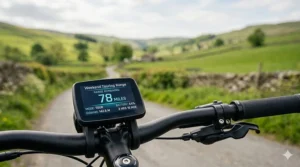
Range anxiety is largely optional if you understand the variables. Here’s what actually affects your battery on a typical British weekend tour.
Eco mode is your friend, until it isn’t. Running consistently on PAS 1 or 2 on flat terrain can genuinely extend range to the higher end of manufacturer claims. The moment you hit a 10%+ gradient under load, however, staying in eco mode starts feeling like an argument with physics. Shift to a higher assist level early on climbs and recover the range loss on downhill sections by barely pedalling.
Cold weather matters more than most buyers realise. Lithium-ion batteries lose roughly 10–15% of their effective capacity at temperatures below 5°C — common enough during British spring and autumn touring seasons. If you’re planning an Easter trip to Northumberland or a September tour in Scotland, build in this buffer.
Tyre pressure is free range. Underinflated tyres increase rolling resistance significantly. Checking and correcting pressure before each day’s ride — a two-minute job — can add 5–8 km to your range without touching the motor.
Regenerative braking, where available. Only a few bikes in this comparison offer regenerative charging (the ENGWE Engine Pro 2.0 being the primary example). On hilly routes it adds modest range — typically 5–10% — but on a 100 km day, that’s a meaningful buffer.
Charge to 80%, not 100%, for battery longevity. Unless you need maximum range for the next day’s stage, charging to 80% rather than full significantly extends the battery’s long-term health. Most of the bikes here allow this via the display settings or by simply removing the charger early — check your specific model’s manual.
Common Mistakes When Buying a Weekend Touring Range Ebike in the UK
Buying a US-spec model that happens to be listed on a UK marketplace. Always confirm the charger includes a UK Type G plug. Some Amazon.co.uk listings from third-party sellers ship with Euro plugs and adapters, which is fine until the adapter fails on a rainy Sunday in Penzance.
Ignoring the “real-world” range adjustment for British conditions. UK terrain is not the terrain on which range testing happens. Apply a conservative 65–70% multiplier to manufacturer claims for hilly routes; 75–80% for flatter ones.
Underestimating the importance of rack mounts. If you’re planning to tour with panniers or a rear rack bag, confirm the frame includes threaded bosses for proper rack attachment. Many commuter-oriented models have no rear rack mounts at all, leaving you with awkward handlebar bags and a compromised ride quality.
Overlooking post-Brexit warranty implications. Some EU-manufactured bikes sold into the UK carry CE marking rather than UKCA marking. For practical purposes this rarely matters — the UK Government has extended CE acceptance for most product categories through 2026 — but it’s worth checking the manufacturer’s UK support arrangements if warranty claims ever become relevant. Consumer protection under the Consumer Rights Act 2015 remains strong regardless.
Buying purely on battery capacity without considering motor type. A 720Wh hub motor bike may deliver less effective range on hilly terrain than a 560Wh mid-drive. The motor’s efficiency in using the battery is as important as the battery’s size.
Long-Term Cost of Running a Weekend Touring Ebike in the UK
The numbers here are genuinely compelling. According to Cycling UK, cycling as a form of transport saves the average British commuter approximately £1,500–£3,000 per year compared to car ownership or public transport costs. For weekend touring specifically, the comparison is even sharper: a weekend tour covering 150 km by e-bike costs roughly £0.20–£0.40 in electricity to charge (at current UK rates of approximately 24p per kWh). The same journey by car, including fuel and depreciation, costs many multiples of that.
Battery replacement — the main long-term cost — typically runs £150–£300 for the models in this comparison. Most quality lithium-ion packs in this category are rated for 800–1,000 charge cycles; at one full charge per weekend, that’s 15–20 years of touring before replacement becomes a serious consideration.
Maintenance costs favour ebikes too. The ENGWE P275 Pro’s Gates belt drive, for example, requires no chain lube, no chain replacement, and less frequent drivetrain servicing than a chain-driven equivalent. For a bike that sees 3,000–4,000 km per year of touring, that translates to a meaningful saving over five years.
FAQs: Weekend Touring Range Ebike UK 2026
❓ What range should I expect from a weekend touring range ebike in real UK conditions?
❓ Are long-range touring ebikes legal on UK roads and cycle paths?
❓ Which weekend touring range ebike is best for hilly UK terrain like the Peak District or Snowdonia?
❓ Can I charge a touring ebike battery at a B&B or campsite?
❓ Do I need UKCA marking on an ebike bought from Amazon.co.uk?
Conclusion: The Weekend Is Long Enough — Make It Count
The weekend touring range ebike market in 2026 is, frankly, better than it has any right to be at these prices. For under £1,100 — less than many traditional touring bikes — you can acquire a machine with genuine 100 km+ capability, maintenance-reducing belt drives, and hydraulic braking that handles loaded British descents with confidence.
The right choice depends on where you’re going. Hilly, multi-day adventures demand the ENGWE Engine Pro 2.0 or the ENGWE P275 Pro’s mid-drive efficiency. Flatter, train-combined touring suits the ADO Air 20 Pro or the ENGWE EP-2 Pro. Budget-conscious riders planning routes along the likes of the Tarka Trail or the Canal du Midi of Britain’s towpath network will find the DUOTTS C29 and HITWAY BK7S Plus deliver remarkable value.
Whatever you choose, remember: the manufacturer’s range figure is a starting point for negotiation, not a guarantee. Adjust for your terrain, your load, and — inevitably — the weather that British weekends specialise in providing at the least convenient moment.
Pack your waterproofs. Charge to 100% on Friday night. The road’s waiting.
✨ Ready to Start Your Weekend Adventure?
🔍 Click any highlighted bike in this guide to check current pricing and availability on Amazon.co.uk. All models are Prime-eligible (next-day delivery for Prime members) — check individual listings for current delivery windows and stock status.
Recommended for You
- Best Electric Enduro Bikes UK 2026: 7 Trail-Ready Picks Tested
- Best Hand Cycle Electric UK 2026: Top 7 Adaptive Handcycles Reviewed
- 7 Best Adapted Electric Bikes UK 2026 – Accessible Cycling Guide
Disclaimer: This article contains affiliate links. As an Amazon Associate, I earn from qualifying purchases. If you purchase products through these links, we may earn a small commission at no additional cost to you.
✨ Found this helpful? Share it with your mates! 💬🤗
