In This Article
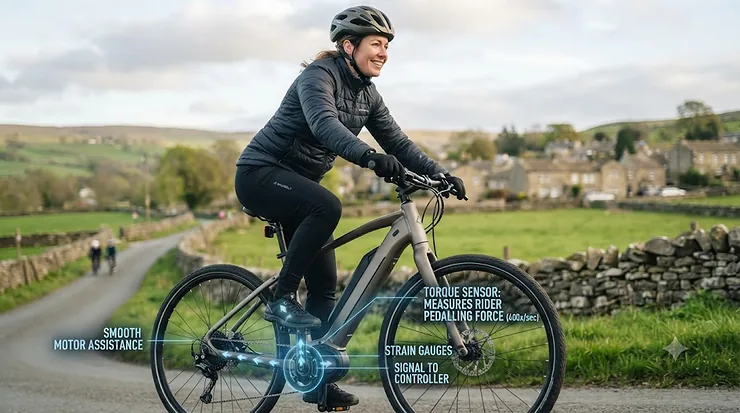
Pedal a normal bike up a slight rise and your effort simply increases – more push, more speed, no drama. Copy that exact feeling onto an electric bike and you’ve more or less summed up how torque sensing works electric bike systems in a single sentence. Rather than flicking the motor on like a light switch, a torque sensor reads the actual force going through your pedals, dozens of times a second, and matches the motor’s output to it. Push harder, get more help. Ease off, and the assistance eases off with you.
That distinction matters more than it sounds. Anyone who has ridden a cheap cadence-based e-bike knows the slightly seasick lurch of the motor kicking in a beat after you start pedalling, then holding a fixed power level regardless of how gently you’re spinning the cranks. A torque sensor removes that disconnect. It’s the difference between being shoved along and being quietly amplified.
This guide walks through the mechanics – strain gauges, response times, gradient detection, the lot – in plain English, then puts seven real, currently available UK torque sensor e-bikes under the microscope, from sub-£1,100 budget options to Bosch-powered premium machines. Whether you’re weighing up a first commuter or trying to work out why one bike’s “45Nm” feels punchier than another’s “65Nm” on paper, you’ll find the reasoning here, not just a spec sheet.
Quick Comparison: Torque Sensor E-Bikes at a Glance
| Bike | Sensor Type | Motor & Torque | Battery / Range | Best For |
|---|---|---|---|---|
| Carrera Vengeance-E 3.0 | Torque (hub) | Bafang 250W, 45Nm | 378Wh, ~40 miles | Budget off-road fun |
| ENGWE P20 | Torque (hub) | 250W, 42Nm | ~346Wh, up to 100km claimed | Fold-and-carry commuters |
| ADO Air 28 | Torque (crank-mounted) | 250W, ~42Nm | 36V, up to 62 miles claimed | Belt-drive city cruising |
| Tenways CGO600 Pro | Torque (magnetic) | 250W, 45Nm | 360Wh, up to 53 miles claimed | Stealthy, low-maintenance commuting |
| Eskute Polluno Pro | Torque (mid-drive) | Bafang M200, 65Nm | Large capacity, up to 80 miles claimed | Hilly commutes, step-through comfort |
| Cyrusher Roam | Torque + Cadence (switchable) | 750W*, 95Nm | 52V 15.6Ah, 50-60 miles claimed | All-terrain, accessible step-through |
| Raleigh Motus (Performance Line) | Torque (Bosch mid-drive) | Bosch 250W, 75Nm | 500Wh Bosch PowerPack, up to 80 miles claimed | Long-term, dealer-backed reliability |
*The Cyrusher Roam’s throttle-enabled 750W spec is a US-market figure; UK road use must stay within EAPC limits – more on that in our regulations section below.
Look at that torque column and a pattern jumps out: the mid-drive machines (Eskute Polluno Pro, Raleigh Motus) post noticeably higher Nm figures than the budget hub-motor bikes, and that’s not marketing puffery – mid-drives multiply their torque through the bike’s own gears, so the number genuinely translates into climbing ability. The Carrera Vengeance-E 3.0 and ADO Air 28 sit in a very similar torque bracket despite a big style gap, which tells you torque alone doesn’t determine ride quality; sensor placement, tuning and battery capacity matter just as much, and we’ll unpack why over the next few sections.
💬 Just one click – help others make better buying decisions too! 😊
Top 7 Torque Sensor E-Bikes: Expert Analysis
We shortlisted these seven from currently sold UK and UK-available models, deliberately spreading budget, mid-range and premium price points, plus a mix of hub-motor and mid-drive torque sensing so you can see how the technology performs across formats. Specs below are drawn from manufacturer data and independent reviews at the time of research; as with all e-bikes, always check the current listing before buying, since running changes happen often.
1. Carrera Vengeance-E 3.0 — torque sensing on a genuine budget
Halfords’ own-brand Carrera Vengeance-E 3.0 is proof that torque sensing has trickled down to genuinely affordable territory. Its Bafang rear-hub motor puts out 45Nm, which independent testers have described as landing in a “sweet spot” for hills and headwinds without draining the battery too fast. That torque figure means the motor doesn’t sound strained on moderate inclines, and because the assistance is proportional rather than binary, the bike doesn’t lurch when you first push off from a standstill.
Based on the spec sheet, the 378Wh battery is modest by 2026 standards, translating to a realistic range closer to 30 miles than the manufacturer’s headline 40, which is fairly typical of hub batteries this size. It suits weekend trail riders and short-to-medium commuters more than long-distance tourers. Reviewers of the Carrera range consistently flag the torque sensing as a genuine step up from the cadence-only systems Halfords used to fit, and note the five-mode TFT display and Shimano 8-speed drivetrain as sensible, serviceable choices rather than flashy ones.
Pros:
- ✅ Torque sensor at this price point is still unusual
- ✅ Halfords’ nationwide service network covers warranty work
- ✅ Shimano 8-speed drivetrain is easy and cheap to maintain
Cons:
- ❌ 378Wh battery gives modest real-world range
- ❌ Heavier than dedicated commuter bikes at this budget
Halfords lists the Carrera Vengeance-E 3.0 around £1,000-£1,150, and given that torque sensors typically start appearing two or three price brackets higher, it’s arguably the best-value entry point on this list for anyone who wants proportional assist without a four-figure-plus outlay.
2. ENGWE P20 — the fold-and-carry torque sensor commuter
For commuters who need to fold their bike into a hallway cupboard or under a train seat, the ENGWE P20 pairs an 18.5kg frame with a genuine torque sensor and a Gates-style carbon belt drive rated for roughly 33,000km of maintenance-free use. The 42Nm motor isn’t chasing hill-climbing records; it’s tuned for flat-to-gently-undulating urban riding, where the torque sensor’s real job is smoothing out the stop-start rhythm of traffic lights and junctions.
What most buyers overlook about folding e-bikes is that lightness and torque sensing rarely coexist at this price, because both cost money – ENGWE has clearly prioritised the fold-and-weight side of the equation. One independent UK review found their test unit’s motor assistance topped out closer to 21km/h rather than the legally permitted 25km/h, which is worth flagging honestly rather than glossing over: it’s the kind of unit-to-unit variation direct-to-consumer brands can suffer from, so it’s sensible to test-ride or check recent reviews before committing.
Pros:
- ✅ Folds in roughly 10 seconds for train or hallway storage
- ✅ Belt drive means no chain grease on trouser legs
- ✅ Hydraulic disc brakes at a budget price point
Cons:
- ❌ Independent testing found assist cutting out below the legal 25km/h on one unit
- ❌ Single-speed drivetrain struggles on steeper gradients
Priced typically in the low-£1,000s to around £1,200, the ENGWE P20 rewards riders whose commute is genuinely flat and who value portability above outright performance.
3. ADO Air 28 — smooth crank-based torque sensing with a belt drive
The ADO Air 28 mounts its torque sensor directly at the crankset rather than in the hub, a configuration reviewers have praised for reading pedal force with less lag than some rear-hub setups. Reviewers testing the Air 28 specifically noted the motor kicks in as soon as pedalling starts and cuts out the instant you stop, without the “overrun” some cheaper systems exhibit where power keeps nudging you forward for a second after you’ve eased off.
With 42Nm on tap and a carbon belt drive rated to around 30,000km, this is a bike built around low-maintenance, everyday reliability rather than raw power. Here’s what to weigh: at roughly 21kg it’s light for an e-bike with a belt drive and hydraulic brakes, but its single-speed transmission means climbs steeper than around 10-12% will ask you to work harder, since there’s no lower gear to lean on when the battery-assisted torque tops out. Aggregated owner feedback across UK retailer and review sites is broadly positive on ride smoothness, with the main recurring criticism being limited hill-climbing on very steep gradients.
Pros:
- ✅ Crank-mounted torque sensor feels notably lag-free
- ✅ Belt drive plus hydraulic brakes at a mid-budget price
- ✅ Removable Samsung-cell battery with lockable seat collar
Cons:
- ❌ Single-speed limits climbing on gradients over 10%
- ❌ Around 21kg makes stairs a two-handed job
Expect to find the ADO Air 28 priced roughly between £900 and £1,150 depending on the exact spec, making it a strong contender against the Carrera Vengeance-E 3.0 for buyers who prioritise road-focused commuting over off-road capability.
4. Tenways CGO600 Pro — the “stealth e-bike” with a magnetic sensor
Tenways built its reputation on making e-bikes that don’t look or sound like e-bikes, and the Tenways CGO600 Pro is the clearest expression of that philosophy. Its magnetic torque sensor is a genuinely different design from the strain-gauge systems most rivals use – Tenways claims it avoids the wear-prone magnetic coating found on some cheaper sensors, which should translate into fewer long-term calibration issues, though we’d flag this as a manufacturer claim rather than something independently verified over years of ownership.
Multiple independent reviewers have singled out the CGO600 Pro’s power delivery as among the smoothest and quietest they’ve tested, with one reviewer able to hit 20mph from a stop in around eight seconds – a strong result for a 250-350W class motor. The trade-off is a single-speed belt-drive option that, per reviewer testing, starts to struggle once gradients exceed roughly 6-8%; Tenways also sells an 8-speed chain-drive Pro-C variant specifically to address hillier routes, which is worth choosing if your commute isn’t pancake-flat.
Pros:
- ✅ Magnetic torque sensor rated as unusually smooth and quiet by reviewers
- ✅ Removable 360Wh battery integrates cleanly into the frame
- ✅ IP65 weatherproofing tested through rain by reviewers
Cons:
- ❌ Single-speed belt version struggles above roughly 6-8% gradients
- ❌ No frame mounting points limits rack and accessory options
At around £1,400-£1,650 for the belt-drive Pro, this sits firmly in the mid-range and competes directly with the Eskute Polluno Pro below for buyers choosing between hub-motor stealth and mid-drive climbing power.
5. Eskute Polluno Pro — mid-drive torque sensing for hillier commutes
Where the previous three bikes use hub motors, the Eskute Polluno Pro switches to a Bafang M200 mid-drive system, and the torque figure jumps accordingly to 65Nm. Because a mid-drive motor works through the bike’s own gearing rather than driving the wheel directly, that torque gets multiplied on lower gears, so climbing hills that would tax a hub-motor bike becomes noticeably easier – reviewers testing the Polluno Pro noted it handled steep hills with less strain than the brand’s earlier hub-motor models.
The step-through frame and upright riding position make this a strong pick for commuters who want to arrive at work in their normal clothes rather than kit, and aggregated reviews consistently praise the smooth, natural-feeling power delivery the torque sensor provides over Eskute’s older cadence-based Polluno. What most buyers overlook about mid-drive bikes generally is the weight penalty: motor position lower and more central helps handling, but the Polluno Pro is a noticeably heavy machine to lift, and reviewers have flagged the mechanical (rather than hydraulic) disc brakes as the one component that doesn’t quite match the rest of the spec.
Pros:
- ✅ 65Nm mid-drive torque handles hills with real ease
- ✅ Step-through frame suits a wide range of riders
- ✅ Large battery capacity supports genuinely long commutes
Cons:
- ❌ Noticeably heavy to lift or carry upstairs
- ❌ Mechanical disc brakes lag behind the rest of the spec
Typically priced between £1,400 and £1,600, the Eskute Polluno Pro earns its place on this list specifically for riders whose commute includes proper hills, where hub-motor torque simply can’t compete.
6. Cyrusher Roam — switchable torque and cadence sensing
The Cyrusher Roam is the outlier here: rather than committing to one sensor type, it lets you toggle between torque and cadence modes on the fly. Reviewers who’ve tested this switch describe torque mode as the more “natural and adaptive” of the two, with the motor’s 95Nm output (on the US-spec model) delivering strong acceleration when the sensor detects real pedal pressure, while cadence mode gives a steadier, more consistent push for relaxed cruising.
Its full-suspension, step-through fat-tyre frame is aimed squarely at riders who want off-road comfort without a high top tube to swing a leg over – a genuinely useful accessibility feature that’s rare on this style of bike. Here’s what to weigh: the 750W motor and throttle capability advertised on Cyrusher’s specification pages exceed UK EAPC limits for road use in throttle mode, so UK buyers need to understand that pedal-assist operation is what keeps this bike road-legal here (we cover this properly in our regulations section below). At roughly 37kg it’s also genuinely heavy, which reviewers have consistently flagged as the main drawback of an otherwise plush, capable ride.
Pros:
- ✅ Switchable torque/cadence sensing is unusually flexible
- ✅ Step-through full-suspension frame aids accessibility
- ✅ Strong claimed range for a fat-tyre bike (50-60 miles)
Cons:
- ❌ At around 37kg, it’s a genuine handful to lift or transport
- ❌ US-spec power figures need checking against UK EAPC rules before road use
Cyrusher’s UK site typically lists the Cyrusher Roam in the £2,000-£2,600 range at the time of research, positioning it as a premium, comfort-first choice rather than a budget one.
7. Raleigh Motus (Performance Line) — the dealer-backed Bosch benchmark
For riders who want the reassurance of a household British bicycle brand and a service network to match, the Raleigh Motus built around Bosch’s Performance Line mid-drive motor delivers 75Nm of torque – comfortably the highest of any bike on this list bar the Cyrusher’s throttle-capable spec. Bosch’s torque sensing is widely regarded across independent reviews as among the smoothest in the industry, with assistance matched to pedal cadence so precisely that testers have described climbing steep hills as feeling “suspiciously easy.”
Reviewers have consistently noted that Raleigh’s own Active Line-powered Motus variants (a lower-torque, 40Nm option) can feel underpowered on very steep or hilly routes, which is exactly why the Performance Line version reviewed here matters: stepping up to the 75Nm motor addresses that criticism directly. Based on the spec comparison, the 500Wh Bosch PowerPack and Shimano Nexus 5-speed hub gearing prioritise low-maintenance reliability over outright speed, and the trade-off is weight – Raleigh’s Motus range has been measured at anywhere from 25kg to over 30kg depending on frame and battery configuration, making this one for riders who won’t be carrying it up stairs daily.
Pros:
- ✅ 75Nm Bosch Performance Line torque handles steep hills confidently
- ✅ Bosch’s dealer and service network is extensive across the UK
- ✅ Hub gears mean low-maintenance, all-weather reliability
Cons:
- ❌ Weighs considerably more than any hub-motor bike on this list
- ❌ Sits at a premium price point versus hub-motor alternatives
Expect to pay somewhere in the £2,200-£2,700 range depending on gearing and frame choice, making the Raleigh Motus the considered, long-term investment pick of this line-up rather than the cheapest way into torque sensing.
How Torque Sensing Actually Works
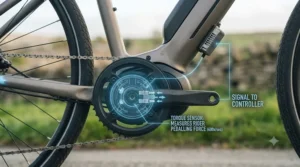
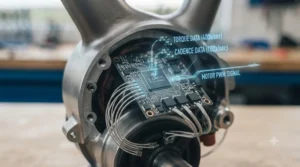
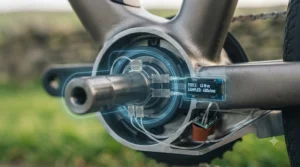
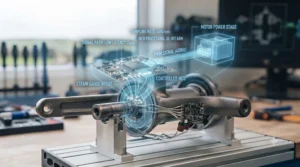
At the heart of most torque sensor e-bikes sits a small, unglamorous component: a strain gauge, bonded either to the bottom bracket axle, a section of the crank, or – in magnetic designs like Tenways’ – a specially shaped magnetic element that flexes almost imperceptibly under load. A strain gauge works by changing its electrical resistance in proportion to how much it physically deforms; bond one to a rotating shaft, apply pedalling force, and the resulting micro-flex alters a tiny electrical signal that the bike’s controller can read many times per second.
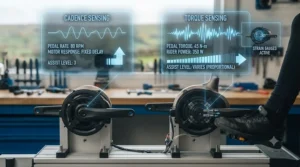
That signal gets converted into a torque value, typically measured in Newton-metres, and fed to the motor controller alongside your chosen assistance level. The controller then calculates exactly how much extra power to add – not a fixed dollop, but a live, continuously updating multiplier of your own effort. This is why cheap explanations calling torque sensors “smart cadence sensors” miss the point entirely: cadence sensors measure rotational speed using magnets and a reed switch or Hall sensor, essentially a bicycle speedometer wired to the throttle logic, while torque sensors measure force. One tells the motor you’re pedalling; the other tells it how hard.
The practical upshot, and the reason UK cyclists increasingly hunt specifically for torque sensor models, is that assistance tracks your intention in real time rather than following a preset curve, which is the mechanical root of that oft-repeated description of feeling like “a tailwind that’s always at your back.”
Response Delay: Cadence Sensor Response vs Torque Sensor Response in Milliseconds
Numbers rarely get thrown around in e-bike marketing with much precision, but response delay is one area where the gap between systems is measurable and genuinely felt. A well-tuned torque sensor typically registers and responds to a change in pedalling force within roughly 50-150 milliseconds – fast enough that most riders perceive it as instantaneous, since human reaction time to visual stimuli alone sits around 200-250ms. Cadence sensor response, by contrast, depends on how many magnets sit on the sensor’s disc: budget systems with as few as 6-8 magnets can take a quarter to half a full pedal revolution before the controller even registers that pedalling has started, which at a typical cadence translates to a noticeably longer real-world lag, often several hundred milliseconds.
Reviewers consistently note that cadence sensor response feels abrupt in a different way to torque sensor response: the motor doesn’t ramp in gradually, it snaps to whatever fixed power level the current assistance mode dictates. On busy urban roads that abruptness is more than a comfort issue – a delayed then sudden power surge at a junction can genuinely catch inexperienced riders off guard. Higher-magnet-count cadence systems narrow the gap considerably, but they still can’t replicate the proportional, force-matched response that a properly tuned torque sensor delivers by design rather than by approximation.
✨ Don’t Miss These Exclusive Deals!
🔍 Ready to feel the difference for yourself? Click through to check current pricing on any of our featured torque sensor picks and find the natural ride that suits your commute.
Proportional Assist and Gradient Detection: Why Hills Feel Different
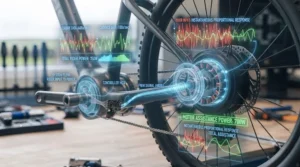
Proportional assist is the technical term for what most riders simply describe as an e-bike that “feels right,” and gradient detection is where it earns its keep. A torque sensor doesn’t have a dedicated incline sensor bolted on – instead, it infers gradient indirectly, because climbing a hill naturally requires more pedalling force to maintain the same speed. As you push harder into a rising road, the strain gauge reads that increased force and the controller responds with proportionally more assistance, without you ever touching a control panel.
What most buyers overlook is that this indirect approach is actually more responsive than a dedicated incline sensor would be, because it reacts to your effort rather than to the road’s geometry – useful on rolling terrain where gradient changes constantly and a fixed “hill mode” would either overcorrect or lag behind. The trade-off is that proportional assist systems reward good pedalling technique: riders who spin a lighter, faster cadence on climbs get less torque-triggered boost than riders who mash a heavier gear, which is worth knowing if you’re used to a lower-cadence riding style from unassisted cycling.
Bikes with higher-torque motors, like the Eskute Polluno Pro‘s 65Nm or the Raleigh Motus‘s 75Nm, translate a given increase in pedal force into a bigger jump in assistance than lower-torque hub motors such as the ENGWE P20‘s 42Nm, which is the real-world reason mid-drive bikes feel dramatically more capable on steep gradients even when their headline wattage looks similar on a spec sheet.
Torque Sensor Accuracy Compared: What the Numbers Really Mean
Manufacturers occasionally quote sensor accuracy figures – claims of “±1%” or “±5%” precision crop up in marketing material – but these numbers are worth treating cautiously since they’re rarely independently verified and testing methodology isn’t usually disclosed. What can be assessed more reliably through aggregated reviewer experience is consistency of feel: does the assistance ramp smoothly, or does it hunt and stutter as you vary your effort?
On that measure, crank-mounted and mid-drive systems (like those in the ADO Air 28 and Eskute Polluno Pro) tend to score well in reviews for minimal lag, likely because they sit closer to the point where force is actually applied, with less mechanical slack between pedal stroke and sensor reading. Rear-hub torque sensors, which typically read force transmitted through the chain or belt to the hub, have a slightly longer signal path and can show marginally more variability, though the difference in day-to-day riding is often smaller than spec-sheet comparisons suggest. Tenways’ magnetic sensor design is a specific attempt to sidestep durability-related accuracy drift, since it avoids a magnetic coating that reviewers note can wear unevenly over thousands of pedal strokes on cheaper systems.
The honest takeaway from comparing accuracy claims across this list: no manufacturer here published independently audited accuracy data, so buyers are better served focusing on aggregated reviewer consensus on smoothness – which consistently favours mid-drive and crank-based sensors over budget rear-hub units, though several of the hub-motor bikes reviewed by UK cycling publications still score well on this front.
What “Natural Riding Feel” Actually Means: Real-World Performance
“Natural riding feel” gets used so often in e-bike marketing that it risks becoming meaningless, so it’s worth translating the spec sheet into what actually happens on the road. On a well-tuned torque sensor bike, starting from a standstill at a junction feels like a normal bicycle with unusually strong legs: push down, the bike moves, ease off, it settles. There’s no half-second wait for the motor to “catch up,” and critically, there’s no overrun – the assistance stops the instant you stop pedalling, rather than continuing to nudge you forward.
Reviewers testing the ADO Air 28 specifically praised this cut-off behaviour as one of its strongest features compared with cheaper cadence systems in the same price bracket. On climbs, natural riding feel translates into assistance that scales with effort rather than jumping between discrete power steps – so easing into a hill produces a gradual increase in help rather than a jarring jump from “level 2” to “level 3” power. The trade-off, worth being upfront about, is that a torque sensor bike still requires you to pedal with real effort to unlock its assistance; riders looking for maximum help with minimum physical input, such as those managing injury or fitness limitations, may actually prefer a well-tuned cadence system or a throttle-equipped bike instead.
Torque Sensors vs Cadence Sensors: The Real Difference
Boiled down, a cadence sensor answers one question – “is the rider pedalling?” – and a torque sensor answers a more useful one: “how hard is the rider pedalling, right now?” That distinction cascades through almost every aspect of ride quality. Cadence systems are cheaper to manufacture, which is why they still dominate the sub-£800 end of the UK e-bike market, and they’re mechanically simpler, meaning fewer parts to fail over years of use. But because they deliver a fixed power output per assistance level regardless of actual pedalling force, riders report a noticeably more mechanical, “on-off” feel, and aggregated review data suggests they’re also less battery-efficient, since the motor runs at a set output even when the rider is barely pressing the pedals.
Torque sensors cost more to engineer and fit – which is reflected in the price gap between, say, the cadence-based Carrera Vengeance E and the torque-sensing Carrera Vengeance-E 3.0 reviewed above – but the payoff is a bike that responds to genuine effort, generally extends range by only using power when it’s actually needed, and gives finer control on technical terrain like loose gravel or steep switchbacks where sudden power surges are actively unhelpful. The Cyrusher Roam‘s switchable approach is a rare attempt to offer both, letting cadence mode handle relaxed cruising while torque mode takes over for more demanding riding, and reviewers who’ve tried the switch generally rate torque mode as the more engaging of the two for regular use.
Practical Usage Guide: Setup, First Rides & Optimisation
Getting a torque sensor e-bike properly set up in its first 30 days makes a real difference to both performance and battery longevity. Start with tyre pressure: under-inflated tyres force the motor and sensor to work harder to achieve the same speed, which skews how “powerful” the assistance feels and drains the battery faster than necessary – check the sidewall for the recommended PSI range and stay near the top of it for efficient road riding. Next, spend your first few rides deliberately varying pedal pressure at low speed in a quiet car park or empty street; this is the fastest way to build an intuitive feel for how your specific bike’s torque curve responds, since tuning varies noticeably between the crank-mounted systems on bikes like the ADO Air 28 and the mid-drive systems on the Eskute Polluno Pro or Raleigh Motus.
A common first-30-days mistake is leaving the bike permanently in the highest assistance mode, which both drains the battery unnecessarily and masks the proportional nature of torque sensing – on a genuinely well-tuned system, a lower assistance mode still feels smooth, just less amplified, so experimenting downward often reveals a more satisfying, more natural ride than defaulting to maximum power. For maintenance, most torque sensors themselves are sealed units requiring no attention, but keep an eye on chain or belt tension (loose belts in particular can introduce a slight lag as slack takes up before force reaches the sensor) and have the bottom bracket checked annually if your bike uses a crank-mounted sensor, since bearing wear there can subtly affect torque readings over thousands of miles.
Real-World Scenarios: Which Torque Sensor E-Bike Suits You?
Consider a university student commuting four miles across a mostly flat city each day, budget capped around £1,200, storing the bike in a small shared hallway: the ENGWE P20‘s folding frame and light weight solve the storage problem directly, and its 42Nm motor is entirely adequate for flat urban riding, even if it wouldn’t be our pick for a hillier route. Now picture a suburban commuter facing a genuinely steep half-mile climb twice a day, arriving at work in office clothes: the Eskute Polluno Pro‘s 65Nm mid-drive and step-through frame directly address both the hill and the practicality problem, at the cost of a heavier bike to manoeuvre at the school run or station.
Finally, think about a retiree in a hilly rural area wanting a dependable bike for social rides and errands, less concerned with initial cost than long-term reliability and local servicing: the Raleigh Motus‘s Bosch Performance Line motor and Raleigh’s extensive UK dealer network make it the sensible long-game choice, even though it costs roughly double the ENGWE P20. In each case, the “best” torque sensor e-bike isn’t the one with the flashiest spec sheet, it’s the one whose torque output, frame style and sensor placement actually match the terrain and daily pattern the rider is dealing with.
Common Mistakes When Buying a Torque Sensor E-Bike
The single most common mistake buyers make is fixating on peak wattage while ignoring torque and sensor type entirely – a 250W hub motor with a well-tuned 45Nm torque sensor will often out-climb a 250W cadence-based bike advertising the same wattage, because torque, not raw power, is what determines pulling force on a hill. A closely related error is assuming higher Nm numbers always mean a better ride: the Cyrusher Roam‘s 95Nm sounds dramatically more capable than the ADO Air 28‘s 42Nm, but for flat urban commuting the Air 28’s crank-mounted sensor and lighter frame may well feel more natural day-to-day, since you’ll rarely tax that extra torque.
Buyers also frequently skip test rides where possible, relying entirely on spec sheets – but torque sensor tuning genuinely varies between manufacturers even at similar Nm figures, and the only reliable way to judge lag and smoothness is to actually pedal the bike. Finally, many first-time buyers underestimate weight as a practical factor: a bike with excellent torque sensing but a 30kg-plus frame, like some mid-drive and fat-tyre options on this list, becomes a genuine burden if you need to lift it up steps or onto a car rack regularly, so match the bike’s weight to your realistic storage and transport situation, not just its ride quality on paper.
Long-Term Cost & Maintenance of Torque Sensor Systems
Torque sensors themselves are largely sealed, solid-state components with no moving parts to wear out in the way a chain or brake pad does, so in isolation they add relatively little to a bike’s long-term running costs. Where costs do creep in is at the interfaces: crank-mounted sensors depend on bottom bracket bearings staying true, and a worn bottom bracket can introduce inconsistent readings well before it causes any obvious mechanical problem, so factor in a bottom bracket service roughly every 12-18 months for regularly ridden bikes. Belt-drive bikes like the ADO Air 28 and Tenways CGO600 Pro largely sidestep chain wear costs (a genuine long-term saving, since chains typically need replacing every 1,000-2,000 miles on a standard drivetrain), though belts themselves aren’t infinite – expect a multi-thousand-mile lifespan before replacement, which manufacturers rate at tens of thousands of kilometres.
Mid-drive systems, such as the Bosch unit in the Raleigh Motus and the Bafang M200 in the Eskute Polluno Pro, generally cost more to service than hub motors when something does go wrong, since the motor sits inline with the drivetrain and diagnosis often requires dealer-level tools – which is precisely why Raleigh’s extensive UK Bosch dealer network is a genuine cost-of-ownership advantage, not just a convenience. Battery replacement remains the single largest long-term cost across every bike on this list regardless of sensor type, typically running into several hundred pounds after 500-1,000 charge cycles, so total cost of ownership calculations should weight battery brand and warranty terms as heavily as the torque sensor spec itself.
Safety, Regulations & UK Compliance Guide
Every bike on this list is designed to be sold as an Electrically Assisted Pedal Cycle, the legal category that lets an e-bike be ridden on UK roads and cycle paths without a licence, tax or insurance, provided it meets a specific set of conditions: motor assistance capped at a maximum continuous rated power of 250W, assistance that cuts off once the bike reaches 15.5mph (25km/h), and a requirement that the motor only provides help while the pedals are actually turning. This last condition is precisely why torque and cadence sensors exist in the first place – EAPC law requires pedalling to trigger assistance, so a sensor of some kind is a legal necessity, not just a comfort feature.
This is where the Cyrusher Roam deserves a specific, honest callout: its US-market specification advertises a 750W sustained motor with throttle capability, both of which exceed UK EAPC limits if used as marketed. UK buyers need to confirm the exact specification of any UK-bound unit and understand that throttle-only propulsion beyond walk-assist speeds is not legal for road use under EAPC rules, regardless of how the bike is marketed elsewhere. More broadly, the Department for Transport has explicitly stated that bikes with an “off-road mode” enabling speeds above 15.5mph do not comply with EAPC regulations and are legally treated as motor vehicles requiring registration, tax and insurance if used on public roads – a distinction worth checking carefully on any imported or dual-market e-bike, a point Cycling UK’s regulatory guidance covers in useful depth for anyone wanting the full legal detail.
FAQ
❓ How does torque sensing work on an electric bike, in simple terms?
❓ Is a torque sensor better than a cadence sensor?
❓ What torque figure (Nm) should I look for in a UK e-bike?
❓ Can a torque sensor e-bike still be legal in the UK if it has a throttle?
❓ Do torque sensors wear out or need replacing?
Conclusion
Working through how torque sensing works electric bike systems ultimately comes down to one elegant piece of engineering: a strain gauge translating your own pedalling force into a live, proportional signal the motor can amplify in real time. That’s the mechanical story behind every “natural riding feel” claim in this guide, and it’s why the technology has moved from a premium extra to something buyers actively search for even on sub-£1,200 bikes like the Carrera Vengeance-E 3.0 and ENGWE P20.
Which bike suits you depends far more on terrain, frame style and weight than on chasing the highest Nm figure available – the ADO Air 28 and Tenways CGO600 Pro cover flat, low-maintenance commuting brilliantly, the Eskute Polluno Pro and Raleigh Motus earn their higher price tags on genuinely hilly routes, and the Cyrusher Roam‘s switchable sensing suits riders who want flexibility across varied terrain, provided its UK specification is confirmed as EAPC-compliant first. Whichever you choose, understanding the mechanics behind the assistance – not just the marketing language wrapped around it – makes for a far more informed purchase.
Recommended for You
- Pedal Assist Electric Bike for Fitness: 7 Best Picks for 2026
- 7 Best 48v Ebike Brands UK 2026 – Power, Range & Value Tested
- 48V System Electric Bike Torque: 7 Top 2026 UK Picks
Disclaimer: This article contains affiliate links. As an Amazon Associate, I earn from qualifying purchases. If you purchase products through these links, we may earn a small commission at no additional cost to you. Prices and specifications are approximate and may vary – always check the current listing before buying.
✨ Found this helpful? Share it with your mates! 💬🤗
