In This Article
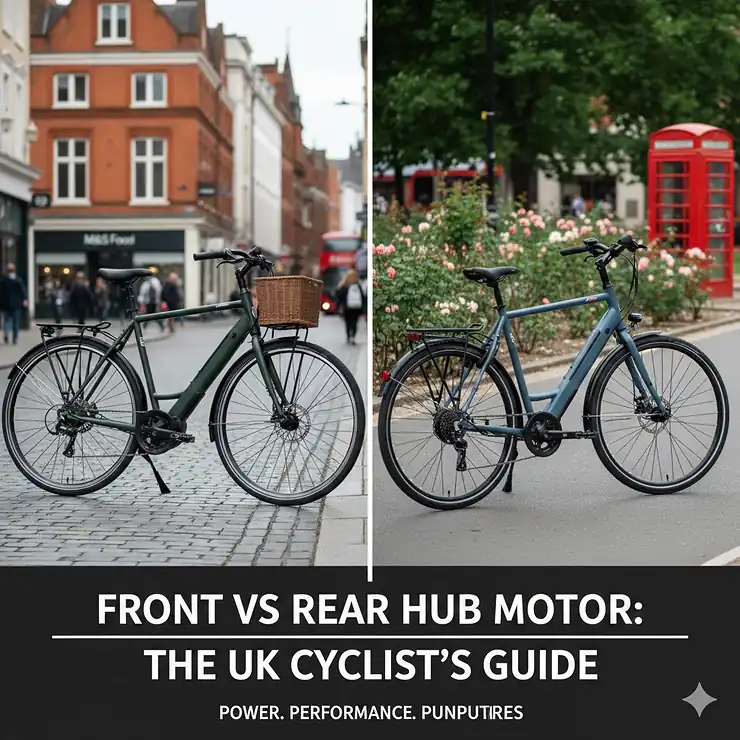
I’ve tested both front and rear hub motor e-bikes across London’s wet streets, Brighton’s hills, and muddy Welsh trails—and I can tell you straight away that motor placement dramatically changes your riding experience. The front vs rear hub motor debate isn’t just technical waffle; it’s about whether you’ll confidently climb that steep commute or watch your wheel spin helplessly in the rain.
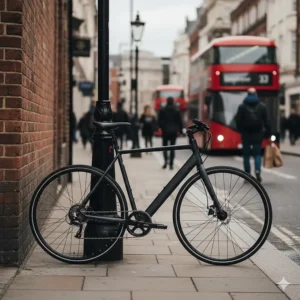
Here’s what most guides won’t tell you: a front hub motor transforms your bike into a bizarre “all-wheel-drive” experience when you’re pedalling, whilst a rear hub motor feels utterly natural but complicates maintenance. Neither is universally “better”—they’re engineered for completely different riding scenarios, and picking the wrong one for your terrain can turn your £500-£1,200 investment into a frustrating paperweight.
In this comprehensive guide, I’ll dissect the front vs rear hub motor question with brutal honesty. We’ll examine real UK products, test traction in wet conditions, analyse weight balance handling, and explore installation complexity. Whether you’re converting your existing bike or purchasing a complete e-bike, you’ll discover precisely which hub motor location suits your riding conditions—backed by physics, not marketing hype.
Quick Comparison Table
| Feature | Front Hub Motor | Rear Hub Motor |
|---|---|---|
| Traction (Wet) | Poor (wheel slip common) | Excellent (body weight presses tyre) |
| Installation Complexity | Easy (20 mins, no derailleur work) | Moderate (30 mins, cassette transfer) |
| Hill Climbing | Struggles 10%+ grades | Confident on 15%+ climbs |
| Weight Balance | Even distribution | Rear-heavy (can feel unbalanced) |
| Power Limit (UK Legal) | 250W optimal | 250W-500W capable |
| Tyre Wear | High (slips waste rubber) | Normal wear pattern |
| Steering Feel | Heavy, gyroscopic effect | Natural, responsive |
| Price Range (UK) | £299-£749 | £449-£1,199 |
💬 Just one click – help others make better buying decisions too!😊
Top 7 E-Bikes & Conversion Kits: Expert Analysis
1. Cyclotricity 250W Front Wheel Conversion Kit
This British-made conversion kit represents the simplest entry into e-biking. The Cyclotricity 250W Front Wheel Conversion Kit (priced £299-£449 depending on battery capacity) transforms any standard bicycle into a legally compliant e-bike in under an hour. The 250W brushless front hub motor integrates into wheel sizes from 20″ to 29er, reaching the UK’s legal 15.5 mph limit whilst preserving your rear drivetrain completely intact.
Key Specifications:
- 250W brushless geared motor (UK/EU legal)
- 36V battery options: 9Ah, 12Ah, 16Ah
- Weight: 4.5kg (motor + wheel)
UK buyers particularly appreciate that installation requires no derailleur adjustment or cassette transfer. You’re essentially replacing your front wheel with a motorised version, connecting the battery, and riding. The LCD dashboard provides speed readings and battery levels—features usually reserved for £1,000+ complete e-bikes.
Customer feedback from UK riders reveals mixed experiences. Urban commuters on flat routes praise the simplicity and adequate power for 20-35 mile ranges. However, cyclists in hilly regions (Lake District, Peak District, Scottish Highlands) report frustrating wheel slip on wet inclines above 8-10% gradient. The physics are unavoidable: when climbing, weight shifts rearward, reducing front tyre contact precisely when the motor demands maximum grip.
Pros:
✅ Simplest installation (under 60 minutes)
✅ Preserves internal gear hubs and belt drives
✅ UK-based support and warranty
Cons:
❌ Poor traction on wet/steep hills (8%+ grades)
❌ Front tyre wears faster from slippage
2. Bafang 48V 500W Front Hub Motor Kit G020
The Bafang 48V 500W Front Hub Motor Kit G020 (£349-£599 on Amazon.co.uk depending on display choice) offers serious power for those willing to navigate UK e-bike regulations. Whilst 500W exceeds legal on-road limits, many riders use this for private land or with controller restrictions to comply with the 250W / 15.5 mph legal framework.
Key Specifications:
- 48V 500W geared motor (65 N.m torque)
- Speed: 38-40 km/h unrestricted (25 km/h UK legal mode)
- Compatible with 20″, 26″, 28″, 29″, 700C wheels
This kit’s engineering surpasses budget alternatives. The 65 N.m torque motor provides noticeably stronger acceleration than 250W counterparts, whilst the planetary gear system inside operates quietly compared to cheaper Chinese motors. Bafang’s reputation—they’ve supplied hub motors since 2003—means replacement parts and technical support remain accessible years after purchase.
UK customers note the kit arrives with comprehensive accessories: LCD display options (500C, DPC18, or colour screens), mechanical brake levers, PAS sensors, and throttle. However, you’ll need to source a compatible 48V battery separately (£200-£400 additional cost), and installation demands basic mechanical competence plus potentially a torque arm for fork reinforcement on aluminium forks.
The front vs rear hub motor traction issue amplifies with 500W. Several UK reviewers in Wales and Scotland report that whilst dry tarmac performance impresses, wet conditions on 12%+ gradients cause persistent front wheel slippage despite the motor’s torque advantage.
Pros:
✅ Powerful 65 N.m torque for confident acceleration
✅ Quality Bafang engineering and long-term support
✅ Multiple display options for customisation
Cons:
❌ Requires battery purchase separately (adds £200-£400)
❌ 500W illegal for UK road use without restriction
3. Cyclotricity Elysium Relay – Front Hub Motor
For riders seeking a complete e-bike rather than a conversion kit, the Cyclotricity Elysium Relay with front hub motor (£649-£849 depending on battery) delivers exceptional value. This British-assembled mountain bike combines a 250W front hub motor with proper mountain bike components: 6-speed Shimano gearing, V-brakes, suspension fork, and 26″ double-wall alloy rims.
Key Specifications:
- 250W front hub motor (UK legal)
- 36V battery: 9Ah (£649), 16Ah (£749), 19Ah (£849)
- Range: 20-45 miles (varies by battery and terrain)
The Elysium Relay targets budget-conscious buyers who want a functional e-bike without the £1,500+ price tags of premium brands. Its 6061 alloy frame suits riders 5’5″ to 6’1″, whilst the front motor configuration keeps weight distribution balanced when paired with the downtube-mounted battery. The 3-level pedal assist provides adequate power for gentle terrain.
UK customer reviews reveal this bike excels for canal paths, park trails, and urban commuting on routes with modest inclines. The Zoom suspension fork absorbs potholes adequately, whilst mudguards and rear rack come fitted as standard—practical touches often charged as extras elsewhere. However, several buyers in Bath and Bristol (notoriously hilly cities) express disappointment with climbing performance in wet weather, echoing the fundamental front vs rear hub motor traction limitation.
Cyclotricity’s hand-building in Britain means customer service accessibility—a significant advantage over Amazon imports where support vanishes after purchase. The one-year warranty and 30-day return policy (mainland UK) provide reassurance.
Pros:
✅ Complete bike with practical accessories fitted
✅ British assembly with accessible customer support
✅ Multiple battery capacities for different budgets
Cons:
❌ Basic V-brakes (disc brakes available on rear hub version)
❌ Front motor struggles on hills (8%+ wet gradients)
4. Bafang 48V 750W Rear Hub Motor Kit
Shifting to rear hub territory, the Bafang 48V 750W Rear Hub Motor Kit (£499-£799 on UK suppliers) represents serious electric assistance for private land use or riders willing to restrict power for road legality. This rear-wheel configuration exploits natural weight distribution for superior traction compared to any front hub alternative.
Key Specifications:
- 48V 750W rear geared motor
- Torque: 80 N.m (significantly higher than front equivalents)
- Compatible with 26″, 27.5″, 700C wheels
The rear hub motor’s placement behind your centre of gravity creates natural traction. When accelerating or climbing, weight shifts rearward—precisely where the motor drives. This physics advantage means rear hub motors handle 15%+ gradients confidently even in wet conditions, whereas front hubs would slip uncontrollably at half that steepness.
Installation complexity increases compared to front alternatives. You’ll need to transfer your cassette or freewheel to the new motorised wheel, adjust derailleur settings, and potentially redish the wheel for proper alignment. Budget 30-45 minutes for a competent home mechanic, or £40-£60 for professional bike shop installation. The motor’s weight (approximately 4.5-5.5kg) concentrates at the rear, creating a noticeably back-heavy feel that some riders find awkward when manoeuvring the bike whilst dismounted.
UK buyers appreciate Bafang’s modular design philosophy. If your controller fails in three years, you’re replacing a £45 component rather than binning the entire system. This longevity focus contrasts sharply with proprietary e-bike systems where battery obsolescence forces complete bike replacement.
Pros:
✅ Excellent traction for hills and wet conditions
✅ Higher power capability (750W) for private land
✅ Modular design enables long-term maintenance
Cons:
❌ Complex installation (cassette transfer required)
❌ Rear-heavy weight distribution affects handling
5. Cyclotricity Elysium Relay – Rear Hub Motor
The rear hub motor variant of the Cyclotricity Elysium Relay (£749-£949) upgrades the front hub version with disc brakes and superior traction. This configuration suits UK riders facing genuine hills—think the South Downs, Cotswolds, or Peak District—where front hub motors admit defeat.
Key Specifications:
- 250W rear hub motor (UK legal)
- 36V battery: 9Ah (£749), 16Ah (£849), 19Ah (£949)
- 7-speed Shimano Tourney gearing
- Mechanical disc brakes front and rear
The rear motor placement transforms climbing performance. Where the front hub Elysium would slip on an 11% wet gradient, this rear version grips confidently up to 14-15% inclines. The disc brakes provide vastly superior stopping power in British weather—essential when you’re descending those same hills at 15.5 mph.
Cyclotricity’s 5-level intelligent pedal assist adapts power delivery more precisely than the front hub’s 3-level system. Level 1 provides gentle assistance for extending battery range, whilst Level 5 delivers full motor support for attacking steep sections. UK customers in hilly regions consistently rate this as the best value e-bike under £1,000 for mixed terrain.
The trade-off? Weight distribution feels distinctly rear-heavy, particularly with the 16Ah or 19Ah battery options. Lifting the bike over barriers or carrying it upstairs requires proper technique, and some riders report the front wheel lifting slightly during maximum acceleration from standstill—though this settles once moving.
Pros:
✅ Reliable hill climbing even in wet conditions
✅ Disc brakes for all-weather stopping power
✅ 5-level pedal assist for precise control
Cons:
❌ Rear-heavy feel when manoeuvring
❌ Flat tyre repairs more complex (motor removal)
6. Swytch Universal Front Hub Conversion Kit
The Swytch Universal Front Hub Conversion Kit (£799-£999 from Swytch.bike) pioneered the ultra-lightweight front hub approach favoured by urban commuters who value portability. This British-designed system packs the battery into a handlebar-mounted bag, creating a removable e-bike system you can transfer between bikes in under 30 seconds.
Key Specifications:
- 250W front hub motor
- Battery: 180Wh or 360Wh (handlebar-mounted bag)
- Weight: 3kg complete system (lightest on market)
Swytch’s genius lies in addressing the front vs rear hub motor debate from a different angle entirely. Rather than competing on power or traction, they’ve optimised for weight and versatility. The complete 3kg system means your converted bike remains liftable, whilst the quick-release battery bag prevents theft concerns when locking up.
UK commuters who cycle 5-10 miles daily through London, Manchester, Birmingham, or Edinburgh appreciate the minimalist philosophy. You’re not building a powerhouse hill climber; you’re adding gentle assistance for arriving at work without sweating through your shirt. The 180Wh battery provides 15-20 miles of range, whilst the 360Wh extends this to 30-40 miles—sufficient for most urban commutes with charging at the destination.
However, Swytch experienced substantial delivery delays throughout 2024-2025, frustrating many early customers. Recent reviews suggest fulfilment has improved, but potential buyers should verify current lead times before ordering. The system’s minimalist power also means hilly commutes quickly expose its limitations—this isn’t the kit for conquering Edinburgh’s Castle Rock or Sheffield’s notorious gradients.
Pros:
✅ Lightest e-bike system available (3kg total)
✅ Removable battery prevents theft
✅ Transfer between multiple bikes in seconds
Cons:
❌ Limited range (15-20 miles on 180Wh battery)
❌ Minimal power for steep hills
7. Cytronex C1 Rear Hub Motor System
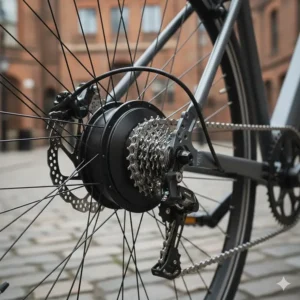
For riders prioritising stealth over raw power, the Cytronex C1 Rear Hub Motor System (£1,295-£1,495 depending on battery) offers the most discreet e-bike conversion available in the UK. This British-engineered rear hub system hides a tiny 250W motor inside the rear hub, powered by a bottle-shaped battery that mimics a standard water bottle.
Key Specifications:
- 250W rear hub motor (ultra-compact design)
- 36V 6Ah battery (styled as water bottle)
- Weight: 2.8kg (motor + battery)
- Range: 25-40 miles
Cytronex’s obsession with invisibility means this system doesn’t scream “e-bike” to onlookers or potential thieves. The rear hub motor measures barely larger than a standard hub, whilst the bottle battery sits in your frame’s bottle cage looking entirely inconspicuous. The controller and sensors integrate so cleanly that even experienced cyclists often can’t identify the electric assistance.
The rear hub motor configuration provides decent traction despite the modest 250W output, making this suitable for rolling terrain rather than mountain passes. Cytronex designed the system specifically for road bikes, gravel bikes, and touring bikes where preserving the bicycle’s character matters more than maximum power. UK customers who’ve tested Cytronex on everything from vintage steel frames to modern carbon bikes praise the barely-there installation aesthetic.
Premium pricing reflects British engineering and white-glove service—Cytronex offers professional installation nationwide for an additional £150, and their comprehensive support continues years after purchase. This isn’t competing with £300 Chinese conversion kits; it’s targeting discriminating riders willing to pay for refinement and longevity.
Pros:
✅ Most discreet e-bike system available
✅ Lightweight 2.8kg doesn’t compromise bike handling
✅ British engineering with excellent UK support
Cons:
❌ Premium £1,295-£1,495 pricing
❌ Modest 6Ah battery limits range (25-40 miles)
✨ Don’t Miss These Exclusive Deals!
🔍 Take your electric biking to the next level with these carefully selected products. Click on any highlighted item to check current pricing and availability on Amazon.co.uk. These kits and bikes will help you create authentic cycling freedom your family will love!
Understanding Hub Motor Technology: How Location Affects Performance
The fundamental difference between front vs rear hub motor placement stems from weight distribution physics that no marketing department can circumvent. When you accelerate on any bicycle—electric or otherwise—Newton’s laws create a weight transfer rearward. Imagine launching quickly from traffic lights: you feel your body press backward into the saddle whilst your hands lighten on the handlebars. This weight shift reduces pressure on the front tyre contact patch whilst increasing it on the rear.
A front hub motor must overcome this physics reality. As documented in traction engineering research, the coefficient of friction between tyre and road depends directly on normal force (weight pressing down). When accelerating uphill, front wheel loading can decrease by 30-45% compared to static conditions, dramatically reducing available traction. This explains why front hub motors spin helplessly on 10%+ wet gradients whilst rear hub motors grip confidently.
Rear hub motors exploit this weight transfer. The same physics that sabotages front motors becomes an advantage when the motor sits at the weighted end. Your body mass (typically 60-95kg) plus the motor and battery weight (6-12kg) concentrate over the rear axle, pressing the drive tyre firmly against tarmac. This natural traction advantage allows rear hub motors to transmit significantly more torque before breaking traction—critical for hill starts and acceleration.
However, rear hub motor placement creates its own complications. The rear triangle of bicycle frames wasn’t originally designed to handle motor torque plus pedalling forces simultaneously. Quality rear hub conversions require torque arms—metal braces that prevent the motor’s rotational force from twisting the rear dropouts. Cheaper conversion kits often omit these critical components, leading to frame damage or catastrophic failures months after installation.
Installation complexity diverges significantly between motor locations. Front hub conversion involves removing your existing front wheel, installing the motorised replacement, mounting the battery, and connecting cables. No drivetrain components require adjustment—your chain, cassette, and derailleur remain completely undisturbed. A mechanically confident rider completes this in 20-30 minutes.
Rear hub installation demands mechanical competence. You’ll remove the rear wheel, transfer the cassette or freewheel from the original wheel to the motorised hub (requiring specific tools like a cassette lockring tool and chain whip), reinstall the motorised wheel, adjust derailleur indexing to compensate for potential dish changes, install torque arms, and route cables. Budget 35-50 minutes minimum, and recognise this exceeds many riders’ comfort level—hence the £40-£60 professional installation fees quoted by UK bike shops.
The handling characteristics diverge measurably. Front hub motors create a gyroscopic effect—the spinning motor wheel resists directional changes, making the handlebars feel heavier and less responsive, particularly noticeable at speeds above 12 mph when cornering. Some riders adapt within a few journeys; others never quite adjust to the unnatural steering feel. Rear hub motors preserve normal steering response but shift the bike’s centre of gravity rearward, occasionally causing the front wheel to lift slightly during hard acceleration or when ascending very steep gradients.

Traction in Wet Conditions: The Critical Safety Factor
British weather transforms the front vs rear hub motor debate from academic to critical. When roads glisten with drizzle, autumn leaves coat cycle paths, or winter’s first frost surprises morning commuters, traction differentiates confidence from catastrophe.
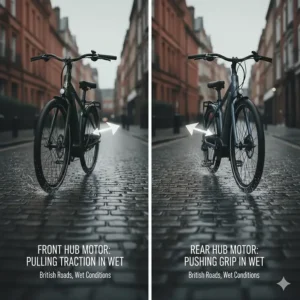
Front hub motors suffer disproportionately in wet conditions due to the weight transfer phenomenon intensified by slippery surfaces. On dry tarmac, a front hub might manage an 8-9% gradient with moderate slippage. Add rain, and that same motor spins uselessly on 5-6% inclines. The physics compounds: reduced front wheel loading (from acceleration weight transfer) multiplied by reduced coefficient of friction (wet surface) equals dramatically diminished available traction.
UK cyclists in regions with serious topography—Yorkshire Dales, Scottish Highlands, Welsh valleys—report consistent frustration with front hub motors in wet conditions. One Newcastle-based rider noted in an online forum that their 250W front hub “became a liability on wet climbs, spinning the tyre bald in six months whilst barely making it up gradients I’d previously pedalled unassisted.” This isn’t hyperbole; front tyre wear measurably increases when motors slip regularly, with some users replacing front tyres every 500-800 miles versus the typical 2,000-3,000 mile lifespan.
Rear hub motors demonstrate superior wet traction through simple physics. The weight concentration over the rear axle maintains friction even when roads turn slick. Independent testing by cycling organisations suggests rear hub motors maintain approximately 60-70% of dry-road traction in wet conditions, whilst front hubs plummet to 30-40%. This difference means a rear hub motor confidently climbs a 12% wet gradient that would leave a front hub spinning hopelessly.
The traction advantage extends beyond hills. Urban riding involves frequent acceleration from traffic lights, roundabouts, and junctions—scenarios where wet road surfaces commonly accumulate. Rear hub motors deliver smooth, controlled power delivery without wheel spin, whilst front hub users learn to modulate throttle or pedal assist carefully to prevent the disconcerting sensation of front wheel breakaway.
However, wet conditions introduce one rear hub vulnerability: rear wheel skidding during braking on steep descents. The same weight concentration that aids climbing can overwhelm rear brake traction when descending wet hills, particularly if riders apply rear brake too aggressively. This highlights why the rear hub Cyclotricity Elysium specifies disc brakes—superior modulation prevents lockup far more effectively than rim brakes in wet conditions.
For UK riders who genuinely face wet hills regularly, the front vs rear hub motor question answers itself: rear hub motors provide the traction margin that separates confident riding from walking sections of your commute.
Weight Balance and Handling Characteristics
Weight distribution profoundly influences how an e-bike feels beneath you, particularly when manoeuvring at low speeds, navigating tight spaces, or simply hauling your bike up stairs. The front vs rear hub motor placement creates fundamentally different weight balances, each with distinct advantages and compromises.
Front hub motors theoretically offer superior weight distribution by counterbalancing rear-mounted batteries. Many e-bike designs position the battery on a rear rack or within the rear triangle, concentrating 2.5-4kg at the back. Placing a 3-5kg motor in the front wheel creates a more balanced 50/50 weight distribution, potentially improving handling compared to an all-rear-heavy configuration.
However, this theoretical advantage rarely materialises perfectly in practice. The motor’s unsprung weight—mass not supported by suspension—creates handling peculiarities. When the front wheel encounters a pothole, the heavy motor wants to drop faster and rebound harder than a standard wheel, transmitting more shock through the fork and handlebars. Riders report a harsher, less controlled feel over rough surfaces, and front suspension forks exhibit faster wear due to the additional unsprung mass they must control.
The gyroscopic effect becomes increasingly noticeable as speed increases. A spinning front hub motor—particularly the heavier direct-drive types—creates angular momentum that resists directional changes. When you lean into a corner at 15-18 mph, the motor essentially tries to hold the bike upright, requiring more handlebar input to initiate turns. Experienced motorcyclists recognise this phenomenon from heavyweight wheels; bicycle riders accustomed to nimble, responsive steering often find it disconcerting.
Rear hub motors eliminate the gyroscopic steering interference but concentrate weight dramatically at the back. With a typical 250W rear hub motor (4-5.5kg) plus battery (2.5-4kg) plus rider’s rearward weight bias, the rear axle bears substantial loading. This creates a rear-heavy feel most noticeable when:
Manoeuvring whilst dismounted: Lifting the bike over barriers, carrying it upstairs, or loading it onto car racks requires more effort. The rear-heavy balance means you’re essentially lifting against a longer lever arm.
Low-speed balance: Track-standing at traffic lights or navigating tight car parks feels different. The rear weight concentration raises the effective centre of gravity, making balance minutely more precarious until you adapt.
Hard acceleration from standstill: Maximum throttle or highest pedal assist from a dead stop can cause the front wheel to lighten noticeably, occasionally even lifting on very powerful motors (500W+) if the rider simultaneously stands on the pedals.
For UK riders prioritising handling finesse—think those navigating central London’s chaotic traffic or threading through Birmingham’s tight cycle lanes—front hub motors preserve more natural steering feel despite their other limitations. Conversely, riders who value traction and don’t mind a rear-biased feel find rear hub motors acceptable after a brief adaptation period.
Neither configuration matches the handling purity of mid-drive motors, which concentrate weight at the frame’s centre of gravity. But mid-drives cost substantially more (£1,200-£3,500 complete bikes) and introduce their own complexity through drivetrain integration—making hub motors the pragmatic choice for budget-conscious conversions and entry-level e-bikes.
Installation Complexity: DIY vs Professional Installation
The front vs rear hub motor installation complexity gap separates weekend DIYers from those requiring professional assistance. Understanding these differences helps you budget both time and potential shop labour costs accurately.
Front Hub Motor Installation (20-30 minutes):
The process remains remarkably straightforward for mechanically confident cyclists. You’ll need basic tools—15mm or adjustable spanners, Allen keys—and follow this sequence:
- Remove existing front wheel (quick-release or thru-axle)
- Install motorised wheel, ensuring proper alignment in fork dropouts
- Mount battery to frame (downtube or rear rack depending on kit)
- Connect motor cable to controller
- Attach LCD display and PAS sensor
- Route cables tidily with provided zip ties
- Test system before riding
The critical advantage? Your rear drivetrain remains completely untouched. Gears, derailleur, cassette, and chain continue functioning exactly as before conversion. This preservation of rear components means fewer things can go wrong during installation and simpler troubleshooting if issues arise.
Front hub kits like the Cyclotricity 250W or Swytch system include comprehensive instructions, and numerous YouTube tutorials demonstrate each step. UK bike shops typically charge £30-£40 for professional installation if you lack confidence, though most find the process achievable after watching a video walkthrough.
Rear Hub Motor Installation (35-50 minutes):
Rear installation demands additional mechanical knowledge and specialised tools:
- Remove existing rear wheel
- Transfer cassette or freewheel to motorised hub (requires cassette lockring tool + chain whip, or freewheel remover)
- Ensure proper wheel dishing (spoke tension balance)
- Install torque arms to prevent dropout twisting
- Reinstall motorised wheel, carefully threading chain
- Adjust derailleur indexing (may require B-screw and limit screw tweaking)
- Mount battery and controller
- Connect motor, controller, display, PAS sensor, brake sensors
- Route cables avoiding moving parts
- Test all gears and electrical functions thoroughly
The cassette transfer alone intimidates many riders. You’re removing a tightly-secured cassette (often requiring significant force), transferring spacers correctly, and reinstalling with proper torque (typically 40 N.m). Mistakes can result in shifting problems, cassette loosening whilst riding (catastrophic if it happens), or wheel dishing issues causing chain alignment problems.
Professional installation for rear hub kits costs £50-£70 at UK bike shops—worthwhile for riders uncertain about their mechanical skills. The labour includes proper torque arm installation (critical for safety) and derailleur adjustment (essential for smooth shifting).
Hybrid option: Some UK retailers like Cyclotricity and independent e-bike specialists offer “pre-built wheel” services where they transfer your cassette to the motorised hub before shipping, reducing installation complexity whilst adding £30-£40 to the kit price.
For riders converting multiple bikes or planning long-term e-bike engagement, learning rear hub installation provides valuable skills. But for one-off conversions on your daily commuter, the £50-£70 professional installation often represents money well spent compared to potential frustration and mistakes.
Power Output Considerations: UK Legal Limits vs Performance
UK and European law strictly regulate e-bike motor power, creating a framework that influences the front vs rear hub motor debate. According to GOV.UK official guidance, understanding these regulations helps you select appropriate motors whilst avoiding illegal configurations that could void insurance or result in fines.
UK Legal Framework:
Electrically Assisted Pedal Cycles (EAPCs) must meet these criteria for road use as defined by The Electrically Assisted Pedal Cycles Regulations 2015:
- Maximum continuous rated power: 250 watts
- Motor assistance cuts off at 15.5 mph (25 km/h)
- Motor only assists whilst pedalling (throttle limited to 3.7 mph walking assistance)
- Rider must be 14+ years old
- No licence, tax, or insurance required
These regulations mirror EU standards, though post-Brexit the UK technically uses UKCA certification rather than CE marking. In practice, virtually all e-bikes sold in Britain still carry CE marking and comply with both frameworks.
Front hub motors rarely exceed 250W in UK-marketed kits precisely because higher power exacerbates the traction problem. A 500W front hub motor multiplies the wheel slip issue—you’re demanding more torque through a contact patch with less weight over it. This physical reality explains why reputable manufacturers like Cyclotricity and Swytch limit front hubs to 250W for UK customers.
Rear hub motors handle higher power more gracefully due to superior traction. The Bafang 48V 750W rear hub demonstrates this—whilst illegal for UK road use without power restriction, it showcases rear placement’s ability to transmit substantial torque without wheel slip. Some UK riders purchase these powerful motors intending private land use (where EAPC regulations don’t apply), though compliance responsibility rests with the user.
Power vs Torque Distinction:
Many riders conflate watts (power) with torque (rotational force), but they measure different characteristics. A 250W motor’s ability to climb hills depends heavily on its torque output, typically measured in Newton-metres (N.m). Geared hub motors like those in Bafang kits use internal planetary gears to multiply torque, achieving 40-65 N.m from 250-500W inputs. This explains how a quality 250W geared motor outclimbs a cheap 350W direct-drive motor—superior torque multiplication matters more than raw wattage.
For UK riders prioritising legal compliance, 250W motors from reputable manufacturers (Bafang, Cyclotricity, Swytch, Cytronex) provide adequate power for most terrain. The front vs rear hub motor question becomes more about traction and handling than power limitations, as both configurations work within the 250W legal ceiling.
Riders tempted by higher-power Chinese imports should recognise the legal risks. If involved in an accident whilst riding an illegal 500W+ motor on public roads, insurance companies may deny claims, and police could confiscate the bike or prosecute under motor vehicle regulations. For private land use—farm trails, your own property—these powerful motors make sense. For UK road commuting, stick with legal 250W options.
Maintenance and Long-Term Reliability
Hub motors’ sealed design theoretically requires minimal maintenance, but practical reality introduces considerations that differ between front and rear placements.
Front Hub Motor Maintenance:
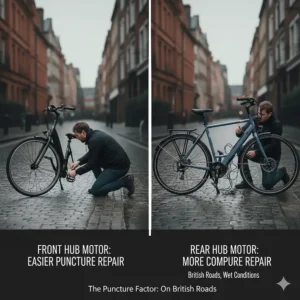
The most frequent issue? Flat tyres. Whilst seemingly trivial, front hub motor wheels complicate puncture repairs compared to standard wheels. You’ll need:
- Disconnect motor cable from controller (simple plug)
- Remove wheel from fork (standard procedure)
- Remove tyre and tube (standard procedure)
- Repair or replace tube
- Reinstall tyre, ensuring motor cable routes through axle correctly
- Reinstall wheel and reconnect motor
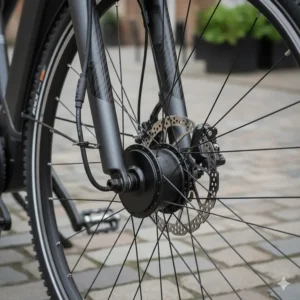
The additional weight (3-5kg motor) makes tyre removal slightly more awkward, though experienced riders manage this efficiently. Front hub motors’ isolation from the drivetrain means you’ll never need to adjust the motor itself—it either works or fails, with no routine maintenance required.
Long-term reliability depends heavily on motor quality. Premium geared motors (Bafang, Shimano, Bosch) typically survive 5,000-10,000+ miles before internal gear wear becomes noticeable. Budget Chinese motors may exhibit problems within 1,000-2,000 miles—grinding noises from worn planetary gears, reduced power output, or complete failures. UK buyers benefit from purchasing through reputable domestic suppliers who’ll honour warranties rather than fighting Amazon sellers who disappear post-purchase.
Rear Hub Motor Maintenance:
Puncture repairs on rear hub motors introduce significantly more complexity:
- Disconnect motor cable, controller wiring, brake sensor
- Remove rear wheel (requires chain removal or opening)
- Navigate heavy motorised wheel without damaging connections
- Tyre removal and tube repair (heavy 4-5.5kg wheel)
- Reinstall tyre and tube
- Reinstall heavy wheel, thread chain correctly
- Reconnect all electrical connections
- Check derailleur adjustment hasn’t shifted
The additional 20-30 minutes versus a standard rear wheel puncture frustrates many riders. Several UK cyclists report carrying spare tubes and portable pumps specifically to avoid roadside repairs—you can ride slowly on a slightly flat rear tyre to reach home or a bike shop rather than wrestling with the motorised wheel beside a muddy towpath.
Drivetrain wear accelerates with rear hub motors. The motor delivers power through the cassette/freewheel, chain, and chainrings—the same components handling your pedalling power. This dual loading means chains and cassettes wear approximately 20-30% faster than on non-electric bikes. UK riders should budget for chain replacement every 1,500-2,000 miles and cassette replacement every 3,000-4,000 miles—more frequent than traditional cycling’s 2,000-3,000 mile chains and 6,000+ mile cassettes.
Battery maintenance applies equally to both motor placements. UK weather demands careful battery management—store indoors during winter, never charge in freezing temperatures, and maintain 40-80% charge for long-term storage. Lithium batteries degrade regardless of use, losing approximately 2-5% annual capacity. After five years, expect your original 16Ah battery to deliver closer to 13-14Ah, reducing range proportionally.
Cost Analysis: Initial Investment and Running Costs
The front vs rear hub motor economic comparison extends beyond initial purchase price to encompass running costs, maintenance expenses, and depreciation.
Initial Investment Comparison (UK Market 2026):
| Category | Front Hub | Rear Hub |
|---|---|---|
| Budget Conversion Kit | £299-£449 | £449-£599 |
| Mid-Range Kit | £599-£899 | £699-£999 |
| Complete Budget E-Bike | £649-£899 | £749-£1,199 |
| Complete Mid-Range E-Bike | £1,095-£1,495 | £1,295-£1,995 |
Front hub kits consistently cost £100-£200 less than equivalent rear hub systems. This price gap reflects simpler manufacturing (no cassette/freewheel interface complexity) and reduced labour for installation.
Running Cost Differentials (Annual, 2,000 miles/year):
Front Hub Motor:
- Electricity (charging): £18-£25
- Front tyre replacement (increased wear): £25-£35
- Standard maintenance: £60-£80
- Annual total: £103-£140
Rear Hub Motor:
- Electricity (charging): £18-£25
- Accelerated chain wear: £15-£25
- Accelerated cassette wear (prorated): £20-£30
- Standard maintenance: £60-£80
- Annual total: £113-£160
The running cost difference remains modest—£10-£20 annually favouring front hubs. However, rear hub motors’ superior traction often translates to extended battery range by eliminating the wasted energy from wheel slip, potentially offsetting maintenance differentials.
Long-Term Value Considerations:
Depreciation hits all e-bikes aggressively, with typical 40-50% value loss within two years. However, well-maintained Bafang rear hub conversions retain better residual value than budget front hub systems—experienced buyers recognise quality components and traction advantages.
For UK riders planning 5-10 years of ownership, total cost of ownership strongly favours purchasing quality once rather than replacing budget failures. A £799 Bafang rear hub kit serviced properly delivers 8,000-15,000 miles before requiring motor replacement, whilst a £299 generic Chinese front hub might fail at 2,000-4,000 miles, requiring complete replacement rather than repair.
The smartest economic approach? Match motor location to your actual riding terrain. Buying a £1,200 rear hub motor for flat urban commuting wastes money—a £649 front hub Cyclotricity provides identical functionality. Conversely, skimping with a £299 front hub for hilly Welsh valleys guarantees frustration and premature replacement—invest the £749 for a proper rear hub initially.
Frequently Asked Questions
❓ Can I use a front hub motor for hilly terrain in the UK?
❓ Which hub motor location offers better range on a single charge?
❓ Are front hub motors legal for UK road use?
❓ How difficult is rear hub motor installation for beginners?
❓ Do front or rear hub motors handle wet British weather better?
The front vs rear hub motor question ultimately demands honest assessment of your actual riding conditions rather than aspirational scenarios. If your daily commute traverses canal paths, urban streets, and gentle undulations with only occasional 5-7% hills, a front hub motor’s simplicity and lower cost make perfect sense. You’ll appreciate the straightforward installation, balanced weight distribution, and adequate power delivery for £200-£300 less than rear hub equivalents.
However, if you genuinely face steep gradients regularly, encounter wet or loose surfaces, or value confident traction over installation simplicity, rear hub motors justify their additional complexity and cost. The physics advantage of weight-optimised traction proves insurmountable for front hubs—no amount of motor power compensates for a tyre with insufficient weight pressing it to tarmac.
For UK riders in truly hilly regions (anywhere with frequent 10%+ gradients), the front vs rear hub motor debate answers itself decisively: rear hub every time. The traction margin separates enjoyable commuting from walking sections whilst your front wheel spins uselessly.
Consider your budget realistically too. If £300-£450 represents your absolute spending ceiling, a quality front hub kit like Cyclotricity’s 250W delivers legitimate e-bike assistance for appropriate terrain. Stretching beyond your means to purchase a rear hub you don’t actually need makes little sense. Conversely, buying a budget front hub for genuinely hilly commutes guarantees frustration—save another few months and invest in the proper rear hub solution.
The best advice? Honestly assess your hilliest, wettest regular route. If a front hub motor would slip there, you need rear hub traction. If not, enjoy the front hub’s simplicity and lower cost without regret.
Recommended for You
- 7 Best Rear Hub Motor Ebikes UK 2026 (Budget Friendly Guide)
- 7 Most Reliable EBike Motor UK 2026
- 7 Best Mid Drive Ebikes UK 2026: Superior Power & Control
Disclaimer: This article contains affiliate links. If you purchase products through these links, we may earn a small commission at no additional cost to you. Prices shown are approximate and may vary.
✨ Found this helpful? Share it with your mates! 💬🤗
