In This Article
Right, let’s get one myth out of the way before we go any further: voltage is not power. A 48v system electric bike torque setup doesn’t automatically mean “faster” — it means the motor can shove harder for longer without breaking a sweat, which on a British hill is a completely different superpower. Ask anyone who’s ground their way up the climb out of Hebden Bridge on a tired 36V hub motor, watching the assistance fade to nothing exactly when they needed it most. That’s a voltage problem, not a fitness problem.
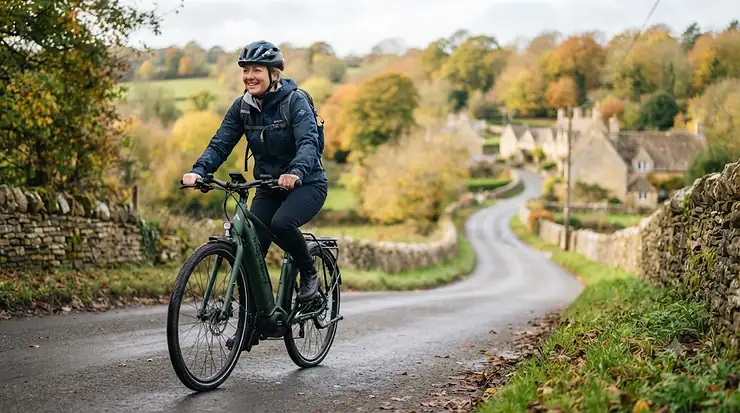
So what is 48v system electric bike torque, really? In short: it’s the rotational shove your motor produces when running on a 48-volt battery pack, typically expressed in Newton-metres (Nm), and it’s the single figure that tells you how an e-bike will actually feel under load — starting from a standstill, hauling shopping up a kerb, or grinding up a 12% gradient — rather than how fast it’ll cruise on the flat.
Here’s why this matters more than most spec sheets let on. UK law caps every road-legal e-bike at 250W continuous power, as Cycling UK explains in its EAPC guidance, so wattage alone can’t be your differentiator — every legal bike is playing with the same power ceiling. Voltage is where manufacturers find genuine headroom, and that’s exactly why 48V systems have quietly become the default for anyone who actually rides hills, carries weight, or commutes somewhere with more gradient than a car park ramp.
Over the next several thousand words, we’ll dig into seven real 48V bikes on the UK market, work out which torque figures genuinely matter, and answer the questions that actually decide whether you’ll be happy with your purchase in six months’ time — not six days. Prices below are indicative ranges only; always check current pricing before buying, as availability and cost shift constantly.
Quick Comparison Table
Before the deep dive, here’s the shortlist. Torque figures below are motor-rated Nm at 48V, and range assumes moderate assist unless stated.
| Bike | Torque | Battery | Best For |
|---|---|---|---|
| Engwe EP-2 3.0 Boost | 75Nm | 48V 13.5Ah | Budget torque-sensor folder |
| Hygge Vester | Standard 250W | 48V 14Ah Samsung | Simple, reliable folding commuter |
| Engwe E26 | 70Nm | 48V 16Ah | Heavy-duty budget workhorse |
| ADO Air 20 Pro/Ultra | Refined hub delivery | 48V | Smoothest premium folder |
| Engwe Engine Pro 3.0 Boost | 90Nm | 48V Samsung | Serious hill climbing, full suspension |
| ADO L20 3.0 Pro | 100Nm (mid-drive) | 48V 15Ah Samsung | Longest range, steepest commutes |
| Shengmilo S600 | Dual 1000W motors | 48V 17.5Ah Samsung | Off-road, private-land power |
Looking at the spread here, the jump from hub-motor torque sensors in the 70-90Nm range to the ADO L20 3.0 Pro‘s mid-drive 100Nm tells its own story: mid-drives multiply torque through the gears rather than delivering it raw at the wheel, so the number alone undersells how much steeper a hill it’ll shrug off. Meanwhile the Shengmilo S600 plays an entirely different game — its dual-motor setup is built for private land, not the school run, and that distinction genuinely matters for legal compliance.
💬 Just one click — help others make better buying decisions too!😊
Top 7 48V Electric Bikes: Expert Torque Analysis
Picking a 48V bike isn’t just about the biggest number on the spec sheet. Below are seven real, currently available UK models spanning budget to premium, each analysed for what its torque figure actually delivers on the road.
1. Engwe EP-2 3.0 Boost — proportional torque sensor at a budget price
The headline here isn’t the motor size — it’s the sensor type. Where cheaper e-bikes use cadence sensors that dump a fixed lump of assistance the moment the pedals turn, the EP-2 3.0 Boost pairs its 48V 250W hub motor with a genuine torque sensor, reading how hard you’re actually pushing and scaling the response accordingly. That’s the difference between assistance that lurches and assistance that simply helps.
On paper this is a modest-looking 75Nm, but paired with proportional delivery it feels far more natural under load than raw numbers suggest — you get shove exactly when your legs ask for it, not a beat later. The 48V 13.5Ah battery is good for roughly 100-120km on the lowest assist setting, dropping if you lean on the throttle, and the 20×4-inch fat tyres soak up potholes and cobbles without complaint. Based on the spec comparison against similarly priced hub-motor folders, the 150kg payload rating stands out — this is a frame built for bigger or loaded riders, not just city sprites.
Reviewers on UK retailer platforms consistently flag the torque sensor’s smoothness as the standout feature at this price point, with several noting it feels closer to a premium bike’s power delivery than its cost suggests. A recurring theme in owner feedback is that the folding mechanism, while functional, doesn’t disguise the bike’s genuine heft.
Pros:
- ✅ Genuine torque sensor for proportional, natural assistance
- ✅ 150kg payload suits bigger and loaded riders
- ✅ Fat tyres handle poor UK road surfaces confidently
Cons:
- ❌ At over 32kg, “folding” doesn’t mean “easy to lift”
- ❌ Recommended rider height tops out around 6’2″
At around £1,050-£1,150 (check current price), the Engwe EP-2 3.0 Boost represents genuine value for anyone wanting real torque-sensor feel without premium-bike spending.

2. Hygge Vester — best straightforward folding commuter
The Hygge Vester doesn’t chase big torque figures — it chases reliability, and for a lot of commuters that’s the smarter trade. It runs the standard UK-legal 250W motor configuration on a 48V 14Ah Samsung-cell battery, delivering up to roughly 80km of range depending on conditions.
What most buyers overlook about this model is the battery cell quality: Samsung cells generally offer more consistent discharge curves than unbranded alternatives, meaning the power you get on hour one of a ride is closer to what you get on hour three. The 20-inch fat tyres paired with front suspension smooth out the worst of British winter roads, and integrated LED lighting front and rear means you’re legally and practically visible without buying accessories separately.
Here’s what the spec sheet won’t tell you, but UK owner feedback suggests: Hygge’s after-sales network across British bike shops is a genuine differentiator for a budget-adjacent import brand, meaning warranty issues tend to get resolved locally rather than via slow overseas shipping — a real consideration when something as unglamorous as a controller fault can otherwise leave a bike unusable for weeks.
Pros:
- ✅ Samsung battery cells for consistent, reliable discharge
- ✅ Strong UK after-sales and repair network
- ✅ Compact folding frame genuinely saves storage space
Cons:
- ❌ Standard torque delivery lacks the punch of sensor-based rivals
- ❌ Range trails behind larger-battery competitors on this list
Priced in the mid-£800s to low-£900s range (check current price), the Hygge Vester suits riders who want dependable 48V commuting without chasing maximum climbing numbers.
3. Engwe E26 — the budget workhorse with real hauling power
The E26’s calling card is straightforward: a 750W-rated motor (1000W peak) delivering 70Nm of torque from a substantial 48V 16Ah battery, which works out to roughly 768Wh of stored energy — genuinely large for its price bracket. Reviewers testing the E26 consistently describe it as more capable than its cost would suggest, particularly when loaded with cargo or a passenger’s worth of shopping.
Based on the spec comparison with lighter hub-motor bikes, what stands out is the sheer size of the battery relative to price — most rivals in this bracket ship with 13-14Ah packs, so the extra capacity translates directly into fewer charging anxieties on longer rides. The 26×4-inch fat tyres and 6061 aluminium frame are built for durability over refinement, and the bike’s 74lb (roughly 34kg) weight reflects that priority.
Aggregated owner feedback across retailer review sections repeatedly praises the hydraulic disc brakes — a genuinely premium inclusion at this price — while a recurring complaint centres on the 7-speed Shimano Tourney drivetrain feeling under-geared for sustained climbing given the bike’s overall mass. It’s a hardtail despite “full suspension” marketing language on some listings, so temper expectations for rear-wheel comfort accordingly.
Pros:
- ✅ Large 768Wh battery gives genuine long-range confidence
- ✅ Hydraulic disc brakes rare at this price point
- ✅ Robust aluminium frame handles heavy cargo well
Cons:
- ❌ 7-speed drivetrain feels underpowered on sustained climbs
- ❌ Marketed “full suspension” is actually a hardtail with seat-post give only
At roughly £950-£1,100 (check current price), the Engwe E26 is the pick for riders who value range and braking power over outright climbing finesse.
4. ADO Air 20 Pro/Ultra — the smoothest premium folder in this guide
Where the previous bikes lean on raw torque numbers, the Air 20 Pro/Ultra sells a different proposition entirely: refinement. This is the bike that feels genuinely premium every time you unfold it, prioritising smooth, predictable power delivery over headline-grabbing Nm figures.
What that means in practice is a 48V hub system tuned for gentle, linear assistance rather than aggressive low-end shove — brilliant for flat-to-moderate commutes through town centres, less suited to riders who live at the top of a proper hill. Reviewers who’ve compared it directly against harder-hitting mid-drive rivals note it has less outright climbing grunt but wins comfortably on day-to-day polish: fold quality, cable routing, and overall build fit-and-finish. Worth noting, ADO has an updated Ultra variant arriving in spring 2026 with a punchier 50Nm motor, IPX6 waterproofing, and NFC power-on — so it’s worth checking the current product page for the latest specification before buying.
Here’s what most buyers overlook: a smoother, more linear power curve isn’t a downgrade for urban riders — it’s often exactly what you want when weaving through pedestrians and traffic, where sudden torque spikes can feel unpredictable rather than helpful.
Pros:
- ✅ Exceptionally smooth, predictable power delivery
- ✅ Premium fold quality and everyday build refinement
- ✅ Updated Ultra variant brings genuine 2026 spec improvements
Cons:
- ❌ Less outright torque than mid-drive or boosted hub rivals
- ❌ Recommended rider height tops out around 6’2″, limiting taller riders
Sitting in the £1,300-£1,600 range (check current price), the ADO Air 20 Pro/Ultra rewards riders who prioritise ride quality over maximum hill-climbing capability.
5. Engwe Engine Pro 3.0 Boost — serious torque for serious hills
This is where the guide shifts from “capable” to “genuinely powerful.” The Engine Pro 3.0 Boost runs a 90Nm boosted motor on a removable Samsung battery, and Engwe quotes up to 130km of range — figures that, even allowing for optimistic manufacturer testing conditions, put this bike in a different performance bracket to the budget entries above.
Based on the spec comparison against the rest of this list, 90Nm is the highest hub-adjacent torque figure here outside the mid-drive ADO L20 3.0 Pro, and it’s paired with an ultra-sensitive torque sensor that Engwe says responds “from the first pedal stroke” — a claim broadly consistent with how torque-sensor systems at this tier tend to behave versus cadence-only rivals. The full suspension setup (front fork plus rear travel) and fat tyres mean rough surfaces get properly absorbed rather than merely tolerated, and GPS anti-theft tracking via companion app adds genuine security value that budget models simply don’t offer.
What the spec sheet won’t tell you is how the extra torque changes riding psychology on hills: instead of standing on the pedals and hoping, you sit and let the motor do the grinding, which matters enormously for anyone managing joint pain or reduced leg strength.
Pros:
- ✅ 90Nm boosted torque handles serious gradients confidently
- ✅ GPS anti-theft tracking via smartphone app
- ✅ Full suspension smooths rough and unpaved surfaces
Cons:
- ❌ Among the heavier folding bikes in this guide
- ❌ Premium positioning means a genuine step up in price
Expect to pay in the £1,600-£1,900 range (check current price) for the Engwe Engine Pro 3.0 Boost — a legitimate investment for hilly commutes or weekend trail use.

6. ADO L20 3.0 Pro — the mid-drive torque king
If raw climbing capability is what brought you to this article, the L20 3.0 Pro is likely the answer. Its Mivice X700 mid-drive motor produces 100Nm of torque — in a completely different league to the hub motors elsewhere in this guide, because mid-drive systems deliver power through the bike’s own gears rather than directly to the wheel.
What that means practically: on steep gradients, you can drop into a low gear and let the motor multiply its torque through the drivetrain, producing smoother, more efficient climbing than any hub motor can manage regardless of its Nm rating. The 48V 15Ah Samsung battery paired with an 8A fast charger delivers up to 160km of range — the longest figure in this entire roundup — while the front hydraulic fork with adjustable lockout and 30mm rear suspension travel keep the ride composed across varied UK surfaces. The Shimano 7-speed drivetrain is unglamorous but genuinely reliable and easy to service at any high-street bike shop.
Retailers who sell heavily into the UK’s Cycle to Work scheme report remarkably consistent feedback from riders in hilly regions: the mid-drive motor, in their words, makes hills feel flat — a sentiment echoed across multiple independent owner reviews rather than a one-off claim.
Pros:
- ✅ 100Nm mid-drive torque outclasses every hub motor here
- ✅ Longest tested range in this guide at up to 160km
- ✅ Adjustable-lockout hydraulic fork improves varied-surface comfort
Cons:
- ❌ Mid-drive systems typically cost more to service than hub motors
- ❌ Premium price puts it out of reach for budget-focused buyers
At around £2,000-£2,400 (check current price), the ADO L20 3.0 Pro is the clear pick for anyone whose daily ride finishes with a genuine climb.
7. Shengmilo S600 — maximum power for private land and off-road
The S600 plays by different rules entirely. Its dual 1000W motors (2000W combined) paired with a substantial 48V 17.5Ah Samsung battery delivering 840Wh place it well beyond UK road-legal limits in unlocked form — this is a bike built primarily for off-road and private-land use, though it can be restricted to the legal 15.5mph EAPC limit for lawful road riding.
Here’s the honest analytical read: dual-motor systems exist because a single hub motor, however powerful, eventually hits mechanical and thermal limits under sustained extreme load. Splitting output across two motors reduces stress on each individual unit, which matters on genuinely technical off-road terrain — deep mud, steep loose gradients, sand — where a single-motor bike would be working at its absolute ceiling continuously.
Multiple UK Amazon buyers cited in aggregate feedback praise its climbing ability and overall build quality, with recurring commentary around how composed it feels on terrain that would overwhelm lighter fat-tyre bikes. The trade-off, unsurprisingly, is weight and complexity: dual-motor systems mean more to maintain, and this is emphatically not a bike for narrow UK terraced-house hallways or daily folding-and-carrying routines.
Pros:
- ✅ Dual-motor system handles extreme off-road gradients confidently
- ✅ Large 840Wh Samsung battery supports genuinely long sessions
- ✅ Restrictable to legal limits for occasional road use
Cons:
- ❌ Unlocked power output exceeds UK road-legal limits
- ❌ Significant weight makes it impractical for daily carrying or storage
Priced around £1,800-£2,200 (check current price), the Shengmilo S600 is a specialist choice for riders whose “commute” is genuinely off-road.
Full Spec Comparison
| Bike | Motor Torque | Battery | Range | Weight | Best For |
|---|---|---|---|---|---|
| Engwe EP-2 3.0 Boost | 75Nm | 48V 13.5Ah | ~120km | ~32.3kg | Budget torque-sensor riders |
| Hygge Vester | Standard | 48V 14Ah | ~80km | Moderate | Simple reliable commuting |
| Engwe E26 | 70Nm | 48V 16Ah | ~140km claimed | ~34kg | Heavy cargo, long range |
| ADO Air 20 Pro/Ultra | Refined | 48V | Moderate | Light for class | Smoothest daily ride |
| Engwe Engine Pro 3.0 Boost | 90Nm | 48V Samsung | ~130km | Heavier | Serious hill climbing |
| ADO L20 3.0 Pro | 100Nm mid-drive | 48V 15Ah | ~160km | Moderate | Steepest daily climbs |
| Shengmilo S600 | Dual 1000W | 48V 17.5Ah | Long | Heaviest | Off-road, private land |
Reading across this table, the clearest split is between hub-motor torque-sensor bikes (Engwe EP-2 3.0 Boost, Engwe Engine Pro 3.0 Boost) and the true mid-drive alternative (ADO L20 3.0 Pro) — the latter’s gear-multiplied torque simply climbs differently, at a price premium that reflects the added mechanical complexity. If your commute is genuinely flat, that premium buys you very little; if it isn’t, it buys you everything.
Getting the Most Torque From Your 48V System
Buying the right bike is only half the job — setup determines whether you actually feel that torque figure on the road. In the first 30 days, three mistakes account for most disappointed new owners.
First: riding permanently in the highest assist mode. It’s tempting, but maximum assist on a 48V system draws current aggressively, meaning you’ll feel strong torque for the first few rides and then wonder why range collapses. Start in mode two or three and reserve maximum boost for genuine climbs.
Second: ignoring tyre pressure. Underinflated fat tyres — a common factory-shipping state — absorb a surprising amount of your motor’s torque before it ever reaches the road, particularly on the wider 4-inch tyres common across this guide’s fat-tyre models. Check pressure weekly for the first month; most manufacturers recommend 15-25 PSI depending on tyre width and rider weight.
Third: skipping the initial battery calibration cycle. Most 48V lithium packs benefit from one or two full charge-to-full-discharge cycles early in ownership to help the battery management system accurately calibrate remaining-range estimates — skip this and your display’s percentage readout may lie to you for weeks.
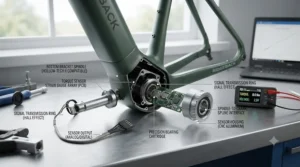
For ongoing maintenance, inspect torque-sensor connections every few months (loose connectors are a common cause of jerky, inconsistent assistance), keep the drivetrain lubricated especially through a British winter, and store the battery between 40-60% charge if the bike sits unused for more than a fortnight.
✨ Don’t Miss These Exclusive Deals!
🔍 Take your 48v electric bike torque research to the next level with these carefully selected models. Click through to check current pricing and availability, and find the setup that finally makes your commute feel effortless!
Real-World Scenario: Which 48V Rider Are You?
Consider Sarah, a physiotherapist commuting eight miles each way through Sheffield’s Steel City hills. Her priority isn’t top speed — it’s consistent torque on a repeated daily climb without her legs giving out by Thursday. For her profile, a mid-drive option like the ADO L20 3.0 Pro makes genuine sense: the gear-multiplied 100Nm torque means she can drop a gear on the steepest section and let the motor do proportionally more work, rather than relying on raw hub-motor shove that fades under sustained load.
Then there’s Tom, a weekend explorer in the Peak District who occasionally rides on bridleways and private land where the 250W legal cap simply doesn’t apply. His use case genuinely suits something like the Shengmilo S600 — dual-motor power for terrain a road-legal bike would struggle with, provided he restricts it appropriately for any road sections.
Finally, picture a retired couple in Harrogate wanting gentle, comfortable rides along flat greenways rather than hill-conquering power. For them, chasing maximum torque figures is genuinely wasted spending — something like the Hygge Vester or a similarly modest hub-motor commuter delivers everything they need without paying a premium for climbing ability they’ll never use.
The lesson across all three: match the torque figure to your actual terrain, not to the biggest number on the page.
Problem → Solution: Fixing Common 48V Torque Complaints
Problem: Jerky or inconsistent power delivery. This is almost always a torque-sensor calibration or connection issue rather than a motor fault. Solution: check the sensor connector for corrosion or looseness, and if the bike is under warranty, request a firmware or sensor recalibration before assuming a hardware replacement is needed.
Problem: Torque feels strong at first, then noticeably weaker on long climbs. This typically points to thermal throttling — the motor controller reducing output to protect itself from overheating during sustained high-current draw. Solution: on repeated steep climbs, drop one assist level to reduce sustained current demand, and avoid stopping mid-climb where restarting from a standstill draws the highest current spike.
Problem: Range far below advertised figures. Manufacturer range claims typically assume ideal conditions — flat terrain, lighter riders, minimal assist. Solution: recalculate your realistic range using roughly half the manufacturer’s headline claim as a conservative planning figure, particularly on hilly, high-assist routes.
Problem: Bike struggles to start on an incline from a dead stop. This is a torque-availability issue at zero rpm, common on cheaper cadence-sensor hub motors. Solution: where possible, avoid coming to a complete stop mid-hill; if you must, dismount briefly for the restart rather than forcing the motor to launch from static on a steep gradient.
How to Choose a 48v System Electric Bike Torque Setup
- Identify your typical gradient, not your worst-case gradient. Buying for the one Alpine-style hill you ride twice a year means overpaying for torque you rarely use.
- Prioritise torque sensors over cadence sensors wherever budget allows — the smoothness difference genuinely changes how the bike feels day-to-day.
- Match battery capacity to your actual commute distance, doubled for safety margin against range-claim optimism.
- Consider mid-drive only if hills are a daily reality, since the added cost and maintenance complexity isn’t justified by occasional inclines.
- Check payload rating against your weight plus cargo, not just your body weight alone.
- Verify UK road-legal compliance before assuming any imported bike is automatically ride-anywhere legal.
- Factor in weight if folding or carrying is part of your routine — a 34kg “folding” bike is still a genuine lift.
Common Mistakes When Buying a 48V Electric Bike
The most frequent mistake is comparing peak wattage figures across bikes as though they’re directly comparable to torque — they’re related but distinct measurements, and a 1000W peak motor with weak torque delivery can still feel sluggish on a steep start compared to a well-tuned 250W torque-sensor system.
A second common error is assuming higher voltage alone guarantees better performance, ignoring controller quality entirely. What most buyers overlook about this specification pairing is that the motor controller — the electronics translating battery voltage into usable motor output — has as much influence on real-world feel as the battery voltage itself; a poorly tuned controller on a 48V system can feel worse than a well-tuned one on 36V.
Third, buyers frequently skip checking UK EAPC compliance on imported or “unlocked” bikes, not realising a bike exceeding the 250W continuous power or 15.5mph assistance limit legally falls outside e-bike classification entirely and requires registration, tax, and insurance as GOV.UK’s electric bike rules confirm.
48V vs 36V: Range Comparison
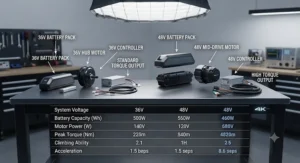
| Factor | 48V System | 36V System |
|---|---|---|
| Torque delivery | Generally stronger, more headroom | Comparatively limited under load |
| Current draw for equivalent power | Lower amperage needed | Higher amperage, more heat |
| Typical range at equivalent Wh | Slightly more efficient | Slightly less efficient |
| Component cost | Higher | Lower, more budget-friendly |
| Best suited to | Hills, cargo, heavier riders | Flat terrain, lighter casual use |
The core reason 48V systems tend to outperform 36V equivalents at the same wattage comes down to current: delivering identical power at higher voltage requires proportionally lower amperage, which means less resistive heat loss and, generally, better real-world efficiency. That efficiency advantage compounds over a ride — it’s not dramatic on a five-minute flat commute, but across a genuinely hilly 20km round trip, the difference in remaining battery percentage becomes noticeable. Riders upgrading from a tired 36V hub system to a 48V equivalent consistently report the biggest improvement isn’t top speed, but how the bike behaves in the final third of a long ride when the battery is depleting.
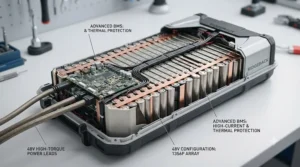
Voltage, Efficiency and the Motor Controller Explained
The motor controller is the unglamorous middleman between your battery and your motor, and it deserves far more attention than it typically gets in buying guides. Its job is to regulate how much of the battery’s stored energy actually reaches the motor windings at any given moment, translating your pedalling input (via cadence or torque sensor) and throttle position into a precise electrical signal.
Here’s what most spec sheets won’t tell you: two bikes with identical 48V batteries and identical motor Nm ratings can feel completely different to ride if their controllers are tuned differently. A well-programmed controller ramps power in smoothly and cuts it cleanly at the legal 15.5mph threshold; a poorly tuned one can deliver a sudden surge or an abrupt, jarring cutoff. This is genuinely one of the least understood aspects of e-bike performance, and it’s part of why review sentiment sometimes diverges sharply between two bikes with near-identical spec sheets.
Efficiency losses also occur here in the form of heat — every controller wastes some proportion of energy as heat during voltage conversion, and this is a core reason lithium-ion battery chemistry and controller quality both matter more to real-world range than the headline Ah figure alone.
48 Volt Ebike Hill Climbing: What the Test Numbers Actually Mean
Torque figures on a spec sheet are a starting point, not the full story. What actually determines hill-climbing performance is the combination of peak torque, how quickly that torque is available (immediately, or does it ramp up), motor placement (hub versus mid-drive), and total system weight working against gravity.
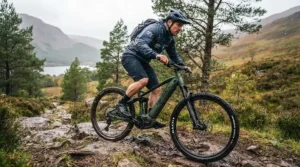
Based on aggregated testing data from multiple UK and international e-bike reviewers, hub motors in the 60-75Nm range typically manage moderate gradients comfortably but can struggle and generate excess heat on repeated steep, sustained climbs. Torque-sensor hub motors in the 90Nm range, like the Engwe Engine Pro 3.0 Boost, handle genuinely steep sections with noticeably more composure. Mid-drive systems such as the ADO L20 3.0 Pro‘s 100Nm unit outperform even higher-rated hub motors on sustained steep sections specifically because gear reduction multiplies effective torque at the wheel — a mid-drive motor rated lower than a hub motor can still out-climb it once you factor in gearing.
What this means for you practically: if your commute includes one steep but short hill, a strong hub motor with a torque sensor is probably sufficient. If your entire route is sustained gradient — genuinely hilly cities like Sheffield or Bath — the mechanical advantage of mid-drive gearing starts to justify its extra cost.
48v Electric Bike Range in the Real World
Manufacturer range claims are, generously, optimistic — they typically assume flat terrain, a lighter-than-average rider, minimal wind resistance, and the lowest assist setting. Genuine real-world range testing consistently reveals a substantial gap between headline claims and everyday performance.
A useful rule of thumb: take the manufacturer’s advertised maximum range and plan around 50-65% of that figure for mixed UK terrain with moderate assist use, adjusting downward further for hillier routes or heavier riders. A 48V 15Ah battery containing roughly 720Wh of energy might claim 100km on the box, but a realistic planning figure for regular commuting with a few climbs is closer to 55-65km.
Temperature also plays a bigger role than most buyers expect — lithium battery performance drops meaningfully in cold weather, meaning that same battery delivering confident range in August may show a noticeably reduced usable range come January. This isn’t a fault; it’s simply lithium chemistry, and it’s worth factoring into winter commuting plans rather than being caught out mid-route.
High Voltage Ebike Benefits Explained
Beyond torque and range efficiency, higher voltage systems bring a handful of benefits that rarely make it onto marketing copy. Lower current draw for equivalent power output means less heat generated in wiring and connectors, which translates to marginally longer component lifespan across the electrical system — controllers, connectors, and wiring harnesses all run cooler under load.
Higher voltage systems also tend to maintain more consistent power output as the battery depletes. A 36V system nearing empty can show noticeably reduced assistance well before it’s technically flat, whereas a well-designed 48V system typically maintains usable power further into its discharge curve, meaning the last 20% of your battery feels less like riding on fumes.
There’s also a practical upgrade-path benefit: 48V has become something close to an industry standard for mid-range and premium e-bikes, meaning aftermarket batteries, chargers, and replacement components are generally more widely available and competitively priced than for less common voltage standards.
Heat Dissipation: Why 48V Systems Run Cooler Under Load
Heat is the quiet enemy of every electric motor system, and it’s directly tied to current, not voltage. Since power equals voltage multiplied by current, delivering the same wattage at 48V requires meaningfully less current than delivering it at 36V — and because resistive heat generation scales with the square of current, even a modest voltage increase produces a disproportionately large reduction in heat build-up.
Practically, this matters most during sustained high-load situations: long climbs, heavy cargo, or riding with a passenger. A 36V system working hard on a long hill is more likely to hit thermal throttling — the controller deliberately reducing power output to protect components from overheating — than an equivalent 48V system under the same load. Reviewers testing high-torque motors on sustained steep sections have specifically noted this pattern, with lower-voltage or underpowered systems overheating on repeated climbs where higher-voltage alternatives complete the same route without throttling back.
For riders in genuinely hilly regions, this heat-management advantage is arguably more relevant day-to-day than the headline torque figure itself, since a bike that quietly throttles back halfway up a climb delivers a worse real-world experience than its spec sheet promised.
48v Electric Bike Legal Guide for the UK
To ride a 48V electric bike on UK roads without a licence, registration, tax, or insurance, it must qualify as an EAPC — Electrically Assisted Pedal Cycle. As GOV.UK’s official EAPC information sheet sets out, this means continuous rated motor power cannot exceed 250W, electrical assistance must cut off once the bike reaches 15.5mph, and the motor must only provide assistance while the rider is actively pedalling (with a narrow exception for low-speed “walk assist” up to 3.7mph).
Here’s the crucial point many buyers misunderstand: the battery being 48V is entirely irrelevant to legality. Voltage is not restricted by EAPC rules — only continuous power output and assisted speed are. A 48V battery running a properly rated 250W motor with correct assistance cut-off is just as road-legal as a 36V equivalent; it’s the motor and controller configuration that determines compliance, not the battery pack.
Where this catches people out is with “unlocked” or private-land-marketed bikes like the Shengmilo S600 featured above — bikes genuinely capable of exceeding 250W or 15.5mph in their unrestricted mode. Riding such a bike unrestricted on a public road, regardless of battery voltage, means it’s legally treated as a moped or motorcycle, requiring registration, insurance, and a licence. Always verify a specific model’s UK-market configuration before assuming road-legal status.
Long-Term Cost & Maintenance
The upfront price of a 48V bike is only part of the total cost of ownership picture. Battery replacement is the single largest long-term expense — a quality 48V lithium pack typically lasts 500-1000 full charge cycles before capacity noticeably degrades, translating to roughly 3-5 years of regular use, with replacement packs costing anywhere from a few hundred pounds upward depending on capacity and brand.
Mid-drive systems like the ADO L20 3.0 Pro‘s motor generally cost more to service than hub-motor equivalents, since specialist tools and dealer-level diagnostics are more often required, whereas hub motors on bikes like the Engwe E26 or Engwe EP-2 3.0 Boost are comparatively straightforward for general bike mechanics to work on.
Battery safety and longevity are closely linked to charging habits — using only the manufacturer-supplied charger, avoiding overnight unattended charging, and storing the battery at partial charge when not in regular use all extend usable lifespan while reducing fire risk, a genuine consideration given documented incidents involving substandard aftermarket batteries and chargers. Factor annual servicing (£50-£150 typically) and eventual battery replacement into your real cost calculation rather than judging value on purchase price alone.
Frequently Asked Questions
❓ What torque is good for a 48V ebike?
❓ Is a 48v ebike legal in the UK?
❓ Does higher voltage mean faster top speed?
❓ How much range does a 48V ebike battery actually give?
❓ Can I upgrade a 36V ebike to 48V?
Conclusion
If there’s one thing worth taking from this entire guide, it’s that 48v system electric bike torque isn’t a marketing buzzword — it’s a genuinely useful proxy for how a bike will behave when the road tilts upward, when you’re carrying more than just yourself, or when winter saps a fraction of your battery’s usual punch. The right torque figure depends entirely on your actual terrain, not the biggest number on a listing page.
Budget riders after honest, proportional power should look hard at the Engwe EP-2 3.0 Boost or the dependable Hygge Vester. Those needing serious range and cargo capacity will find the Engwe E26 hard to beat for the money. Riders chasing genuine hill-conquering performance should weigh the Engwe Engine Pro 3.0 Boost‘s 90Nm hub torque against the ADO L20 3.0 Pro‘s superior mid-drive climbing, while anyone venturing seriously off-road should look to the Shengmilo S600. And if smoothness and everyday polish matter more than raw numbers, the ADO Air 20 Pro/Ultra remains the most refined folder here.
Whichever you choose, always check current pricing and availability before committing, and match your torque figure to the hills you actually ride — not the ones you imagine you might.
Affiliate Disclosure: This article contains affiliate links. As an Amazon Associate, I earn from qualifying purchases. If you purchase products through these links, we may earn a small commission at no additional cost to you.
Recommended for You
- 36V Ebike Brands: 7 Best Lightweight Picks for 2026
- Is 36V Enough for Electric Bike? 7 Models Tested (2026)
- Add Second Battery Electric Bike: 7 Real Options (2026)
Disclaimer: This article contains affiliate links. As an Amazon Associate, I earn from qualifying purchases. If you purchase products through these links, we may earn a small commission at no additional cost to you.
✨ Found this helpful? Share it with your mates! 💬🤗
