
In This Article
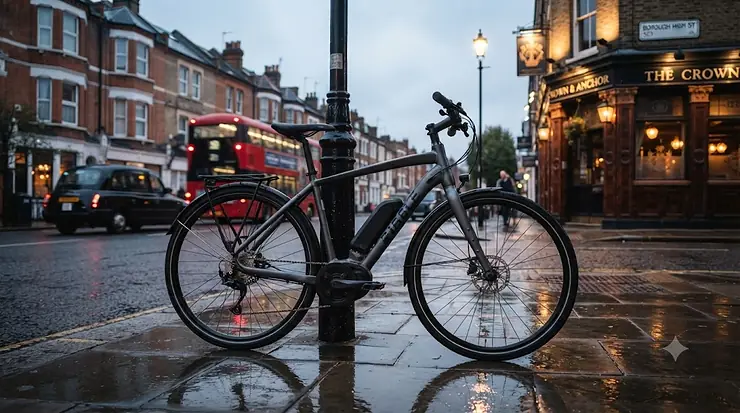
Leave an electric bike outside through one proper British winter and you’ll understand, fast, why “it’s just a bit of surface rust” is the lie cyclists tell themselves right up until a seized bolt snaps off in a stripped thread. An electric bike anti-rust frame coating is any product — spray, wax, internal treatment, or touch-up paint — applied to a frame or its fixings to slow or stop oxidation caused by moisture, road salt, and daily exposure. E-bikes are especially vulnerable because they carry more exposed metal (motor casings, battery contacts, steel fixing bolts) than a standard pedal cycle, and a lot of us leave them chained up outside precisely because they’re too heavy to carry up three flights of stairs. This piece digs into seven genuinely useful UK-available products, explains what the label claims actually mean in practice, and gives you a proper decision framework rather than just another spec sheet dressed up as advice.
Quick definition aside, the maths on this is dull but persuasive: an EAPC — the legal term for a road-legal e-bike in Great Britain — must be fitted with pedals capable of propelling it, carry a motor with continuous rated power no greater than 250W, and cut electrical assistance at 15.5mph, according to government guidance on EAPC standards. None of that touches corrosion protection, of course — but it does mean most of us are riding relatively affordable, mass-produced frames with painted (not powder-coated to aerospace standard) steel or aluminium tubing, motor mounts, and dozens of small steel fasteners that the factory finish barely skims. That’s the gap these products are built to fill.
Quick Comparison Table
| Product | Type | Best For | Price Range |
|---|---|---|---|
| ACF-50 | Aerosol spray | Deep, long-lasting corrosion protection | £15-£30 |
| Muc-Off Bike Protect | Aerosol spray | Post-wash finishing protection | Under £15 |
| Weldtite TF2 Ultimate Spray | Aerosol lube/protector | Budget all-rounder | Under £15 |
| Boeshield T-9 | Aerosol/drip lubricant | Coastal and salted-road riders | £10-£20 |
| Weldtite Rapid Ceramic Shield | Ceramic spray kit | Glossy showroom finish | £20-£30 |
| Problem Solvers Frame Saver | Internal aerosol | Steel frame interior rustproofing | £15-£25 |
| Ribble Touch-Up Paint Kit | Brush-on paint + lacquer | Chip and scratch repair | £15-£25 range |
Prices are approximate and checked at the time of research — always check current pricing before buying, since retailer pricing shifts constantly.
Looking at the table, there’s a clear split between products that protect existing paintwork from the outside (Muc-Off Bike Protect, Weldtite TF2 Ultimate Spray, Weldtite Rapid Ceramic Shield) and products designed to stop corrosion that’s already started, or that attacks from the inside of a steel tube (ACF-50, Boeshield T-9, Problem Solvers Frame Saver). The Ribble Touch-Up Paint Kit sits in a category of its own — it doesn’t prevent rust so much as it closes the door rust would otherwise walk through, by resealing a chip before bare metal gets the chance to oxidise. Most riders genuinely need two of these products, not one, which is worth bearing in mind before you commit to a single purchase.
💬 Just one click — help other riders keep their frames rust-free too!😊
Top 7 Electric Bike Anti-Rust Frame Coating Products: Expert Analysis
1. ACF-50 — aerospace-grade corrosion protection that actually penetrates
ACF-50 started life protecting aircraft, and that lineage matters more than marketing fluff usually does: this is a genuinely different chemistry to a typical bike spray, formulated to stay fluid and keep working its way into fastener threads and seams for months rather than drying into an inert film within a day. Independent long-term testing found that steel test panels coated with ACF-50 stayed rust-free for close to six months outdoors, outperforming every comparable product tested — a genuinely useful data point when most manufacturer claims can’t be cross-checked at all. On an e-bike, the practical value is in the places you can’t easily reach with a rag: battery contact pins, motor housing seams, the underside of a rack mount, bolt threads on mudguard stays. Reviewers on cycling and motorcycle forums consistently describe it as more expensive per millilitre than a basic protectant but noticeably longer-lasting, which changes the actual cost-per-year calculation in its favour if you’re not reapplying every fortnight.
Pros:
- ✅ Penetrates into threads and seams other sprays can’t reach
- ✅ Long-lasting protection measured in months, not weeks
- ✅ Brings up matt-black and unpainted plastic finishes nicely
Cons:
- ❌ Pricier per application than mainstream bike-specific sprays
- ❌ Oily jet-style spray pattern takes practice to control neatly
At around £15-£30 depending on can size, ACF-50 earns its premium if you commute year-round through salted streets; casual weekend riders may find cheaper options adequate.
2. Muc-Off Bike Protect — best all-rounder for post-wash finishing protection
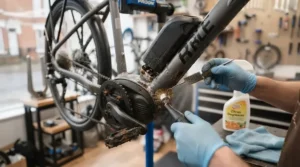
Muc-Off Bike Protect is the spray most UK riders will already recognise from bike shop shelves, and there’s a reason it’s become the default finishing step after a wash. The formula is built to displace residual water left in seams and around bolt heads immediately after cleaning — the exact moment most frame corrosion actually gets its start, since a damp bike left to air-dry is far more likely to develop surface rust than one that’s actively dried and sealed. Aggregated customer feedback repeatedly flags two things: it noticeably slows the dull, chalky corrosion that appears on unprotected bolts and cable ends, and it leaves a dry, non-tacky finish that doesn’t attract the road grime a wetter, oilier product would. On an e-bike specifically, it’s safe around most painted battery housings and cable routing, though Muc-Off’s own guidance (echoed across owner threads) says to keep it well away from disc brake rotors.
Pros:
- ✅ Genuinely dry, non-sticky finish that doesn’t attract grit
- ✅ Safe on carbon, alloy, steel, rubber, and most plastics
- ✅ Widely stocked, so replacement cans are never hard to find
Cons:
- ❌ Shorter protective window than aerospace-grade sprays
- ❌ Needs reapplying after most washes to stay effective
Sitting comfortably under £15, this is the sensible default for anyone who washes their bike regularly and wants a simple last step rather than a separate maintenance ritual.
3. Weldtite TF2 Ultimate Lubricant Spray — best budget multi-tasker
Weldtite has been a fixture of the British cycling trade since 1940, and the TF2 Ultimate Lubricant Spray reflects that heritage: it’s not marketed purely as a rust preventer, but its Teflon-reinforced formula is explicitly built to lubricate, clean, and inhibit corrosion in one product, which matters when you’re trying to keep a maintenance kit simple rather than buying five single-purpose sprays. Independent testing cited by the manufacturer found the spray is 35% more durable than competitor products in wear testing, and it’s formulated specifically for cycle components rather than being a repurposed household oil — which matters, because generic lubricants can actually degrade grease already sitting in bearings and headsets. Reviewers rate it highly for gears, cables, and pivot points, and treat the corrosion resistance as a welcome side effect of a product bought primarily for smooth shifting.
Pros:
- ✅ Doubles as a genuinely effective drivetrain lubricant
- ✅ Won’t strip or degrade existing bearing grease
- ✅ Cheapest entry point on this list for regular use
Cons:
- ❌ Corrosion protection is secondary, not the primary formulation goal
- ❌ Needs more frequent reapplication on exposed frame areas
Priced well under £15 for a 400ml can, this is the one to keep in the shed for weekly top-ups rather than deep seasonal protection.
4. Boeshield T-9 — best for coastal air and heavily salted winter roads
Boeshield T-9 shares a similar origin story to ACF-50 — developed initially for aerospace use — but its selling point is a waxy, waterproof film that stays put through rain and puddles rather than washing away like a lighter oil-based spray would. It’s formulated without Teflon, silicone, or fluorocarbons, which some riders specifically look for, and it’s rated by the manufacturer to protect for roughly 150-200 miles of riding per application, a genuinely useful benchmark for planning reapplication rather than guessing. What makes it particularly relevant to e-bike owners living near the coast or riding through gritted winter roads is its documented performance in saltwater testing, where it continued to resist corrosion that untreated steel succumbed to quickly. It’s non-conductive, too, which matters given how much more exposed wiring and electrical connection points an e-bike frame carries compared with an unpowered bicycle.
Pros:
- ✅ Waterproof wax film survives rain and puddle splash
- ✅ Non-conductive, so it’s safe near electrical connections
- ✅ Clear mileage-based reapplication guidance from the maker
Cons:
- ❌ Wax film can attract dust if applied too heavily
- ❌ Not widely stocked in UK bike shops — mostly online
At roughly £10-£20 for a standard can, it’s a strong pick specifically for anyone within smelling distance of the sea or riding through a gritting-heavy winter commute.
5. Weldtite Rapid Ceramic Shield — best for a showroom finish with real protection behind it
Weldtite Rapid Ceramic Shield moves beyond a simple protectant spray into genuine ceramic-coating territory: rather than just sitting on top of the paint, the formula is designed to fill microscopic imperfections in the topcoat, creating a smoother, harder, more hydrophobic surface that sheds water, mud, and tree sap before they get the chance to sit against bare paint edges and chips. This matters more than it sounds — most frame corrosion doesn’t start on flat, intact paint, it starts at a scratch or stone chip where the protective layer has already failed, and a hydrophobic coating reduces how long moisture lingers exactly there. It’s supplied as a kit with application and buffing cloths, which keeps the process tidy, and it’s explicitly rated safe across carbon, aluminium, steel, and titanium — a genuinely useful spread for anyone with mixed-material components on their e-bike.
Pros:
- ✅ Hydrophobic finish sheds water before it can pool at chips
- ✅ Suitable across carbon, alloy, steel, and titanium
- ✅ Comes with application cloths, so no separate purchase needed
Cons:
- ❌ More expensive than a basic protectant spray
- ❌ Best results require buffing time most riders will skip
At around £20-£30, it’s a premium pick best suited to riders who care as much about appearance as they do about long-term corrosion resistance — which, in practice, is most people who’ve just spent serious money on an e-bike.
6. Problem Solvers Frame Saver — best internal rustproofing for steel-framed e-bikes
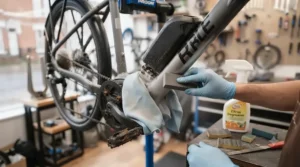
Here’s the product most riders forget exists, and it’s arguably the most important one on this list if your e-bike has a steel frame: exterior paint does nothing to protect the inside of the tubes, and moisture that gets in through a seatpost gap, a cable-routing hole, or condensation from temperature swings can sit against bare steel for years, quietly eating through from the inside where you’ll never see it coming. Problem Solvers Frame Saver is designed specifically to be sprayed into the frame through the bottom bracket shell, seat tube, and any accessible cable ports, coating internal surfaces and leaving a protective film that reportedly lasts several years per application. Long-time framebuilders and restorers who’ve used it for decades describe it as cheap insurance against a failure mode that’s genuinely hard to detect until a tube fails structurally — which, on a bike carrying a heavy battery and motor, is a considerably more serious prospect than on a lightweight road frame.
Pros:
- ✅ Targets internal corrosion no exterior spray can reach
- ✅ One application is reported to last several years
- ✅ Treats several frames per can, so it’s genuinely economical
Cons:
- ❌ Only relevant to steel frames, not aluminium or carbon
- ❌ Application requires partial disassembly to access frame tubes
Costing roughly £15-£25 per can, this is a once-every-few-years job rather than routine maintenance, but it’s the one product on this list that a Which?-style long-term durability test would likely flag as genuinely undersold relative to its importance.
7. Ribble Touch-Up Paint Kit — best frame touch-up paint for stopping rust before it starts
Every other product on this list is about slowing corrosion across an intact surface; Ribble Touch-Up Paint Kit exists for the moment that surface has already failed. A stone chip, a kerb strike, a pedal clipping the down tube while leaning the bike against a wall — any of these exposes bare metal, and bare metal exposed to a British winter starts oxidising within days, not months. The kit pairs a colour-matched 25ml paint bottle with a clear lacquer top coat and two brushes, letting you seal a chip properly rather than just dabbing generic nail varnish over it and hoping. Framebuilders and restorers consistently make the same point: touch-up paint isn’t cosmetic vanity, it’s the cheapest possible corrosion-prevention step available, because it closes the exact entry point where rust would otherwise establish itself and eventually undermine the surrounding paint too.
Pros:
- ✅ Colour-matched paint plus lacquer seals chips properly
- ✅ Cheapest way to stop rust starting at a specific point
- ✅ Includes brushes, so no extra tools needed to apply
Cons:
- ❌ Custom colour-matching can take up to a week to despatch
- ❌ Only useful for spot repairs, not overall frame protection
At roughly £15-£25 for a matched set, this is arguably the single highest-value item here per pound spent, precisely because it targets the exact spot where corrosion is statistically most likely to begin.
Top 7 Products: Specs & Value Comparison
| Product | Format | Reapplication | Best For | Value Verdict |
|---|---|---|---|---|
| ACF-50 | Penetrating spray | Every few months | Overall long-term protection | High value at higher upfront cost |
| Muc-Off Bike Protect | Aerosol spray | After most washes | Regular post-wash routine | Best low-cost default |
| Weldtite TF2 Ultimate Spray | Aerosol spray | Weekly-ish | Combined lube + protection | Best budget all-rounder |
| Boeshield T-9 | Aerosol/drip | ~150-200 miles | Coastal/salted roads | Strong niche value |
| Weldtite Rapid Ceramic Shield | Ceramic spray kit | Every 1-2 months | Showroom finish + protection | Premium but durable |
| Problem Solvers Frame Saver | Internal aerosol | Every 3-5 years | Steel frame interiors | Excellent long-term value |
| Ribble Touch-Up Paint Kit | Brush-on paint | As needed | Chip and scratch repair | Best value per pound spent |
The pattern that jumps out here is reapplication frequency versus reach: Muc-Off Bike Protect and Weldtite TF2 Ultimate Spray need the most frequent top-ups but cost the least per can, while Problem Solvers Frame Saver costs more upfront but is applied so rarely that its annualised cost is arguably the lowest of the seven. If you’re budgeting for a full protection routine rather than a single purchase, pairing a cheap, frequent exterior spray with one infrequent internal treatment and an on-hand touch-up kit tends to beat any single “do everything” product.
How to Apply an Anti-Rust Coating to Your E-Bike Frame
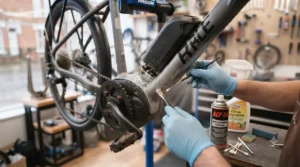
Getting a corrosion protectant to actually work is less about the product and more about the fifteen minutes of prep most people skip. First, wash the bike properly and let it dry completely — spraying any protectant onto a damp frame just seals moisture in rather than keeping it out, which is the opposite of the intended effect. Second, mask or cover the disc brake rotors and rim braking surfaces before spraying anything nearby, since almost every protectant listed here explicitly warns against contamination there. Third, work from the top of the frame downward, paying particular attention to bolt heads, cable stops, the underside of the bottom bracket, and any exposed weld seams, since these low-lying, hard-to-dry spots are where rust typically establishes first. Fourth, wipe off excess product with a microfibre cloth rather than leaving a heavy film, which attracts road grit and actually accelerates dirt buildup on the frame. Finally, mark a reapplication date in your phone calendar based on the product’s stated lifespan — the single biggest reason these coatings under-perform in the real world isn’t the formula, it’s riders forgetting to reapply until the paint’s already chipped and the bolts have gone orange.
Real-World Scenarios: Matching Protection to Your Ride
Picture three different owners of the same £1,800 hybrid e-bike, and the right coating strategy looks completely different for each. The daily commuter riding twelve miles through central Manchester, chained outside a train station gate five days a week regardless of weather, needs the combination that trades convenience for durability: ACF-50 or Boeshield T-9 applied monthly, plus a Ribble Touch-Up Paint Kit kept at home for the inevitable lock-related scuffs, since this bike genuinely never gets a dry, sheltered night. The weekend leisure rider who keeps their e-bike in a garage and only takes it out twice a week in decent weather has a far easier job — Muc-Off Bike Protect applied after each wash is realistically sufficient, since the bike spends most of its life somewhere dry. The coastal-living retiree riding along the seafront most mornings faces the harshest environment of the three despite riding the least distance, because airborne salt attacks paint and bare metal even without direct rain exposure; for this rider, Weldtite Rapid Ceramic Shield for the visible frame paired with Problem Solvers Frame Saver for the internal tubes (if the frame is steel) makes the most sense, since salt air will find any gap left unprotected.
Common E-Bike Corrosion Problems — and How to Fix Them
Problem: rust bleeding through paint around a weld seam. This usually means moisture got underneath the paint at a factory imperfection rather than sitting on top of it, so a surface spray alone won’t fix it — you’ll need to gently key the affected area, treat the bare metal directly, then seal with a Ribble Touch-Up Paint Kit once it’s fully dry.
Problem: seized bolts on the battery mount or rack. This is classic galvanic corrosion between dissimilar metals, worsened by road salt acting as an electrolyte; regular application of ACF-50 or Boeshield T-9 to fastener threads prevents this from developing, but once bolts have seized, a penetrating spray plus patience (not brute force) is the safer fix.
Problem: orange staining appearing on chrome or unpainted alloy components. This is typically light surface oxidation rather than structural corrosion, and it usually responds well to a wipe with Weldtite TF2 Ultimate Spray, which was specifically designed to clean and protect exposed metal in one step.
Problem: rust appearing inside the frame at the bottom bracket, invisible until a service. By the time this is visible, it’s already established — Problem Solvers Frame Saver applied preventatively, before any rust starts, is genuinely the only reliable fix; once internal rust is present, a bike shop will typically need to flush and treat the tube during a full service rather than relying on a spray alone.
Problem: a chipped down tube that’s been “meaning to get touched up” for six months. This is the easiest problem on the list to solve and the most commonly ignored — a five-minute application of colour-matched touch-up paint stops what would otherwise become a much larger, harder-to-repair patch of corrosion.
How to Choose an Electric Bike Anti-Rust Frame Coating
Picking the right product isn’t complicated once you break it into a handful of genuine decision points rather than comparing every spray on the shelf.
- Identify your frame material first. Steel needs internal protection that aluminium and carbon simply don’t, so check your frame’s material before assuming one product suits everything you own.
- Be honest about where the bike actually lives. A bike stored indoors overnight needs far less aggressive protection than one chained outside through every weather system the UK can produce.
- Check reapplication frequency against your habits. A product that needs reapplying weekly is only effective if you’ll genuinely do that — otherwise a longer-lasting, pricier option delivers better real-world protection.
- Prioritise fastener and joint protection, not just paint. Bolts, cable stops, and weld seams fail faster and more visibly than flat painted panels, so target products there first.
- Keep a touch-up kit on hand regardless of what else you buy. Every protectant on this list works best on intact paint — none of them fix a chip, which is where corrosion actually starts.
- Factor in your local environment. Coastal air and heavily gritted winter roads justify premium, longer-lasting formulas; a dry inland commute doesn’t need the same investment.
- Match cost to how long you plan to keep the bike. A £2,000+ e-bike you intend to keep for a decade justifies internal rustproofing that a bike you’ll likely replace in two years probably doesn’t.
Corrosion Resistant Frame Electric Bicycle: Steel vs Aluminium vs Carbon
The material your e-bike frame is built from changes almost everything about how — and how urgently — you need to think about corrosion. Steel frames are the classic case: strong, comfortable to ride, and genuinely vulnerable to rust both inside and out, because bare steel oxidises quickly once moisture and oxygen reach it, and that process is electrochemical rather than purely surface-level. Galvanic corrosion specifically occurs when one metal corrodes preferentially while in electrical contact with a different metal in the presence of an electrolyte — which is exactly what happens at a steel bolt threaded into an aluminium frame, especially once road salt water provides that electrolyte.— which is exactly what happens at a steel bolt threaded into an aluminium frame, especially once road salt water provides that electrolyte. Aluminium frames don’t rust in the traditional sense — they oxidise into a stable, largely protective layer rather than flaking away destructively — but they’re not immune to galvanic attack at contact points with steel fasteners, and their paint is just as vulnerable to chipping as any other frame. Carbon fibre frames don’t corrode at all in the metallic sense, since there’s no metal to oxidise, but every carbon e-bike still carries metal fixings, dropouts, and often a metal motor casing, so “carbon means no rust worries” is a genuinely common misconception that ignores every metal part actually bolted to the frame. Practically speaking, this means a steel-framed e-bike owner should prioritise Problem Solvers Frame Saver and regular fastener treatment, while aluminium and carbon owners can focus their budget on protecting bolts, the motor housing, and touch-up paint at chips rather than worrying about the main tubes themselves.
Powder Coat Durability: What the Factory Finish Can and Can’t Do
Most mid-range and premium e-bike frames leave the factory with a powder-coated rather than wet-painted finish, and it’s worth understanding what that buys you before assuming the frame is somehow immune to everything. Powder coating is applied as a free-flowing dry powder, typically electrostatically, then cured under heat, producing a thicker, tougher finish than conventional liquid paint — and that extra thickness genuinely does make it more resistant to everyday scuffs and scratches than a standard sprayed finish.. The UK’s Health and Safety Executive notes that coating powders give a corrosion-resistant, attractive, and durable finish and are used across a wide range of metal products, which is precisely why manufacturers favour it for frames that need to survive years of outdoor use. But durability isn’t invincibility: powder coat is still a surface layer, and once it’s chipped down to bare metal — at a cable rub point, a lock contact, a pedal strike — the exposed steel or aluminium underneath is just as vulnerable as it would be under any other finish. What most buyers overlook is that a factory powder coat actually raises the stakes on prompt touch-up repair, precisely because the coating is thicker and harder, any breach in it tends to be a sharper, more defined edge where moisture can sit and work inward, rather than the gentler feathered edge you’d get from a worn liquid paint finish.
Galvanised Frame Parts: Where Zinc Coatings Help (and Where They Don’t)
Some of the smaller steel components on an e-bike — certain bolts, brackets, mudguard stays, and rack hardware — are galvanised rather than painted, meaning they carry a zinc coating specifically intended to protect the steel beneath. The mechanism is genuinely elegant: galvanic protection works because zinc coatings on steel provide protection through zinc-rich paints, zinc anodes, and coating layers, with the zinc corroding preferentially to protect the underlying steel — in other words, the zinc is designed to sacrifice itself first, corroding visibly (that dull grey-white bloom you sometimes see on galvanised hardware) so the structural steel underneath stays sound for far longer than it otherwise would. This is genuinely good news for anyone whose e-bike uses galvanised fixings, since it means minor surface dulling on those parts isn’t actually a failure — it’s the coating doing exactly what it’s designed to do. The catch is that galvanising only protects as long as the zinc layer remains largely intact; heavy scratching, aggressive wire-brushing, or years of abrasion against a lock cable can wear through to bare steel at a specific point, and once that happens the sacrificial protection at that exact spot is gone. For riders wanting to extend galvanised hardware further, a light coat of Weldtite TF2 Ultimate Spray over the zinc surface adds a second layer of moisture displacement without interfering with the zinc’s own protective chemistry.
Outdoor Storage Rust Protection for E-Bikes: Long-Term Cost & Maintenance
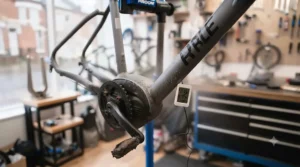
Storing an e-bike outdoors long-term changes the entire cost calculation around corrosion protection, and it’s worth running the numbers honestly rather than assuming a decent cover solves everything. A quality e-bike frame replacement or full respray typically runs into several hundred pounds once labour is included, while a genuinely thorough anti-rust routine — a bottle of Muc-Off Bike Protect for regular washes, an occasional application of ACF-50 or Boeshield T-9 for deeper protection, and a Ribble Touch-Up Paint Kit kept on hand for chips — realistically costs under £70 a year even applied generously. That’s before factoring in the knock-on cost of corroded bolts seizing and needing to be drilled out during a service, which is a genuinely common and entirely avoidable repair bill. If the bike lives outside permanently, a breathable, waterproof cover is worth adding to this routine too, not as a substitute for coating products but alongside them, since covers reduce direct rain and UV exposure while doing nothing for the moisture that still condenses underneath overnight. Total cost of ownership over five years of permanent outdoor storage, protection routine included, still comes in well below the cost of a single frame replacement — which is really the entire argument for bothering with any of this in the first place.
Frequently Asked Questions
❓ Does WD-40 protect an e-bike frame from rust?
❓ Can I use car anti-rust spray on my electric bike?
❓ How often should I reapply anti-rust coating on an e-bike?
❓ Is powder coating better than paint for e-bike rust prevention?
❓ Do aluminium e-bike frames need anti-rust protection?
Conclusion
There’s no single “best” electric bike anti-rust frame coating, and honestly, any article claiming otherwise is oversimplifying a problem that genuinely depends on your frame material, where the bike sleeps at night, and how much rain your specific postcode gets in a given February. What the research consistently supports is a layered approach: a light, regular exterior protectant like Muc-Off Bike Protect or Weldtite TF2 Ultimate Spray for routine use, a deeper penetrating treatment such as ACF-50 or Boeshield T-9 for genuinely exposed bikes, Problem Solvers Frame Saver if you own a steel frame and plan to keep it for years, and a touch-up kit like Ribble Touch-Up Paint Kit sitting in a drawer for the inevitable chip. None of these products are expensive in isolation, and the combined annual cost of a proper routine is genuinely trivial compared with the repair bill — or the replacement bill — that untreated corrosion eventually generates. Treat your frame the way you’d treat any other expensive, weather-exposed investment: a little consistent attention now, rather than a large unavoidable bill later.
Recommended for You
- Electric Bike Puncture-Resistant Tyres: 7 Best Picks (2026)
- Electric Bike Comfort Accessory Bundle: 7 Top Upgrades (2026)
- Electric Bike Easy-Reach Brake Levers: 7 Best UK Picks (2026)
Disclaimer: This article contains affiliate links. As an Amazon Associate, I earn from qualifying purchases. If you purchase products through these links, we may earn a small commission at no additional cost to you.
✨ Found this helpful? Share it with your friends! 💬🤗
