In This Article
If you’ve been cycling to work through Manchester’s drizzle only to arrive with your lower back screaming, or if you’re one of the millions of Britons living with chronic back pain, an electric recumbent bike might be your unexpected salvation. These machines aren’t just exercise equipment — they’re medical-grade rehabilitation tools that happen to make your morning commute rather pleasant.
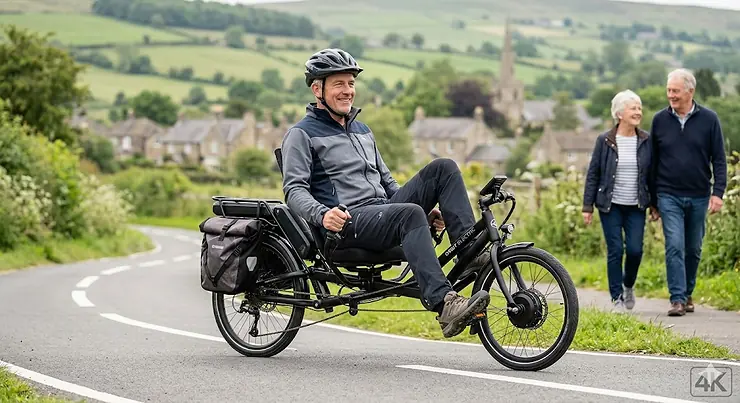
Unlike traditional upright bikes that force you to hunch forward like you’re auditioning for a remake of The Hunchback of Notre Dame, electric recumbent bikes position you in a semi-reclined posture that eliminates vertical pressure on your spinal discs. The electric motor assistance means you’re not fighting against steep Bristol hills or those surprise headwinds that seem to materialise whenever you’re already running late. What most British buyers overlook is that the combination of ergonomic seating and pedal-assist technology creates something unique: cardiovascular exercise that actually rehabilitates your back rather than aggravating it. According to research from the Annals of Physical and Rehabilitation Medicine, 58.3% of seniors with lumbar spinal stenosis reported clinical improvement after three months of consistent cycling on recumbent bikes, with reductions in both radicular pain and disability.
The British climate adds another layer of consideration. Our perpetual dampness, those six-month stretches of grey skies, and the occasional biblical downpour mean outdoor cycling isn’t always feasible. Indoor electric recumbent bikes solve this brilliantly — you get your cardio, protect your spine, and never have to worry about arriving at the office looking like you’ve just emerged from the Thames. For outdoor enthusiasts, motorised pedal assist means you can tackle the Peak District or Scottish Highlands without your back staging a full-scale rebellion halfway through. The UK Chief Medical Officers recommend at least 150 minutes of moderate aerobic activity weekly — electric recumbent bikes make this achievable even for those managing chronic pain conditions.
Quick Comparison Table: Top Electric Recumbent Bikes in the UK
| Model | Motor Type | Back Support | Weight Capacity | Price Range (£) | Best For |
|---|---|---|---|---|---|
| MERACH S50 Smart | Electromagnetic (16 levels) | Mesh backrest with lumbar | 158 kg (350 lbs) | £350-£450 | App enthusiasts, UK home use |
| Sunny Health SF-RB4850 | Magnetic (16 levels) | Breathable mesh | 136 kg (300 lbs) | £400-£500 | Budget-conscious, reliable performance |
| SOLE LCR | Commercial-grade magnetic | Adjustable lumbar support | 159 kg (350 lbs) | £900-£1,200 | Serious rehabilitation, lifetime frame warranty |
| HOMCOM 8-Level | Magnetic resistance | Basic padded backrest | 120 kg (265 lbs) | £150-£250 | Entry-level, compact UK flats |
| Matrix R30 | Magnetic (20 levels) | Arc-moulded lumbar mesh | 181 kg (400 lbs) | £1,500-£2,000 | Clinical-grade, limited mobility |
| HP Velotechnik Scorpion | Shimano STEPS 250W | ErgoMesh seat system | 120 kg (265 lbs) | £5,000-£7,000 | Outdoor trike, UK road legal |
| ICE PERS Chainless | Pedal-by-wire electric | Adjustable recumbent seat | 115 kg (254 lbs) | £6,000-£8,000 | Cutting-edge tech, British-made |
From the comparison above, the MERACH S50 and Sunny Health SF-RB4850 dominate the mid-range market for indoor use, offering the best value for British households where space and budget matter. If you’re serious about rehabilitation and have the room, the SOLE LCR’s lifetime frame warranty justifies the £900-£1,200 investment — that’s roughly £50 per year over a 20-year lifespan. For outdoor enthusiasts who need legitimate pedal-assist for British roads, HP Velotechnik and ICE represent the premium tier, though you’ll need to verify UKCA compliance and insurance requirements with your local council.
💬 Just one click — help others make better buying decisions too! 😊
Top 7 Electric Recumbent Bikes: Expert Analysis for UK Buyers
1. MERACH S50 Smart Recumbent Exercise Bike
The MERACH S50 represents the sweet spot between German engineering principles and prices that won’t require a second mortgage. This smart bike packs a 15-pound flywheel — triple the weight of budget models that vibrate like a washing machine on spin cycle — delivering whisper-quiet operation that your downstairs neighbours will actually appreciate.
What the spec sheet won’t tell you: The 16-level electromagnetic resistance responds instantly, which matters when you’re following a HIIT workout video and don’t want to fumble with knobs. The mesh backrest isn’t adjustable (that’s reserved for £1,000+ models), but it’s breathable enough that you won’t end up with a sweaty back patch during hour-long sessions. British users should note the bike ships from EU warehouses, typically arriving within 5-7 working days, and includes UK-standard 230V power requirements.
The MERACH app integration genuinely adds value. You get scenic routes through locations you’ll actually recognise (not just generic American suburbs), real-time syncing with Apple Watch and Google Fit, plus compatibility with Zwift and Kinomap. Think of it as transforming your spare bedroom into a virtual cycling studio, minus the pretentious instructor shouting motivational nonsense.
Customer feedback from UK reviews: Riders consistently praise the stability — the double-thick steel frame (0.08″ versus the industry-standard 0.04″) means this 39kg beast stays planted even during aggressive intervals. Several reviewers with herniated discs note they can finally manage 30-minute sessions without reaching for the paracetamol afterwards.
✅ 15lb flywheel for commercial-grade smoothness
✅ Bluetooth app ecosystem (MERACH, Zwift, Kinomap)
✅ 85% pre-assembled — setup in under 30 minutes
❌ Backrest not adjustable (fixed angle)
❌ Requires smartphone for full functionality
Price verdict: Around £400-£450 on Amazon.co.uk, which represents solid value given the build quality. You’re paying roughly £13 per kilogram of bike — compare that to budget models at £8-£10/kg that rattle apart within six months. Prime-eligible for next-day delivery in most UK postcodes.
2. Sunny Health & Fitness SF-RB4850 Programmable
The Sunny Health SF-RB4850 is what happens when an American company actually bothers to understand what British buyers need: robust construction, straightforward operation, and none of the overwrought marketing that plagues the fitness industry. This 39.5kg machine doesn’t pretend to be more than it is — a thoroughly reliable recumbent bike that’ll serve you well for years.
Here’s what matters in practice: The magnetic resistance system operates in near-silence, crucial for terraced housing where your workout schedule shouldn’t dictate your neighbour’s television viewing. The 12 preset programmes include BMI calculation and target heart rate modes, though honestly, most users end up creating their own custom routines after the first month. The seat adjustment accommodates leg inseams from 30 to 40 inches (76-102 cm), covering the vast majority of British adults.
The spinal support angle: The mesh backrest distributes pressure across your entire back rather than concentrating it on your lumbar region. Think of it like lying on a hammock versus a wooden plank. The step-through design means you’re not performing gymnastics to mount the thing — particularly valuable if you’re dealing with sciatica or post-surgical recovery. The seat-level pulse grips let you monitor heart rate without contorting yourself, though they’re not as accurate as a chest strap if you’re serious about training zones.
Real-world UK performance: Users in the Lake District and Peak District report this bike handles their rehabilitation needs between outdoor rides. The 300-pound (136kg) weight capacity suggests solid engineering, and multiple reviews mention this bike surviving 2-3 years of daily use without major maintenance beyond belt tension adjustments.
✅ Step-through design for limited mobility
✅ 12 workout presets plus custom programming
✅ Belt-drive mechanism requires virtually no maintenance
❌ LCD console is basic (no backlight)
❌ Device holder won’t accommodate larger tablets
Price and availability: Typically £400-£500 on Amazon.co.uk. Often available with £30-£50 voucher discounts, bringing it into the £350-£450 range. Check for Prime eligibility — some sellers ship from EU warehouses with longer delivery times. UK plug included, 230V compatible, UKCA marked for compliance.
3. SOLE LCR Light Commercial Recumbent Bike
When your GP suggests “low-impact cardiovascular exercise” and you’re serious enough to invest properly, the SOLE LCR enters the conversation. This isn’t a consumer bike that happens to be sturdy — it’s commercial gym equipment you’re allowed to own at home. The price tag reflects that: £900-£1,200 depending on the retailer, but you’re buying something built to survive daily punishment in a physiotherapy clinic.
What justifies the premium: The adjustable lumbar support alone sets this apart from sub-£500 models. You’re not just getting “a backrest” — you’re getting anatomically-designed support that accommodates different spinal conditions. Herniated disc? Adjust it forward. Spinal stenosis? Tilt it back. The inward-angled pedals reduce hip and knee strain, a patented design feature that SOLE guards jealously and competitors can’t replicate.
The 10kg flywheel delivers momentum that mimics actual road cycling, not the herky-jerky motion of budget bikes. The ECB (Eddy Current Brake) magnetic resistance system responds instantly to console adjustments, providing 20 distinct levels that actually feel different from each other. For British winter training, this means you can simulate everything from gentle Thames Path rides to climbing Box Hill without leaving your garage.
The lifetime frame warranty deserves emphasis. SOLE isn’t hedging their bets here — they’re confident this frame will outlast most marriages. Parts are readily available in the UK through official distributors, and SOLE’s customer service actually operates during British business hours, not some 3am California timezone nonsense.
✅ Lifetime frame warranty (unheard of in this price range)
✅ Adjustable lumbar support for specific conditions
✅ Commercial-grade construction (used in NHS facilities)
❌ Heavy (requires two people to move)
❌ Limited smart features (no app integration)
Investment analysis: At £1,000, you’re paying £4.17 per month over 20 years. Compare this to a £40/month gym membership (£480/year) where you still need to commute, deal with other people, and face those judgmental looks when you’re moving at rehabilitation pace. The maths rather speaks for itself. Available through UK fitness retailers; Amazon UK occasionally stocks refurbished units at £700-£800.
4. HOMCOM 8-Level Magnetic Recumbent Bike
The HOMCOM 8-Level exists for those who don’t want to explain to their accountant why they spent £500 on “bicycle-shaped furniture.” Typically £150-£250 on Amazon.co.uk, this Chinese-manufactured bike represents the absolute minimum you should consider if you actually plan to use the thing more than twice.
Setting realistic expectations: This is not a rehabilitation-grade machine. The backrest provides basic lumbar support equivalent to a budget office chair — it’ll prevent you from slouching backwards, but don’t expect it to resolve your disc problems. The 8 resistance levels are adequate for gentle cardiovascular work and basic rehabilitation, but if you’re training for anything beyond “can walk up stairs without gasping,” you’ll outgrow this within six months.
Where the HOMCOM earns its keep is compact living. The footprint suits British flats and terraced houses where your “spare room” is actually a glorified cupboard. The basic LCD display tracks time, speed, distance, and calories — all the metrics you need, without smartphone apps, Bluetooth pairing, or other technology that inevitably fails during firmware updates.
UK-specific considerations: This bike ships from UK warehouses with next-day Prime delivery. The 120kg (265 lbs) weight capacity suggests lighter construction than premium models, but users report it’s stable enough for steady-state cardio. The quiet operation means you can watch EastEnders without missing dialogue, which is apparently important to some people.
✅ Genuinely budget-friendly (£150-£250)
✅ Compact enough for British flats
✅ Quick Amazon Prime delivery
❌ Basic construction (expect 1-2 year lifespan)
❌ Resistance maxes out quickly for fitter users
Who this suits: Absolute beginners, elderly users doing gentle rehabilitation, or anyone who needs to confirm they’ll actually use a recumbent bike before investing in something serious. Think of it as a test drive before committing to a proper relationship. Check current Amazon.co.uk pricing — it fluctuates between £180-£250 depending on seasonal demand.
5. Matrix Cycle R30 Recumbent Bike
The Matrix R30 represents what happens when an American company that supplies equipment to luxury hotels decides to make something for home use. At £1,500-£2,000, you’re firmly in “investment piece” territory, but for users with limited mobility or serious spinal conditions, this bike delivers features you simply cannot find at lower price points.
The accessibility advantage: The step-through height approaches zero — legitimately zero, not “zero for someone who’s 6’2″ and flexible.” If you’re recovering from hip replacement, dealing with severe arthritis, or using a walking frame, you can actually mount this bike without assistance. The dual-post frame design eliminates the tipping hazard common to single-post recumbents, providing rock-solid stability regardless of how aggressively you pedal or how you shift your weight.
The arc-designed seat deserves a paragraph of its own. Moulded to provide lumbar support while allowing ventilation (British perspiration levels being what they are), it accommodates 6-8 hour sessions if you’re genuinely committed to rehabilitation. The mesh construction prevents the sweaty-back phenomenon that plagues cheaper bikes with solid plastic seats.
NHS and private physiotherapy clinics across Britain stock this model, which tells you everything about its medical credentials. The 20-level magnetic resistance system covers “gentle elderly rehabilitation” through “serious cardiovascular training” without gaps in the progression. The ECB magnetic braking system operates in absolute silence — you could use this at 3am without waking anyone.
✅ Near-zero step-through for severe mobility limitations
✅ Dual-post frame prevents tipping (stability unmatched)
✅ Used in NHS facilities (medical-grade credentials)
❌ Premium price (£1,500-£2,000)
❌ Large footprint (not suitable for small flats)
Where to buy: Typically available through UK commercial fitness equipment suppliers rather than Amazon. Some retailers offer NHS/healthcare worker discounts of 10-15%. Factor in delivery costs (£50-£100 for this weight class) and professional assembly if needed. Worth checking if your private health insurance covers rehabilitation equipment — some policies reimburse up to 50%.
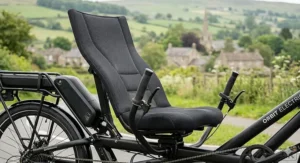
6. HP Velotechnik Scorpion FS 26 Electric Trike
Now we’re venturing into proper outdoor recumbent territory with the German-engineered HP Velotechnik Scorpion. At £5,000-£7,000, this isn’t an exercise bike — it’s a fully road-legal electric tricycle that happens to be comfortable enough for people with back conditions. Think of it as the Rolls-Royce of recumbent transport, minus the pretension.
What you’re actually buying: The Shimano STEPS 250W motor provides pedal-assist up to 25 km/h (15.5 mph), making this EAPC-compliant across England, Scotland, and Wales. No licence, tax, or insurance required, though you’d be foolish not to get insurance given what this costs. The motor assistance transforms British cycling — those Birmingham hills that previously meant walking become effortless glides. The rechargeable battery delivers 55-80 km range depending on assistance level, easily covering most UK commutes with juice to spare.
The recumbent seating position distributes your weight across your entire back and buttocks, eliminating the pressure points that make traditional bicycle saddles instruments of torture. The ErgoMesh seat system includes anatomically-shaped side cushioning and reflective strips — the latter being rather crucial for British visibility conditions. The foldable design means it fits in most car boots, solving the “how do I get this to the Peak District” problem.
British weather considerations: The full suspension system absorbs everything Britain’s crumbling infrastructure throws at you. The IQ-X E headlamp (150 lux) provides visibility without blinding oncoming traffic — designed for European road use, not American-style “light up the entire county” overkill. The turn signal system gives you proper indication capability, though you’ll need to register this with some local councils for cycle path use.
✅ UK road-legal EAPC (no licence/insurance needed)
✅ Foldable for transport and storage
✅ German engineering quality (30-year company history)
❌ Premium pricing (£5,000-£7,000)
❌ Requires secure storage (theft target)
Where this excels: Long-distance touring, daily commuting in hilly cities (Bristol, Sheffield, Edinburgh), or anyone who needs cycling to remain accessible despite back conditions. Not available on Amazon.co.uk — purchase through specialist UK recumbent dealers like D-Tek or Laid-Back Bikes. Budget £300-£500 for essential accessories (panniers, mudguards, security) that aren’t included.
7. ICE PERS Chainless Electric Trike
The British-made ICE PERS Chainless represents genuinely innovative technology, not just iterative improvements on existing designs. Based in Falmouth, Cornwall, Inspired Cycle Engineering has created the first production recumbent trike where pedalling generates electricity to power the hub motor — eliminating chains, gears, and traditional drivetrain maintenance entirely.
Why this matters for UK conditions: Traditional recumbent chains stretch to 2+ metres, requiring frequent adjustment and lubrication. In British weather (perpetual dampness with occasional torrential downpours), chain maintenance becomes a monthly ritual. The PERS system eliminates this entirely — pedalling generates electricity, which powers the rear hub motor, which propels you forward. Think of it as regenerative braking in reverse.
The system claims zero maintenance for 50,000 km, which is roughly 31,000 miles or about 10 years of average British cycling. The integrated anti-theft technology and smartphone app provide security features that actually work, unlike those comedy cable locks that thieves defeat with nail clippers. The ICETrike design accommodates the British rider position (upright enough to see over hedgerows, reclined enough to protect your back).
The catch: This revolutionary technology comes at £6,000-£8,000, making it more expensive than most motorcycles. You’re paying for British manufacturing, cutting-edge engineering, and the knowledge that ICE transitioned to 100% employee ownership in 2022 — your money supports British workers, not offshore shareholders.
✅ British-made in Cornwall (support UK manufacturing)
✅ Chainless design eliminates maintenance
✅ Regenerative braking adds 25% range
❌ Premium pricing (£6,000-£8,000)
❌ New technology (less track record than traditional systems)
Realistic assessment: This suits early adopters willing to pay premium prices for innovative technology. If you’re cycling daily in British weather and sick of chain maintenance, the extra £2,000-£3,000 over traditional e-trikes amortises over the eliminated maintenance costs. Purchase directly from ICE or through UK specialist dealers. Not available on Amazon. Factor in 8-12 week lead times for custom configurations.
Understanding Electric Recumbent Bikes: What British Buyers Need to Know
Electric recumbent bikes combine two distinct technologies into something greater than the sum of their parts. The recumbent seating position — where you’re leaning back with legs extended forward rather than hunched over handlebars — redistributes your body weight across a larger surface area. This eliminates the pressure points that cause numbness, reduces strain on wrists and shoulders, and crucially, removes vertical compression from your spinal column.
Add electric motor assistance, and you’ve solved the British cycling dilemma: how to exercise without arriving everywhere looking like you’ve just survived a shipwreck. The motor amplifies your pedalling effort, typically by 1.5x to 4x depending on the assistance level selected. Climb a steep hill in Bristol? The motor compensates. Face a surprise headwind across the Fens? The motor absorbs the extra effort. Need to arrive at the office without requiring a complete wardrobe change? Drop the assistance level and pedal gently.
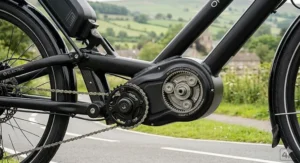
The medical distinction separates two categories: indoor exercise bikes with electric resistance adjustment (what most of this article covers), and outdoor electrically-assisted pedal cycles (EAPCs) like the HP Velotechnik and ICE models. Indoor bikes use electricity to power magnetic resistance systems and digital displays, providing variable workout intensity. Outdoor e-bikes use batteries to power hub motors or mid-drive systems, providing pedal-assist that makes actual road cycling accessible to people with limited fitness or physical conditions.
For British buyers, EAPC legal status matters. Electrically assisted pedal cycles are legal in England, Scotland, and Wales if they meet specific criteria: 250W maximum motor output, pedal-assist only (no throttle), and speed limited to 15.5 mph (25 km/h). These require no licence, tax, or insurance, though common sense suggests insuring anything costing £3,000+. Northern Ireland may have different regulations — verify locally before purchasing.
The back pain advantage stems from biomechanics, not marketing hype. Traditional bicycle saddles concentrate your entire body weight on approximately 100 square centimetres of soft tissue, creating pressure that would make medieval torture devices jealous. Recumbent seats distribute that same weight across 1,500-2,000 square centimetres of your back and buttocks — reducing pressure by 15-20 times. The semi-reclined posture eliminates vertical pressure on spinal discs during workouts, while magnetic resistance systems ensure smooth, jerk-free pedaling that prevents sudden movements triggering painful muscle spasms.
How to Choose an Electric Recumbent Bike for British Conditions
1. Indoor versus outdoor use defines everything else
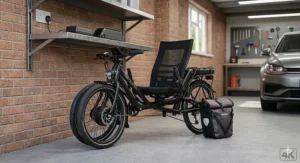
Indoor bikes prioritise comfort, programmable workouts, and app connectivity. They’re mains-powered (230V UK standard), designed for climate-controlled environments, and focus on cardiovascular fitness and rehabilitation. Outdoor e-bikes prioritise weather resistance, road-legal compliance, and practical transport utility. They’re battery-powered, require secure storage, and must meet EAPC regulations for legal road use. Choose wrong here and you’ll be disappointed regardless of quality.
2. Weight capacity indicates frame quality, not just maximum load
A bike rated for 350 lbs (159 kg) uses heavier-gauge steel and reinforced joints compared to 250 lb (113 kg) models. Even if you weigh 150 lbs, the heavier-rated bike will be more stable, less prone to flexing during vigorous pedalling, and likely to last longer. British manufacturing standards (BS EN ISO 20957) require specific structural testing — look for UKCA or CE compliance marks.
3. Backrest adjustability becomes crucial for serious rehabilitation
Fixed-angle backrests suit general fitness use. If you’re managing specific spinal conditions (herniated discs, scoliosis, spinal stenosis, post-surgical recovery), adjustable lumbar support stops being a luxury and becomes medical necessity. Expect to pay £800+ for genuinely adjustable systems — anything cheaper likely just reclines the entire seat, which isn’t the same thing.
4. Resistance levels need to match your actual fitness progression
Eight levels might seem sufficient, but you’ll outgrow them within 6-12 months if you’re remotely consistent. Sixteen levels provide room for several years of progression. Twenty levels cover “gentle elderly rehabilitation” through “serious athlete training” without gaps. Electromagnetic resistance (more expensive) responds faster than mechanical magnetic systems (cheaper) — relevant if you’re following interval training programmes.
5. The British space equation: footprint versus storage
A typical recumbent bike occupies 150cm x 60cm of floor space when assembled — roughly the size of a small sofa. For terraced housing, flats, or the standard British “third bedroom” that’s actually a cupboard with delusions of grandeur, this matters. Some models fold, though folding mechanisms add weight, reduce stability, and represent additional failure points. Measure your available space before falling in love with something that won’t fit through your door.
6. Warranty terms reveal manufacturer confidence
Lifetime frame warranties (SOLE) suggest the manufacturer expects that component to outlast you. Three-year structural warranties (standard mid-range) indicate decent quality. Ninety-day parts coverage (budget models) basically admits the thing will break and they’re hoping you won’t bother returning it. UK consumer rights provide two-year minimum warranty under the Consumer Rights Act 2015, regardless of manufacturer claims — but good luck enforcing that against a Chinese dropshipper.
7. UK delivery and assembly logistics cost real money
Amazon Prime offers next-day delivery on bikes under 40kg from UK warehouses. Heavier models (50-80kg) often ship from EU warehouses with 5-10 day delivery. Commercial-grade units require freight delivery (£50-£100) and professional assembly (£75-£150) unless you’re rather handy with spanners. Factor these costs into your budget — that £600 bike becomes £750+ after delivery and assembly.
Common Mistakes When Buying Electric Recumbent Bikes
British buyers repeatedly make the same errors, usually learned through expensive experience. Here’s what to avoid:
Assuming all magnetic resistance is identical — It’s not. Budget bikes use permanent magnets on sliding tracks (cheap, effective, eventually wears out). Mid-range bikes use electromagnetic resistance (computer-controlled, precise, lasts longer). The difference becomes apparent around month six when budget systems start providing inconsistent resistance.
Ignoring seat height relative to British ceiling heights — Standard British ceiling height is 2.3 metres (7’6″). Some recumbent bikes position riders 90-100cm off the floor, which feels precarious in older terraced housing with 2.2m ceilings. If you’re over 6′ tall and your bedroom ceiling was installed during Victoria’s reign, measure carefully.
Trusting voltage specifications without verification — Many Amazon listings copy-paste US product descriptions showing 110V compatibility. UK mains voltage is 230V/50Hz. Verify the specific model includes UK power supply and proper UKCA marking. Using voltage converters on high-wattage exercise equipment is asking for either blown fuses or house fires.
Buying outdoor e-bikes without understanding insurance reality — That £6,000 recumbent trike isn’t covered under standard home insurance. Specialist cycle insurance costs £200-£400 annually for high-value e-bikes. Many policies require specific security measures (ground anchors, garage storage, GPS tracking). Budget for this or accept you’re self-insuring.
Underestimating British rust — Our climate excels at corroding anything metal. Indoor bikes with painted steel frames will rust in damp garages or conservatories. Outdoor e-bikes require regular maintenance beyond what Americans or Australians would consider normal. Stainless steel hardware costs more initially but saves money long-term.
Believing app connectivity is essential — It’s not. Apps provide entertainment value and detailed metrics, but they’re not necessary for effective cardiovascular exercise. What matters is resistance levels, comfortable seating, and your willingness to actually use the thing. Don’t pay £200 extra for Bluetooth connectivity if you’re not the type who follows structured training programmes.
Failing to test seat compatibility with your actual anatomy — British adults range from 5’2″ to 6’6″, and no single seat design suits everyone. That “universally comfortable” seat in the marketing photos might hit your spine at exactly the wrong angle. If possible, test at a UK retailer (Decathlon, Evans Cycles, specialist recumbent dealers) before committing to online purchase. At minimum, verify generous return policies — Amazon UK typically allows 30-day returns, though you’ll pay return shipping on heavy items.
Electric Recumbent Bikes for Different UK User Profiles
London commuters navigating Zones 2-3: You need something that handles stop-start traffic, fits in your flat, and doesn’t require extensive maintenance. The MERACH S50 or Sunny Health SF-RB4850 suit indoor cross-training during weather that makes cycling genuinely miserable (November-February). For actual commuting, outdoor e-bikes require secure workplace storage and shower facilities — realistically limiting them to offices with proper cycle facilities.
Manchester suburb families with mixed fitness levels: Multiple users mean adjustable seat systems become essential. Look for bikes supporting 30-40 inch (76-102cm) leg inseam ranges. The Sunny Health SF-RB4850 handles this well at mid-range pricing. Avoid budget bikes with limited adjustment — family peace depends on everyone being comfortable, not just the person who made the purchasing decision.
Retired couples in the Cotswolds or Peak District: Outdoor e-trikes like the HP Velotechnik Scorpion transform hilly terrain from impossible to pleasant. British rural roads suit recumbent trikes better than bikes — the three-wheel stability compensates for road surfaces that haven’t been properly maintained since before decimalization. Budget for panniers and weather protection; our climate punishes inadequate preparation.
Sheffield residents recovering from back surgery: Medical-grade equipment like the Matrix R30 or SOLE LCR provides genuine rehabilitation support. The step-through design matters more than you’d expect when you’re managing post-surgical movement restrictions. Verify your private health insurance or NHS physiotherapy programme covers home exercise equipment — some policies reimburse 50-75% with proper documentation.
Birmingham office workers managing chronic back pain: Indoor bikes for 20-30 minute sessions before work transform mornings. The semi-reclined position means you’re not aggravating disc issues before your day even starts. The MERACH S50 app integration provides enough variety to prevent boredom without requiring technical expertise. Place the bike where you’ll actually use it — spare bedrooms gather clothes, not miles.
Edinburgh students on limited budgets: The HOMCOM 8-Level represents minimum viable quality for £150-£250. Pair it with a second-hand tablet running free workout apps rather than paying for premium bike technology you’ll outgrow quickly. Student housing typically lacks storage, so compact footprint trumps features you won’t use anyway.
Cardiff families with disabled members: The Matrix R30‘s near-zero step-through height and dual-post stability serve users with mobility limitations that standard bikes simply cannot accommodate. This isn’t fitness equipment — it’s assistive technology that happens to provide cardiovascular benefits. Check if local council disability grants cover adaptive exercise equipment; eligibility varies by Welsh borough.
Real-World Performance: Electric Recumbent Bikes in British Weather
Our maritime climate presents unique challenges Americans and Australians never consider. Here’s what actually happens when British weather meets exercise equipment:
Humidity and condensation attack indoor bikes stored in unheated spaces. That conservatory that seemed perfect for a home gym? It’s actually a moisture trap where metal components rust faster than you’d believe possible. Heated rooms (living areas, bedrooms) provide better long-term storage despite taking valuable space. Apply a thin film of PTFE spray to exposed metal monthly — it’s cheaper than replacing corroded parts.
Outdoor e-bikes face accelerated wear from salt-laden coastal air and grit-covered winter roads. Chain-drive models require cleaning and lubrication after every wet ride, which is effectively every ride from October through March. The ICE PERS chainless system’s appeal becomes obvious when you’re wrestling with a frozen chain at 6am before your commute. Standard maintenance intervals double in British conditions compared to manufacturer specifications.
Battery range drops 10-15% in cold weather — lithium batteries lose capacity below 10°C, which describes most British mornings from November through April. That advertised 70km range becomes 60km in practice. Plan charging cycles accordingly and don’t rely on range estimates from American or Australian reviewers who’ve never faced proper British cold.
Visibility requirements exceed minimum legal standards for safe cycling. Recumbent bikes and trikes sit lower than traditional bikes, making you less visible to distracted drivers. LED lights rated for 200+ lumens front and rear stop being optional extras and become survival equipment. The AA estimates UK drivers travel with defective lights 30% of the time — compensate with redundant lighting systems.
Storage security matters more in Britain than manufacturers acknowledge. According to data from 2026 crime statistics, bicycles worth £2,000+ represent prime targets for theft across urban Britain. That £5,000 e-trike needs ground anchors, garage storage, and proper insurance — budget an additional £500-£800 for security infrastructure. Flats and terraced housing without secure storage effectively rule out high-value outdoor e-bikes.
Long-Term Cost & Maintenance in the UK
Indoor electric recumbent bikes typically cost £0.15-£0.30 per hour to operate (electricity at UK rates of £0.24-£0.30 per kWh). A daily 30-minute workout consumes roughly £1-£2 monthly in electricity — less than a single café coffee. Maintenance consists of annual belt tension adjustment and occasional display calibration. Budget £50 annually for preventive maintenance or £100+ for reactive repairs when things break.
Outdoor e-bikes and e-trikes demand significantly more investment. Battery replacement every 4-6 years costs £400-£800 depending on capacity. Tyres last 2,000-3,000 miles in British road conditions (£60-£120 per replacement set). Annual servicing runs £150-£250 at specialist recumbent shops — more if you’ve neglected maintenance and components have deteriorated. Insurance adds £200-£400 annually for high-value models.
Parts availability varies wildly. American brands (Sunny Health, SOLE) ship replacement parts from US warehouses with 10-14 day UK delivery. German manufacturers (HP Velotechnik) maintain UK distributor networks with 3-5 day parts delivery. Chinese budget brands often provide zero UK support — that £180 bike might be impossible to repair when the console fails. Factor this into purchase decisions.
Total cost of ownership over five years:
- Budget indoor bike (£200): Initial £200 + maintenance £250 + electricity £100 = £550 (£110/year)
- Mid-range indoor bike (£450): Initial £450 + maintenance £150 + electricity £120 = £720 (£144/year)
- Premium indoor bike (£1,000): Initial £1,000 + maintenance £100 + electricity £150 = £1,250 (£250/year)
- Outdoor e-trike (£6,000): Initial £6,000 + insurance £2,000 + maintenance £1,250 + battery £600 = £9,850 (£1,970/year)
Compare these figures to annual gym membership (£400-£600) where you still face commuting costs, time investment, and exposure to whatever plague is currently circulating through the changing rooms. The home equipment case becomes compelling around month 18, assuming you actually use it.
Features That Actually Matter (And Those That Don’t)
Essential features worth paying for:
Adjustable resistance — Sixteen levels minimum. Your fitness improves faster than you’d expect; eight levels become limiting within months. Computer-controlled electromagnetic systems beat mechanical magnetic sliders for consistency and longevity.
Proper lumbar support — Not just “a backrest,” but anatomically-designed support that maintains spinal curves. The difference between generic padding and medical-grade ergonomic design manifests around minute 25 of your workout when your back either feels supported or starts screaming for mercy.
Step-through design — Even if you’re currently mobile and flexible, injuries happen. That knee you twisted playing football at age 20 will remind you of its existence eventually. Step-through frames maintain usability across changing physical conditions.
Weight capacity 300+ lbs (136+ kg) — Indicates robust construction even if you weigh considerably less. Heavier-rated bikes use superior materials and stronger welds, translating to better stability and longer lifespan.
Belt-drive systems — Quieter and longer-lasting than chain drives on indoor bikes. Chains need regular lubrication; belts run maintenance-free for years. Crucial for flat-dwelling Britons whose downstairs neighbours already dislike them.
Features with marginal value:
Bluetooth app connectivity — Adds £100-£200 to purchase price. Genuinely useful if you’re motivated by metrics, leaderboards, and structured training. Completely irrelevant if you just want to pedal while watching Homes Under the Hammer. Most users stop syncing apps after 3-6 months when the novelty fades.
Heart rate monitoring — Built-in pulse grips provide ballpark accuracy (±10-15 bpm). Sufficient for general fitness but useless for serious training. Athletes need chest strap monitors; casual users don’t need monitoring at all. Don’t pay extra for pulse grips alone.
Water bottle holders — Nice to have but hardly worth £20-£30 additional cost. Any bottle cage from Halfords costs £3-£5 and attaches with zip ties. Marketing photos make these seem more essential than they are.
Transport wheels — Helpful for 50kg+ bikes but hardly revolutionary. Two people can lift anything in this weight class; one person can tilt-and-roll. Don’t choose bikes based on this feature; consider it a bonus.
Features actively worth avoiding:
Tablet/iPad holders — Tablets fall out during vigorous exercise, then you’re buying new iPads. Mount a TV on the wall or place a laptop on a stable surface nearby. Moving displays and bouncing bikes don’t mix well.
Built-in speakers — Universally terrible audio quality. Any £15 Bluetooth speaker from Amazon sounds better. Built-in speakers add cost and potential failure points without meaningful benefit.
Electronic displays requiring subscription services — Some premium bikes lock features behind monthly payments (£15-£30). You’ve already paid £1,000+ for the hardware; paying additional fees to unlock functionality feels exploitative. Choose bikes with full functionality out of the box.
Frequently Asked Questions About Electric Recumbent Bikes
❓ Are electric recumbent bikes legal on UK roads and cycle paths?
❓ How long do batteries last on electric recumbent bikes?
❓ Can recumbent bikes help with herniated disc recovery?
❓ What's the realistic maintenance schedule for UK owners?
❓ Do I need special insurance for electric recumbent bikes in the UK?
Conclusion: Finding Your Ideal Electric Recumbent Bike in Britain
Choosing an electric recumbent bike demands clarity about your actual use case, not fantasies about the cyclist you imagine becoming. If you’re managing chronic back pain, need low-impact cardiovascular exercise, or want fitness equipment that won’t aggravate existing injuries, recumbent bikes offer legitimate medical benefits beyond typical gym equipment marketing.
For most British buyers, the MERACH S50 (£350-£450) or Sunny Health SF-RB4850 (£400-£500) represent the sensible middle ground — robust enough for daily use, affordable enough that purchase doesn’t require significant financial contortion, feature-rich without overwhelming complexity. These suit terraced housing, flats, and standard British homes where space remains perpetually scarce.
If you’re recovering from surgery or managing serious spinal conditions, the SOLE LCR (£900-£1,200) or Matrix R30 (£1,500-£2,000) provide medical-grade support that cheaper bikes simply cannot replicate. Yes, the price stings initially, but proper rehabilitation equipment pays for itself by reducing physiotherapy visits, medication costs, and lost work days.
Outdoor enthusiasts with proper budgets and secure storage should seriously consider the HP Velotechnik Scorpion (£5,000-£7,000) or ICE PERS (£6,000-£8,000). These transform British cycling from endurance test to pleasant transport, making hilly terrain accessible and wet weather manageable. They’re not toys — they’re legitimate transportation solutions that happen to provide cardiovascular benefits.
Whatever you choose, remember the best electric recumbent bike is the one you’ll actually use. That means comfortable seating, appropriate resistance levels, and crucially, placement where you’ll encounter it daily rather than tucked away in a spare room gathering clothes. Start with reasonable expectations, build consistency over months rather than weeks, and recognise that fitness equipment works only when you do.
Recommended for You
- 7 Best Electric Cyclocross Bikes UK 2026
- 7 Best Electric Touring Bicycles UK 2026
- 7 Best Bikepacking Electric Bikes UK 2026
Disclaimer: This article contains affiliate links. As an Amazon Associate, I earn from qualifying purchases. If you purchase products through these links, we may earn a small commission at no additional cost to you.
✨ Found this helpful? Share it with your mates! 💬🤗
