In This Article
Ask ten people at your local cycling club about rear wheel motor vs mid drive, and you’ll get eleven opinions. Strong ones, too — usually from someone who’s never ridden the other type. It’s one of the great e-bike debates, and in 2026, with sales of electrically assisted bikes now exceeding two million units annually across the UK, it genuinely matters more than ever.
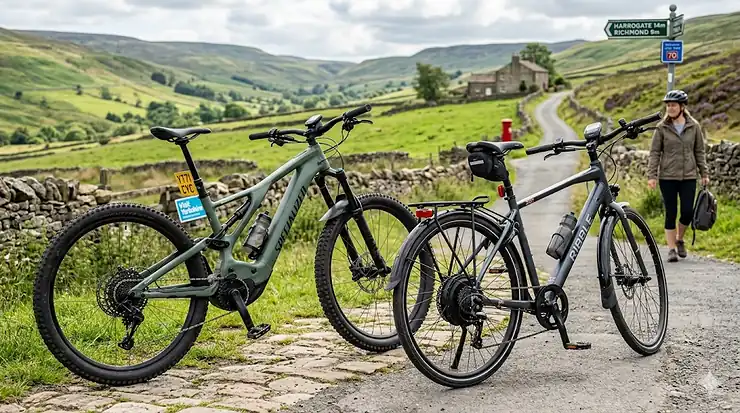
Here’s the short answer for those in a hurry: a rear wheel motor (also called a rear hub motor) sits neatly inside your back wheel, drives the tyre directly, and works completely independently of your gears. A mid drive motor bolts to your bottom bracket — where the pedals live — and pushes power through the chain and cassette. Same destination, very different journey.
What that single mechanical distinction means in practice is remarkable. It affects how the bike climbs hills, how the chain wears, how natural the pedalling feels, whether you can fit a standard puncture repair kit, and — critically for a country that enjoys roughly 1,200 mm of rainfall a year — how reliably the whole lot functions on a wet Tuesday morning somewhere outside Preston. This guide covers all of it, including seven real products currently available on Amazon.co.uk, with prices in GBP and honest commentary on who each one actually suits.
What is rear wheel motor vs mid drive? A rear wheel (hub) motor is a self-contained unit inside the rear wheel that drives the tyre directly, independently of your gears. A mid drive motor sits at the bottom bracket and powers your chain, leveraging the bike’s existing gear ratios. Hub motors are simpler and cheaper; mid drive systems are more efficient on hills and offer a more natural pedalling sensation.
Quick Comparison: Rear Hub Motor vs Mid Drive at a Glance
| Feature | Rear Hub Motor | Mid Drive Motor |
|---|---|---|
| Motor position | Inside rear wheel hub | Bottom bracket (between pedals) |
| Hill climbing | Adequate on gentle gradients | Excellent — leverages gears |
| Chain wear | Normal (motor bypasses drivetrain) | Accelerated — power goes through chain |
| Ride feel | “Pushed” sensation | Natural, like stronger legs |
| Flat tyre fix | More fiddly | Easy — standard wheel removal |
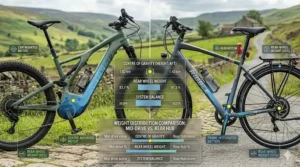
| Weight distribution | Rear-heavy | Central, balanced |
| Typical price range | £400–£1,200 | £800–£3,000+ |
| Maintenance complexity | Low | Higher |
| Best for | Commuting, flat to rolling terrain | Hills, trails, touring |
From this table, the picture is already emerging: if your commute runs along the relatively flat Thames Path or through Birmingham’s grid streets, a rear hub motor is a pragmatic, affordable workhorse. If you’re tackling Sheffield’s notorious seven hills every morning, or exploring the Peak District on weekends, a mid drive’s ability to leverage gears makes it worth the premium. The spec sheet won’t tell you this, but in practice the difference on a sustained 12% gradient can be the difference between “manageable” and “I’m getting off and walking.”
💬 Just one click — help others make better buying decisions too! 😊
✨ Don’t Miss These Exclusive Deals!
🔍 Take your cycling to the next level with these carefully selected e-bikes and conversion kits. Click on any highlighted item to check current pricing and availability on Amazon.co.uk. These picks will help you find exactly what you need for British roads, British hills, and British weather!
Top 7 Rear Wheel Motor vs Mid Drive E-Bikes: Expert Analysis
1. Eleglide M1 Plus — Best Rear Hub MTB for UK Trail Riders
The Eleglide M1 Plus is what happens when a manufacturer actually thinks about what British weekend riders need: a 250W brushless rear hub motor tucked into a 29-inch wheel, paired with a 36V 12.5Ah removable battery and a proper 21-speed Shimano drivetrain. The 29er wheels roll over the kind of rutted bridleways and gravelly fire roads that make up a huge chunk of UK off-road cycling — smoothly enough that you stop worrying about the surface and start enjoying the scenery.
The rear hub placement keeps the chain and gears experiencing only your own pedal input, which means component lifespan is dramatically longer than equivalent mid drive bikes. UK riders report chains lasting 4,000–5,000 miles rather than the 1,500–2,000 miles typical on mid drive models. On a mixed-terrain commute or weekend trail ride through somewhere like Dalby Forest or the Thetford Forest Park, that translates to real savings. The motor delivers a “pushed from behind” sensation that suits leisure riders perfectly, though it won’t match a mid drive on truly steep technical climbs.
UK buyers praise the solid build quality and the generous 100 km claimed range (expect 65–75 km realistically in British autumn temperatures). A few wish the saddle were more comfortable from the off, which is easily sorted.
✅ 29″ wheels handle rough British bridleways well
✅ Long chain life — motor bypasses drivetrain
✅ Removable battery — charges indoors away from damp garage
❌ Rear-heavy feel on steep switchbacks
❌ Hub motor can’t leverage gears on very steep climbs
Price range: around £500–£650 | Prime eligible — next-day delivery available
2. Fafrees F20 PRO — Best Folding Rear Hub E-Bike for London Commuters
Folding e-bikes live or die by one question: does it actually fold fast enough that you’ll bother? The Fafrees F20 PRO answers that convincingly — it collapses in about 10 seconds, fits neatly under a desk, and squeezes into the boot of most hatchbacks. From 2026, Transport for London and several other UK transport authorities permit folding e-bikes on public transport even during peak hours (full-size bikes remain banned during rush hour), so this kind of compactness is genuinely useful.
The 250W rear hub motor produces 40 Nm of torque — adequate for London’s flat-to-undulating terrain — and the 36V 18Ah battery is genuinely massive for a folding bike, delivering a realistic 70–90 km range in mild conditions. The fat 20×3.0″ tyres absorb the brutal pothole assault that TfL’s roads dish out daily. What most buyers overlook: the fat tyres also provide enormous grip on the wet tarmac that defines British winters from October to April, making this a genuinely year-round commuter rather than a fair-weather toy.
UK reviews are overwhelmingly positive, with commuters from Manchester to Bristol praising the balance between portability and range. Some note the display is a touch basic, but for a bike at this price point, the power-to-pound ratio is difficult to fault.
✅ Folds in under 10 seconds — properly usable for mixed commutes
✅ Massive 18Ah battery for a folding bike
✅ Fat tyres handle potholes and wet conditions brilliantly
❌ 20″ wheels make high-speed riding feel busier than larger-wheeled bikes
❌ Basic display — no Bluetooth connectivity
Price range: around £550–£700 | Prime eligible
3. Touroll B1 — Best Budget Rear Hub City E-Bike
The Touroll B1 is a 26″ city/urban e-bike with a 36V 15.6Ah removable battery, a 7-speed drivetrain, and a rear hub motor that does its job quietly and without drama. The adjustable handlebars are a genuinely thoughtful touch for riders of different heights sharing one bike — handy for couples or flatmates in the kind of compact urban accommodation that characterises British city living.
For a bike in this price bracket, the 90 km claimed range (expect 55–70 km realistically) is impressive. The dual disc brakes inspire confidence on wet descents, which in the UK means pretty much every November morning. The hub motor keeps maintenance minimal: there’s no complex sensor calibration, no motor cover to remove for chain cleaning, and no increased wear on gears. For someone dipping their toes into e-bike ownership for the first time, the Touroll B1 is an honest, practical starting point — sensibly priced, sensibly specced, no nasty surprises.
UK buyers are particularly positive about the value proposition. Some note the saddle could be more comfortable on longer rides beyond 10 miles, easily fixed with a gel cover.
✅ Adjustable handlebars suit multiple riders
✅ Clean, understated urban styling
✅ Very strong value for money under £600
❌ Not ideal for rides beyond 12–15 miles due to basic suspension
❌ Saddle needs upgrading for longer commutes
Price range: around £450–£580 | Prime eligible
4. SAMEBIKE XWLX09 — Best Fat Tyre Rear Hub E-Bike for Mixed Terrain
Fat tyres — 20×4.0″ — on a rear hub motor ebike is a combination that British weather genuinely rewards. The SAMEBIKE XWLX09 UK variant is correctly limited to 250W for road legality (worth checking any listing carefully; some international variants run higher wattage), and those balloon tyres provide natural suspension, extraordinary grip on wet grass or gravel paths, and a confidence-inspiring planted feel that narrow-tyred commuters simply don’t experience.
This is the bike for the rider who lives on the edge of town and has a commute that crosses a canal towpath, a gravelly park path, and two miles of urban road. The rear hub motor means the fat tyres’ rolling resistance is the main efficiency challenge, but for shorter distances under 15 miles, this is entirely manageable. The sealed hub motor handles British mud and rain far better than an exposed mid drive unit would, which is a genuinely practical advantage for rural or semi-rural UK riders.
UK feedback highlights the sheer fun factor — Cornwall, the Cotswolds, and coastal paths near Whitby all feature in reviews. The bike looks substantial in photos, and it is; factor in carrying it up stairs to a first-floor flat, because at around 25 kg it’s a committed relationship.
✅ Fat tyres provide remarkable grip in wet British conditions
✅ Sealed hub motor copes beautifully with mud, rain, and road salt
✅ Brilliant for mixed terrain — path to road to gravel track
❌ Heavy (~25 kg) — storage in multi-storey flats requires planning
❌ Rolling resistance higher than narrower-tyred alternatives
Price range: around £600–£750 | Delivery available — check Prime status at time of purchase
5. ENGWE M20 — Premium Rear Hub E-Bike with Long-Range Battery
The ENGWE M20 is where rear hub motor engineering starts to look genuinely impressive. The 48V 13Ah battery delivers real-world range of around 60–80 km on a single charge, and the build quality is a clear step above budget options — hydraulic disc brakes, a proper suspension fork, and a motor with enough torque to make light work of the kind of moderate hills you find throughout most of England. The 20-inch tyres keep the whole package compact for urban storage, and the step-through variant is thoughtfully designed for riders who want easy mounting.
What makes the ENGWE M20 worth considering over cheaper rear hub options is the component quality throughout. The motor is quiet — quieter than most mid drive systems — and the cadence sensor provides reasonably smooth power delivery on flat to rolling terrain. For a retired couple in, say, the Cotswolds who want something reliable for gentle daily rides without needing a degree in bicycle mechanics to maintain, this represents the sweet spot of the rear hub market.
UK reviews highlight reliability over 12+ months of ownership, with several buyers noting minimal required maintenance beyond tyre inflation and occasional brake adjustment.
✅ Hydraulic disc brakes — excellent wet-weather stopping power
✅ Quiet operation — pleasant on rural lanes and canal towpaths
✅ Premium component quality for the price point
❌ Cadence sensor (not torque) means power delivery feels slightly on/off
❌ 20″ wheels limit performance on very rough terrain
Price range: around £700–£900 | Prime eligible — check current delivery options
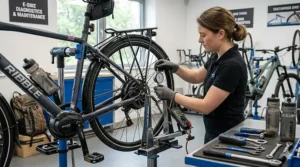
6. Bafang BBS02B 250W Mid Drive Conversion Kit — Best Mid Drive for DIY Converters
The Bafang BBS02B is the conversion kit that turned thousands of unloved bicycles into capable e-bikes, and it remains the benchmark for mid drive DIY projects on Amazon.co.uk. Fitted to a compatible bike’s bottom bracket (68–73mm), it delivers 250W continuous power and up to 80 Nm of torque — and crucially, because it’s a mid drive, that torque gets multiplied through the bike’s existing gears. Climb Roseberry Topping in a low gear and the BBS02B makes it feel almost insultingly easy.
The spec sheet won’t tell you this, but the most valuable feature is the CAN or UART protocol compatibility, which means it pairs cleanly with a range of Bafang displays and allows straightforward speed limiter configuration for UK EAPC compliance. The kit comes with PAS sensor, controller, and display options — everything needed bar the battery, which is sold separately. Installation takes a competent home mechanic around two to three hours; a local bike shop will often charge £50–£80 for fitting if DIY isn’t your thing.
The trade-off is honest: because mid drive power flows through the chain, you’ll be replacing chains more frequently — perhaps every 1,000–1,500 miles rather than 3,000+. Factor this into your long-term cost calculations.
✅ Mid drive efficiency — genuinely superb hill climbing through gears
✅ Compatible with most bikes with 68–73mm bottom bracket
✅ Torque sensor option available for natural pedal feel
❌ Increased chain and cassette wear compared to rear hub systems
❌ Installation requires mechanical confidence (or budget for a bike shop)
Price range: kit around £250–£400 (battery extra) | Available on Amazon.co.uk — verify UK spec before purchasing
7. Bafang BBSHD Mid Drive Kit — Best High-Torque Mid Drive for Hills and Heavy Riders
Where the BBS02B is the thoughtful commuter, the Bafang BBSHD is its considerably more enthusiastic sibling. Delivering up to 100 Nm of torque from its 1,000W peak motor (configured to UK-legal 250W continuous for road use), it’s designed for heavy riders, cargo bikes, and anyone who regularly encounters gradients that make normal mid drive systems labour. The housing is more substantial than the BBS02B, which means it suits bikes with a sturdier frame — steel touring bikes, cargo bikes, and mountain bikes fare best.
For UK use specifically: the BBSHD is the right choice for anyone cycling in the Welsh Valleys, Scottish Highlands, or Pennine routes where sustained 15–20% gradients are a regular feature rather than an occasional inconvenience. The motor’s ability to leverage low gear ratios means it simply doesn’t run out of puff the way a rear hub motor would on extended climbs. That said, it does accelerate drivetrain wear considerably, and chain quality matters here — a cheap chain on a BBSHD kit is a false economy that ends in a snapped link halfway up a hill in the Lake District rain.
UK buyers report outstanding hill performance and long motor longevity (many citing 20,000+ km of reliable use). Configure it correctly for 250W UK compliance; several sellers provide pre-configured UK variants.
✅ 100 Nm torque — genuinely exceptional hill climbing
✅ Outstanding motor longevity when maintained properly
✅ Ideal for heavy riders and cargo bike conversions
❌ Significant chain/cassette wear — budget for more frequent replacement
❌ Heavier and bulkier than BBS02B — not ideal for lightweight frames
Price range: kit around £350–£550 (battery and display extra) | Available on Amazon.co.uk — verify UK configuration
How a UK Rider Should Actually Choose Between These Two Motor Types
The decision is simpler than the internet makes it sound. Work through these five questions honestly:
1. What terrain do you ride? Predominantly flat — Greater London, East Anglia, coastal paths, Cambridge? A rear hub motor is entirely adequate and considerably easier on the wallet. Hilly — Sheffield, Bristol, Edinburgh, the Peak District, Wales, anywhere in Scotland? A mid drive will transform your experience; the hill-climbing difference is not marginal.
2. What’s your chain-wear tolerance? Mid drive motors push power through the drivetrain, and chains typically need replacing every 1,000–1,500 miles rather than 3,000–5,000 miles on hub motor bikes. Over two years of commuting, that’s potentially £30–£60 extra in chain replacement costs, plus cassette wear. If you resent unplanned maintenance stops, a rear hub motor’s mechanical simplicity is a genuine advantage.
3. Do you need to fix punctures roadside? Rear hub wheel removal requires disconnecting the motor cable and is generally more involved than a standard wheel change. Not impossible — but not the five-minute kerb-side job it is on a mid drive bike. If you commute long distances and punctures fill you with genuine dread, this is worth factoring in.
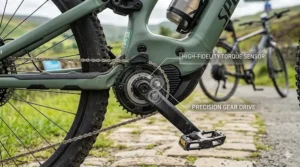
4. How important is ride feel? Mid drive systems — particularly those with torque sensors (standard on quality Bafang and Shimano STEPS motors) — provide a pedalling sensation that genuinely feels like cycling with stronger legs. Hub motors with cadence sensors feel more like occasional electrical injections of pace. For riders who’ve spent years on conventional bikes, the mid drive’s natural feel is often worth the premium.
5. What’s your budget in GBP? Under £700: the rear hub market is excellent and the mid drive market is thin. £700–£1,500: both types offer strong options; choose by terrain. Above £1,500: mid drive systems from Bosch, Shimano STEPS, and premium Bafang units become available and the riding experience takes another step up.
Real UK Riders, Real Scenarios: Which Motor Type Wins?
The London Zone 2 Commuter — Sarah, Hackney to Canary Wharf Sarah needs a bike that folds, handles potholes on Whitechapel Road, fits under her desk, and doesn’t soak up maintenance time she doesn’t have. The terrain is flat to mildly rolling. A rear hub motor folding bike — the Fafrees F20 PRO or the Touroll B1 — is the clear winner. She has zero interest in chain wear intervals; she wants to get to work dry and arrive vaguely presentable.
The Sheffield Hills Commuter — James, Crookes to the City Centre Sheffield is famous for its hills for a reason. James’s 4.5-mile commute involves two climbs that would wind a reasonably fit cyclist without assistance. A mid drive conversion on his existing steel hybrid — the Bafang BBS02B — transforms those hills from daily ordeal to daily non-event. The torque sensor version means power ramps proportionally with his effort, which after six weeks feels entirely natural.
The Retired Couple, Cotswolds Weekend Riders — David and Margaret They ride 10–15 miles on Sundays along relatively gentle Cotswold lanes, want something reliable and low-fuss, and balk slightly at the idea of mid drive chain maintenance. The ENGWE M20 or Eleglide M1 Plus — both rear hub, both quiet and smooth — are ideal: enough range for their rides, minimal maintenance, and the reassurance of a sealed motor that handles the occasional October drizzle without complaint.
What to Expect from Real-World Performance in British Conditions
British cycling conditions deserve their own section, because several specs that look great on a manufacturer’s website behave quite differently when tested against reality.
Range in wet and cold: Lithium-ion batteries lose capacity in cold weather. A battery claiming 80 km range in mild conditions may realistically deliver 55–65 km on a January morning in the Midlands. Mid drive motors, being more efficient at leveraging gears, typically extract 15–25% more range from the same battery capacity than a hub motor equivalent — meaningful on longer routes. For short urban commutes, this difference is negligible; for 20+ mile rides, it’s genuinely significant.
Wet weather performance: Both motor types handle British rain perfectly adequately when the motors carry an IPX4 rating or better — most current Amazon.co.uk products do. What differs is the drivetrain exposure on mid drive bikes. The chain, cassette, and chainring are working harder under motor load AND getting soaked and gritty simultaneously, which accelerates wear considerably. A sealed rear hub motor, completely independent of the drivetrain, sidesteps this entirely. Regular chain cleaning and quality chain lube (wet-weather formulas, not dry-lube products) extends mid drive component life substantially.
Weight and storage: Average rear hub e-bikes weigh 20–26 kg; mid drive bikes vary more widely (18–27 kg) depending on battery size. In the context of UK urban living — terraced houses with steep narrow stairs, small hallways, limited garden storage — weight genuinely matters. A 25 kg fat-tyre hub motor e-bike carried up three flights of stairs is an experience that tests commitment to sustainable transport.
Throttle rules: Under UK EAPC law (as confirmed by the UK government’s official EAPC guidance), throttles may only operate up to 3.7 mph (6 km/h) walking assist without pedalling. Rear hub motor bikes more commonly come configured with throttle assistance; mid drive bikes typically offer pedal-assist only. Neither is inherently better — but if you have mobility issues that make starting from a standstill difficult, a rear hub bike with walk-assist throttle is the legally compliant, practically useful choice.
Long-Term Cost & Maintenance in the UK: The Numbers Nobody Advertises
The upfront price is the least interesting part of the total cost calculation. Here’s a more honest picture over two years of regular commuting (around 3,000 miles):
| Cost Item | Rear Hub Motor | Mid Drive Motor |
|---|---|---|
| Chain replacement (at 1p/mile) | ~£30 total | ~£90 total (3× more frequent) |
| Cassette replacement | ~£25 once | ~£75 (2–3× more frequent) |
| Brake pad replacement | ~£20 | ~£20 |
| Motor servicing | Usually negligible | £50–£100 (Bosch/Shimano service) |
| Tyre replacement | ~£40 | ~£40 |
| Estimated 2-year running cost | ~£115 | ~£225–£285 |
Mid drive bikes carry a running cost premium of roughly £100–£170 over two years — not crippling, but real. Partially offset by the better range efficiency of mid drive systems (fewer charges, marginally slower battery degradation). For high-mileage riders covering 5,000+ miles per year, this gap widens considerably; for occasional riders doing 500 miles per year, it barely registers.
Parts availability matters too. Rear hub motors are largely interchangeable commodities; a Bafang rear hub motor can be sourced, fitted by most bike shops, and swapped in a couple of hours. Premium mid drive systems like Bosch Performance CX or Shimano STEPS EP8 require authorised service centres, and parts availability in rural UK can mean waiting a week or more. For riders in cities with good cycle shop infrastructure — London, Manchester, Birmingham, Edinburgh — this is a minor inconvenience. For riders in the Outer Hebrides, it’s worth considering carefully.
For a broader perspective on e-bike motor longevity and efficiency data, this technical analysis from Cycling Electric provides detailed motor-by-motor comparisons from independent testing. And for the definitive word on what UK road law requires, the official Gov.uk guidance on EAPCs remains the authoritative source.
✨ Don’t Miss These Exclusive Deals!
🔍 Whether you’re leaning toward the simplicity of a rear hub or the hill-climbing brilliance of a mid drive, check current pricing on Amazon.co.uk for the highlighted products above. Prices and availability change regularly — what matters is finding the right motor type for your actual commute.
UK Regulations, Legal Requirements & What Actually Gets Riders Into Trouble
Both rear hub and mid drive motors can be completely road-legal Electrically Assisted Pedal Cycles (EAPCs) — or completely illegal motor vehicles, depending entirely on how they’re configured. The UK rules are actually quite simple, though the internet has a gift for making them sound complicated.
To qualify as a road-legal EAPC in Great Britain (note: Northern Ireland can have slightly different requirements), a bike must: use a motor rated at 250W continuous power or less, stop providing motor assistance once the rider reaches 15.5 mph (25 km/h), have working pedals capable of propelling the bike, and display the manufacturer, motor rating, and battery information. Riders must be at least 14 years old. No licence, insurance, or road tax is required for a compliant EAPC.
The 2024 government consultation that proposed raising the limit to 500W and allowing throttles up to 15.5 mph was dropped in February 2025 — so the 250W/15.5 mph framework remains firmly in place, and all bikes listed in this article are specified accordingly.
What gets riders into trouble is surprisingly specific: high-powered imports advertised with eye-catching 500W, 750W, or 1,000W continuous motor ratings are not road-legal bicycles in the UK. Some sellers configure these bikes with a speed limiter for the UK market, but as the Department for Transport clarified, if the motor is capable of exceeding 250W or 15.5 mph in any mode of use, it’s not a compliant EAPC. Buy from reputable sellers on Amazon.co.uk who explicitly confirm UK EAPC compliance. The conversion kits covered in this article (Bafang BBS02B and BBSHD) can be configured for UK legality — verify before purchasing.
For a full technical breakdown of what mid drive motors are capable of in 2026, BikeRadar’s coverage of Bosch’s latest motor launches provides excellent context on where premium hub and mid drive technology is heading.
Common Mistakes When Buying a UK E-Bike Motor Type
Assuming watts equals performance. A 250W mid drive with a torque sensor will outperform a poorly engineered 500W rear hub motor on every meaningful metric except top speed — which is legally capped anyway.
Ignoring cadence vs torque sensors. Most budget rear hub bikes use cadence sensors: they detect whether the pedals are moving and switch motor assistance on or off accordingly. The result is a slightly binary, surging power delivery. Torque sensors — standard on mid drive motors and increasingly available on better hub motor bikes — measure how hard you’re actually pedalling and scale assistance proportionally. The difference in ride feel is dramatic and worth paying for if you’ll be doing significant mileage.
Buying a high-wattage import and assuming it’s road-legal. As covered above, a 750W motor does not become legal by fitting a 25 km/h speed limiter. The continuous power rating is the determining factor. Many cheap Amazon imports in the £300–£450 range are configured for international markets and are not UK-legal in standard form.
Underestimating UK battery range in winter. Battery range claims are made at around 20°C. British winters hover between 3°C and 10°C for months, reducing effective battery capacity by 15–25%. Add in the extra rolling resistance of wet tyres and headwinds, and the 80 km claimed range becomes a realistic 50–55 km. Plan commutes accordingly, particularly in January and February.
Forgetting about the theft risk. Urban e-bike theft in UK cities has risen significantly. Both rear hub and mid drive bikes are targets; what matters more than motor type is security provision. A Sold Secure Gold-rated lock is the minimum standard worth using in any UK city; in London and Manchester, a Gold-plus-chain-through-wheel combination is increasingly the practical minimum.
Frequently Asked Questions
❓ Is a rear hub motor or mid drive better for commuting in UK cities?
❓ Do mid drive e-bikes wear out chains faster than rear hub bikes in the UK?
❓ Are Bafang conversion kits on Amazon.co.uk road-legal in the UK?
❓ Can I take a rear hub motor e-bike on London Underground or British trains?
❓ Does a mid drive motor feel more natural to ride than a rear hub motor?
Conclusion: Which Motor Type Wins for UK Riders in 2026?
Neither motor type is objectively better. That’s not a fence-sit — it’s the honest answer, and the motor industry knows it. Bosch launched their first rear hub motor (the Hub Line) this very week in June 2026, acknowledging that hub motors have a genuine role in urban cycling that their mid drive systems weren’t designed to fill.
For most UK riders — the daily commuter, the leisure cyclist, the urban errand-runner — a well-specified rear wheel motor e-bike in the £500–£800 range from Amazon.co.uk represents excellent value, minimal fuss, and years of reliable service. For the hill-tackling commuter, the serious tourer, and anyone covering significant weekly mileage across varied British terrain, a mid drive system earns its price premium through efficiency, natural ride feel, and genuine performance advantages on gradients that would humble a hub motor.
Buy for your actual terrain, your actual commute, your actual budget. Not for the terrain you might cycle on someday if everything goes perfectly.
✨ Don’t Miss These Exclusive Deals!
🔍 Ready to choose? Click on any highlighted e-bike or kit in this article to check current pricing and availability on Amazon.co.uk. With Prime next-day delivery available on many models, your commute could look very different by this time tomorrow.
Recommended for You
- Front Wheel Drive Electric Bike: 7 Best UK Picks (2026 Guide)
- Best Budget Hub Motor Ebike UK 2026: 7 Top Picks Reviewed
- Hub Motor Ebike UK: 7 Best Picks for 2026 Riders
Disclaimer: This article contains affiliate links. As an Amazon Associate, I earn from qualifying purchases. If you purchase products through these links, we may earn a small commission at no additional cost to you. All prices shown are approximate ranges and may vary — always check current pricing on Amazon.co.uk before purchasing.
✨ Found this helpful? Share it with your mates! 💬🤗
