In This Article
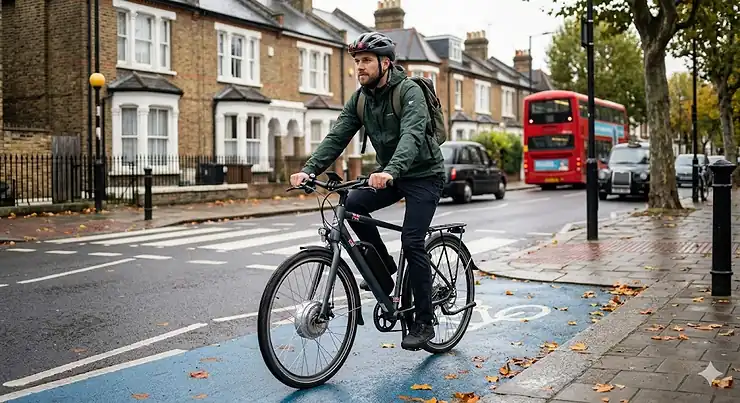
There’s a moment every British cyclist knows well. It’s 7:43 am. The pavement glistens with that particular shade of wet that only October mornings produce. You’re late. And somewhere between the garden gate and the bus stop, you think: there must be a better way.
A front wheel drive electric bike might be exactly that — or it might be precisely the wrong tool for the job. The honest answer depends on who you are, where you ride, and whether you’ve thought carefully about what “front wheel drive” actually means in practice on British roads. Unlike rear-hub or mid-drive systems, a front hub motor effectively pulls you forward from the front axle, a fundamentally different sensation to being pushed. It’s simpler, often cheaper, and genuinely easier to maintain. But slap full power onto a wet patch of north London tarmac in November, and you’ll find out very quickly that the laws of physics have opinions.
What is a front wheel drive electric bike? In short, it’s a bicycle with the motor integrated into the front hub, driving the front wheel rather than the rear. The system is self-contained — the wheel contains the motor, which is powered by an external battery and controlled by a handlebar-mounted display. Most front hub kits available on Amazon.co.uk are designed as conversion options for existing bikes, though several complete e-bikes also use front hub configurations.
This guide cuts through the noise. We’ve researched seven genuine options available on Amazon.co.uk in 2026, weighed up real-world performance in British conditions, and been refreshingly candid about when a front motor makes sense — and when it doesn’t.
Quick Comparison Table: Top Front Wheel Drive Electric Bike Options 2026
| Product | Motor Power | Battery | Best For | Price Range (GBP) |
|---|---|---|---|---|
| BAFANG G020 48V 500W Kit | 500W | Optional 13-17Ah | DIY enthusiasts, customisers | £350–£600 |
| Swytch Max++ Kit | 250W (EAPC legal) | Handlebar-mount, ~30km | Commuters wanting UK-legal simplicity | £350–£500 |
| Swytch Go Kit | 250W (EAPC legal) | Frame-mount, ~65km | Urban riders, longer commutes | £400–£600 |
| Voilamart 26″ Front Hub Kit | 250W (UK-restricted) | Sold separately | Budget converters on flat routes | £100–£200 |
| GSOU 26″ E-Bike 250W | 250W front hub | 8Ah/13Ah built-in | City commuters, beginners | £500–£750 |
| ZAZAWORK 26″ Electric City Bike | 250W | 17.5Ah removable | All-round urban and leisure use | £550–£800 |
| SMARTRAVEL 26″ Electric Mountain Bike | 250W | 13Ah removable | Mixed-terrain, suburb commuters | £450–£650 |
The table tells an interesting story before you’ve read a single review. Notice how all the road-legal options cluster around 250W — that’s not a coincidence, that’s UK EAPC law, which requires pedal-assist motors to be capped at 250W continuous rated power and assistance to cut off at 25 km/h (15.5 mph). The BAFANG G020 at 500W sits in a separate category: it’s a powerful conversion kit that, used at full power, takes the bike out of EAPC classification and into motor vehicle territory — important to know before you bolt it on and join the commuter queue. For most UK riders, the 250W sweet spot is precisely where you want to be.
💬 Just one click — help others make better buying decisions too! 😊
✨ Don’t Miss These Exclusive Deals!
🔍 Take your riding to the next level with these carefully selected front wheel drive electric bike options. Click any highlighted product to check current pricing and availability on Amazon.co.uk. These picks will help you find exactly what you need!
Top 7 Front Wheel Drive Electric Bikes: Expert Analysis
1. BAFANG G020 48V 500W Front Hub Motor Kit
The BAFANG G020 is the kit that serious ebike converters keep coming back to, and for good reason — it’s built by the company that effectively industrialised the hub motor conversion market. The 500W brushless gearless motor is capable of reaching 38–40 km/h under optimal conditions, with an efficiency rating north of 80%. Compatible with 20″, 26″, 28″, 29″, and 700C wheel sizes, it covers the vast majority of bikes you’re likely to own.
Here’s the real-world context a spec sheet won’t give you: 500W puts this kit firmly outside UK EAPC classification if used at full rated power, which means no cycle lanes, no riding without registration, no ignoring the helmet question. However, many UK buyers use it with a programmed controller that restricts output to a legal 250W for road use — a perfectly sensible approach, provided you know what you’re doing with the wiring. For rides on private land, canal towpaths (check permissions), or simply if you want future flexibility, the extra headroom is genuinely useful. The kit comes with a DZ40 LCD display, brake cut-off levers, PAS sensor, and headlight — impressively complete for the price range.
UK buyers should note: the BAFANG G020 requires steel fork dropouts and a torque arm for safe installation. Aluminium forks are not recommended at 500W. If your beloved carbon road bike is what you had in mind, look elsewhere.
UK reviews consistently praise the motor’s smoothness and the quality of BAFANG’s components, though several note the installation process takes a few hours and basic mechanical confidence.
✅ Broad wheel-size compatibility
✅ High build quality from a market-leading manufacturer
✅ Excellent power-to-price ratio for the DIY builder
❌ Requires careful legal management for UK road use
❌ Steel forks essential — not for carbon or low-quality alloy frames
Priced in the £350–£600 range depending on battery option, this is outstanding value for anyone who knows what they’re buying.
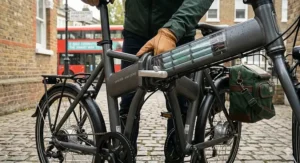
2. Swytch Max++ Front Wheel Kit
Swytch is a London-based company, which means they’ve designed their kit around the realities of British commuting rather than California sunshine — a small but meaningful distinction. The Max++ represents their most capable handlebar-mounted battery option, delivering approximately 30 km of assisted range from a compact power pack that weighs just over a kilogram. The front hub motor is EAPC-legal at 250W, which means you can use cycle lanes, need no insurance, and ride it at 14 years old — the full unrestricted freedom of a regular bicycle, just with a quiet electric assist.
What makes the Swytch system genuinely clever is the installation philosophy. The motor comes pre-laced into a replacement front wheel; you swap it for your existing front wheel, attach the battery to the handlebars, clip on a cadence sensor, and you’re done in under an hour. For most riders, this is the significant advantage over something like the BAFANG — no soldering, no controller programming, no YouTube tutorials at midnight.
The Max++ also includes a bright ring light integrated into the battery casing, which addresses one of the great overlooked hazards of British cycling: being invisible to drivers in the permanent grey drizzle of a November afternoon.
The limitation to acknowledge honestly: 30 km range won’t satisfy riders doing longer commutes. And at 40 Nm of torque, this motor is noticeably underpowered on steep hills — Sheffield residents, Edinburgh commuters, and anyone in Bristol should think twice before assuming 250W will conquer a 15% gradient with groceries on board.
✅ Designed and supported in the UK with excellent customer service
✅ Very fast installation, no technical expertise required
✅ Fully EAPC-compliant, legal on all UK roads and cycle paths
❌ 30 km range is limiting for longer daily commutes
❌ Not compatible with thru-axle forks (100x9mm or 100x10mm only)
Available in the £350–£500 range — a measured price for genuine plug-and-play simplicity.
3. Swytch Go Front Wheel Kit
Where the Max++ prioritises compactness, the Swytch Go prioritises range. The Go kit’s frame-mounted battery extends the assisted range to approximately 65 km — comfortably covering most UK commuting distances, including the lengthier runs that the Air and Max couldn’t manage. According to Cycling Electric’s 2026 review, the Swytch Go delivers smooth low-speed acceleration and a notably easy installation process, making it well-suited to urban riders who need reliable help getting off the line in traffic.
That low-speed punch is particularly relevant to front hub motor physics: the front wheel carries less weight than the rear, especially under acceleration, so the risk of the wheel spinning rather than gripping is highest from a standing start. Swytch appears to have calibrated the Go’s power delivery carefully to keep this manageable.
The 250W motor is fully road-legal, and the frame-mount battery positioning improves weight balance compared to handlebar-mounted units — a welcome change for riders who found the Max+ made their steering feel slightly nose-heavy. Worth noting: this battery cannot be taken on aircraft due to its capacity, so travelling cyclists should factor that in.
UK buyers should also be aware that as of late 2025, Swytch experienced some fulfilment delays — worth checking current delivery timescales before purchasing if you’re in a hurry.
✅ ~65 km range suits longer UK commutes comfortably
✅ Better weight balance than bar-mounted alternatives
✅ Fully legal, smooth power delivery optimised for urban use
❌ Not flight-compatible (high battery capacity)
❌ Frame mounting reduces compatibility with certain bike geometries
Priced in the £400–£600 range, it sits at a fair premium over the Max++ for the significant range improvement.
4. Voilamart 26″ Front Wheel Conversion Kit
The Voilamart 26″ Front Hub Motor Kit is the budget option in this list, and unashamedly so. At under £200, you’re getting a brushless gearless hub motor laced into an aluminium rim with a basic controller, twist throttle, brake levers, and PAS sensor. Battery is sold separately, which keeps the initial outlay low but adds to the total cost — expect to spend another £150–£250 on a decent 48V pack.
In UK road-legal configuration, the kit runs at 250W output, which is perfectly adequate for flat urban routes — think commuting across central Manchester, navigating the gentler parts of Glasgow, or getting around Cambridge. It is noticeably less capable on sustained inclines, and the controller’s power delivery is on/off rather than progressive, which takes some adjustment.
Here’s the critical note for UK buyers: the connectors are not waterproof out of the box. This is not a minor quibble in a country where it rains with the reliability of a BBC weather forecast. Experienced builders typically waterproof the controller box and connectors with additional sealing — a job that adds an hour of work but is genuinely necessary if you’re riding in British weather rather than a YouTube studio. Cycling Weekly’s hands-on test of similar budget kits notes this as a consistent shortcoming across the category.
Despite these caveats, the Voilamart is remarkably popular among UK DIY builders on a tight budget, and spares are readily available.
✅ Exceptional value — lowest entry price on this list
✅ Compatible with standard 26″ bikes (100mm dropout spacing)
✅ Spares widely available in the UK
❌ Not waterproof without modification — a genuine issue for UK climate
❌ On/off power delivery lacks smoothness of premium options
In the £100–£200 range (plus battery), this is a creditable budget option for flat-route commuters who don’t mind a Saturday afternoon of wiring.
5. GSOU 26″ E-Bike 250W UK Legal
The GSOU 26″ Electric Mountain Bike represents a different approach to the front wheel drive electric bike question: rather than converting an existing bike, you buy a complete package with the hub motor already integrated and the whole thing ready to ride. The 250W front motor is paired with a choice of 8Ah or 13Ah removable battery, which translates to a realistic range of 40–60 km on a full charge — adequate for the 78% of British cycle commuters who travel less than 13 km each way.
Seven gears via a standard derailleur system mean you’re not relying solely on motor assistance to manage hills, which is wise given the front hub’s acknowledged limitations on steep gradients. The dual disc brakes deserve particular mention: on wet British roads, stopping power genuinely matters, and cable-actuated discs on budget bikes can be inconsistent. GSOU’s disc setup earned consistent praise in UK customer reviews.
The lockable suspension fork is a nice touch for urban riding — it soaks up pothole abuse when unlocked and stiffens for efficiency on smoother roads. For a commuter bike navigating the average British pothole-riddled A-road, this matters more than it might at first appear.
A smart LCD display shows speed, battery level, and assistance level without clutter. The bike is Road Legal UK compliant (EAPC standard), meaning no licence or insurance required.
✅ Complete ready-to-ride package — no conversion required
✅ Dual disc brakes — vital for wet UK conditions
✅ Removable battery with lockable suspension
❌ Front hub motor limits performance on steep inclines
❌ 8Ah battery version offers limited range for longer routes
In the £500–£750 range, solid value for a complete e-bike with useful UK-specific features.
6. ZAZAWORK 26″ Electric City Bike
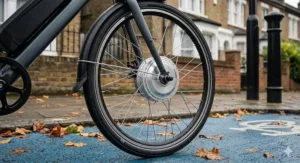
The ZAZAWORK 26″ Electric City Bike makes a compelling case for the all-round urban commuter. Its 17.5Ah removable battery is one of the highest-capacity units in this price bracket, delivering a claimed range of 70–90 km per charge — which, in real-world British conditions (20°C warmer than test conditions, headwinds, and the inevitable hills), translates to a reliable 55–70 km. That puts a serious dent in the “running out of charge halfway home” anxiety that plagues budget e-bike ownership.
The front suspension system does meaningful work on UK urban roads, which are considerably less smooth than manufacturers’ promotional imagery tends to suggest. Seven-speed gearing combined with the 250W front hub motor keeps the bike manageable across varied terrain, though the usual front-hub caution applies: modulate your power delivery on wet or loose surfaces rather than asking for everything at once.
UK customer reviews frequently highlight the build quality as above what the price suggests — particularly the frame finish and the quality of the braking system. For city cyclists doing daily commutes in the £550–£800 range, this represents arguably the best balance of range, features, and price on this list.
The removable battery charges separately from the bike, which is genuinely useful for riders in flats without ground-floor access — you can carry it upstairs to charge without dragging the whole bike to a socket.
✅ Market-leading range for the price bracket
✅ High-capacity removable battery — excellent for flat-dwellers
✅ Solid build quality and good UK user feedback
❌ Heavier than lighter-spec competitors (typical for this battery size)
❌ Front hub motor retains traction limitations in wet conditions
A well-rounded choice in the £550–£800 range for the commuter who prioritises range above all else.
7. SMARTRAVEL 26″ Electric Mountain Bike
The SMARTRAVEL 26″ Electric Mountain Bike occupies an interesting middle ground: it’s more capable than a pure city bike, without quite stretching into the premium territory where dedicated off-road e-MTBs live. The 250W front hub motor pairs with a 13Ah removable battery for a realistic range of around 47 km under mixed conditions — honest enough for suburban commuters who need to cover varied terrain.
Hydraulic brakes are the standout specification at this price point. Hydraulic disc brakes offer significantly better modulation and wet-weather performance than their cable-actuated counterparts — the kind of difference you notice acutely when you’re descending towards a junction in the rain at 25 km/h. For UK buyers who ride year-round, this is not a specification to overlook.
The 48V system and 7-speed gearing give the bike a confident feel on rolling countryside roads, though the front hub motor remains limited on sustained 10%+ gradients — a consideration for buyers in hilly regions. The LCD display provides clean speed and range information without visual clutter.
UK buyers will find the 47 km real-world range suits a 2–3 day commuting cycle without recharging, depending on distance. The LCD is straightforward and weather-resistant — not always a given on budget e-bikes that were evidently tested in sunnier climates.
✅ Hydraulic disc brakes — exceptional wet-weather stopping power
✅ 48V system delivers confident performance on rolling terrain
✅ Sensible mid-range spec without unnecessary complexity
❌ 47 km range on the modest side for longer commuting distances
❌ Front hub remains a limitation on very steep hills
In the £450–£650 range, this is excellent value for the hydraulic brake specification alone.
How Front Wheel Drive Works in British Conditions: A Realistic Guide
Let’s talk honestly about something the product listings won’t say clearly: a front wheel drive electric bike and a wet British road are not natural friends.
The physics are straightforward. Your front wheel carries less of your body weight than the rear — roughly 40% compared to 60% under normal riding posture, and that ratio shifts further backwards under acceleration. When a motor drives the lighter wheel, grip is reduced. On dry, smooth tarmac in summer, this is largely academic. On a damp October morning in Leeds, on a road that hasn’t been resurfaced since the 2012 Olympics, it becomes genuinely relevant.
This doesn’t mean a front wheel drive e-bike is dangerous — it means you need to ride one with appropriate awareness. Research into ebike handling in wet conditions consistently points to the same conclusion: the risk is highest when applying full power from a standing start on slippery surfaces. The solution is simple: use lower power assistance levels in wet weather, accelerate progressively, and don’t ask for maximum assist while cornering on a wet roundabout. Exactly the kind of measured riding that British road conditions teach you fairly quickly regardless of motor position.
Practical wet-weather riding tips for front hub motors:
🚴♂️ Use PAS level 1 or 2 on wet mornings — this delivers partial assist rather than asking the front wheel for everything at once.
🚴♂️ Fit quality wet-weather tyres — a knobbly mud tyre is no better for traction than a smooth road tyre on wet tarmac; you want a tyre with defined sipes designed for wet grip. Schwalbe’s Marathon range is a popular UK choice.
🚴♂️ Weight distribution matters — sitting further back on the saddle transfers more weight to the front wheel under acceleration. Counterintuitive, but effective.
🚴♂️ Give yourself extra stopping distance — braking distances increase in wet conditions regardless of motor position. If your bike has mechanical disc brakes, consider upgrading pads to a sintered compound for wet-weather performance.
🚴♂️ Check your dropout security — a front hub motor exerts rotational torque on the fork dropout. Ensure your torque arm (on conversion kits) is properly fitted before every winter season.
Real-World UK User Profiles: Who Should Buy a Front Hub E-Bike?
Not every electric bike suits every rider. Here’s a considered match of real UK situations to the right choice from this list.
The London Flat-Commuter
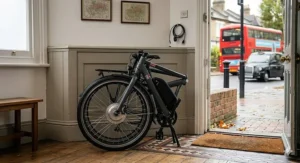
Marcus lives on the 3rd floor of a converted terrace in Hackney. He cycles 6 km each way to work in Shoreditch through relatively flat East London streets. Storage is a cupboard on the landing.
Best fit: Swytch Go Kit on his existing Boardman hybrid. The front wheel converts in under an hour, the battery is removable for upstairs charging, and the 65 km range easily covers his week without a recharge. EAPC-legal means he can use Hackney’s cycle superhighway and needs no insurance. At around £450–£600, it keeps the total cost well under a new e-bike.
The Sheffield Hill-Commuter
Priya commutes 8 km across Sheffield’s frankly absurd topography, combining a 6% climb on the outbound leg with a faster descent. She wants something simple.
Best fit: ZAZAWORK 26″ Electric City Bike. The high-capacity 17.5Ah battery means she can use assistance generously on the climb without range anxiety. That said, she should manage expectations: a front hub motor on a sustained hill will require supplementing with genuine pedalling. If the gradient is consistently above 8%, a rear hub or mid-drive would genuinely suit her better.
The Retired Leisure Cyclist in the Cotswolds
David and his wife use their bikes mainly at weekends on quiet country lanes near Bourton-on-the-Water. Neither has touched a soldering iron since 1987.
Best fit: GSOU 26″ complete e-bike — ready to ride out of the box, no conversion required. The suspension fork handles rougher lane surfaces comfortably, and the 250W assist transforms weekend rides from a workout into a pleasure. For gentle Cotswold lanes, a front hub motor’s traction limitations are largely irrelevant.
Common Mistakes When Buying a Front Wheel Drive Electric Bike in the UK
The UK ebike market has matured considerably, but certain buying mistakes remain remarkably consistent. Here are the ones worth avoiding.
1. Ignoring EAPC legal status — The Department for Transport’s position is clear and has remained unchanged despite 2024 consultation proposals being shelved in early 2025: 250W continuous rated power and 25 km/h assistance cut-off are the legal limits for EAPC classification. A conversion kit sold at 500W or 750W on Amazon.co.uk is not a road-legal bicycle if used at full power. This is not a grey area.
2. Buying a kit without checking fork compatibility — Front hub motors exert torque on the fork dropout. Steel forks handle this well; cheap aluminium forks can crack. If you’re converting a bike you already own, identify the fork material before purchasing. A cracked fork at speed is not a situation you want to encounter on the A40.
3. Underestimating the British weather impact on range — Manufacturers test range in controlled conditions. Real-world range in the UK, riding in 8°C with a headwind on damp roads, is typically 15–25% lower. Factor this in, not the number on the box.
4. Forgetting about UKCA marking — Post-Brexit, UK products should carry UKCA certification rather than (or in addition to) the EU’s CE mark. Many imported conversion kits carry CE marking only. This doesn’t make them illegal to purchase, but it does mean they haven’t been independently verified against UK-specific safety standards. For peace of mind, look for UKCA marking or buy from established UK retailers who have verified compliance.
5. Neglecting torque arms on conversion kits — On a conversion kit, the torque arm prevents the axle from rotating in the dropout under motor load. Skip it and you risk the wheel separating from the forks under power. This is not optional. Fit one, check it regularly, and replace it if it shows signs of wear.
UK Regulations, Safety Standards & Legal Requirements
This is a topic that rewards careful reading, particularly in 2026 where the regulatory environment has recently been tested and confirmed.
To ride a front wheel drive electric bike on UK public roads without a licence, insurance, or registration, the bike must qualify as an Electrically Assisted Pedal Cycle (EAPC). The requirements are: a maximum continuous rated motor power of 250W, pedal assistance that cuts off at 25 km/h (15.5 mph), and functional pedals that must be in motion for motor assistance to be provided. As Cycling UK explains, these regulations apply in England, Scotland, and Wales; Northern Ireland has historically operated under similar but separately enacted rules.
The 2024 Department for Transport consultation that proposed raising the limit to 500W and relaxing throttle rules was formally dropped in early 2025. The 250W framework remains. If you’re buying a conversion kit marketed as 500W, 750W, or 1000W for road use, ask the seller explicitly how it delivers 250W-legal operation — ideally in writing.
One important nuance: a bike sold in a power-restricted configuration but whose motor is capable of exceeding 250W is technically not EAPC-compliant under DfT guidance. This matters because several budget kits on Amazon.co.uk can be unlocked to higher power via a simple cable disconnection. If you unlock it for off-road use, remember to re-restrict before returning to public roads.
For riders considering front hub conversion kits from the EU post-Brexit: some products now carry only CE marking rather than UKCA certification. Trading Standards enforcement of this varies, but for liability and insurance purposes, UKCA-certified products offer better protection.
How to Choose a Front Wheel Drive Electric Bike in the UK: 6 Key Criteria
1. Define your route honestly. Front hub motors are excellent on flat-to-rolling urban terrain and genuinely struggle on sustained steep gradients. If your commute involves a significant hill, test this before committing — or acknowledge from the outset that you’ll need to contribute real pedalling on the climb.
2. Set a realistic total budget in GBP. Conversion kits require a battery (add £150–£300 to the kit price), a charger, potentially a torque arm, and possibly new tyres. A budget kit can end up costing as much as a budget complete e-bike once properly equipped.
3. Check fork compatibility before anything else. Wheel size, axle standard (9mm QR vs 10mm nutted), and fork material determine whether a conversion kit will work on your specific bike. Measure the inside of your fork dropout before ordering.
4. Verify EAPC compliance for road use. If you need to ride on public roads, cycle paths, or anywhere other than private land, the motor must operate within 250W/25 km/h limits. Get this confirmed in writing by the seller.
5. Consider weather protection seriously. UK riding means wet connectors, damp controllers, and salt-laden roads in winter. Look for IP-rated controllers, sealed connectors, or plan for waterproofing as part of your installation.
6. Think about storage and security. In a terraced house or flat without secure outdoor storage, a removable battery system (Swytch, GSOU, ZAZAWORK, SMARTRAVEL) offers significant practical advantages — you can bring the battery inside to charge without moving the whole bike.
Long-Term Cost & Maintenance in the UK
One of the genuinely underappreciated advantages of a front wheel drive electric bike is maintenance simplicity. Because the motor is in the front wheel rather than the drivetrain, your existing rear cassette, chain, and derailleur continue to function exactly as before — and can be serviced at any standard bike shop on any British high street without specialist e-bike knowledge.
Battery replacement is the largest long-term cost. A quality 48V 13Ah lithium-ion battery loses approximately 20% of its capacity after 500 full charge cycles — roughly 3–4 years of regular commuting. Replacement packs from reputable suppliers run £150–£300 in the UK, though this varies considerably by cell quality. Using name-brand cells (Samsung, LG, Panasonic) rather than generic alternatives extends cycle life meaningfully — ask sellers to specify cell origin where possible.
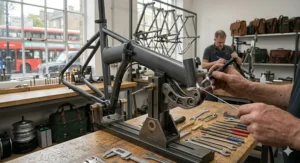
Front hub motors themselves are remarkably durable. Brushless gearless hub motors have no brushes to wear and minimal internal movement beyond the bearings. Sealed bearing replacement is a periodic requirement — every 3,000–5,000 km under typical UK conditions — and costs under £20 in parts plus a half-hour of time if you’re moderately mechanically confident.
The brake pads on UK-ridden bikes require more frequent replacement than the manufacturers’ estimates, which invariably assume Mediterranean riding conditions. Budget for pad replacement every 6–8 months if you commute year-round in British weather, particularly on rim-brake configurations. Disc brakes are more forgiving but not immune: sintered pads last longer in wet conditions than organic alternatives and are worth the modest extra cost.
Tyres are the unglamorous maintenance item that makes the most practical difference. A Puncture-resistant tyre with decent wet grip — Schwalbe’s Marathon Plus is the UK touring classic — eliminates the roadside puncture experience that has ended many a commuting enthusiasm permanently.
Features That Actually Matter (And Those That Don’t)
Features that genuinely matter for UK front hub e-bike buyers:
⚡ IP rating of the controller — A controller without waterproofing is a liability in Britain. Look for IP65 or above.
⚡ Brake motor cut-off sensors — These disconnect motor power when you apply the brakes, preventing the motor from fighting the braking force. Standard on quality kits, occasionally absent on the cheapest options. Check before buying.
⚡ Battery quality and cell origin — Determines long-term range retention. Name-brand cells age better.
⚡ Torque arm inclusion (conversion kits) — Non-negotiable for safety. If the kit doesn’t include one, buy one separately immediately.
⚡ Display clarity in British light — Overcast grey skies are your permanent backdrop. A high-contrast display with backlight is more useful than a beautifully designed unit visible only in direct sunlight.
Features that matter less than the marketing suggests:
❌ Claimed maximum speed above 25 km/h — Irrelevant for UK road-legal use. Disregard.
❌ Peak wattage figures — “1000W peak” on a budget kit means it can briefly draw that power under maximum load. The continuous rated power is the legally relevant figure — and for most UK-legal kits, it’s 250W.
❌ Wireless connectivity and app integration — Useful in theory; battery-draining and often poorly supported in practice. The most reliable displays are simple LCD units with physical buttons.
FAQ
❓ Are front wheel drive electric bikes road-legal in the UK?
❓ Do front hub motors slip on wet roads?
❓ What fork dropout size do I need for a front wheel conversion kit?
❓ How long does a front hub motor battery last in the UK?
❓ Can I use a 500W or 1000W front hub kit on UK roads?
Conclusion
The front wheel drive electric bike occupies an interesting niche in the UK market: it’s the most accessible, most affordable, and most DIY-friendly entry point into electric cycling — and it comes with trade-offs that honest riders should understand rather than discover unexpectedly on a wet roundabout.
For flat urban commuting, casual weekend leisure rides, and anyone who values simple installation and low-maintenance operation above raw performance, a front hub system makes excellent sense. The Swytch kits deliver polished, UK-designed simplicity. The BAFANG G020 rewards the technically confident with outstanding power and flexibility. The GSOU, ZAZAWORK, and SMARTRAVEL complete bikes remove conversion complexity entirely. There’s a genuine option here for almost every type of British rider.
The honest advice: be realistic about your terrain, take wet-weather handling seriously (because it rains, it always rains), and check EAPC compliance before clicking purchase. Do those three things and a front wheel drive e-bike will serve you well for years.
✨ Don’t Miss These Exclusive Deals!
🔍 Ready to choose? Click any highlighted product above to check current pricing and availability on Amazon.co.uk. Whether you’re looking for a simple conversion kit or a complete ready-to-ride e-bike, these picks represent the best of what’s available in 2026.
Recommended for You
- Best Budget Hub Motor Ebike UK 2026: 7 Top Picks Reviewed
- Hub Motor Ebike UK: 7 Best Picks for 2026 Riders
- 7 Best Mid Drive Electric Bike for Hills Picks UK 2026
Disclaimer: This article contains affiliate links. As an Amazon Associate, I earn from qualifying purchases. If you purchase products through these links, we may earn a small commission at no additional cost to you.
✨ Found this helpful? Share it with your mates! 💬🤗
