In This Article
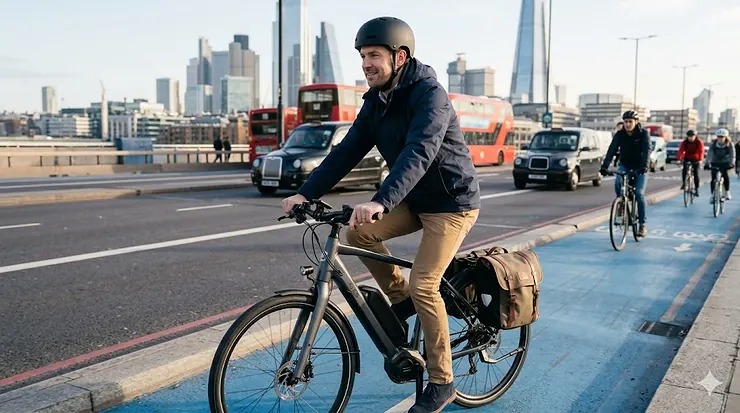
Cycling to work in Britain has shifted from worthy but rain-soaked suffering to something genuinely appealing, and cycle to work scheme e-bikes deserve most of the credit. Through salary sacrifice, you’re essentially getting the taxman to subsidise roughly a third of your new electric bike—basic-rate taxpayers save around 28%, whilst higher-rate payers pocket a rather satisfying 42% saving on bikes that would otherwise cost upwards of £1,000.
The mechanics are straightforward enough. Your employer purchases the e-bike, you repay through pre-tax salary deductions over typically 12 months, and HMRC never sees that income. On a £1,500 e-bike, a higher-rate taxpayer pays around £870 instead—a saving of £630 that makes premium models suddenly rather affordable. What most guides won’t tell you is that the real value extends beyond the initial discount. You’re also dodging National Insurance contributions, and many employers now offer extended schemes beyond the old £1,000 limit, opening access to genuinely capable e-bikes with proper batteries and motors that won’t leave you stranded halfway up Streatham Hill.
Here’s what matters in 2026: every e-bike must comply with UK EAPC regulations from GOV.UK (250W maximum motor, 15.5mph assistance cut-off, pedal-assist only) to qualify for the scheme. Electrically assisted pedal cycles, known as EAPCs in UK law, are classified identically to traditional bicycles provided they meet these strict criteria. Anything more powerful legally becomes a moped, requiring registration, insurance, and a driving licence—precisely what the cycle to work scheme doesn’t cover. This guide cuts through the marketing flannel to identify seven e-bikes available on Amazon.co.uk that genuinely suit British commuting conditions: wet weather, compact storage, variable terrain, and the reality of cycling through six months of drizzle annually. We’ve prioritised models with UK warehouse stock, proper customer support, and specifications that translate to real-world performance rather than optimistic range claims that evaporate the moment you encounter a headwind.
Quick Comparison: Top C2W Scheme E-Bikes at a Glance
| Model | Motor/Battery | Range | Weight | Price Range | Best For |
|---|---|---|---|---|---|
| Eleglide M2 | 250W / 36V 15Ah (540Wh) | 80-120km | 23kg | £800-£950 | Hilly commutes, longer distances |
| HITWAY BK5S | 250W / 36V 7.5Ah (270Wh) | 35-55km | 19kg | £599-£699 | Budget-conscious, flat routes |
| Eleglide Mopride 2 | 250W / 36V 15.6Ah (561Wh) | 90-130km | 24kg | £850-£1,000 | Premium range, all-weather |
| SAMEBIKE MY275 | 250W / 48V 10Ah (480Wh) | 60-80km | 22kg | £700-£850 | Mixed terrain, value seekers |
| ADO Air 20 | 250W / 36V 10.4Ah (374Wh) | 60-90km | 17.5kg | £899-£1,099 | Lightweight, city commuting |
| Fafrees F20 Max | 250W / 48V 15Ah (720Wh) | 100-140km | 25kg | £950-£1,200 | Maximum range, heavy riders |
| HITWAY BK12 | 250W / 36V 11.2Ah (403Wh) | 50-75km | 20kg | £749-£899 | Folding, train commuters |
From this comparison, three patterns emerge that most buyers overlook. First, battery capacity matters infinitely more than motor wattage—the Fafrees F20 Max’s 720Wh battery delivers nearly double the real-world range of the HITWAY BK5S despite identical 250W motors. Second, weight becomes critical if you’re lugging the bike up three flights to a flat or squeezing it onto the 07:42 to Waterloo; that 7.5kg difference between the ADO Air 20 and the Fafrees is the difference between manageable and genuinely burdensome. Third, price-per-watt-hour reveals true value: the Eleglide Mopride 2 offers 561Wh for around £900, whilst premium brands charge £1,500+ for comparable capacity. When you’re claiming 42% tax relief through C2W, suddenly that £950 Fafrees costs you £551—exceptional value for a bike that’ll cover 140km between charges.
💬 Just one click — help others make better buying decisions too! 😊
Top 7 Cycle to Work Scheme E-Bikes: Expert Analysis for UK Riders
1. Eleglide M2 — The Hill-Climbing Workhorse
The Eleglide M2 combines proper mountain bike geometry with road-legal electric assistance, making it the rare e-bike that genuinely excels on both urban commutes and weekend trail rides. Its 250W rear hub motor delivers 50Nm of torque—sufficient to tackle steep gradients without that embarrassing mid-climb power fade that cheaper motors suffer. The 36V 15Ah battery (540Wh) translates to 80-120km of real-world range, though expect closer to 65-80km if you’re regularly climbing or riding through persistent headwinds.
What most Amazon listings won’t mention: the aluminium alloy frame resists corrosion far better than cheaper steel alternatives, rather crucial when you’re parking outside year-round in British weather. The 21-speed Shimano drivetrain provides genuine versatility—you can pedal efficiently even when the battery’s depleted, unlike single-speed models that become absolute torture when the power runs out. UK buyers particularly appreciate the hydraulic disc brakes, which maintain stopping power even in wet conditions, and the removable battery design means charging at work without manhandling the entire bike indoors.
Customer feedback from British riders consistently highlights build quality exceeding the price point, though several mention the supplied saddle warrants immediate replacement—budget £30-£40 for a comfort upgrade. The bike arrives 85% assembled; expect 30-45 minutes with basic tools to complete setup.
✅ Pros:
- Exceptional hill-climbing capability for steep UK gradients
- Large 540Wh battery delivers consistent 80km+ range
- Hydraulic brakes perform reliably in wet weather
❌ Cons:
- 23kg weight challenges multi-storey flat dwellers
- Stock saddle quality disappoints for longer rides
Price: Around £800-£950 | After 42% C2W saving: £464-£551
2. HITWAY BK5S — Budget Entry Without Compromise
The HITWAY BK5S proves that tight budgets needn’t exclude you from electric commuting, delivering essential features at a price point accessible to most salary sacrifice schemes. This compact 16-inch folding e-bike packs a 250W rear hub motor with three pedal-assist modes, reaching the legal 25km/h (15.5mph) limit whilst remaining fully EAPC compliant across England, Scotland, and Wales.
The 36V 7.5Ah battery (270Wh) provides 35-55km of assisted range—perfectly adequate for the average UK commute of 8-12km each way, though you’ll want to charge daily rather than relying on multiple-day reserves. Where the BK5S genuinely shines is practicality: it folds in under 30 seconds and weighs just 19kg, making it manageable for carrying onto trains or storing under office desks. The compact 16-inch wheels sacrifice some ride comfort on rough surfaces but enhance portability and manoeuvrability through congested city centres.
UK customer reviews particularly praise the grease-free chain guard—no more oil-stained work trousers—and the integrated LED display showing battery level, speed, and distance. The three assist levels allow you to balance power consumption against effort; eco mode extends range to the upper limit, whilst sport mode drains the battery faster but eliminates any cycling effort on flat routes.
Be realistic about limitations: the smaller battery means range anxiety becomes genuine on routes exceeding 25km, and the compact wheels make uneven pavements rather more noticeable than on full-size models. Several British buyers recommend upgrading the tyres to puncture-resistant versions after the first month.
✅ Pros:
- Folds compact enough for train commuting and small flats
- Chain guard prevents workplace wardrobe disasters
- Price point accessible even on basic-rate C2W savings
❌ Cons:
- 270Wh battery limits range to shorter commutes
- 16-inch wheels amplify road imperfections
Price: Around £599-£699 | After 42% C2W saving: £347-£405
3. Eleglide Mopride 2 — Premium Range for Serious Commuters
The Eleglide Mopride 2 targets riders who’ve grown weary of range anxiety and want an e-bike that simply works through British weather without constant charging. Its substantial 36V 15.6Ah battery (561Wh) enables genuinely impressive 90-130km of assisted range—sufficient for most UK commuters to manage three or four days between charges, even accounting for cold weather’s 10-15% range reduction.
The 250W motor may seem modest on paper, but paired with a 21-speed Shimano drivetrain, it tackles varied terrain with surprising competence. Bristol and Sheffield commuters report handling the notoriously steep Park Street and Ecclesall Road climbs without the motor cutting out mid-ascent—a common complaint with cheaper hub motors under load. Dual hydraulic disc brakes provide confident stopping power, absolutely essential when descending wet hills at speeds approaching 25mph.
What distinguishes the Mopride 2 from similarly-priced competitors is attention to weather resistance. The high-quality aluminium alloy frame features sealed bearing hubs that resist British rain far better than exposed components—you won’t be re-greasing every 500 miles like with budget models. The removable battery includes a locking mechanism that actually works, addressing the frustration many commuters face with batteries that rattle loose on rough roads.
UK buyers consistently rate build quality as exceptional for the sub-£1,000 bracket, though several note the bike arrives requiring more assembly than advertised—budget an hour with a decent toolkit, or pay a local bike shop £40-£50 for professional setup. The stock tyres suit mixed terrain adequately but lack the puncture resistance serious commuters demand; upgrading to Schwalbe Marathon Plus tyres (around £60 for the pair) transforms reliability.
✅ Pros:
- 561Wh battery eliminates daily charging anxiety
- Sealed components withstand months of British drizzle
- 21-speed gearing provides genuine versatility
❌ Cons:
- 24kg weight challenges those without ground-floor storage
- Assembly complexity exceeds beginner capabilities
Price: Around £850-£1,000 | After 42% C2W saving: £493-£580
4. SAMEBIKE MY275 — The Mixed-Terrain All-Rounder
The SAMEBIKE MY275 occupies the sweet spot between budget accessibility and genuine capability, delivering surprisingly robust performance for riders who demand more than basic commuting functionality. Its 250W motor pairs with a 48V 10Ah battery (480Wh)—the higher voltage provides better efficiency under load, particularly noticeable when tackling inclines or riding into persistent wind.
The 27.5-inch wheels strike an intelligent balance: larger than folding models for improved ride comfort and obstacle handling, yet more manoeuvrable than full 29-inch mountain bike wheels in congested urban environments. The front suspension fork absorbs the worst of Britain’s pothole epidemic, whilst mechanical disc brakes provide adequate stopping power in dry conditions (upgrade to hydraulics if you’re regularly descending steep hills in rain).
What British buyers particularly appreciate is the 7-speed Shimano derailleur, which transforms the bike’s versatility. Low gears make hills manageable even with minimal battery assistance, extending range significantly when you’re willing to contribute some effort. High gears allow efficient pedalling beyond the 15.5mph assistance cut-off—useful for keeping pace with faster traffic on dual carriageways where cycle lanes vanish.
The MY275’s 60-80km real-world range suits most UK commutes comfortably, though those tackling particularly hilly routes should expect the lower end of that spectrum. Customer feedback suggests the supplied saddle and grips warrant immediate replacement—factor £40-£50 for comfort upgrades. Several Scottish buyers report excellent cold-weather performance, with the battery maintaining capacity down to around 2°C before showing noticeable degradation.
✅ Pros:
- 48V system delivers efficient hill climbing
- 27.5-inch wheels handle mixed terrain confidently
- 7-speed gearing extends versatility and range
❌ Cons:
- Mechanical brakes underperform in sustained wet conditions
- Stock components require budget for comfort upgrades
Price: Around £700-£850 | After 42% C2W saving: £406-£493
5. ADO Air 20 — Lightweight Urban Specialist
The ADO Air 20 achieves something genuinely remarkable: a full-size folding e-bike weighing just 17.5kg. For context, that’s 5-7kg lighter than comparable models, and the difference transforms daily usability for anyone navigating stairs, trains, or tight storage spaces. The weight saving comes from intelligent frame design and component selection rather than compromising structural integrity—the aluminium alloy construction maintains rigidity whilst shedding unnecessary bulk.
The 250W rear hub motor delivers smooth, predictable assistance that suits urban cycling’s stop-start rhythm perfectly. Unlike some cheaper motors that surge aggressively from standstill, the ADO provides graduated power delivery that feels natural rather than alarming in heavy traffic. The 36V 10.4Ah battery (374Wh) offers 60-90km of assisted range, though expect the lower figure if you’re predominantly using higher assist levels through hilly terrain.
What sets the Air 20 apart is genuine attention to the complete user experience. The carbon belt drive eliminates chain maintenance entirely—no more oil, no more rust, no more adjusting tension. For British commuters wearing work clothes, this alone justifies the premium over chain-driven models. The integrated lights run from the main battery rather than requiring separate charging, and the colour LCD display remains readable even in direct sunlight.
UK customer feedback consistently highlights the ADO app connectivity, which allows customising assist levels, tracking ride statistics, and even locating the bike via GPS if it’s nicked from outside the office. The 20-inch wheels fold remarkably compact—several London commuters report fitting it under Tube seats during off-peak hours without blocking aisles.
The primary trade-off for low weight is the smaller battery capacity. If your commute exceeds 30km each way, you’ll need workplace charging facilities or a second battery (around £280 from ADO directly). Several buyers also mention the folding mechanism requiring more force than advertised—expect to develop a specific technique over the first week.
✅ Pros:
- 17.5kg weight transforms multi-modal commuting
- Carbon belt drive eliminates maintenance headaches
- App integration provides useful tracking and customisation
❌ Cons:
- 374Wh battery limits range for longer commutes
- Folding mechanism demands practice to master
Price: Around £899-£1,099 | After 42% C2W saving: £521-£637
6. Fafrees F20 Max — Maximum Range for Heavy Riders
The Fafrees F20 Max addresses the two complaints most commonly levelled at budget e-bikes: inadequate range and insufficient weight capacity. Its enormous 48V 15Ah battery (720Wh) delivers genuinely impressive 100-140km of assisted range—comfortably the longest in this price bracket, and sufficient for most riders to manage an entire working week between charges.
The robust frame construction supports riders up to 120kg (official limit), though customer feedback suggests it handles heavier loads without complaint. This matters considerably for larger riders or those carrying substantial cargo—many e-bikes struggle noticeably above 90kg, but the F20 Max’s 250W motor maintains consistent assistance even under significant load. The fat 20-inch tyres (4-inch width) provide exceptional stability and shock absorption, particularly valuable on Britain’s deteriorating road surfaces.
Where the F20 Max genuinely excels is winter performance. The large battery capacity means cold weather’s inevitable range reduction (typically 15-20% below 5°C) still leaves you with 80-100km of usable range. Several Scottish buyers report commuting through Highland winters without range anxiety, which speaks volumes about the battery management system’s efficiency.
The considerable weight (25kg) represents the primary compromise. If you’re tackling stairs daily or need to hoist the bike onto train luggage racks, this becomes genuinely burdensome. The folding mechanism works adequately but demands more effort than lighter models. UK buyers also note the stock tyres, whilst grippy, wear faster than premium alternatives—budget for replacements after 2,000-3,000km of mixed-terrain riding.
Customer feedback suggests the integrated rear rack supports genuine cargo capacity—several buyers use it for weekly grocery runs or transporting laptops and gym kit without affecting handling. The dual suspension (front fork and seat post) smooths rough surfaces effectively, though purists note it’s not genuine mountain bike-grade suspension.
✅ Pros:
- 720Wh battery virtually eliminates range anxiety
- 120kg weight capacity suits larger riders and cargo
- Fat tyres handle wet, uneven British roads confidently
❌ Cons:
- 25kg weight challenges anyone without lift or ground-floor storage
- Size makes storage in compact flats difficult
Price: Around £950-£1,200 | After 42% C2W saving: £551-£696
7. HITWAY BK12 — Folding Commuter for Train Travel
The HITWAY BK12 optimises specifically for multi-modal commuting: cycling to the station, folding quickly onto crowded trains, then cycling from the destination station to work. The 250W motor and 36V 11.2Ah battery (403Wh) deliver 50-75km of assisted range—perfectly adequate for most British train commuters whose actual cycling distance totals 15-25km daily across both legs.
The folding mechanism represents the BK12’s strongest feature: it collapses in approximately 15 seconds without tools, and the compact result fits comfortably in train luggage areas without blocking aisles or doorways. At 20kg, it’s manageable for most adults to carry short distances, though you’ll feel it after hoisting it onto high train luggage racks repeatedly. The 20-inch wheels compromise slightly on ride comfort compared to full-size models but enhance portability and urban manoeuvrability.
UK buyers particularly value the integrated lights and mudguards—both essential for British commuting yet frequently omitted on cheaper models to hit attractive price points. The LCD display provides essential information (speed, battery level, distance) without overwhelming complexity, and the three assist levels allow balancing range against effort depending on whether you’re running late or enjoying a leisurely morning ride.
Customer feedback from London commuters highlights the BK12’s practicality on the Underground and Overground, noting it’s considerably more manageable than attempting to wrangle a full-size bike through ticket barriers and escalators. Several buyers mention the stock saddle warrants immediate replacement—a recurring theme across budget e-bikes, suggesting manufacturers save costs on contact points.
The primary limitation is battery capacity. Whilst 403Wh suffices for typical train commuters, those facing longer cycling segments or particularly hilly routes should consider models with larger batteries. Cold weather reduces range noticeably; several Edinburgh buyers report the 50km lower range estimate becoming accurate during winter months.
✅ Pros:
- Rapid folding suits rushed train connections
- Integrated lights and mudguards ready for British weather
- Compact folded size navigates public transport easily
❌ Cons:
- 403Wh battery limits range on longer or hillier routes
- 20kg weight becomes noticeable when repeatedly lifted
Price: Around £749-£899 | After 42% C2W saving: £434-£521
How to Maximise Your Cycle to Work Scheme Savings
The advertised tax savings—28% for basic-rate taxpayers, 42% for higher-rate—represent just the starting point. Strategic timing and informed decision-making can extract considerably more value from salary sacrifice schemes than most employees realise.
Timing Your Application Strategically
Apply during your employer’s financial year-end when budgets refresh and approval processes accelerate. Many companies batch-process C2W applications quarterly; submitting just after a processing deadline could delay your bike by three months. Check your HR department’s schedule and aim for the start of their processing window.
Consider tax year timing if you’re expecting a promotion or pay rise. The salary sacrifice calculation uses your gross salary at application; if you’re due a £5,000 raise in April, delaying your application until May means higher gross income and therefore larger absolute savings on the same bike.
Accessories Matter More Than You Think
Most schemes allow up to 25% of the total value for accessories—on a £1,000 bike, that’s £250 of kit you’d otherwise purchase with already-taxed income. Prioritise essentials that genuinely improve usability: a proper lock (budget £60-£80 for sold secure gold-rated), puncture-resistant tyres (£50-£70 for quality Schwalbe or Continental), waterproof panniers (£40-£60), and decent lights if not integrated (£30-£50). That £250 accessory allowance saves you £70-£105 in tax depending on your rate.
What most guides won’t mention: replacement batteries often qualify as accessories if purchased alongside the initial bike. A second battery typically costs £200-£350; buying it through C2W saves £56-£147 compared to purchasing separately later.
Understanding the End-of-Hire Options
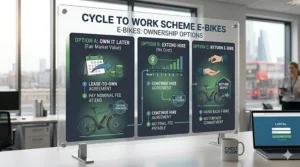
After your salary sacrifice period (typically 12 months), you technically haven’t purchased the bike outright. Most schemes offer three options: return it (nobody does this), extend the hire period interest-free (common), or pay a “Fair Market Value” (FMV) fee to own it completely.
The FMV represents the bike’s depreciated value and varies by scheme provider. For a £1,000 bike, expect around 3-7% (£30-£70) after 12 months, 3-5% (£30-£50) after extended hire periods. Some employers waive this entirely; others require formal payment. Check your specific scheme’s terms before committing.
Claim Mileage if You’re Technically Employed Cycling
If your employer operates a business mileage scheme for cycling (20p per mile tax-free under HMRC rules), you can claim this atop your C2W savings. Cycling 10 miles daily for work purposes generates £40 monthly (200 miles × 20p)—£480 annually that further offsets your bike’s cost. Few employees realise this double-dipping opportunity exists.
Real-World Scenarios: Which E-Bike for Your UK Commute?
Sarah: Central London Multi-Modal Commuter
Profile: 32, Canary Wharf office, lives in Zone 3 Clapham. 3km cycle to Clapham Common station, Tube to Canary Wharf, 2km cycle to office. Total cycling: 10km daily. Budget: around £900 after C2W savings (£1,550 gross value, higher-rate taxpayer).
Best Choice: ADO Air 20 — The 17.5kg weight transforms Sarah’s daily routine. She carries it down two flights of stairs from her first-floor flat, cycles to the station, folds it in 10 seconds, carries it onto the Northern Line without blocking passengers, unfolds at Canary Wharf, and completes the office cycle. The carbon belt drive means no trouser-staining oil, critical for professional appearance. The 60-90km range comfortably covers three days of commuting, allowing mid-week charging at the office.
Alternative consideration: If Sarah’s budget stretches to around £650 after C2W (£1,100 gross), the HITWAY BK12 delivers similar portability at lower cost, though she sacrifices the belt drive and accepts slightly heavier weight.
James: Hilly Sheffield Commuter
Profile: 28, works in Sheffield city centre, lives in Crookes (notoriously steep hills). 8km each way, 150m elevation gain. Budget: around £550 after C2W savings (£950 gross value, basic-rate taxpayer).
Best Choice: Eleglide M2 — The 50Nm torque motor and 21-speed Shimano drivetrain handle Sheffield’s brutal gradients without the embarrassing mid-climb power fade cheaper motors suffer. The 540Wh battery ensures James isn’t running on fumes after tackling Crookes Bank twice daily, and the hydraulic disc brakes provide confident descending control on wet mornings. The 23kg weight matters less since James has ground-floor garage storage.
Why not lighter models: Sheffield’s hills expose underpowered motors ruthlessly. The HITWAY BK5S’s smaller motor and battery would leave James pedalling frantically on lower gears, negating the e-bike’s purpose.
Emma & Tom: Suburban Family in Birmingham
Profile: Both commute 15km each way to Birmingham city centre from Solihull, predominantly flat routes. Want one high-quality e-bike to share, taking turns cycling whilst the other drives. Budget: around £700 after C2W savings (£1,200 gross value, higher-rate taxpayer).
Best Choice: Fafrees F20 Max — The 120kg weight capacity and adjustable geometry accommodate both riders comfortably (Emma is 5’4″, Tom is 6’1″). The enormous 720Wh battery means the bike happily manages an entire week of Emma’s Monday/Wednesday/Friday cycling plus Tom’s Tuesday/Thursday rotation without charging anxiety. The robust construction withstands daily use from two riders better than lighter models optimised for single users.
Why this over others: Most e-bikes optimise for a specific rider height and weight. The F20 Max’s adjustable components and strong frame accommodate the height and weight variance typical in shared household bikes.
How to Choose the Right E-Bike for Your C2W Scheme
Selecting an e-bike through salary sacrifice differs fundamentally from impulse purchases—you’re committing to 12 months of salary deductions and potentially several years of daily use. These five criteria determine whether your chosen bike delivers lasting value or becomes an expensive mistake.
1. Calculate Your Actual Range Requirements Honestly
Most manufacturers quote optimistic range figures (flat terrain, minimal assist, 70kg rider, no wind). Slash those numbers by 25-30% for realistic UK conditions. If your round-trip commute totals 30km, you need a bike claiming at least 45-50km range to avoid daily charging anxiety. Add 20% buffer for detours, battery degradation over time (expect 10-15% capacity loss after 500 charge cycles), and cold weather’s impact (15-20% reduction below 5°C).
For the mathematically inclined: divide battery capacity (Wh) by 12-15 to estimate real-world range in kilometres. A 480Wh battery delivers approximately 32-40km of practical range under typical British commuting conditions.
2. Weight Versus Range: Choose Your Compromise
Larger batteries mean longer range but add weight. The Fafrees F20 Max’s 720Wh battery weighs around 4kg more than the HITWAY BK5S’s 270Wh unit. If you face stairs daily or need to lift the bike frequently, prioritise weight over absolute range. If you have ground-floor storage and longer commutes, accept the weight penalty for range confidence.
British buyers overlook that weight distribution matters equally. Mid-frame battery placement (like the ADO Air 20) centres gravity better than rear-rack batteries, improving handling particularly noticeable on wet roads or when cornering.
3. Consider Your Terrain’s Motor Demands
Flat city commutes suit basic hub motors perfectly. Hilly routes demand higher torque (aim for 45Nm+) and multiple gears to maintain efficiency. The Eleglide M2’s 50Nm motor and 21-speed drivetrain tackle Bristol’s Park Street confidently; the HITWAY BK5S’s simpler setup leaves you sweating halfway up.
Quick test: identify your route’s steepest hill using Google Earth’s elevation profile. If it exceeds 8-10% gradient, eliminate single-speed models and motors under 45Nm from consideration.
4. Storage and Security Determine Foldability Needs
Full-size e-bikes (27.5-inch+ wheels) outperform folding models for comfort and stability but demand secure storage. If you lack ground-floor access or worry about theft from communal bike sheds, folding capability becomes essential rather than optional. The ADO Air 20 and HITWAY BK12 fold compact enough for under-desk office storage, eliminating outdoor theft risk entirely.
British buyers in cities with high bike theft (London, Manchester, Birmingham) increasingly prioritise models they can bring indoors over those requiring outdoor locking.
5. Check Real UK Customer Reviews for Weather Performance
Amazon.co.uk reviews from British buyers reveal weather-related failures manufacturers never mention. Look specifically for feedback about: battery performance below 5°C, electrical component reliability in persistent rain, frame corrosion resistance after winter salt exposure, and brake performance on wet descents.
Patterns matter more than individual complaints. One person struggling with range in Scottish winter is anecdotal; fifteen reporting similar issues indicates genuine cold-weather inadequacy.
Common Mistakes When Buying Through Cycle to Work Schemes
British employees waste thousands annually on cycle to work scheme purchases that seem sensible initially but reveal critical flaws within months. Avoiding these errors separates successful long-term e-bike ownership from expensive garage ornaments.
Mistake 1: Ignoring EAPC Compliance and Buying Overpowered Models
The most expensive mistake UK buyers make is purchasing non-compliant e-bikes through C2W schemes, then discovering they’ve technically bought a moped requiring registration, insurance, and a driving licence. EAPC regulations from GOV.UK specify maximum 250W continuous motor output and 15.5mph assistance cut-off. Cycling UK’s detailed guide to EAPC regulations explains precisely what qualifies as a legal electric bicycle. Many imported models tout 500W, 750W, or even 1000W motors—these are illegal for road use without registration.
The financial sting: if HMRC determines your purchased vehicle doesn’t qualify as an EAPC, you lose the tax-free status retrospectively and owe back taxes plus potential penalties. Your employer also faces complications. Stick rigidly to 250W motors with verifiable EAPC compliance certification.
Mistake 2: Maximising Budget Rather Than Meeting Needs
Higher-rate taxpayers saving 42% often stretch to the scheme’s maximum limit (many now £3,000+) without considering whether that premium e-bike genuinely suits their usage. A £2,500 carbon-framed model with electronic shifting saves £1,050 through C2W but costs £1,450 out-of-pocket—still considerable money for a 6km daily commute that a £900 bike (£522 after C2W) handles equally well.
The sensible approach: identify your minimum requirements (range, weight, features), then add one step up for future-proofing. Don’t automatically jump to maximum budget just because the tax saving feels like free money.
Mistake 3: Underestimating British Weather’s Component Impact
Many e-bikes sold on Amazon.co.uk originate from manufacturers primarily serving drier climates. Components adequate for California or Australia fail rapidly in Britain’s persistent damp. Exposed electrical connections corrode, unsealed bearings develop play, and chain drives rust despite regular maintenance.
Look specifically for: IPX4 minimum waterproof rating on electrical components, sealed bearing hubs, corrosion-resistant aluminium frames (not steel), integrated mudguards (preventing road spray reaching components), and chain guards or belt drives. The Eleglide Mopride 2’s sealed bearings withstand British weather far better than cheaper models with exposed components.
Mistake 4: Neglecting Replacement Part Availability in the UK
Budget Chinese e-bike brands dominate Amazon.co.uk but often lack UK-based parts support. When the controller fails after 18 months, you’re ordering from Shenzhen with 6-8 week delivery and customs charges. Established brands like Eleglide, HITWAY, and ADO maintain UK warehouses stocking common replacement parts.
Before purchasing, verify: UK-based customer service (not just a Gmail address), replacement battery availability and cost, and whether local bike shops can service the model. Several buyers report fantastic initial experiences with obscure brands, then discovering nobody in Britain stocks compatible brake pads or controllers when components fail.
Mistake 5: Assuming Cycle to Work Covers All E-Bike Types
Some scheme providers restrict e-bike eligibility by maximum value, battery size, or intended use. Cargo e-bikes, despite being brilliant for families, sometimes fall outside scheme parameters. Fat-tire models designed for off-road use might be questioned by administrators unfamiliar with their legitimate commuting applications.
Check your specific employer’s scheme documentation before committing to any model. If in doubt, seek written confirmation from your HR department that your chosen e-bike qualifies—verbal approval proves useless if complications arise.
E-Bikes vs Traditional Bikes: Worth the Salary Sacrifice?
The fundamental question for prospective cycle to work scheme participants: does electric assistance justify the considerable price premium over traditional bikes, or are you spending hundreds more for marginal benefit?
The Mathematics of Additional Cost
A quality traditional bike suitable for UK commuting costs £400-£600 through C2W. After 42% higher-rate tax savings, you’re paying around £230-£350 out-of-pocket. A comparable e-bike costs £800-£1,200; after the same tax savings, you’re paying £464-£696. The premium for electric assistance therefore totals £234-£346 in actual expenditure.
That premium buys you: electric motor assistance eliminating arrival sweat (critical for professional environments), significantly extended range making longer commutes feasible, hill-climbing ability that transforms hilly cities from torture to manageable, and reduced physical strain allowing sustainable daily cycling rather than initial enthusiasm followed by abandonment.
The Sweat Equity Calculation
British employers increasingly care about arrival appearance. Cycling 12km at the pace required to arrive within 30 minutes on a traditional bike generates considerable perspiration, necessitating workplace showers and clothing changes. Many offices lack adequate facilities; e-bike assistance allows arriving presentable in work clothes directly.
Several London professionals report that e-bike adoption enabled ditching gym memberships (saving £40-£60 monthly) because the commute provides adequate exercise when using lower assist levels. Over 12 months, that’s £480-£720 saved—more than covering the e-bike premium.
Range and Commitment Sustainability
Traditional bike commuters average 8-10km before physical exertion becomes sufficiently burdensome to discourage daily cycling. E-bikes extend feasible commuting distance to 15-20km without requiring athletic fitness. For British workers facing expensive season tickets (London Zone 1-4 annual pass: £2,300+), e-bikes expand the geographical area where cycling becomes genuinely viable.
The critical consideration: e-bikes reduce the barrier between considering cycling and actually doing it consistently. Traditional bikes look appealing until you’re grinding up a 10% gradient in driving rain on a Monday morning; e-bikes make that scenario manageable rather than miserable.
Understanding the UK Tax Benefits and How They Work
The cycle to work scheme’s tax mechanics confuse many employees, leading to missed savings opportunities or unpleasant surprises. Here’s precisely how the numbers shake out in 2026.
The Basic Salary Sacrifice Formula
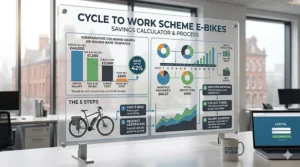
Your employer purchases the e-bike directly (£1,000 example). They reduce your gross salary by £1,000 across 12 months (£83.33 monthly). Because this reduction happens before calculating income tax and National Insurance, you avoid paying tax on that £1,000 completely.
For a basic-rate taxpayer (20% income tax, 8% National Insurance): £1,000 salary = £720 take-home after tax. Through C2W salary sacrifice: £1,000 bike costs approximately £720 in gross salary, which costs you around £720 × 0.72 = £518 in actual take-home reduction. You’ve saved £202 (28%) compared to buying the same bike with already-taxed income.
For a higher-rate taxpayer (40% income tax, 2% National Insurance): £1,000 salary = £580 take-home. Through C2W: £1,000 bike costs you around £580 in take-home reduction. You’ve saved £420 (42%).
The Hidden National Insurance Employer Saving
What fewer employees realise: your employer also saves on National Insurance contributions (13.8% on the sacrificed salary). On a £1,000 bike, they save £138. Progressive employers pass some of this saving to employees through extended scheme limits or reduced administration fees. Others pocket it entirely. Worth asking HR whether your company shares NI savings.
Tax Year Considerations and P11D Implications
If your salary sacrifice period spans two tax years and you receive a pay rise mid-way, your tax savings calculation can shift. Promotions moving you from basic to higher-rate (£50,270 threshold in 2026/27) mid-scheme don’t retrospectively change your already-made payments, but affect remaining months’ calculations.
The bike itself doesn’t appear on your P11D (taxable benefits form) because it’s classified as a “qualifying benefit” under HMRC rules. This matters for higher earners approaching £100,000 where additional benefits trigger personal allowance withdrawal.
Scottish Tax Differences
Scottish taxpayers face different rates: starter (19%), basic (20%), intermediate (21%), and higher (42%). The intermediate band affects Scottish employees earning £28,867-£50,270, who save around 29% rather than England’s 28%. Higher-rate Scottish taxpayers save the same 42%.
The Fair Market Value Final Payment
After completing salary sacrifice payments, you haven’t technically purchased the bike outright—you’ve hired it. Most schemes then offer ownership through a “Fair Market Value” (FMV) payment representing the bike’s depreciated value.
HMRC provides suggested FMV percentages: 12 months hire = 18% of original value, 18 months = 16%, 36 months = 7%. On a £1,000 bike after 12 months, that’s £180. Many employers waive this or charge token amounts; others require full FMV payment. Check your scheme’s specific terms before committing.
Some schemes offer extended hire periods (additional 36 months) after which ownership transfers with minimal or zero FMV. This maximises tax efficiency but means you don’t legally own the bike for four years total.
What to Expect: Real-World Performance in British Weather
Manufacturer specifications assume ideal conditions—dry roads, mild temperatures, minimal wind, optimal tyre pressure. British weather provides precisely none of these. Here’s what actually happens when you subject an e-bike to six months of persistent drizzle, winter gales, and the odd freeze.
Battery Range in Cold British Winters
Lithium batteries lose capacity as temperatures drop. Expect 10-15% range reduction between 5-10°C (typical British autumn/spring), and 15-25% reduction below 5°C (winter mornings). That 80km summer range becomes 60-68km in November and potentially 56-68km in January.
The Fafrees F20 Max’s 720Wh battery provides sufficient overhead that even 25% winter reduction still delivers 90-105km of usable range. Smaller batteries like the HITWAY BK5S’s 270Wh struggle more noticeably—the 45-55km summer range drops to 34-42km in winter, creating genuine anxiety on longer commutes.
Store batteries indoors overnight if possible. A battery starting at 18-20°C room temperature retains capacity significantly better than one left in an unheated shed overnight at 2°C.
Wet Weather Braking and Traction
Hydraulic disc brakes (Eleglide M2, Eleglide Mopride 2) maintain consistent stopping power in rain. Mechanical disc brakes work adequately but require stronger lever pressure when wet. Rim brakes (absent from these recommendations) become dangerously ineffective in British rain—avoid entirely for e-bike applications where speeds regularly approach 25km/h.
Tyre tread matters more than most buyers realise. Slick or minimally-treaded tyres hydroplane on wet painted road markings and metal drain covers—common hazards in British cities. The SAMEBIKE MY275’s knobby tread and the Fafrees F20 Max’s fat tyres provide superior wet grip compared to minimalist urban tyres.
Several British buyers report upgrading to Schwalbe Marathon Plus tyres (around £60/pair) specifically for wet-weather grip and puncture resistance. The investment proves worthwhile after the first avoided injury from wet-road slipping.
Corrosion and Component Longevity
Six months of British road spray tests component quality ruthlessly. Cheap electrical connectors corrode, causing intermittent motor cut-outs. Unsealed bearing hubs develop play, creating irritating creaks and grinding. Steel components rust despite paint, particularly around weld joints.
Look for: sealed electrical connectors (preferably IP54+ rated), sealed cartridge bearings in hubs and headset, aluminium or stainless steel fasteners (not zinc-plated steel), and integrated mudguards preventing spray reaching components.
Customer reviews reveal patterns: the Eleglide range’s sealed components withstand British weather better than comparably-priced alternatives. Budget brands often show corrosion issues after 6-12 months of year-round commuting.
Visibility and Lighting in Short Winter Days
Britain’s winter daylight shortage (sunrise 08:00, sunset 16:00 in December across much of England) means most commuters ride in darkness both morning and evening. Integrated lights running from the main battery eliminate the daily frustration of discovering your separate rechargeable lights died overnight.
The ADO Air 20’s integrated front and rear lights provide adequate visibility for urban street-lit cycling but insufficient for unlit rural routes. Serious night riders should budget £40-£60 for additional high-powered front lights (500+ lumens) regardless of integrated lighting.
Long-Term Cost Analysis: True Value in the UK Market
The initial purchase price represents just the beginning of e-bike ownership costs. British buyers must account for maintenance, replacement parts, electricity, and depreciation to understand genuine long-term value.
Annual Running Costs Breakdown
Electricity: Charging a 500Wh battery costs approximately 8-10p per full charge (based on 24p/kWh average UK electricity rate in 2026). Daily commuters charging 4 times weekly consume around £17-£21 annually—negligible compared to petrol or public transport.
Tyres: Quality tyres (Schwalbe Marathon Plus, Continental Contact) cost £50-£70 per pair and last 3,000-5,000km depending on conditions and weight. Annual replacement totals £50-£70 for high-mileage commuters.
Brake Pads: Hydraulic disc pads cost £15-£25 per set and last 1,500-3,000km depending on terrain and braking style. Budget £20-£40 annually for front and rear replacement.
Chain/Belt: Traditional chains require replacement every 2,500-4,000km (around £15-£25). Belt drives (ADO Air 20) last 15,000-20,000km but cost £80-£120 to replace eventually—still cheaper long-term.
Battery Replacement: Lithium batteries degrade to 70-80% capacity after 500-800 full charge cycles (roughly 3-5 years of daily commuting). Replacement batteries cost £200-£400 depending on capacity. Amortised annually: £50-£100.
Total Annual Running Costs: £157-£251 for typical daily commuters covering 3,000-4,000km annually.
Comparison with Public Transport and Driving
London Zone 1-3 annual Travelcard: £1,960 (2026 price). Manchester city centre to suburbs season ticket: approximately £1,200-£1,400. Birmingham similar: £1,100-£1,300.
An e-bike purchased through C2W for £900 gross (£522 to higher-rate taxpayer) plus £200 annual running costs totals £722 first year, £200 annually thereafter. Over five years: £1,322 total cost versus £9,800 for London public transport—a saving of £8,478.
Driving comparison: Average UK fuel cost £1.45/litre (April 2026), car achieving 12km/litre. A 20km daily commute (10km each way, 220 working days) requires 367 litres annually: £532 fuel alone, before parking (£8-£15 daily central London: £1,760-£3,300 annually), insurance, depreciation, or maintenance.
Depreciation and Resale Value
E-bikes depreciate faster than traditional bikes due to battery degradation concerns. Expect 40-50% value loss in year one, 15-20% annually thereafter. A £900 e-bike purchased new typically resells for £450-£540 after 12 months, £360-£430 after 24 months.
Crucially, cycle to work scheme bikes weren’t purchased with post-tax income, so depreciation stings less. You paid £522 (after 42% C2W saving) for a £900 bike; selling it for £500 after 12 months represents effective profit rather than loss.
Frequently Asked Questions About C2W E-Bikes
❓ Are all e-bikes eligible for cycle to work schemes in the UK?
❓ How much can I actually save with cycle to work scheme e-bikes?
❓ Can I use cycle to work scheme e-bikes for purposes other than commuting?
❓ What happens to my cycle to work scheme if I change jobs mid-payment?
❓ Do cycle to work scheme e-bikes require insurance or registration in the UK?
Conclusion: Your Next Steps to Tax-Free E-Bike Ownership
Cycle to work scheme e-bikes represent one of the UK tax system’s genuinely useful quirks—a rare instance where the government actively subsidises something that benefits both your wallet and your health. The 28-42% savings transform £1,000+ e-bikes from aspirational to accessible, whilst the salary sacrifice structure spreads costs painlessly across 12 months of pre-tax deductions.
The seven models featured here—from the budget-friendly HITWAY BK5S at around £347 after higher-rate C2W savings to the range-leading Fafrees F20 Max at approximately £551—demonstrate that EAPC-compliant e-bikes now deliver genuine capability without compromising British legal requirements. Whether you’re tackling Sheffield’s hills on the Eleglide M2, squeezing the ADO Air 20 onto packed Tube carriages, or simply wanting a reliable commuter that handles wet weather without constant maintenance, an option exists within most salary sacrifice budgets.
The critical success factors bear repeating: verify EAPC compliance rigorously, calculate your actual range requirements honestly including British weather’s impact, consider where you’ll store and charge the bike realistically, and check replacement part availability in the UK before committing. Models from established brands with UK warehousing (Eleglide, HITWAY, ADO) provide considerably better long-term support than grey-import bargains that seem attractive initially but leave you stranded when components fail.
Begin by checking your employer’s cycle to work scheme provider and any value limits. Most UK companies now offer schemes through Cyclescheme, Vivup, or Evans Cycles, with maximum values typically £2,000-£3,000. Identify your shortlist based on your specific commute characteristics, then visit Amazon.co.uk to verify current pricing and Prime delivery availability. With many models shipping from UK warehouses, you’re often cycling within 2-3 working days of purchase approval.
British cities are transforming around cycling infrastructure—London’s cycle superhighways, Birmingham’s A38 cycle corridor, Manchester’s Beelines network—making 2026 an exceptional time to abandon expensive, unpredictable public transport for electric-assisted cycling. The combination of improved infrastructure, genuinely capable e-bikes, and generous tax savings creates unprecedented opportunity for British commuters willing to reconsider their journey to work.
Recommended for You
- 7 Best Electric Bikes Between £1000 £2000 UK 2026
- 7 Best Value for Money E-Bikes UK 2026
- 7 Best Entry-Level E-Bikes UK: Top Budget Electric Bikes 2026
Disclaimer: This article contains affiliate links. As an Amazon Associate, I earn from qualifying purchases. If you purchase products through these links, we may earn a small commission at no additional cost to you.
✨ Found this helpful? Share it with your mates! 💬🤗
