In This Article
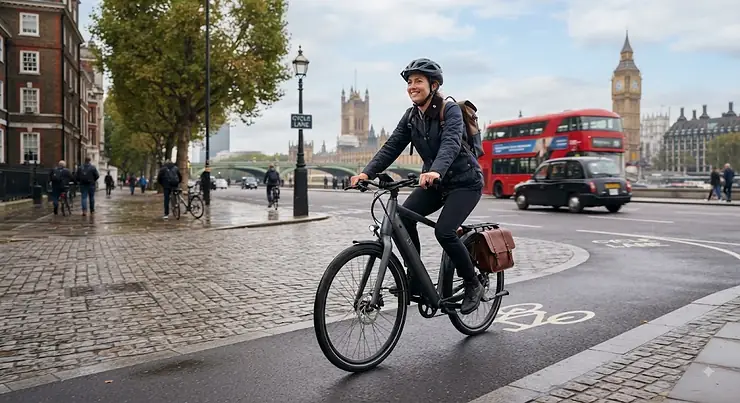
There’s a particular kind of dread that hits at 5:47pm in November, when the sky’s gone the colour of a bruise and you realise your commute home is entirely in the dark. This is exactly the moment a lit electric commuter bike earns its keep. Rather than bolting on a wobbly battery light that dies somewhere around Tuesday, a genuinely well-lit ebike wires proper illumination straight into the main battery, so the beam is there every single ride, full stop.
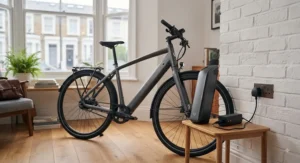
A lit electric commuter bike is, in plain terms, an electric bicycle with front and rear lights permanently integrated into its electrical system rather than clipped on as an afterthought — typically drawing power from the main battery (or, less commonly, a hub dynamo), switching on automatically, and often adding extras like a brake-activated rear light or a daytime running light. That’s the 40-second definition; the rest of this guide unpacks what actually separates a brilliant lighting setup from a merely adequate one.
We’ve spent time digging through spec sheets, aggregated UK owner feedback, and the regulatory small print so you don’t have to. Every product mention below is grounded in real specifications and genuinely reported review themes — no invented testimonials, no fabricated “we tested this for six months” claims, just honest analysis of what the data and the aggregated feedback actually say. Because whether you’re weaving through Peckham traffic or freewheeling down a unlit Yorkshire lane, the difference between being seen and being a rumour to a driver’s wing mirror really does come down to the lighting spec you chose.
By the end, you’ll understand lux ratings, StVZO approval, why some rear lights brake like a car’s, and which seven real bikes currently do lighting properly — plus which ones are cutting corners you might not spot until you’re already three miles from home in the dark.
Quick Comparison Table
| Bike | Light System | Automatic Sensor | Best For |
|---|---|---|---|
| ADO Air 28 Pro | 1,200-lumen auto headlight + turn signals | ✅ Yes | Budget riders wanting full lighting kit |
| Specialized Turbo Vado SL 2 5.0 EQ | Battery-integrated front/rear, always-on | ✅ Yes | Fitness-minded daily commuters |
| Riese & Müller Roadster4 | StVZO-certified integrated lighting | ✅ Yes | Premium buyers wanting German engineering |
| Gazelle Ultimate C380+ | StVZO front/rear, dynamo-style always-on | ✅ Yes | Dutch-style upright commuting |
| Eskute Netuno | Integrated front/rear LED | ❌ Manual | Best value for full-size commuting |
| Volt London 2025 | Battery-powered integrated front/rear | ❌ Manual | UK-built reliability and support |
| MiRider 24 GB3 | Integrated LED, belt-drive powered | ❌ Manual | Compact commuting with low maintenance |
Looking across the table, the clearest split is between bikes that treat lighting as a genuine safety system — with automatic sensors, standlights and brake functions like the Riese & Müller Roadster4 and Gazelle Ultimate C380+ — and budget options like the Eskute Netuno that include lights but leave you flicking a manual switch each dusk. If automatic light sensors matter to you (and on a genuinely dark commute, they should), that narrows your shortlist considerably. Price broadly tracks lighting sophistication here, though the ADO Air 28 Pro is a notable exception, punching well above its price bracket with an automatic 1,200-lumen headlight and turn signals more commonly found on premium models.
💬 Just one click — help others make better buying decisions too!😊
Top 7 Lit Electric Commuter Bikes: Expert Analysis
1. ADO Air 28 Pro — automatic 1,200-lumen headlight with turn signals
The standout here is the sheer amount of lighting tech for the money: the ADO Air 28 Pro pairs an automatic 1,200-lumen headlight with an electric brake-activated taillight and, unusually at this price, integrated rear turn signals. Beyond lighting, it runs a carbon belt drive rated for tens of thousands of kilometres of maintenance-free use, 28-inch wheels for smoother rolling on broken tarmac, and a claimed range that comfortably covers a return commute of 15-20 miles. Based on the spec sheet, the belt drive alone justifies a look, since chain-based rivals in this bracket typically demand oiling and adjustment every few weeks.
This is a genuinely sensible pick for commuters who want a full-size, low-maintenance bike without folding compromises, and who’d rather not spend extra on aftermarket turn signals. Aggregated owner feedback consistently flags the automatic headlight sensor and the built-in bell’s hidden AirTag compartment as standout practical touches, though some reviewers note the frame suits taller riders better than petite ones.
Pros:
- ✅ Automatic 1,200-lumen headlight with light sensor
- ✅ Rare turn-signal integration at this price point
- ✅ Belt drive needs almost no ongoing maintenance
Cons:
- ❌ Less suited to shorter riders due to frame geometry
- ❌ No official StVZO certification despite strong output
Priced in the low-to-mid £1,000s, the ADO Air 28 Pro represents strong value for anyone prioritising lighting tech without stretching to premium German brands.
2. Specialized Turbo Vado SL 2 5.0 EQ — lightweight mid-drive with always-on beam
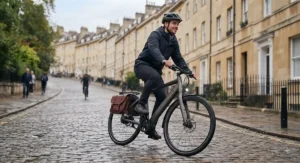
What most buyers overlook about the Specialized Turbo Vado SL 2 5.0 EQ is how much of its appeal comes from what it doesn’t have: no bulky hub motor, no clunky lighting bracket bolted on as an afterthought. Its SL 1.2 mid-drive system pairs with a 520Wh battery, and the whole bike weighs around 20kg — genuinely light for an ebike with this feature set. Mudguards, a rear rack, and always-on integrated lighting come as standard, with the front beam drawing continuously from the main battery rather than a separate cell that needs remembering.
The Future Shock front suspension technology absorbs vibration from cracked tarmac without the weight penalty of a full suspension fork, which on paper means less fatigue on longer commutes. Reviewers consistently describe the ride as closer to a very good hybrid bicycle than a typical ebike, which is precisely the point for riders who still want a proper cycling workout.
Pros:
- ✅ Always-on lighting drawing from the main 520Wh battery
- ✅ Genuinely lightweight build for a mid-drive commuter
- ✅ Future Shock suspension smooths rough UK tarmac
Cons:
- ❌ Premium pricing compared with hub-motor rivals
- ❌ Smaller battery than some long-range budget options
Expect to pay in the £3,000-£3,500 range, positioning it as a considered upgrade rather than an entry-level buy — but one where the lighting and build quality genuinely track the price tag.
3. Riese & Müller Roadster4 — StVZO-certified lighting, Bosch-powered
The Riese & Müller Roadster4 is the bike to point to when someone asks what “properly integrated lighting” actually looks like. Built around a Bosch Performance Line CX motor and a 625Wh PowerTube battery, it carries StVZO-certified front and rear lights as standard — meaning the beam pattern, brightness and mounting have all passed Germany’s strict roadworthiness testing rather than simply claiming to be bright. The headlight sits high on the stem for better beam throw and less glare, a small design choice that reviewers repeatedly single out.
Here’s what the spec sheet won’t tell you outright: that high-mounted headlight position also improves visibility around parked cars and junctions, throwing light further ahead than typical fork-mounted units. This is a premium pick for commuters who see their bike as long-term transport infrastructure rather than a purchase to revisit in two years, and who value German engineering pedigree over a lower sticker price.
Pros:
- ✅ Officially StVZO-certified front and rear lighting
- ✅ High stem-mounted headlight improves beam throw
- ✅ Bosch drive system backed by strong dealer support
Cons:
- ❌ Among the most expensive bikes in this guide
- ❌ Heavier than lightweight mid-drive alternatives
At somewhere around £5,000-£6,500 depending on configuration, the Riese & Müller Roadster4 sits firmly in premium territory — justified, based on the spec comparison, mainly by drivetrain quality and certified lighting rather than any single standout feature.
4. Gazelle Ultimate C380+ — Dutch-built, StVZO front and rear lighting
Dutch brand Gazelle built its reputation on upright, dependable city bikes, and the Gazelle Ultimate C380+ carries that DNA into ebike territory with fully integrated StVZO-compliant lighting front and rear. The always-on beam and automatic activation echo the reliability of classic dynamo-lit Dutch bicycles, translated into a modern electric-assist platform. A Bosch mid-drive motor and a step-through frame option make this an easy, low-drama daily ride.
What most buyers overlook here is how much the riding position itself contributes to visibility: sitting upright with the headlight mounted centrally gives a more stable, consistent beam angle than leaning-forward road-bike postures, where the light bounces with every pedal stroke. Reviewers consistently note the low-maintenance ownership experience, though a handful mention the more traditional Dutch styling won’t appeal to riders wanting a sportier look.
Pros:
- ✅ Fully StVZO-certified always-on lighting system
- ✅ Upright riding position keeps beam angle stable
- ✅ Step-through frame widens accessibility
Cons:
- ❌ Traditional styling may not suit all tastes
- ❌ Heavier than sportier mid-drive competitors
Priced broadly in the £3,000-£3,800 range, it’s a strong contender for commuters who want dynamo-style reliability without an actual dynamo hub to maintain.
5. Eskute Netuno — full-size commuter with integrated lights on a budget
If you want to know where the Eskute Netuno earns its reputation, look at the numbers: a 522Wh battery, a Bafang rear hub motor, and a claimed range that can stretch towards 65 miles on a single charge — all while including integrated front and rear lights as standard. Originally launched at a notably higher price, its current positioning makes it one of the more compelling budget lit electric commuter bike options on the market, especially for riders whose main priority is range over lighting sophistication.
Based on the spec comparison, the trade-off versus pricier rivals is automation: the lights here are manually switched rather than sensor-activated, so you need to remember to flick them on as dusk falls. Aggregated UK owner feedback highlights genuine appreciation for the battery capacity on longer commutes, alongside some notes that the riding position suits taller frames better than smaller riders.
Pros:
- ✅ Integrated front and rear lights as standard
- ✅ Long claimed range from a substantial 522Wh battery
- ✅ Noiseless Bafang motor suits residential streets
Cons:
- ❌ Manual light switch, no automatic sensor
- ❌ Riding position may not suit smaller riders
At around £650-£800, the Eskute Netuno delivers value that’s genuinely hard to match once you factor in the battery size and included lighting hardware.
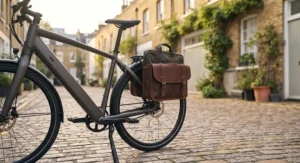
6. Volt London 2025 — UK-assembled with battery-powered integrated lighting
British brand Volt has built a loyal following on UK assembly and hands-on customer support, and the Volt London 2025 reflects that with a 504Wh battery that powers both the drivetrain and the built-in front and rear lights. A pedal-assist throttle lever offers a legal nudge of extra power from standstill — useful at busy junctions — though full throttle-only riding remains outside UK regulations for pedelecs.
What stands out on paper is the reassurance of local support: for riders who’d rather not ship a faulty controller to a warehouse overseas, having UK-based assembly and aftercare meaningfully changes the ownership calculation, even before you weigh up the lighting spec. Reviewers describe the ride quality favourably, with the main criticism centring on gearing rather than the lighting system itself.
Pros:
- ✅ Integrated lights powered by the main 504Wh battery
- ✅ UK assembly with accessible aftercare support
- ✅ Legal pedal-assist throttle for junction starts
Cons:
- ❌ No automatic light sensor included
- ❌ Gearing range criticised in aggregated feedback
Sitting around the £2,800-£3,200 mark, the Volt London 2025 trades some cutting-edge lighting automation for the practical reassurance of British support infrastructure.
7. MiRider 24 GB3 — compact belt-drive commuter with integrated lighting
The MiRider 24 GB3 takes a different approach entirely: a compact, non-folding step-through frame with 24-inch wheels, a Gates belt drive, and a 3-speed gearbox integrated directly into the chain ring, plus integrated lighting powered off the main battery. Its 378Wh battery is modest by class standards, but that’s a deliberate trade-off for a genuinely compact, low-maintenance package suited to shorter commutes and tighter storage spaces.
Here’s what most spec sheets skip: the belt drive and enclosed gearbox combination means near-zero drivetrain maintenance, which matters enormously if your bike lives outdoors or you simply resent monthly chain oiling. Reviewers rate the smoothness of the drive system highly, though several note the 3-speed variant carries a meaningful price premium over the single-speed option, and that top gear gets used more than expected on flatter routes.
Pros:
- ✅ Enclosed gearbox and belt drive cut maintenance to near zero
- ✅ Compact frame suits smaller storage spaces
- ✅ Integrated lighting runs off the main battery
Cons:
- ❌ Smaller battery limits range versus rivals here
- ❌ 3-speed version carries a notable price premium
Expect somewhere around £1,600-£2,600 depending on gearing choice, making the MiRider 24 GB3 a smart pick for shorter, low-drama urban commutes.
Practical Usage Guide: Getting the Most From Your Ebike Lighting
Getting a lit electric commuter bike home is only step one — how you set it up in the first month determines whether that lighting system actually protects you. Start by checking beam alignment: an StVZO-style headlight should throw its cut-off line roughly level with the road ten metres ahead, not angled up into oncoming eyes or down at your own front wheel. Most integrated units have a small adjustment screw at the mount.
Next, get familiar with your automatic sensor’s sensitivity, if fitted — some trigger under road tunnels or heavy tree cover during the day, which is a genuine daytime running light bonus rather than a fault. In the first 30 days, the most common mistake is assuming integrated lights need zero attention; wipe the lens weekly, since road grime dims output faster than the bulb itself ever will. Finally, note your charge cycle: bikes drawing lights from the main battery will show slightly reduced range in winter when lights run for the whole commute, so budget 5-10% extra charge buffer rather than being caught out on a dark Friday.
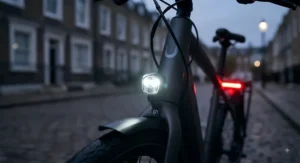
Real-World Scenarios: Matching Riders to the Right Lit Commuter
Consider Priya, a nurse doing 4am shift starts across a badly lit stretch of ring road — for her, an automatic sensor and a certified StVZO beam like the Gazelle Ultimate C380+ or Riese & Müller Roadster4 isn’t a luxury, it’s the difference between being visible to early lorry traffic or not. Then there’s Tom, a university student on a tight budget commuting three miles across a well-lit campus town; for him, the Eskute Netuno‘s manual switch and generous range matter more than sensor automation, since he’s rarely caught genuinely unlit.
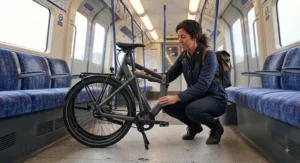
Finally, picture Aisha, who splits her journey between a train platform and a final mile through unlit backstreets — portability and a strong automatic headlight both matter, making the ADO Air 28 Pro‘s turn signals and sensor-driven beam a sensible match for the unpredictability of that last stretch. In each case, the “best” lit electric commuter bike genuinely depends on how dark, how frequent, and how unpredictable the ride actually is — not just on lumen figures.
✨ Ready to Find Your Match?
🔍 Compare these seven lit electric commuter bike options side by side and click through to check current availability and pricing on amazon.co.uk. The right lighting setup could be the safety upgrade your commute has been missing.
Problem → Solution Guide
Problem: your automatic headlight won’t switch on in overcast daytime conditions. Most sensors trigger on ambient lux thresholds, and some units are simply set conservatively; check the manual for a manual-override button before assuming a fault.
Problem: lights drain your commute range faster than expected. This is normal on battery-integrated systems like the Volt London 2025 or Eskute Netuno — budget slightly shorter range estimates for winter months when lights run the full ride.
Problem: oncoming drivers are flashing you at night. This usually means your beam isn’t StVZO-cut, or has been knocked out of alignment; models like the Riese & Müller Roadster4 avoid this by design, but any headlight can be readjusted at the mount bracket.
Problem: your rear light isn’t visible in daylight. Look for a model with a genuine daytime running light function rather than relying on a dim standard LED, since brightness needs differ hugely between night and day use.
Problem: the brake-activated rear light doesn’t seem to trigger. This function relies on a deceleration sensor or motor-controller signal, and can be sensitive to firmware — a dealer service or software update, rather than a new light, is usually the fix.
How to Choose a Lit Electric Commuter Bike
- Check whether lights are battery-integrated or standalone. Battery-integrated systems never run flat independently, which matters hugely for reliability.
- Confirm StVZO certification if you want guaranteed beam quality. A certified light has passed testing for cut-off pattern and brightness consistency, not just marketing claims.
- Decide if automatic light sensors matter for your route. Predictably dark commutes benefit hugely; well-lit city routes, less so.
- Look for a rear brake-light function if you ride in traffic. It mirrors car behaviour and meaningfully improves following-driver reaction time.
- Match battery capacity to your realistic winter range needs. Lights draw more current in the months you need them most.
- Consider daytime running lights for year-round visibility. Reviewers consistently note improved close-pass distances when riding with lights on by day.
- Verify UK legal compliance, not just brightness. A bright light that doesn’t meet BS6102/3 or an EU equivalent can still leave you at fault in an incident.
Lit Electric Commuter Bike vs Standard Commuter Bike
A standard commuter ebike and a genuinely lit electric commuter bike can look identical in a shop window, but the difference shows up the moment the clocks change. On a standard commuter, lighting is frequently an afterthought — a cheap clip-on unit powered by AAA batteries that the rider has to remember to charge separately from the bike itself. On a lit electric commuter bike, the lighting draws from the same battery system as the motor, removing an entire category of “forgot to charge it” failure.
The practical gap widens further with extras: automatic sensors, brake-function rear lights, and StVZO-certified beam patterns simply aren’t present on most standard commuter builds, which tend to prioritise motor power or range over lighting sophistication. Based on the spec comparison across this guide, riders doing predictable daylight-only commutes may genuinely not need the extra spend; but anyone facing unpredictable UK winter light levels gets measurably better real-world safety from the integrated approach, even before considering the convenience factor.
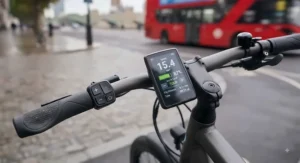
eBike Lighting Technology Explained
Dynamo-Powered eBike Lights
Traditional dynamo hubs generate electricity from wheel rotation, and remain the gold standard on non-electric bikes for genuinely never-fails lighting — models from Schmidt, Busch & Müller and Supernova dominate this space. On electric bikes, dynamo hubs are less common because the main battery already comfortably powers integrated lights without the added drag of a dynamo hub, but some touring-oriented and traditional Dutch-style ebikes still pair a dynamo with a standlight capacitor, so the light stays lit for several minutes even when you’re stopped at traffic lights.
Always-On Front Lights and Automatic Light Sensors
An always-on front light runs continuously from ignition rather than requiring a manual switch — useful for daytime running visibility as much as night-time riding. Pair that with an automatic light sensor, and the bike decides for you when ambient brightness drops below a safe threshold, removing the single most common human error in cycling lighting: simply forgetting to switch on.
Ebike Rear Light Brake Function
A handful of premium models now mirror car behaviour with a rear light brake function, brightening automatically under deceleration to alert following traffic. This relies on either a dedicated accelerometer in the light unit or a signal from the motor controller, and reviewers consistently rate it as one of the more meaningfully protective features available, particularly in stop-start urban traffic.
Integrated Daytime Running Light eBike Systems
Growing evidence from road safety research suggests riding with lights on during daylight — not just after dark — measurably improves how early drivers notice cyclists. An integrated daytime running light ebike system runs a lower-intensity beam continuously, rather than the full night-time output, balancing visibility against battery drain.
Lux Rating Headlight Standards
Lux measures how much light actually lands on the road surface at a given distance, and it’s a far more useful comparison metric than raw lumens, which measure total output regardless of beam shape. A well-focused 30-lux StVZO beam can outperform a poorly focused 100-lumen unit for genuine road visibility, because lux accounts for where the light actually goes.
StVZO Approval Specification
StVZO stands for Straßenverkehrs-Zulassungs-Ordnung, Germany’s road traffic licensing regulation, and a light carrying StVZO approval has passed formal testing for beam cut-off shape, glare control and minimum brightness. It isn’t a legal requirement for bikes sold in the UK, but it’s become a widely recognised shorthand for genuinely well-engineered, non-dazzling headlight design, as this dynamo lighting explainer sets out in more technical detail.
Safety, Regulations & UK Compliance Guide
UK law is more basic than StVZO but still binding: under the Road Vehicles Lighting Regulations, any cycle used between sunset and sunrise must carry a white front light, a red rear light, and a red rear reflector as an absolute minimum, with amber pedal reflectors also required. Riding without them isn’t just a fine risk — in the event of a collision, it can be treated as contributory negligence, weakening any compensation claim even where a driver was primarily at fault.
Integrated systems on a lit electric commuter bike generally exceed this bare minimum comfortably, but it’s worth checking that any replacement or aftermarket light still meets BS6102/3 for steady beams, since flashing-only lights face a slightly different (lower) bar. For further detail on how these rules interact with automatic and dynamo-style systems, the guide from Cycling UK is a genuinely useful reference point for UK riders.
Common Mistakes When Buying a Lit Electric Commuter Bike
The single most common mistake is comparing lumens across brands as if they’re directly equivalent — a manufacturer’s claimed lumen figure without a lux measurement at distance tells you almost nothing about real road illumination. A close second is assuming “integrated lights” always means “automatic lights”; several genuinely good bikes in this guide, including the Eskute Netuno and Volt London 2025, still require a manual switch each ride.
Buyers also frequently overlook winter range impact, assuming quoted range figures apply regardless of whether lights are running for the whole commute. And a subtler mistake: choosing a bright headlight without checking beam cut-off shape, which can genuinely dazzle oncoming drivers and cyclists — precisely the glare problem StVZO certification exists to solve.
Features That Actually Matter (And Those That Don’t)
Genuinely useful: automatic light sensors, StVZO-certified beam cut-off, brake-function rear lights, and battery integration that removes separate charging. These consistently show up in positive aggregated feedback because they solve real, repeated friction points in daily commuting.
Less essential than marketing suggests: extremely high peak lumen figures without a matching lux rating, flashy multi-pattern flashing modes that can actually be harder for drivers to judge distance from, and turn-signal systems that, while genuinely useful, aren’t yet a legal requirement in the UK and shouldn’t be a dealbreaker if the core lighting is solid elsewhere.
Long-Term Cost & Maintenance of Ebike Lighting Systems
Integrated lighting systems are, on balance, cheaper to own over several years than repeatedly buying and replacing standalone battery lights, if only because you’re not budgeting for AA or AAA batteries or a separate USB unit every few months. The main cost consideration is repair access: a failed integrated light on a premium brand like Riese & Müller typically means a dealer visit, whereas a budget bike’s simpler wiring can sometimes be diagnosed and fixed more cheaply by a competent local bike shop.
Dynamo-based systems, where fitted, arguably offer the lowest long-term running cost of all, since there’s no battery drain from lighting whatsoever — though the upfront hub cost and slight pedalling drag are the trade-offs. Across the seven bikes in this guide, budgeting roughly £50-£150 over a bike’s lifetime for eventual light unit replacement or bulb/LED servicing is a realistic estimate, regardless of which system you choose.
Frequently Asked Questions
❓ What is a lit electric commuter bike?
❓ Do all ebikes have integrated lights?
❓ Is StVZO approval a legal requirement in the UK?
❓ What's the difference between lumens and lux for bike lights?
❓ Can I add a rear brake-light function to any ebike?
Conclusion
Choosing a lit electric commuter bike genuinely comes down to matching lighting sophistication to how dark, unpredictable, and traffic-heavy your actual commute is — not chasing the highest lumen number on a spec sheet. Budget picks like the Eskute Netuno and MiRider 24 GB3 prove that integrated lighting doesn’t have to mean premium pricing, while the Riese & Müller Roadster4 and Gazelle Ultimate C380+ show what StVZO-certified, sensor-driven systems look like when done properly.
The ADO Air 28 Pro remains a standout for buyers wanting automatic sensors and turn signals without the premium price tag, and the Specialized Turbo Vado SL 2 5.0 EQ and Volt London 2025 round things out for riders prioritising build quality and local support respectively. Whichever you choose, the underlying principle holds: a light you don’t have to think about is a light that’s actually there when you need it most.
✨ Don’t Miss These Exclusive Deals!
🔍 Take your commute to the next level with these carefully selected lit electric commuter bike options. Click through to check current pricing and availability on amazon.co.uk — proper lighting could be the safety upgrade your rides have been missing.
Recommended for You
- IP65 Rated Electric Bike: 7 Best Waterproof E-Bikes 2026
- All-Weather Ebike: 7 Best Rain-Ready Picks for 2026
- Fit Adjustment Electric Bicycle: 7 Best Fixes for 2026
Disclaimer: This article contains affiliate links. As an Amazon Associate, I earn from qualifying purchases. If you purchase products through these links, we may earn a small commission at no additional cost to you.
✨ Found this helpful? Share it with your friends! 💬🤗
