In This Article
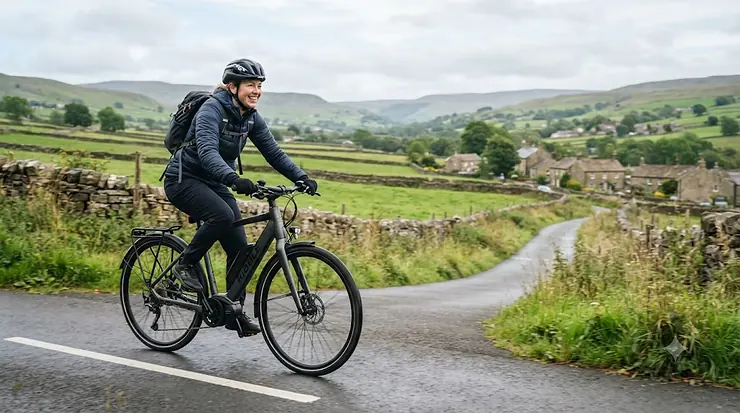
Right, let’s get one thing out of the way first: not every “smart” ebike on Amazon actually knows how hard you’re pedalling. Plenty of budget machines fake it with a cadence sensor — a glorified switch that flicks the motor on the moment your cranks start spinning, whether you’re barely brushing the pedals or hauling yourself up a 12% gradient in Sheffield. A proper torque sensor is different. It reads the actual pressure your legs are putting through the pedals, dozens of times a second, and matches the motor’s output to your effort in real time. The result feels less like riding a machine and more like your own legs have quietly developed superpowers.
That distinction is exactly why torque sensing ebike brands have become the thing serious buyers ask about first, rather than an afterthought buried in the spec sheet. What is a torque sensing ebike? In short, it’s an electric bicycle that uses a strain-gauge sensor — usually built into the bottom bracket or rear hub — to measure pedalling force and deliver proportional, near-instant motor assistance, rather than the fixed, on/off boost of a basic cadence system.
Over the past two years the technology has trickled down from £3,000 Bosch-equipped hybrids into folding commuters costing under £1,000, which means British riders genuinely have choice for the first time. This guide draws on real specifications, verified UK availability, and aggregated review sentiment from owners and independent testers to walk you through seven genuine torque sensor ebikes worth your money, why the sensor technology matters more than the headline wattage, and how to avoid the common buying mistakes that leave people with a bike that doesn’t suit how they actually ride. We’ll also get into UK regulations, because a shockingly large number of “torque sensor” listings on marketplaces skirt close to the legal edge of what counts as an EAPC — electrically assisted pedal cycle rules set out by the Department for Transport matter more than most buyers realise.
Quick Comparison Table
Before the deep dive, here’s how our seven picks stack up at a glance. Prices are indicative ranges only — always check current pricing before buying, since stock and promotions shift weekly.
| Model | Torque | Motor Type | Price Range | Best For |
|---|---|---|---|---|
| Eleglide Citycrosser | 45Nm | Rear hub | Under £1,000 | Budget-conscious first-time buyers |
| ADO Air 20 | 40Nm | Rear hub, belt drive | £800-£950 range | Portability and folding commutes |
| Aventon Level.2 | High-resolution hub sensor | 500W rear hub | £1,500-£1,800 range | Daily commuters wanting throttle backup |
| Engwe EP-2 3.0 | 90Nm | Fat-tyre hub | £1,400-£1,700 range | Confidence on rough UK roads |
| Engwe LE20 | 100Nm | Mid-drive | £1,100-£1,300 range | Cargo, school runs, ULEZ dodging |
| Raleigh Motus | 40Nm (Bosch) | Bosch Active Line mid-drive | £1,500-£2,200 range | Long-term reliability and dealer support |
| Engwe Engine Pro 2.0 | 75Nm | Full-suspension mid-drive | £1,400-£1,700 range | Hill-heavy routes and rougher terrain |
Looking at the spread, there’s a clear pattern: hub-motor torque sensor bikes dominate the sub-£1,000 bracket, while genuine mid-drive systems with higher torque figures — the kind that make hills genuinely disappear rather than just feel less awful — start appearing from around £1,100 upward. The Engwe LE20 and Raleigh Motus occupy different ends of that mid-drive spectrum: one chases raw torque for cargo hauling, the other chases refinement and a fifteen-year-old drivetrain brand’s dealer network. Neither is objectively “better” — it depends entirely on whether you’re optimising for load-carrying or long-term peace of mind.
💬 Just one click — help others make better buying decisions too! 😊
Top 7 Torque Sensing eBike Brands: Expert Analysis
We’ve deliberately spread this list across budget, mid-range and premium tiers, plus a genuine variety of use cases — folding commuters, cargo haulers, fat-tyre all-rounders and hill-focused full-suspension builds — because “best torque sensor ebike” means something completely different to a Tube-station commuter than it does to someone doing the school run up a Yorkshire hill.
1. Eleglide Citycrosser — cheapest genuine torque sensor ebike in the UK
The headline here isn’t the spec sheet, it’s the price point: this is widely regarded as the most affordable e-bike on the UK market with a real, strain-gauge torque sensor rather than a dressed-up cadence system. The 250W rear hub motor produces a claimed 45Nm of torque, which sounds modest next to a mid-drive but feels entirely adequate on the flat streets and gentle inclines most commuters actually ride. A 36V 10Ah battery gives a realistic 45-mile range in mixed assist modes, comfortably enough for a week of London or Bristol commuting between charges. What most buyers overlook about this model is that the torque sensor genuinely changes the ride character even on a budget hub motor — reviewers who’ve tested it back-to-back with cadence-sensor rivals at similar prices consistently describe the power delivery as noticeably smoother and less “on/off.” Based on the spec comparison against similarly priced rivals, the trade-off is a fairly basic mechanical disc brake setup and a rigid, no-suspension frame, so this suits smooth tarmac commuting far better than pothole-heavy back lanes. Aggregated owner feedback frequently praises the light 21kg weight and Shimano 7-speed gearing, while a recurring theme in longer-term reviews is that the mechanical brakes need more frequent adjustment than hydraulic setups on pricier bikes.
Pros:
- ✅ Genuinely rare torque sensor at a sub-£1,000 price point
- ✅ Light enough (around 21kg) for stairs and narrow hallways
- ✅ 100km-rated range makes it viable for longer commutes
Cons:
- ❌ Mechanical rather than hydraulic disc brakes
- ❌ No suspension, so rougher roads transmit through the frame
Price sits comfortably under £1,000, and for that money it remains the strongest value case for anyone wanting to try torque sensing technology without committing to a four-figure spend.

2. ADO Air 20 — lightest folding ebike with true torque sensing
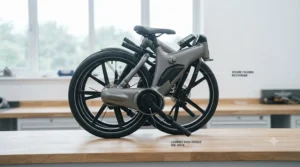
If your priority is carrying the bike up flats stairs or squeezing it under a desk, the ADO Air 20 solves a problem the Citycrosser doesn’t even attempt: portability. At roughly 16-17kg with a carbon belt drive instead of a chain, it’s one of the lightest folding e-bikes with genuine torque sensing currently sold through Amazon.co.uk. The 250W hub motor is paired with hydraulic disc brakes — unusual generosity at this price bracket — and IPX5 water resistance that’s been independently certified against SGS CE EN15194 and UKCA standards, which matters more than marketing copy might suggest, since it confirms the bike has actually been tested against the EU/UK standard rather than just claiming compliance. Reviewers who’ve put serious mileage on it note the torque sensor’s near-immediate response from a standstill, particularly useful when pulling away on an incline with a single-speed drivetrain and no gears to drop into. Here’s what to weigh: because it’s single-speed, all your climbing assistance comes from motor response rather than mechanical leverage, so the quality of that torque sensor genuinely dictates how the bike feels on hills far more than it would on a geared machine.
Pros:
- ✅ Among the lightest folding torque sensor ebikes available
- ✅ Hydraulic disc brakes rare at this weight and price
- ✅ Belt drive needs virtually no maintenance for years
Cons:
- ❌ Single-speed limits climbing flexibility on steep gradients
- ❌ Smaller battery capacity than heavier rivals, so shorter range
Expect to pay somewhere in the £800-£950 range depending on which suspension or Pro variant you choose — genuinely good value for a bike this portable.
3. Aventon Level.2 — best precision torque sensor for daily commuting
Aventon built its reputation on cadence-sensor commuter bikes before switching the flagship Level.2 to a genuine torque sensor, and the upgrade is widely reported as transformative rather than cosmetic. The 500W rear hub motor is backed by an 8-speed Shimano drivetrain, Tektro hydraulic brakes, and a 672Wh integrated battery — a serious capacity that supports real-world ranges into the 40-60 mile bracket depending on assist level and throttle use. What most buyers overlook about this model is the sensor’s dual role: it doesn’t just smooth out pedal assist, it also meaningfully extends range compared with the cadence-sensor original Level, because power only flows when and to the degree you’re actually applying pressure. Reviewers consistently report the response as “nearly instant” and describe the climbing feel as noticeably more confident than the previous generation, with testers specifically praising hill-climbing performance during steeper test routes. The trade-off for that refinement is weight and price — this sits toward the premium end of our list, and UK buyers should note Aventon ships internationally rather than stocking UK warehouses the way Engwe or ADO do, so factor delivery time into your planning.
Pros:
- ✅ Genuinely precise, high-resolution torque sensor feedback
- ✅ Large 672Wh battery supports genuinely long ranges
- ✅ Hydraulic Tektro brakes and 8-speed gearing throughout
Cons:
- ❌ Heavier than most hub-motor rivals on this list
- ❌ No dedicated UK warehouse, so delivery can take longer
Realistically budget somewhere in the £1,500-£1,800 range once shipping and duty are factored in, positioning it as a genuine mid-to-premium commuter rather than a budget pick.
4. Engwe EP-2 3.0 — highest-torque fat-tyre commuter with built-in GPS
For riders who want raw confidence on cracked pavements, cycle paths strewn with gravel, or the odd bit of towpath, the Engwe EP-2 3.0 brings genuinely serious numbers: a 750W motor (1500W peak) paired with a 90Nm torque sensor, reading pedalling force roughly a thousand times per second according to the manufacturer’s own engineering claims. That resolution matters practically — the difference between a torque sensor that samples occasionally and one sampling almost continuously is the difference between assistance that feels laggy versus assistance that feels like an extension of your own legs. The 720Wh battery supports a genuinely long real-world range, and an 8A fast charger cuts charging time to around two hours rather than the more typical six-to-eight. Reviewers consistently highlight the magnesium alloy frame’s vibration dampening on rough surfaces, plus Tektro hydraulic disc brakes that give confident one-finger stopping power on a bike that, loaded with battery and fat tyres, isn’t light. On paper this means the EP-2 3.0 suits riders prioritising all-weather, all-surface confidence over minimal weight — it’s built for RV storage, SUV boots and campground trails as much as city streets, and its UL 2849 certification (covering the entire electrical system, not just the battery) is worth knowing about if you’re planning to charge it indoors.
Pros:
- ✅ 90Nm torque handles hills and loose surfaces confidently
- ✅ Full UL 2849 electrical system certification for indoor charging
- ✅ Built-in 4G GPS tracking through the companion app
Cons:
- ❌ Heavier build makes it less practical to carry or lift
- ❌ Fat tyres add rolling resistance on smooth tarmac
Typical pricing sits in the £1,400-£1,700 range, making it a strong mid-tier pick for anyone whose commute genuinely isn’t all smooth cycle lane.
5. Engwe LE20 — best mid-drive torque sensor for cargo and family runs
Cargo e-bikes rarely get the torque-sensor treatment at accessible prices, which is what makes the Engwe LE20 stand out. Its 250W mid-drive motor produces a claimed 100Nm of torque — genuinely substantial for a bike that regularly carries a child seat, panniers full of shopping, or both simultaneously. Mid-drive placement matters here specifically because it centres weight low and central on the frame, which — as most cargo bike engineers will tell you — provides noticeably better balance than a hub motor when you’re carrying an asymmetric or top-heavy load. The step-through frame supports mounting and dismounting gracefully even in office attire, a detail that sounds trivial until you’ve tried it in a pencil skirt with panniers loaded. Reviewers and UK owners frequently frame this bike as a genuine car-replacement for families navigating ULEZ zones and daily congestion charges, since school-run mileage on an ebike costs a fraction of the equivalent car journey once charging costs are factored against fuel and clean-air-zone fees. The trade-off for that torque and cargo capacity is bulk — this isn’t a bike you’re folding onto a train, and its heavier overall build means storage and portability take a back seat to load-carrying capability.
Pros:
- ✅ 100Nm mid-drive torque handles heavy loads on inclines
- ✅ Low-slung motor position improves balance when loaded
- ✅ Step-through frame genuinely practical for daily family use
Cons:
- ❌ Bulkier and heavier than commuter-focused alternatives
- ❌ Not realistically portable for stairs or public transport
Prices vary by configuration but commonly land in the £1,100-£1,300 range, which represents solid value against dedicated cargo e-bikes from more specialist brands that often start considerably higher.
6. Raleigh Motus — best Bosch-powered torque sensor hybrid
For buyers who value a century-old British brand name, a nationwide dealer network, and the reassurance of Bosch’s engineering pedigree over chasing the highest torque number on a spec sheet, the Raleigh Motus is the obvious inclusion. It runs the Bosch Active Line motor — a compact, near-silent mid-drive unit delivering up to 40Nm of torque and 250% support — paired with a 300-500Wh PowerPack or PowerTube battery depending on configuration. This is a genuine Bosch torque sensor 40Nm system, the same core technology used across Bosch-equipped bikes from Orbea, Cube, Scott and Haibike, and independent reviewers note Bosch’s torque sensor processes rider input roughly twenty times faster than many rival systems, translating into power delivery that responds the instant you push down rather than a fraction of a second later. Professional reviewers testing the Motus Tour variant describe the ride feel as deliberately restrained rather than punchy — this is a system tuned for natural pedalling assistance rather than effortless acceleration, meaning riders in genuinely hilly regions like the Pennines may find it works you harder than a higher-torque rival, while flatter-terrain commuters tend to find it exactly matched to their needs. Reviewers consistently flag the Purion or Intuvia display as clear and simple, and the wider Bosch ecosystem means servicing, diagnostics and spare parts are available through hundreds of authorised UK bike shops rather than relying solely on a single importer.
Pros:
- ✅ Bosch Active Line delivers proven, refined 40Nm torque sensing
- ✅ Extensive UK dealer network for servicing and spares
- ✅ Removable PowerPack battery simplifies home charging
Cons:
- ❌ Less punchy than higher-torque rivals on steep gradients
- ❌ Higher price for broadly similar real-world range
Realistic pricing for the Motus range spans roughly £1,500 to £2,200 depending on frame style, gearing and battery capacity — a premium over Far East-manufactured rivals, but one that buys genuine long-term dealer backup.
7. Engwe Engine Pro 2.0 — best full-suspension climber
Rounding out the list is the pick specifically for hilly routes: the Engwe Engine Pro 2.0 pairs full suspension with a 75Nm torque sensor, aimed squarely at riders who regularly face steep gradients rather than gentle urban inclines. The four-bar linkage suspension system absorbs impacts that would otherwise transmit straight through a rigid frame, which matters enormously on Britain’s notoriously inconsistent tarmac and gravel-strewn cycle paths. Paired with a genuine mid-drive-style torque application, the combination is specifically engineered to handle repeated steep-gradient riding rather than the occasional gentle rise — this is, in practical terms, a torque sensor ebike for climbing rather than one merely capable of it. Aggregated reviewer sentiment consistently highlights how the suspension and torque delivery work together on rough terrain: hard pedal pressure on a loose or uneven climb produces immediate, proportional power rather than the surging, unpredictable delivery some cadence-based full-suspension bikes exhibit on technical ground. The trade-off, inevitably, is weight and complexity — full suspension adds moving parts, servicing requirements, and mass that a rigid commuter simply doesn’t carry, so buyers should weigh whether their actual routes justify it.
Pros:
- ✅ Full suspension genuinely improves control on rough climbs
- ✅ 75Nm torque copes confidently with sustained gradients
- ✅ Robust build suited to mixed on/off-road commuting
Cons:
- ❌ Heavier and more complex than rigid-frame alternatives
- ❌ Suspension components add long-term maintenance overhead
Expect pricing in the £1,400-£1,700 range, positioning it directly against the EP-2 3.0 but for a genuinely different riding profile — hills and rough terrain rather than flat-surface confidence.
What Actually Makes a Torque Sensor “Good”? High Resolution and Response Time Explained
Not all torque sensors are created equal, and this is where a lot of marketing copy gets slippery. The two numbers that actually matter — far more than the headline Nm figure — are sampling resolution and response latency. A genuinely high resolution torque sensor ebike measures pedalling force dozens or even hundreds of times per second, which is why premium systems like Bosch’s feel almost telepathic: input and output are essentially simultaneous. Budget systems sample less frequently, which can introduce a barely perceptible but real lag between pushing the pedal and feeling the motor respond.
This is also where “12-magnet” terminology comes from, and it’s worth understanding rather than dismissing as jargon. Some torque-adjacent systems actually use magnetic ring arrays — commonly built around 12-magnet torque sensing configurations — where a dozen small magnets rotate past a Hall-effect sensor to infer both cadence and, with clever calibration, an approximation of pedalling force. True strain-gauge torque sensors, by contrast, measure physical deflection in the bottom bracket axle directly, which tends to be more accurate but also more expensive to manufacture. Neither approach is inherently “fake” — but if a listing describes “12-magnet technology” without separately confirming a strain-gauge torque sensor, it’s worth digging into the actual spec sheet before assuming you’re getting genuine proportional assist rather than a sophisticated cadence system.
✨ Don’t Miss These Exclusive Deals!
🔍 Take your ebike shopping to the next level with these carefully selected torque sensor models. Click on any highlighted product to check current pricing and availability on Amazon.co.uk. These bikes will help you create a smoother, smarter commute your legs will thank you for!
Torque Sensing vs Cadence Sensing: What Actually Feels Different
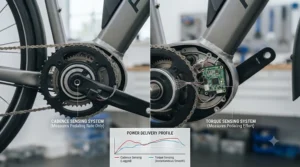
The theory is straightforward enough — torque sensors measure how hard you push, cadence sensors measure whether you’re pedalling at all — but the practical difference is worth spelling out properly, because it genuinely changes how a bike feels day to day. A cadence sensor essentially waits for your cranks to complete a portion of a rotation before triggering assistance, using a set of magnets and a fixed pedal-assist ratio; push gently or push hard, you get the same preset motor output for that assist level. This is cheaper to manufacture and perfectly fine for flat commutes at a steady pace, but it can feel jerky when starting from a standstill on an incline, because there’s a brief moment where you’re doing all the work before the motor catches up.
Torque sensing systems instead deliver what’s often described as a seamless power transition — the harder you push, the more assistance you get, scaling continuously rather than jumping between fixed levels. Independent testers who’ve ridden both back-to-back consistently describe torque-sensor bikes as feeling more like an extension of your own effort, “as if a friendly tailwind is always at your back” rather than a separate motor kicking in and out. The efficiency gains are real too: because torque sensors only deliver power proportional to genuine pedalling effort, they tend to squeeze more range from the same battery capacity than cadence systems running at a fixed output regardless of how lightly you’re actually pedalling — independent industry analysis suggests torque-sensor bikes can be meaningfully more efficient than cadence-based equivalents over a full charge cycle.
Where this matters most in practice is hill starts and stop-start urban riding — exactly the conditions most British commuters actually face, rather than the long flat cruises manufacturers photograph their bikes on.
Common Mistakes When Buying a Torque Sensing eBike
Even switched-on buyers trip over a handful of recurring pitfalls, and it’s worth naming them plainly rather than assuming good faith from every listing.
Assuming any “smart assist” claim means genuine torque sensing. Marketing copy loves the word “intelligent,” “responsive” or “adaptive” without actually specifying sensor type. If a listing doesn’t explicitly say “torque sensor” or specify a strain-gauge bottom bracket, assume cadence until proven otherwise.
Ignoring motor placement. A hub motor with a torque sensor and a mid-drive motor with a torque sensor are genuinely different riding experiences, particularly on hills, where mid-drive systems leverage your bike’s own gearing for more efficient climbing.
Overlooking IP and certification ratings. Waterproofing claims vary wildly in honesty. Look specifically for IPX4 or higher, and check for genuine EN15194 or UKCA certification rather than a vague “CE compliant” claim with no standard number attached.
Buying the wrong version for the UK. Several Far East brands sell “international” variants with higher unrestricted speeds or peak power that technically don’t comply with UK EAPC law — Cycling UK’s regulatory guidance is worth reading before you buy, since riding a non-compliant machine on public roads carries real legal exposure.
Chasing peak Nm figures over real-world tuning. A 100Nm motor poorly calibrated can feel worse than a well-tuned 40Nm Bosch system. Torque numbers matter, but sensor quality and software tuning matter just as much, if not more.
Real-World Scenarios: Which Torque Sensor eBike Fits Your Life?
The Zone 2 commuter navigating central London stations. Stairs, tight storage, and a train journey each way make the ADO Air 20‘s sub-17kg folded footprint genuinely decisive — a heavier bike simply becomes a daily chore rather than a convenience, however good its motor.
The parent doing an 8-mile round-trip school run with two kids’ bags in tow. This is precisely the Engwe LE20‘s territory: mid-drive torque, a step-through frame, and enough sustained power to handle load without straining the motor or the battery on repeated short trips.
The weekend rider tackling genuinely hilly countryside routes. Between the Raleigh Motus‘s refined 40Nm Bosch system and the Engwe Engine Pro 2.0‘s 75Nm full-suspension setup, the choice comes down to terrain roughness — smoother B-roads favour the Motus’s polish, while broken surfaces and steeper off-road sections favour the Engine Pro 2.0’s suspension and higher torque ceiling.
The all-weather daily commuter riding regardless of conditions. Fat tyres, hydraulic brakes and a properly sealed electrical system make the Engwe EP-2 3.0 the sensible pick here — its UL 2849 certification and GPS tracking add practical peace of mind for a bike that’s likely spending real time locked up outdoors.
Buyer’s Decision Framework
If portability is your absolute priority, choose a folding hub-motor bike like the ADO Air 20, because weight and fold size will matter more day-to-day than a few extra Newton-metres of torque.
If you regularly carry cargo or passengers, choose a mid-drive torque sensor bike like the Engwe LE20, because centred weight distribution genuinely changes handling under load in a way hub motors can’t replicate.
If your route includes sustained climbs, choose a higher-torque system — the Engwe Engine Pro 2.0 or Engwe EP-2 3.0 — because torque ceiling directly determines how comfortably a motor handles gradient without straining.
If long-term dealer support and parts availability matter more than raw spec, choose a Bosch-equipped bike like the Raleigh Motus, because the wider service network reduces downtime risk over a multi-year ownership period.
If budget is the binding constraint, choose the Eleglide Citycrosser, because it’s currently the most accessible genuine torque sensor ebike on the UK market without meaningfully compromising the core riding feel that makes torque sensing worthwhile.
Long-Term Cost & Maintenance: What Torque Sensor Ownership Actually Costs
Torque sensor systems themselves are largely maintenance-free — there are no serviceable parts inside a sealed strain-gauge bottom bracket, and failures are relatively rare across the models in this guide, according to aggregated owner reports. The costs that do accumulate sit elsewhere: brake pads (hydraulic systems typically need replacement every 12-18 months of regular use), battery degradation (expect noticeably reduced range after roughly 500-800 full charge cycles, meaning a 3-5 year horizon for most commuters), and drivetrain wear, which belt-drive bikes like the ADO Air 20 largely sidestep compared with chain-driven alternatives.
Many UK bike shops, including Halfords and independent specialists, now offer ebike-specific diagnostic and calibration services, typically priced in the £60-£120 range for a comprehensive electrical check — worth budgeting for annually if you’re covering serious mileage. Brands like Engwe, Eleglide and ADO typically supply replacement batteries through Amazon.co.uk or their own UK distributors, which matters for long-term parts availability; Bosch-equipped bikes like the Raleigh Motus benefit from an even broader third-party servicing network, since Bosch components are standardised across dozens of bike brands rather than proprietary to one manufacturer.
Cold weather genuinely affects range — lithium-ion cells lose roughly 20% capacity at freezing temperatures compared with room temperature, meaning a 100km summer range might realistically drop closer to 80km during a British January commute. Torque sensors actually help mitigate this to some degree, since they only draw the power you’re genuinely demanding rather than a fixed output regardless of conditions, but it’s still worth planning charging habits around winter range loss rather than being caught out.
Safety, Regulations and EAPC Compliance in the UK
Every bike in this guide is designed to comply with UK EAPC regulations, but compliance isn’t automatic just because a listing says “250W” — it’s worth understanding the actual legal thresholds. To qualify as an electrically assisted pedal cycle and avoid registration, tax and insurance requirements, a bike must have a motor rated at no more than 250W continuous power, must only provide assistance while the rider is actively pedalling, and that assistance must cut off once the bike reaches 15.5mph (25km/h) under its own motor power — you can pedal faster than that under your own steam, but the motor cannot help you do it.
This is precisely where some “international” or “unlocked” variants of bikes sold online cause problems. According to the Department for Transport’s official guidance, bikes fitted with an “off-road mode” that allows motor assistance beyond 15.5mph are not considered compliant EAPCs, regardless of what mode they’re normally sold or ridden in — meaning riding one on a public road, cycle path or bridleway in that state is technically riding an unregistered, uninsured motor vehicle. Riders should specifically verify they’re buying the UK or EU-spec version of any model, particularly with brands that also sell higher-power “international” variants for markets with looser regulations.
Beyond raw legality, brake standards matter too. UK EAPC regulations require brakes to meet BS EN ISO 4210-2:2014 or an equivalent standard and to be kept in efficient working order, which is one practical reason hydraulic disc brakes — standard on several bikes in this list, including the ADO Air 20 and Engwe EP-2 3.0 — represent a genuine safety upgrade over basic mechanical callipers, not just a comfort feature.
Practical Usage Guide: Getting the Most from Your Torque Sensor eBike
First 30 days. Most torque sensor systems benefit from a short calibration period where the controller learns your typical pedalling pressure range — avoid immediately maxing out the highest assist level, since starting in a mid-range setting lets you feel how the sensor responds before relying on maximum boost. Check tyre pressure weekly initially, since factory-set PSI is often lower than ideal for UK road surfaces, and a properly inflated tyre meaningfully improves both range and the crispness of torque sensor response.
Maintenance schedule. Hydraulic brake systems should be bled roughly every 12 months of regular use; chain-driven models need lubrication every 200-300km in dry conditions, more frequently in wet British weather; belt-drive bikes like the ADO Air 20 need only an occasional wipe-down. Battery care matters more than most owners realise: avoid regularly draining below 20% or leaving fully charged for extended storage periods, since both accelerate long-term capacity loss.
Common early mistakes. New torque sensor owners frequently over-rely on the highest assist setting out of habit from cadence-sensor bikes, which unnecessarily drains the battery faster than needed — because torque sensors scale output to your actual effort, a mid-level assist setting on a torque sensor bike often delivers more genuinely useful, proportional power than the same numbered setting would on a cadence system. It’s also worth resisting the urge to immediately install aftermarket components before understanding how the stock torque sensor calibration behaves, since some conversion kits and third-party parts can interfere with the manufacturer’s tuning.
Features That Actually Matter (And Those That Don’t)
Matters: Genuine strain-gauge torque sensing over cadence-only systems; hydraulic over mechanical disc brakes; verified IPX4+ waterproofing; UKCA or EN15194 certification with a real standard number attached; removable batteries for easier home charging and eventual replacement.
Doesn’t matter as much as marketing suggests: Peak wattage figures far beyond the 250W continuous UK legal limit (peak power is largely irrelevant to legal road use); app connectivity beyond basic ride tracking, which is nice-to-have rather than decisive; headline top-speed claims, since UK law caps assisted speed at 15.5mph regardless of what the motor is theoretically capable of.
The genuinely intuitive assist torque electric bicycle experience buyers are chasing comes down to sensor quality and tuning far more than any single headline spec — a well-calibrated 40Nm Bosch system consistently outperforms the feel of a poorly tuned 100Nm budget unit, even though the numbers suggest otherwise on paper.
Frequently Asked Questions
❓ What's the difference between a torque sensor and cadence sensor ebike?
❓ Are torque sensor ebikes legal on UK roads without a licence?
❓ Do torque sensor ebikes really get better range than cadence sensor models?
❓ Can I retrofit a torque sensor onto an existing ebike?
❓ Is a higher Nm torque figure always better for hill climbing?
Conclusion
Torque sensing has quietly become the feature that separates an ebike you tolerate from one you genuinely enjoy riding, and the good news for British buyers is that the technology no longer demands a premium-only budget. Whether you land on the Eleglide Citycrosser‘s unbeatable entry price, the ADO Air 20‘s featherweight portability, or the Raleigh Motus‘s Bosch-backed refinement, the common thread across every recommendation here is the same: proportional, responsive power delivery that matches your own effort rather than fighting against it.
The right choice ultimately depends on the unglamorous specifics of your actual life — how far you’re carrying it up stairs, how many hills stand between you and work, whether you’re hauling a child seat or just yourself. Use the comparison table, the decision framework, and the honest pros and cons above as your starting point, and don’t be afraid to prioritise sensor quality over headline torque numbers, because that’s genuinely where the riding experience lives.
✨ Ready to Feel the Difference Yourself?
🔍 Browse the full range of torque sensing ebike brands featured in this guide and compare current pricing on Amazon.co.uk. A smoother, smarter commute is one click away!
Recommended for You
- How Torque Sensing Works Electric Bike: 7 Top Picks 2026
- Pedal Assist Electric Bike for Fitness: 7 Best Picks for 2026
- 7 Best 48v Ebike Brands UK 2026 – Power, Range & Value Tested
Disclaimer: This article contains affiliate links. As an Amazon Associate, I earn from qualifying purchases. If you purchase products through these links, we may earn a small commission at no additional cost to you.
✨ Found this helpful? Share it with your friends! 💬🤗
