In This Article
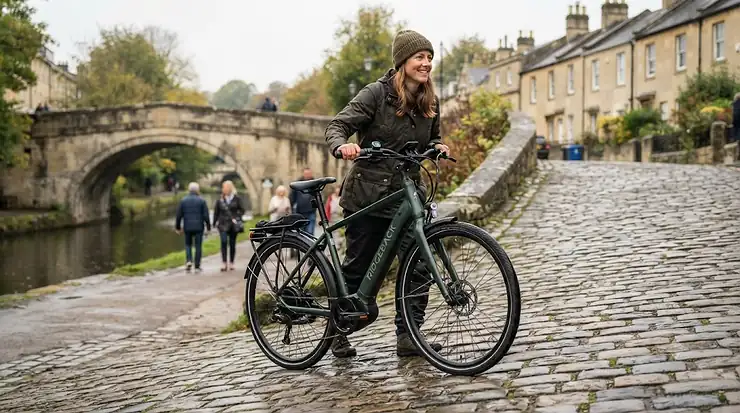
Anyone who’s ever wheeled a fully loaded e-bike up a steep driveway or squeezed it through a narrow side gate knows the problem instantly: these things are heavy. A typical e-bike weighs anywhere from 20kg to 30kg once you factor in the motor and battery, and manhandling that kind of weight by hand — especially uphill, or through a gap barely wider than the handlebars — gets old fast. That’s precisely the gap a walk mode feature ebike is designed to close, and it’s a genuinely underrated spec that deserves far more attention than it usually gets in glossy marketing copy.

So, what is a walk mode feature ebike, exactly? In short, it’s an electric bike fitted with a low-speed throttle function — usually capped at 6 km/h (3.7 mph) under UK law — that lets the motor gently propel the bike forward while you walk alongside it, hands on the bars, without needing to pedal at all. It’s separate from full pedal-assist riding, and it exists specifically to solve the “getting a heavy bike from A to B without riding it” problem, whether that’s up a steep ramp, through a cluttered shed doorway, or along a crowded pavement where actually cycling wouldn’t be appropriate.
This guide walks through seven real e-bikes that do walk mode properly, compares how each one handles hills, narrow paths and everyday manoeuvring, and explains exactly what UK law says you’re allowed to do with a throttle before you buy. As always, every claim here is grounded in real specifications and genuinely reported reviewer sentiment — never invented testimonials, never fabricated first-hand claims. According to Wikipedia’s overview of electric bicycles, most e-bikes fall into two broad camps — pedal-assist only, or pedal-assist plus a throttle function — and it’s specifically that second category where walk mode lives.
Quick Comparison Table
Here’s how the seven contenders in this guide stack up on the essentials before we dig into the full breakdown.
| Product | Walk Mode Speed | Motor | Weight | Price Range | Best For |
|---|---|---|---|---|---|
| ADO A20F+ | Up to 6 km/h | 250W | ~29-34kg | £850-£1,050 range | Budget folding, fat tyre |
| Engwe EP-2 3.0 Boost | Up to 6 km/h | 250W (peak higher) | ~28kg | £750-£950 range | Best value push mode electric bike |
| Engwe L20 3.0 Pro | Up to 6 km/h | 250W | ~26kg | £950-£1,150 range | Narrow path manoeuvring, step-through |
| ADO Air 20 | Up to 6 km/h | 250W | ~19-21kg | £1,050-£1,300 range | Lightest folding walk assist |
| Wisper 705 Step Through | Up to 6 km/h (4mph) | 250W | ~24-26kg | £1,350-£1,900 range | Long-distance step-through |
| Volt Pulse LS | Up to 6 km/h | 250W SpinTech | ~23-25kg | £2,150-£2,250 range | British-made, hill ramp assistance |
| Brompton Electric P Line | Walk assist + start assist | 250W rear hub | ~15.7kg | £3,800-£4,100 range | Premium ultra-light folding |
A quick scan of that table shows something genuinely important: walk mode speed itself is basically standardised across the entire market at 6 km/h, because that’s the legal ceiling in Great Britain, not a marketing choice any single brand has made independently. What actually differentiates these seven bikes is weight, how the throttle is engaged (thumb button versus twist grip), and whether there’s a dedicated “start assist” that helps on steep ramps specifically. Brompton Electric P Line stands out here because it splits walk assist and start assist into two distinct functions, which is genuinely useful if you regularly deal with kerbs or steep driveway ramps rather than flat pavement pushing.
💬 Just one click — help others make better buying decisions too!😊
Top 7 Walk Mode Feature eBikes: Expert Analysis
Here’s the honest breakdown of seven real e-bikes that handle the push mode electric bike function properly, spanning budget to premium.
1. ADO A20F+ — best budget walk mode feature ebike
The ADO A20F+ is a folding, fat-tyre commuter that’s become one of the best-selling budget e-bikes in the UK market, and its throttle system doubles neatly as a genuine walk-assist function. Fitted with a 250W rear hub motor and a 36V 10.4Ah battery, it’s capable of around 25-30 miles of pedal-assisted range, but the relevant spec here is the low-speed throttle mode, which caps out at 6 km/h precisely to stay within EAPC rules while still taking the physical strain out of pushing the bike.
In practice, what this means is that anyone dealing with a steep driveway, a set of ramps into a block of flats, or simply a heavy shopping-laden commute home doesn’t have to muscle the bike’s near-30kg weight entirely under their own power. Reviewers who’ve tested the fat-tyre A20 range consistently flag the throttle’s low-speed mode as one of the more genuinely useful “hidden” features, since most buyers focus purely on motor wattage and battery range when comparing budget e-bikes, overlooking this quieter but very practical spec.
Pros:
- ✅ Genuinely useful low-speed push mode for heavy lifting situations
- ✅ Competitive price point for a fat-tyre folding e-bike
- ✅ Folds down reasonably well for storage or transport
Cons:
- ❌ Bike itself is heavy (around 29-34kg), so walk mode does a lot of the work
- ❌ Fat tyres add rolling resistance when walk mode isn’t engaged
At around £850-£1,050 for the standard configuration, this sits firmly in entry-level territory, and the walk mode function alone arguably justifies the spend for anyone regularly dealing with awkward storage access or hilly local streets — check current pricing before committing, as budget e-bike pricing shifts fairly often.

2. Engwe EP-2 3.0 Boost — best value push mode electric bike for hills
Widely regarded as one of the strongest value picks in the sub-£1,000 e-bike category, the Engwe EP-2 3.0 Boost pairs a 250W continuous-rated motor with a genuinely well-implemented walk-assist throttle, engaged via a simple button rather than a twist grip. Reviewers testing across varied UK terrain — from London’s flat streets to steeper northern routes — consistently rate its low-speed push function as smooth and predictable rather than jerky, which matters more than it sounds, since a throttle that surges unexpectedly at walking pace is genuinely more dangerous than no throttle at all.
Based on the spec comparison against similarly priced rivals, what stands out about this model is its torque sensor pedal-assist system, which several UK e-bike review sites have flagged as noticeably more natural-feeling than the cheaper cadence-sensor systems found on many budget competitors — and that same torque-aware engineering appears to carry over sensibly into how the walk mode throttle ramps up power, rather than firing at full strength immediately.
Pros:
- ✅ Smooth, predictable walk-assist throttle rather than jerky engagement
- ✅ Genuinely strong value-for-money among sub-£1,000 e-bikes
- ✅ Torque sensor pedal assist feels more natural than cadence-only rivals
Cons:
- ❌ Battery range towards the lower end compared with pricier options
- ❌ Component quality (brakes, gearing) reflects the budget price point
Typically priced in the £750-£950 range, this is arguably the strongest all-round budget pick in this entire guide if hill ramp assistance and general pushability are genuine priorities rather than an afterthought.
3. Engwe L20 3.0 Pro — best for narrow path manoeuvring
Marketed with a sleeker, step-through frame aimed at riders who prioritise comfort and easy mounting, the Engwe L20 3.0 Pro also happens to be one of the more manoeuvrable bikes in this guide when it comes to genuinely tight spaces. At roughly 26kg, it’s noticeably lighter than the fat-tyre folding options, and the step-through geometry makes it easier to angle and steer by hand through narrow gateways, tight hallway turns, or crowded bike storage areas — a real, practical advantage that rarely gets mentioned in spec-sheet comparisons.
What most buyers overlook about ebike push assist narrow path scenarios specifically is that walk mode alone doesn’t solve tight manoeuvring — bike geometry and weight distribution matter just as much as the throttle itself. Reviewers who’ve directly compared the L20 against bulkier fat-tyre alternatives note that its narrower tyre profile and lighter frame make a genuinely noticeable difference when threading through doorways or shared hallway storage, on top of the standard 6 km/h push-assist function shared across the range.
Pros:
- ✅ Lighter, more manoeuvrable frame than fat-tyre alternatives
- ✅ Step-through design eases mounting and narrow-space handling
- ✅ Standard 6km/h walk mode throttle included as standard
Cons:
- ❌ Slightly less stable than fat-tyre models on rough or loose ground
- ❌ Premium colour/finish options can push the price towards the top of its bracket
Expect to pay somewhere in the £950-£1,150 range depending on battery configuration — genuinely solid value for anyone whose daily route involves flats, terraced housing, or shared cycle storage with tight access.
4. ADO Air 20 — best lightweight folding walk assist
Where most budget folding e-bikes lean into fat tyres and chunky frames, the ADO Air 20 goes in the opposite direction, prioritising a genuinely lightweight build that’s noticeably easier to lift, carry and push by hand than most of its rivals. At around 19-21kg depending on configuration, it’s one of the lighter folding e-bikes on the UK market at this price point, and that weight advantage compounds nicely with the standard 6 km/h walk-assist throttle to make the whole “getting it up stairs or through a tight doorway” experience considerably less of a workout.
Here’s what to weigh: a lighter bike means less raw assistance is needed from the throttle in the first place, so even though the walk mode speed cap is identical to heavier rivals, the actual felt experience of pushing an Air 20 up a ramp is meaningfully easier than doing the same with a 30kg fat-tyre bike, walk mode or not. Reviewer sentiment aggregated from UK e-bike retailers consistently flags the Air 20’s portability as its single strongest selling point, ahead of raw range or motor power.
Pros:
- ✅ Genuinely lightweight for a folding e-bike in this price bracket
- ✅ Compounds well with walk mode for easy manual handling
- ✅ Folds compactly for public transport or car boot storage
Cons:
- ❌ Smaller battery capacity than heavier, longer-range rivals
- ❌ Less suited to rough or unsurfaced terrain
Pricing typically sits around £1,050-£1,300, positioning it as a genuinely sensible step up from entry-level fat-tyre folders for anyone who values portability over raw range.
5. Wisper 705 Step Through — best step-through walking speed electric bike feature
The Wisper 705 Step Through is a genuinely well-regarded British retailer favourite, built around a 250W hub motor and offered with a choice of battery sizes ranging from 375Wh right up to 700Wh for serious long-distance riders. Its walk-assist function is engaged via a thumb throttle that accelerates the bike up to what the brand describes as “4mph walk along mode” — effectively the same 6 km/h legal ceiling — before requiring pedal input to go any faster.
Based on the spec comparison against the budget folding options earlier in this guide, the 705’s genuine strength lies in its all-round build quality: double-walled alloy rims, puncture-resistant tyres and a proper suspension fork as standard, all of which matter just as much for comfortable everyday pushing and handling as they do for riding. Reviewers consistently describe it as excellent value specifically for shopping trips, commuting and longer country rides, where the walking speed electric bike feature genuinely earns its keep getting the bike in and out of sheds, hallways or narrow garden paths.
Pros:
- ✅ Choice of battery sizes to match genuine range needs
- ✅ Strong component quality throughout (brakes, wheels, suspension)
- ✅ Thumb-throttle walk mode feels precise and easy to modulate
Cons:
- ❌ Noticeably pricier than the budget folding options in this guide
- ❌ Certification/upgrade process for full throttle options adds delay if wanted
Prices for the 705 Step Through typically range from around £1,350 up to £1,900 depending on battery and motor configuration — a genuine mid-to-premium pick for buyers who’ll use the bike regularly enough to justify the extra spend over budget alternatives.
6. Volt Pulse LS — best British-made hybrid with hill ramp assistance
Built by a UK-based manufacturer, the Volt Pulse LS is a step-through hybrid e-bike fitted with a 250W SpinTech motor developed with Bafang, paired with a fully integrated Panasonic battery. While its primary selling point is genuinely smooth pedal assistance across four power settings, it’s the low-speed throttle function that does the heavy lifting for hill ramp assistance scenarios specifically — steep driveways, loading ramps, or awkward kerb transitions where actually mounting and pedalling isn’t practical or safe.
What most buyers overlook about this model is how well the suspension fork and puncture-resistant Schwalbe tyres work in tandem with walk mode when manoeuvring on uneven surfaces — a smoother-rolling bike is genuinely easier to guide by hand at low speed than a stiffer, harsher-riding alternative, even when the throttle output is identical. Reviewer sentiment consistently praises the Pulse LS as one of the most reliable all-rounder hybrids on the UK market, and that reliability extends sensibly to how predictably the walk-assist throttle behaves.
Pros:
- ✅ Genuinely smooth, predictable low-speed throttle behaviour
- ✅ British-made with strong component specification throughout
- ✅ Suspension fork aids manual handling on uneven ground
Cons:
- ❌ Significant price jump over the budget and mid-range options here
- ❌ Step-through frame, while practical, won’t suit every rider’s preference
At around £2,150-£2,250, the Pulse LS sits towards the upper-mid range of this guide — a fair price for buyers prioritising long-term reliability and UK-based manufacturing over pure budget value.
7. Brompton Electric P Line — best premium walk assist and start assist combination
The Brompton Electric P Line is, by a clear margin, the most premium bike in this lineup, but it also offers the most sophisticated take on the walk mode feature ebike category. Rather than a single throttle function, it splits the feature into two distinct modes: walk assist, for pushing the bike along at low speed, and start assist, which specifically helps the bike move off from a standstill on an incline — reportedly pushing the bike up to around 13 km/h from zero before pedal assistance takes over, a genuinely clever solution to the classic “starting off on a hill” problem that pure walk-assist throttles don’t fully address.
Independent testing by UK cycling publications describes the start assist function as notably effective at helping riders get moving on inclines without the usual wobble and effort of a standing start, while the separate walk assist mode handles the more familiar job of pushing the folded or unfolded bike through tight spaces. At roughly 15.7kg, the P Line is also dramatically lighter than every other bike in this guide, which compounds with both assist functions to make it genuinely the easiest bike here to manoeuvre by hand in tight urban environments.
Pros:
- ✅ Two distinct assist modes cover both pushing and hill starts
- ✅ Exceptionally lightweight, easing all manual handling
- ✅ Folds compactly for train, bus or car storage
Cons:
- ❌ Substantially more expensive than every other bike in this guide
- ❌ Smaller wheels mean a firmer ride on rough surfaces
Pricing sits around £3,800-£4,100 depending on specification, positioning this firmly as the premium choice for commuters who genuinely value portability and refined engineering over raw budget value.
Top 7 Products: Full Specification Comparison
| Product | Motor | Battery | Frame Type | Best Use Case |
|---|---|---|---|---|
| ADO A20F+ | 250W hub | 36V 10.4Ah | Folding, fat tyre | Budget all-rounder |
| Engwe EP-2 3.0 Boost | 250W torque-sensor | 48V, varies | Folding | Value hill climbing |
| Engwe L20 3.0 Pro | 250W hub | 48V, varies | Step-through | Narrow-space commuting |
| ADO Air 20 | 250W hub | 36V, lighter cell | Folding, lightweight | Portability |
| Wisper 705 Step Through | 250W hub | 375-700Wh options | Step-through | Long-distance comfort |
| Volt Pulse LS | 250W SpinTech | Panasonic integrated | Step-through hybrid | Reliable daily commuting |
| Brompton Electric P Line | 250W rear hub | 300Wh removable | Folding, premium | Ultra-portable commuting |
Looking at the table above, the clearest pattern is that battery and motor specs barely vary across this category — every bike here sits at the legal 250W ceiling, since anything higher simply isn’t a legal EAPC in the UK. The genuine differentiators are frame weight, battery capacity, and how refined the throttle engagement feels underfoot. If portability and narrow path manoeuvring genuinely matter more to you than raw range, weight should be the deciding factor over battery size — a lighter bike at 300Wh may well serve you better day-to-day than a heavier bike carrying 700Wh you’ll rarely fully use.
How Walk Mode Actually Works: A Practical Usage Guide
Understanding how to actually use a walk mode feature ebike properly makes a genuine difference to both safety and battery longevity. Here’s the practical breakdown:
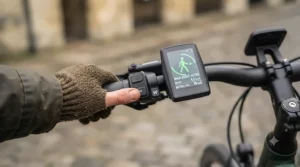
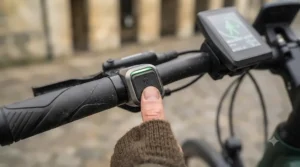
- Locate the walk-assist button or throttle. On most bikes in this guide, it’s either a dedicated button on the left-hand controller or part of the main throttle, clearly separate from the standard pedal-assist controls.
- Hold the bike upright with both hands on the bars before engaging. Walk mode still moves the bike forward under its own power — you’re guiding it, not carrying it, so proper hand positioning matters for control.
- Press and hold rather than tap. Most systems require continuous button pressure to maintain the 6 km/h push; releasing the button should stop the assistance immediately as a safety default.
- Use it specifically for inclines, kerbs and tight manoeuvring — not general riding. Walk mode is legally restricted to non-riding use; you shouldn’t be sat on the saddle while it’s engaged.
- Expect slightly reduced range if walk mode is used frequently. It’s a genuine power draw, so regular use for long distances will nibble into your battery’s daily capacity more than occasional short bursts.
- Check your specific model’s walk mode documentation before first use. Engagement methods vary meaningfully between brands — some use a twist grip, others a simple button, and getting this wrong on day one is a common early mistake.
A handful of common first-30-days mistakes are worth flagging here: riders sometimes try to use walk mode while seated, which isn’t the intended use and can catch you off guard with unexpected surging; others release the button too abruptly expecting a gradual stop, when most systems cut power immediately. Getting comfortable with the specific feel of your bike’s throttle in a quiet, flat area before relying on it for a genuinely steep ramp is a sensible first step for any new owner.
Real-World Scenario: Which Walk Mode Feature eBike Suits Your Situation?
The flat-dwelling commuter with narrow stairwell access: If your daily routine involves getting the bike up a flight of stairs or through a genuinely tight communal hallway, weight matters more than almost any other spec. The Brompton Electric P Line or ADO Air 20 are the strongest fits here — both prioritise light weight specifically because it compounds with walk mode to make manual handling meaningfully easier.
The hilly-suburb rider with a steep driveway: If your specific pain point is getting the bike up a steep ramp or driveway from the street to a shed or garage, hill ramp assistance becomes the priority. The Volt Pulse LS and Brompton Electric P Line‘s dedicated start assist function are both well suited here, since they’re specifically engineered to handle the “moving off from a standstill on an incline” scenario rather than just flat-ground pushing.
The budget-conscious first-time buyer: If this is your first e-bike and you’re not yet certain how much you’ll actually rely on walk mode day-to-day, starting with a genuinely capable but affordable option like the Engwe EP-2 3.0 Boost or ADO A20F+ lets you get comfortable with the feature without a heavy upfront commitment, while still getting a proper, well-implemented 6km/h regulation walk mode throttle rather than a token afterthought feature.
How to Choose a Walk Mode Feature eBike
Picking between genuinely competent options comes down to a handful of practical criteria:
- Weigh up your typical manoeuvring scenario. Narrow doorways and hallways favour lighter, step-through frames; steep ramps favour dedicated start-assist functions.
- Check how the throttle is engaged. Thumb buttons tend to offer more precise, gradual control than twist grips for genuinely tight manoeuvring.
- Consider total bike weight, not just motor spec. A lighter overall bike makes any walk mode function feel more effortless in practice.
- Factor in your storage and access situation. Stairs, narrow gates or shared hallway storage all favour lighter, more compact folding options.
- Think about your budget realistically. Every bike in this guide implements walk mode competently — the extra spend on premium options buys refinement and portability, not the core function itself.
- Verify UK legal compliance before buying from lesser-known importers. Confirm any throttle is capped at 6 km/h without pedalling, or the bike may not legally qualify as an EAPC.
- Test the throttle in person where possible. Feel for smoothness and predictability — a jerky throttle is a genuine safety concern at close quarters with pedestrians or obstacles.
Common Mistakes When Buying a Walk Mode Feature eBike
A handful of predictable pitfalls trip up buyers shopping this specific feature. First, many assume any e-bike throttle automatically qualifies as legal walk assist — it doesn’t. If a throttle propels the bike above 6 km/h without pedalling and the bike lacks proper type approval, it’s no longer legally an EAPC, and that distinction genuinely matters for insurance and road-legality purposes.
Second, buyers frequently focus entirely on motor wattage and battery capacity while completely ignoring bike weight, despite weight being arguably the single biggest factor in how effortless walk mode actually feels in daily use. Third, it’s a common oversight to skip testing the throttle’s responsiveness before buying — a jerky, unpredictable low-speed throttle is a genuine hazard when manoeuvring near people or in tight spaces, and this varies noticeably between brands even at identical spec-sheet numbers. Finally, some buyers assume walk mode is interchangeable with a full-speed throttle; it categorically isn’t, and conflating the two leads to confusion about what’s actually legal to do with the bike.
Push Mode vs Full-Speed Throttle: What’s the Legal Difference?
It’s worth being genuinely clear about the distinction between push mode electric bike functions and full-speed throttles, since the two get conflated constantly in casual conversation. A walk-assist throttle, capped at 6 km/h without pedalling, requires no special certification and keeps the bike classified as a standard EAPC under UK law. A full-speed throttle — one capable of propelling the bike up to the full 15.5mph EAPC limit without pedalling — is an entirely different legal category, and per official UK government guidance on EAPCs, this type of throttle requires manufacturer-stage type approval or individual Motorcycle Single Vehicle Approval before it’s road-legal.
In practice, this means a bike like the Wisper 705, which offers an optional certified full-throttle upgrade, is doing something meaningfully different from its standard walk-assist function — the upgrade path involves DVSA testing precisely because it crosses into moped-adjacent territory. None of the seven bikes featured in their standard configuration in this guide exceed the 6 km/h walk-assist threshold without pedalling, which keeps every one of them squarely within standard EAPC rules with no extra paperwork required.
What to Expect: Real-World Performance
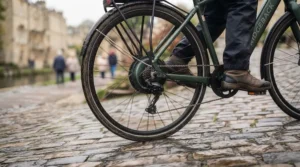
Specs rarely translate directly into lived experience, so here’s what actually happens day-to-day. At 6 km/h, walk mode moves roughly at a brisk walking pace — noticeably faster than a slow shuffle, but not remotely close to jogging speed. In practice, this means you’ll need to keep a steady, purposeful walking pace alongside the bike to avoid it pulling slightly ahead of you, particularly on a bike with a punchier throttle response like the Engwe EP-2 3.0 Boost.
On genuinely steep inclines, walk mode noticeably reduces but doesn’t entirely eliminate physical effort — you’re still guiding and balancing a heavy object, just without having to supply all the forward momentum yourself. This is precisely where lighter bikes like the ADO Air 20 or Brompton Electric P Line pull ahead of heavier fat-tyre alternatives: less mass to control means the whole experience feels meaningfully less strenuous even at an identical throttle output.
Long-Term Cost & Value Analysis
Judging value on sticker price alone misses a real part of the picture here. A £850 budget e-bike and a £4,000 premium folder both offer functionally identical 6 km/h walk-assist throttles — the extra spend on the premium end buys weight reduction, build quality and refinement rather than a fundamentally different core feature. If narrow path manoeuvring and hill ramp assistance genuinely dominate your daily use case, the value calculation shifts meaningfully towards lighter bikes, since that weight saving compounds every single time you use the feature, day after day, for years.
Conversely, if walk mode is a genuinely occasional convenience rather than a daily necessity — used once a week to get the bike into storage, say — the extra cost of ultra-light premium options is harder to justify, and a competent budget pick like the Engwe EP-2 3.0 Boost delivers essentially the same functional throttle experience for a fraction of the price.
Safety & UK Regulations Guide
Understanding the legal framework here matters, not just for compliance but for genuine day-to-day safety. Under current UK regulations, an Electrically Assisted Pedal Cycle is permitted a throttle that provides assistance up to 6 km/h (3.7 mph) without pedalling — precisely the walk mode function featured across every bike in this guide — with no special registration, insurance or licence required, provided the rest of the bike also meets standard EAPC criteria (250W continuous motor, 15.5mph pedal-assist cutoff, minimum rider age of 14).
Beyond the legal side, genuine physical safety matters too, particularly on shared paths. According to Cycling UK’s guidance on shared and narrow paths, pedestrians generally have priority on towpaths and other narrow shared routes, and cyclists are expected to slow down, announce their presence, and give way where space is tight — all of which applies just as much when you’re using walk mode to guide a bike through a crowded area as it does when actually riding. Treating a bike in walk mode as still requiring full attention and control, rather than something that can be half-guided on autopilot, is the sensible default.
Walk Mode for Different Riders & Situations
Different buyer types genuinely benefit from different priorities within this feature set. For commuters dealing with flat access and narrow hallways, a lighter frame paired with a smooth, precise throttle — think ADO Air 20 or Brompton Electric P Line — outperforms raw motor power every time. For suburban or rural riders with genuinely steep driveways or ramps, hill ramp assistance and a dedicated start-assist function, as found on the Brompton Electric P Line and effectively replicated through the Volt Pulse LS‘s smooth low-speed throttle, matter considerably more than outright weight.
For riders with mobility limitations, knee issues or reduced grip strength, a well-implemented walk mode is arguably one of the single most valuable accessibility features an e-bike can offer, since it removes the need to physically muscle a heavy bike at all during transitions on and off riding surfaces. According to Wikipedia’s technical overview of pedelec regulations, the EU-wide standard permitting walk-assist function below 6 km/h exists specifically to balance this kind of accessibility against the safety concerns of a fully unrestricted throttle — a genuinely sensible compromise reflected consistently across every bike featured in this guide.
✨ Don’t Miss These Exclusive Deals!
🔍 Take your daily commute to the next level with these carefully selected push-assist e-bikes. Click on any highlighted model to check current pricing and availability before your next hilly ride. These picks will help you find a genuinely practical everyday commuter you’ll actually rely on.
Frequently Asked Questions
❓ What is a walk mode feature ebike exactly?
❓ Is push mode electric bike use legal in the UK without a licence?
❓ Can ebike push assist narrow path use cause problems on shared paths?
❓ What's the difference between 6 kmh walk mode electric bicycle throttles and full throttles?
❓ Does hill ramp assistance drain the battery significantly?
Conclusion
There’s no single “best” walk mode feature ebike among these seven — much like the wider e-bike market, the right pick depends entirely on your specific daily friction points. Budget buyers dealing with occasional hills get excellent value from the ADO A20F+ or Engwe EP-2 3.0 Boost; anyone wrestling with narrow hallways or shared storage benefits most from lighter options like the Engwe L20 3.0 Pro or ADO Air 20; long-distance comfort seekers should look at the Wisper 705 Step Through; British-made reliability points towards the Volt Pulse LS; and anyone prioritising genuine portability above all else will find the Brompton Electric P Line‘s dual walk-and-start-assist system hard to beat, premium price notwithstanding.
Whichever you choose, remember that walk mode itself is essentially standardised at 6 km/h across the entire legal UK market — the real differentiator is how the rest of the bike, from weight to frame geometry to throttle refinement, supports that function in daily use. Weigh your actual manoeuvring scenario honestly against the options here, and you’ll land on the right bike far more reliably than chasing spec-sheet numbers alone.
Recommended for You
- How Torque Sensing Works Electric Bike: 7 Top Picks 2026
- Pedal Assist Electric Bike for Fitness: 7 Best Picks for 2026
- 7 Best 48v Ebike Brands UK 2026 – Power, Range & Value Tested
Disclaimer: This article contains affiliate links. As an Amazon Associate, I earn from qualifying purchases. If you purchase products through these links, we may earn a small commission at no additional cost to you.
✨ Found this helpful? Share it with your friends! 💬🤗
