In This Article
Push a fully loaded electric bike up a kerb ramp with the motor switched off and you’ll understand the problem in about four seconds flat. These things are heavy. A typical battery, hub motor and reinforced frame can add 10-20kg over a normal bicycle, and when you’re not sat on the saddle to steer that weight, gravity does not care about your good intentions. That’s precisely why an electric bike with walk assist exists — a low-speed push mode that lets the motor do the heavy lifting while you walk alongside, hand on the bars, rather than wrestling the bike solo.

It sounds like a gimmick until you actually need it: hauling a bike up a steep driveway, manoeuvring it through a narrow hallway, or getting it onto a train platform via a ramp rather than steps. Reviewers of heavier fat-tyre models routinely flag walk assist as one of those features you don’t think about until the first time you’re grateful for it. In this guide we’ve researched seven real, currently available UK models that include the feature, explained exactly how push mode activation works under UK law, and broken down which bike suits which situation — whether that’s a daily commute, a hilly driveway, or a parent who needs a bit of extra confidence getting the bike out of the shed. Affiliate disclosure: this article contains Amazon affiliate links, and we may earn a small commission on qualifying purchases at no extra cost to you.
Quick Comparison Table
| Bike | Best For | Motor | Battery Range | Walk Assist |
|---|---|---|---|---|
| HIMO Z20 | Lightest budget folder | 250W | Up to 80km (assisted) | Yes, single-speed push |
| ADO A20F+ | Heavy frame management on a budget | 250W | Up to 70km (assisted) | Yes, button-activated |
| Fiido C11 Pro | Step-through commuting and ramps | 500W | Up to 90km (Eco) | Yes, dedicated mode |
| EBCO UCL-30 | Low-step design for seniors | 250W | 30-40 miles | Yes, on display |
| Wisper 705 Torque | Steep hills, British engineering | 250W (Torque) | Up to 60-100 miles | Yes, hold-to-walk |
| Engwe Engine Pro 2.0 | Heaviest fat-tyre bikes | 750W (1000W peak) | Up to 68 miles claimed | Yes, throttle-limited |
| Cyrusher Kommoda 3.0 | All-terrain, steep off-road pushes | 250W (UK-limited) | Up to 68 miles | Yes, torque-sensor bike |
Looking at the spread here, the HIMO Z20 and ADO A20F+ sit at the budget end and both keep walk assist genuinely simple — a button press rather than a fiddly hold-and-release sequence. The Fiido C11 Pro and EBCO UCL-30 occupy the sensible middle ground, pairing walk assist with step-through frames that already reduce how often you’ll need push mode in the first place. At the top, the Wisper 705 Torque, Engwe Engine Pro 2.0 and Cyrusher Kommoda 3.0 are the heaviest bikes on this list, which is exactly where walk assist stops being a nice-to-have and starts being close to essential.
💬 Just one click — help others make better buying decisions too!😊
Top 7 Electric Bikes With Walk Assist: Expert Analysis
1. HIMO Z20 — lightest and cheapest true folder with push mode
The HIMO Z20 is the bike to consider if storage space and budget are your two biggest constraints, and it still doesn’t skip walk assist. Key specs first: a 250W rear motor, a 36V 10Ah removable battery good for up to roughly 80km of assisted range, a six-speed Shimano drivetrain and a fold that reportedly takes around ten seconds. What that means in practice is a bike genuinely small enough to lift into a car boot or up a flight of stairs, which pairs neatly with push mode for the awkward bit in between — say, getting it from the car to the front door up a kerb. Based on the spec comparison with the rest of this list, the Z20’s assist system is the most basic here: activation is via a long press on the display rather than the finer graduated control some pricier bikes offer, and pedal assist itself is limited to a small number of levels rather than a full five-mode spread. That’s a fair trade at this price point. Reviewers consistently note that the fold-and-carry experience is the Z20’s real selling point, with several long-term owners specifically praising how unobtrusive it is to store in a flat with no shed or garage. Aggregated user feedback also flags the LCD display as functional rather than flashy, which tracks with the bike’s positioning as a value pick rather than a flagship. Who should buy it: renters, flat-dwellers, and anyone whose main barrier to cycling is “where do I even put a bike.”
Pros:
- ✅ Genuinely compact fold for flats and small cars
- ✅ Simple, no-fuss walk assist activation
- ✅ Lower price point than every other bike on this list
Cons:
- ❌ Fewer pedal assist levels than pricier rivals
- ❌ Basic monochrome display lacks route or app data
Price range: under £650 at the time of research. For the price, this is hard to beat if portability is your priority — check current price and availability before ordering, as HIMO stock levels fluctuate.
2. ADO A20F+ — best value for heavy frame management
If the standout feature you actually need is help managing a bike’s weight rather than folding it into a rucksack, the ADO A20F+ is worth a longer look. It runs a 250W motor paired with a 36V 10.4Ah battery, giving an assisted range widely quoted around 70km, and it wraps that in a genuinely sturdy aluminium alloy frame with 20-inch by 4-inch fat tyres and dual suspension. Here’s what the spec sheet doesn’t spell out: fat tyres and dual suspension add weight — this bike sits noticeably heavier than a slim-tyred commuter, at roughly 29kg unloaded — which is exactly the scenario walk assist was built for. Based on owner reports, push mode on the A20F+ is activated from the display’s minus button, similar to the layout used across many Chinese-manufactured e-bikes sold in the UK, and it caps out at a gentle walking pace rather than surging forward. What most buyers overlook about this model is that its dual suspension, while great for comfort on rough tarmac, also means there’s more unsprung weight to control when you’re pushing rather than riding, so the walk assist isn’t just a convenience here — it earns its keep. Aggregated review sentiment is broadly positive on build quality and braking, with mechanical disc brakes praised for predictable stopping power, though some reviewers note the stock tyres could grip better in the wet. This is a strong match for buyers who want an off-road-capable folder without stepping up to Engwe or Cyrusher pricing.
Pros:
- ✅ Fat tyres and suspension handle rough surfaces well
- ✅ Sturdy alloy frame despite the folding design
- ✅ Strong braking feedback reported by owners
Cons:
- ❌ Around 29kg unloaded, heavier than slim-tyre rivals
- ❌ Stock tyres reportedly average in wet conditions
Price range: roughly £650-£800 at the time of research. Prices may vary by colour and retailer, so it’s worth comparing a couple of listings before you commit.
3. Fiido C11 Pro — best step-through for commuting and kerb ramps
The Fiido C11 Pro leans into a different problem: not overall bike weight so much as the awkwardness of stepping over a crossbar while manoeuvring a heavy bike onto a ramp or ledge. Its step-through frame solves half the equation on its own, and the walk assist mode — explicitly marketed as helping “with ramps” — handles the rest. Specs worth flagging: a 500W motor with 55Nm of torque, a Mivice torque sensor rather than a basic cadence sensor, and a removable 499.2Wh battery rated for up to roughly 90km in Eco mode. On paper this means smoother, more proportional assistance than cadence-only systems, because torque sensors respond to how hard you’re actually pedalling rather than just detecting that the pedals are turning at all. What that translates to on a ramp: less lurching, more predictable low-speed control, which matters when you’re guiding a bike rather than riding it. Reviewers consistently highlight the hydraulic disc brakes and the 40mm suspension fork as standout comfort features for a bike in this price bracket, and the adjustable frame components mean it suits a wide height range — Fiido states roughly 155cm to 195cm. A common theme in aggregated feedback is that real-world range runs somewhat below the marketing figure once you factor in higher assist levels and hillier UK terrain, so budget for something closer to 55-65km in mixed use rather than the full claimed distance.
Pros:
- ✅ Step-through frame minimises mounting hassle entirely
- ✅ Torque sensor gives smoother low-speed control
- ✅ Hydraulic disc brakes at a mid-range price point
Cons:
- ❌ Real-world range typically falls short of claimed figures
- ❌ Heavier than slim commuter bikes due to fat-tyre variant weight
Price range: in the mid-£900s to low-£1,000s at the time of research. As with most e-bikes, prices fluctuate with currency shifts and promotions, so check current price before buying.
4. EBCO UCL-30 — best low-step design for seniors and shorter riders
EBCO built its reputation on unglamorous, sensible engineering, and the UCL-30 is a good example of what that looks like in practice. The low-step frame lets you swing a leg through rather than over, the riding position is close to upright thanks to swept-back handlebars, and the TranzX front hub motor pairs with an RPM sensor and a proper walk assist function built into the display. Key specs: a 250W TranzX motor, four power support modes, and a claimed average range of 30-40 miles in eco mode, which for most local errands and leisure rides is comfortably enough — Cycling UK’s own guidance for older riders emphasises that maintaining mobility matters more than chasing maximum range, and this bike is built around that priority. Here’s what most buyers overlook about low-step frames generally: they’re not just about getting on and off, they also lower the bike’s centre of gravity slightly and make it easier to plant a foot flat on the ground at a standstill, which is exactly the confidence boost that makes walk assist genuinely useful rather than a novelty button nobody presses. Aggregated customer sentiment consistently praises EBCO’s reliability and the brand’s history — the original UCL/R-30 won a Sunday Times “In Gear” award and featured on BBC’s The One Show — though some reviewers note the component spec is more workmanlike than flashy compared with premium mid-motor rivals.
Pros:
- ✅ Low-step frame genuinely eases mounting and dismounting
- ✅ Upright riding position reduces back and wrist strain
- ✅ Established brand with a strong reliability track record
Cons:
- ❌ Rear hub motor feel less refined than mid-drive rivals
- ❌ Component spec is functional rather than premium
Price range: around £1,000-£1,300 at the time of research, depending on battery and frame configuration. Availability can vary by retailer, so check current price before ordering.
5. Wisper 705 Torque — best British-engineered walk assist for steep hills
Wisper is a UK company, and the 705 Torque range reflects a design brief built around exactly the kind of hilly, unpredictable terrain British commuters actually ride on. The bike uses a torque sensor rather than the more basic cadence sensor found on Wisper’s cheaper SE range, and it includes what the brand describes as “a very useful walk function” that powers the bike up to roughly 4mph off the saddle — precisely the kind of assistance you want when pushing a loaded bike up a steep ramp alongside a flight of steps. Activation is via holding the minus button on the display, a deliberate design choice: it stops the bike “walking away from you” if you accidentally let go, which reviewers on cycling forums have specifically praised as a sensible safety measure compared with a simple toggle. Battery options range from 375Wh up to 700Wh, translating to a claimed 40-100 miles depending on the pack you choose, and the frame comes in step-through, crossbar and folding variants. Based on the spec comparison with cheaper cadence-sensor bikes, the torque sensor here means power delivery that tracks your own pedalling effort far more closely, which matters most exactly on steep gradients — less surge, less need to fight the bike for control. Reviewers consistently rate the ride comfort highly, though several note that above the UK’s 15.5mph assisted limit the bike doesn’t feel built for extra unassisted speed, trading top-end pace for stability instead.
Pros:
- ✅ Torque sensor delivers smooth, hill-friendly power
- ✅ Hold-to-walk assist prevents accidental runaway motion
- ✅ UK company with domestic parts and support network
Cons:
- ❌ Noticeably pricier than Chinese-import equivalents
- ❌ Not built for speed beyond the legal assisted limit
Price range: roughly £1,600-£1,900 range depending on battery capacity and frame style. As with any premium purchase, it’s worth comparing current pricing across a couple of retailers before buying.
6. Engwe Engine Pro 2.0 — best walk assist for the heaviest fat-tyre bikes
If there’s one bike on this list where walk assist genuinely stops being optional, it’s this one. The Engwe Engine Pro 2.0 is a full-suspension, fat-tyre folding e-bike that reviewers have independently weighed at around 37-38kg — heavier than some motorcycles you’d find in a shed. Specs: a 52V 16Ah battery (roughly 750-800Wh), a torque-sensing pedal assist system, hydraulic disc brakes, and a UK-spec version with assisted speed capped at 15.5mph and throttle-only walk mode capped at 6km/h to stay within EAPC rules. Here’s what the spec sheet won’t tell you, but delivery riders who’ve tested it professionally note: at that weight, manoeuvring the bike without power assistance — up a kerb, into a hallway, out of a shed — is genuinely difficult, so the throttle-limited walk mode isn’t a bonus feature, it’s core to the bike being liveable day to day. Aggregated reviewer sentiment is consistently positive about the motor’s pulling power on steep gradients, with one professional tester noting it “pulls like a train” even on 20% inclines, though the same reviewers are candid that claimed range figures (up to 68 miles) run optimistic against real-world results in the 20-40 mile range once you factor in the bike’s mass. Who should buy it: confident riders who want serious off-road capability and don’t mind the bulk, provided they lean on walk assist rather than trying to muscle the bike around by hand.
Pros:
- ✅ Torque sensor and 52V battery deliver strong hill performance
- ✅ Full suspension smooths rough and off-road surfaces
- ✅ Walk assist essential and well-implemented given the weight
Cons:
- ❌ Around 37-38kg — very heavy to lift or carry without power
- ❌ Real-world range consistently below marketed claims
Price range: roughly £1,400-£1,700 range at the time of research, varying with battery and colour options. Check current price, as import and shipping costs can shift UK retail pricing.
7. Cyrusher Kommoda 3.0 — best all-terrain step-through for steep off-road pushes
The Kommoda 3.0 splits the difference between the fat-tyre bulk of the Engwe and the everyday usability of a step-through commuter, and it does so with a UK-compliant spec: a 250W continuous motor (the international version ships with a higher-power option, but the UK-spec model is pedal-assist only and electronically limited to 25km/h to remain a legal EAPC). Beyond that headline number, the bike runs a torque-sensor pedal assist system, full front-and-rear suspension, 20-inch by 4-inch puncture-resistant fat tyres, and a 48V 20Ah battery good for a claimed 68 miles. What most buyers overlook about torque-sensor fat-tyre bikes like this one is that the suspension setup, while brilliant for comfort on gravel or trail sections, adds noticeable unsprung weight — which is exactly why walk assist matters so much when you’re pushing rather than riding, particularly on the steep, uneven ground this bike is actually designed for. Aggregated reviews consistently praise the step-through frame for making mounting and dismounting easier for shorter riders or those with mobility limitations, and the hydraulic disc brakes get repeated mentions for confident stopping on loose surfaces. On the flip side, several owners note that a bike this substantial benefits from practice getting used to the walk assist button placement before you’re relying on it on an actual hill, since fumbling for the control while balancing the bike defeats the purpose.
Pros:
- ✅ Full suspension and fat tyres handle rugged, steep terrain
- ✅ Step-through frame eases mounting on uneven ground
- ✅ UK-spec model is fully EAPC road-legal out of the box
Cons:
- ❌ Heavy for a step-through, so walk assist familiarity matters
- ❌ Higher-power international variants aren’t UK road-legal
Price range: roughly £1,300-£1,600 range at the time of research. Prices vary by retailer and battery configuration, so check current price before purchase.
Full Spec Comparison: Price Range & Value
| Bike | Weight (approx) | Motor Power | Price Range | Best For |
|---|---|---|---|---|
| HIMO Z20 | ~22kg | 250W | under £650 | Storage-limited buyers |
| ADO A20F+ | ~29kg | 250W | £650-£800 range | Off-road folding on a budget |
| Fiido C11 Pro | ~24-25kg | 500W | mid-£900s to low-£1,000s | Step-through commuting |
| EBCO UCL-30 | ~20-22kg | 250W | £1,000-£1,300 range | Seniors, shorter riders |
| Wisper 705 Torque | ~24-26kg | 250W (Torque) | £1,600-£1,900 range | Steep UK hills |
| Engwe Engine Pro 2.0 | ~37-38kg | 750W (1000W peak) | £1,400-£1,700 range | Heaviest fat-tyre bikes |
| Cyrusher Kommoda 3.0 | ~28-30kg | 250W (UK-limited) | £1,300-£1,600 range | Steep off-road pushes |
Weighing value against weight rather than just price, the pattern here is fairly clear: the HIMO Z20 and EBCO UCL-30 are the two lightest bikes, which somewhat reduces how often you’ll lean on walk assist in the first place, while the Engwe Engine Pro 2.0 sits at nearly double that weight, making its walk assist implementation the most functionally important on this list rather than a minor convenience. Buyers prioritising long-term value should also weigh battery capacity against price — the Wisper 705 Torque‘s higher cost partly reflects UK-based servicing and parts availability, which can matter more than the sticker price once you factor in a bike’s total lifespan.
How Walk Assist Actually Works: Push Mode Activation and the 6kph Motor Assist Limit
Walk assist, sometimes called push mode or walk mode, is a low-speed function that moves the bike forward at a gentle, motor-driven pace without you needing to pedal. Under UK EAPC rules, this throttle-only movement is legally capped at roughly 3.7mph, or about 6km/h — a limit set specifically so the feature stays useful without turning the bike into something that needs registration and insurance. According to GOV.UK’s official EAPC guidance, an electrically assisted pedal cycle must otherwise be pedal-assist only, with a motor cutting off at 15.5mph; walk assist is the one deliberate exception, and manufacturers build it accordingly.
The push mode activation button itself varies by manufacturer, but the pattern across most of the bikes above is a long press or a hold-and-release on the minus button of the handlebar display, with a small walking icon appearing to confirm the mode is live. Some systems, like Wisper’s, require you to keep a finger on the button throughout — a deliberate safety choice so the bike stops the instant you let go rather than continuing to roll under power. Others use a hold-then-release pattern that lets you keep both hands on the bars once activated. Neither approach is objectively better; it’s a genuine trade-off between constant control and two-handed stability, so if you’re buying primarily for walk assist, it’s worth checking which system a given model uses before you order.
✨ Don’t Miss These Exclusive Deals!
🔍 Take your electric bike shopping to the next level with these carefully selected models. Click on any highlighted bike to check current pricing and availability. These picks will help you find a genuinely usable walk assist e-bike your whole household can manage.
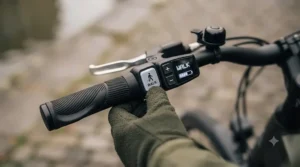
Walk Assist for Heavy E-Bikes: Heavy Frame Management Made Easier
Heavy frame management is the unglamorous phrase for a genuinely common problem: getting a 25-38kg bike from A to B when you’re not sitting on it. Fat tyres, dual suspension and bigger batteries all add mass, and none of that weight distributes evenly when you’re pushing rather than riding — it tends to lean, drag, and fight your steering input in exactly the moments you can least afford it, like a kerb edge or a train platform ramp.
Walk assist for heavy ebikes solves this by letting the motor carry a chunk of that rolling resistance while you focus purely on balance and direction. The Engwe Engine Pro 2.0, at around 37-38kg, is the clearest example on this list of why the feature matters so much on heavier bikes — professional delivery riders who’ve tested it note that manoeuvring it without power assistance is genuinely difficult work. By contrast, lighter bikes like the HIMO Z20 still benefit from walk assist, but the stakes are lower; you could, in a pinch, muscle a 22kg bike over a small step. You couldn’t comfortably do the same with a fully loaded fat-tyre bike pushing 30-40kg. As a rule of thumb, the heavier the bike, the more walk assist shifts from convenience to necessity — which is worth factoring into your buying decision alongside range and motor power.
Practical Usage Guide: Getting the Most From Walk Assist
Getting comfortable with walk assist in the first 30 days matters more than most manufacturer manuals suggest. A common mistake new owners make is discovering the feature by accident, mid-hill, rather than practising it somewhere flat and low-stakes first — find a quiet car park or your own driveway and run through activation a few times before you actually need it under pressure.
Setup basics worth checking on delivery: confirm the display firmware is up to date (some manufacturers push updates that adjust walk assist sensitivity), and check that your walk assist speed feels controllable rather than jerky — most systems allow at least a small amount of calibration via the settings menu, though this varies by brand. Maintenance-wise, walk assist relies on the same motor and battery systems as normal riding, so there’s nothing bike-specific to service, but it’s worth periodically checking that the activation button itself isn’t sticking or losing responsiveness, particularly on cheaper display units where the plastic housing can wear with repeated use. One optimisation trick several long-term owners on cycling forums mention: on step-through frames especially, walking slightly ahead of and beside the bike, rather than directly behind it, gives you a better angle to correct drift before it becomes a problem. Finally, a genuinely common first-month mistake is releasing the activation control too abruptly on a slope, which on some systems causes a brief jolt as the motor cuts — a gentler release, letting speed bleed off before fully letting go, avoids this on most models.
Electric Bike Push Mode for Elderly Riders
Cycling UK’s own advice on ageing and cycling is refreshingly direct: there’s no reason to stop riding as you get older, and there are specific benefits — balance, mobility, cardiovascular health — that make it worth continuing well into later life, as their guide on cycling into old age sets out. Electric bike push mode for elderly riders addresses one of the genuine physical barriers that stops people acting on that advice: the strength required to manoeuvre a heavier e-bike around a garage, up a driveway, or onto a train.
For this audience specifically, the low-step frame matters just as much as walk assist itself — bikes like the EBCO UCL-30 are built around exactly this combination, pairing an easy mount-and-dismount frame with a walk assist system operated from a clearly labelled display rather than a fiddly handlebar gesture. What most buyers overlook here is that walk assist speed itself is fairly uniform across brands, capped at roughly 6km/h by UK regulation, so the meaningful differences for older riders come down to how intuitive the activation control is and how upright and stable the frame feels at a standstill. A bike that requires holding a button with real pressure, for instance, may suit someone with strong grip strength less of a concern than one requiring a simple tap-and-release. If you’re buying for an older relative rather than yourself, it’s worth testing the actual button mechanism in person where possible, since this is one area where genuine hands-on trial beats spec-sheet comparison.
Dismount Push Mode: Getting On and Off Safely
Dismounting safely with push mode engaged is a specific skill, distinct from simply knowing the feature exists. The core principle across every bike on this list: always come to a full stop, release the activation control completely, and confirm the display shows zero speed before swinging a leg over or stepping away from the bike. Walk assist is designed to move the bike at walking pace alongside you, not to remain engaged while you dismount — releasing the button while still in motion, even briefly, is the single most common cause of the awkward wobble beginners describe when they’re getting used to the feature.
A specific problem several forum users flag: pedal-cycle disc brakes on some budget models, including the mechanical (non-hydraulic) systems found on bikes like the base ADO A20F+, can have slightly more lever travel than hydraulic systems, so squeezing gently and holding rather than grabbing sharply gives a smoother, more controlled stop before dismounting. The solution here isn’t a different bike necessarily — it’s simply building the habit of a full stop, brake check, then dismount, every single time, regardless of which model you’re riding. For heavier bikes specifically, such as the Cyrusher Kommoda 3.0 or Engwe Engine Pro 2.0, it’s also worth dismounting on the side furthest from traffic or obstacles where possible, since a loaded fat-tyre bike takes a fraction longer to settle once you’ve stepped off than a lighter commuter model.
Electric Bike Walk Mode on Steep Slopes
Steep slopes are where walk assist earns its keep most obviously, and also where the differences between bikes become most apparent. Giant’s own consumer guidance on the feature describes walk assist as designed specifically for steep ramps, trail obstacles, and busy areas where riding isn’t practical — which matches almost exactly the scenario UK cyclists describe when pushing a bike up a driveway or a multi-storey car park ramp.
On paper, every bike here caps walk assist at the same roughly 6km/h regulatory limit, so speed isn’t really the differentiator on a slope — control is. Torque-sensor bikes like the Fiido C11 Pro, Wisper 705 Torque and Cyrusher Kommoda 3.0 tend to deliver smoother, more predictable low-speed power because the underlying assist system is already tuned to respond proportionally rather than in fixed steps, and that same smoothness typically carries over into how their walk assist feels underhand. Heavier bikes need this smoothness more, not less: on the Engwe Engine Pro 2.0, a jerky walk assist system paired with 37kg of bike on an incline would be a genuinely awkward combination, which is presumably why Engwe capped throttle-only movement tightly at 6km/h on the UK-spec version rather than leaving more headroom. If steep slopes are a regular part of your route — a hilly street, a sloped driveway, an allotment path — it’s worth prioritising a torque-sensor bike over a basic cadence-sensor one, even if that means spending a little more.
Common Mistakes When Buying an Electric Bike With Walk Assist
The single biggest mistake buyers make is assuming all walk assist systems are functionally identical because the regulatory speed cap is the same across the board. As covered above, activation method, control smoothness and how the motor behaves when you release the button all vary meaningfully by manufacturer, and none of that shows up in a basic spec sheet comparison.
A second common mistake is under-weighting the bike’s unloaded mass relative to your own strength and the terrain you’ll actually push it over. A 22kg folder and a 38kg fat-tyre bike both technically have “walk assist,” but the day-to-day experience of owning them is genuinely different, and buyers who choose based purely on motor power or range figures sometimes end up with more bike than they can comfortably manage in the moments walk assist isn’t quite enough — lifting it onto a rack, for instance. Third, several reviewers note that buyers frequently skip testing the walk assist button in person, relying instead on spec sheets or video reviews, only to find the activation mechanism awkward for their hand size or grip strength once the bike arrives. Finally, it’s worth flagging a UK-specific mistake: buying an e-bike from an overseas retailer without checking it meets EAPC criteria, since higher-powered or throttle-unrestricted imports can fall outside road-legal limits — Cycling UK’s guide to e-bike legality is a useful reference point before you buy from anywhere other than a UK-established retailer.
Electric Bike Walk Assist vs Throttle-Only Mopeds
It’s worth being clear about what walk assist is not: it isn’t a substitute for a throttle-driven moped or a full electric motorbike, and confusing the two categories is a genuine legal risk. The table below sets out the core distinction.
| Feature | EAPC Walk Assist Bike | Throttle Moped/L1e Vehicle |
|---|---|---|
| Legal category | Bicycle (no licence needed) | Moped (licence, tax, insurance required) |
| Riding speed cap | 15.5mph pedal-assisted | Typically higher, varies by type approval |
| Walk/push speed | ~6km/h (3.7mph), throttle-limited | Not a standard feature |
| Where you can ride | Cycle lanes, roads, bridleways as a bicycle | Roads only, as a registered vehicle |
The analysis here matters because a handful of bikes sold online — sometimes even under similar model names to UK-spec versions — ship with unrestricted throttles that exceed EAPC limits, which legally reclassifies them as mopeds requiring registration, insurance and a licence to ride. Every bike featured in this guide is described here in its UK-compliant, EAPC-legal configuration, but it’s genuinely worth double-checking the specific listing before you buy, since the same model name sometimes covers multiple regional variants with different power outputs. Walk assist itself is one of the clearest markers of an EAPC-focused design brief: manufacturers building road-legal UK bikes consistently cap it at walking pace precisely because going further would blur the legal line Cycling UK and GOV.UK both describe.
Buyer’s Decision Framework
If you’re still weighing up which of these seven bikes suits you, a simple framework helps more than another spec table. If your main barrier is storage space and budget, choose a lightweight folder like the HIMO Z20, because its low weight means walk assist is a convenience rather than a necessity, and the smaller footprint solves your actual problem. If you’re managing a heavier fat-tyre bike regularly — for off-road use or simply because you prefer the ride comfort — choose a bike with a torque-sensor walk assist system like the Engwe Engine Pro 2.0 or Cyrusher Kommoda 3.0, because smoother low-speed control matters more as bike weight increases.
If you’re buying for an older relative or anyone prioritising ease of mounting, choose a low-step frame like the EBCO UCL-30, because the combination of an accessible frame and simple walk assist activation reduces friction at every stage, not just when pushing the bike. If steep hills are a daily reality rather than an occasional inconvenience, choose a torque-sensor bike such as the Wisper 705 Torque or Fiido C11 Pro, because proportional power delivery — both riding and walking — handles gradients more predictably than basic cadence sensors. And if budget is genuinely the deciding factor above all else, the ADO A20F+ offers a reasonable middle ground: real off-road capability and functional walk assist without flagship pricing.
Long-Term Cost & Maintenance
Purchase price is only part of an e-bike’s total cost of ownership, and walk assist systems specifically add very little to ongoing maintenance since they draw on the same motor, battery and display components used for normal riding — there’s no separate mechanism to service. Where costs do diverge across this list is battery replacement and component quality more broadly. Heavier, higher-power bikes like the Engwe Engine Pro 2.0 put more cumulative strain on drivetrain components, and several reviewers note that budget hub motors on lower-priced imports may need replacement sooner under heavy use than the torque-sensor systems on bikes like the Wisper 705 Torque, which also benefits from UK-based parts and servicing support rather than relying on international shipping for replacement parts.
Battery lifespan is the single biggest long-term cost across every model here, typically rated for 500-800 full charge cycles before capacity noticeably declines, translating to roughly 2-4 years of daily use depending on how deeply you discharge the battery each time. Buyers on a tighter long-term budget should weigh a UK-based brand’s parts availability — as with the EBCO UCL-30 or Wisper 705 Torque — against the lower upfront cost of imported models like the HIMO Z20 or Fiido C11 Pro, where replacement batteries and components may take longer to source. Neither approach is wrong, but it’s worth factoring into your decision rather than judging purely on the initial price range.
Safety, Regulations & Compliance Guide
UK law on electric bikes is more specific than many buyers realise, and it directly shapes how walk assist is engineered on every bike in this guide. Under the Electrically Assisted Pedal Cycles Regulations, as amended in 2015, a bike qualifies as an EAPC — usable anywhere a standard bicycle can go, with no licence, tax, registration or insurance required — provided the motor’s continuous rated power doesn’t exceed 250W, pedal assistance cuts off once you reach 15.5mph, and any throttle-only function (which is where walk assist sits, legally) is limited to roughly 6km/h. Full detail is available directly from GOV.UK’s EAPC guidance page, which is worth reading in full if you’re buying from a retailer outside the mainstream UK e-bike market.
A few practical safety points worth flagging beyond the legal minimum. First, always test walk assist activation somewhere flat and quiet before relying on it on an actual slope or ramp — muscle memory matters when you’re balancing a heavy bike. Second, never use walk assist to move the bike downhill; the low speed cap means it has limited ability to control descent, and gravity will do more work than the motor can moderate. Third, if you’re considering a bike advertised primarily on non-UK marketplaces, check the wattage and speed figures carefully, since higher-powered international variants of otherwise identical-looking models can fall outside EAPC rules and effectively require moped registration to ride legally.
Frequently Asked Questions
❓ What is walk assist on an electric bike?
❓ How do I activate push mode on my e-bike?
❓ Can I use walk assist while riding the bike normally?
❓ Is an electric bike with walk assist legal on UK roads?
❓ Do heavier e-bikes need walk assist more than lighter ones?
Conclusion
Walk assist is one of those features that’s easy to overlook on a spec sheet and genuinely hard to live without once you actually own a heavier e-bike. Across the seven models covered here, the pattern holds fairly consistently: the lighter the bike, the more walk assist is a nice convenience, and the heavier it gets — think the Engwe Engine Pro 2.0 at nearly 38kg — the more it becomes central to owning the bike comfortably day to day. If storage and budget top your list, the HIMO Z20 remains the simplest, cheapest route in. If you’re managing a heavier frame or steep local terrain regularly, torque-sensor bikes like the Wisper 705 Torque, Fiido C11 Pro or Cyrusher Kommoda 3.0 deliver noticeably smoother low-speed control, both riding and walking. And if you’re buying for an older relative or anyone prioritising ease of mounting, the EBCO UCL-30‘s low-step frame pairs naturally with its straightforward walk assist system. Whichever you choose, take the time to actually test the push mode activation button before you need it on a real hill — it’s a five-minute habit that makes the whole feature genuinely work for you rather than against you.
Recommended for You
- Torque Sensing eBike Brands: 7 Best UK Picks for 2026
- How Torque Sensing Works Electric Bike: 7 Top Picks 2026
- Pedal Assist Electric Bike for Fitness: 7 Best Picks for 2026
Disclaimer: This article contains affiliate links. As an Amazon Associate, I earn from qualifying purchases. If you purchase products through these links, we may earn a small commission at no additional cost to you.
✨ Found this helpful? Share it with your friends! 💬🤗
