In This Article
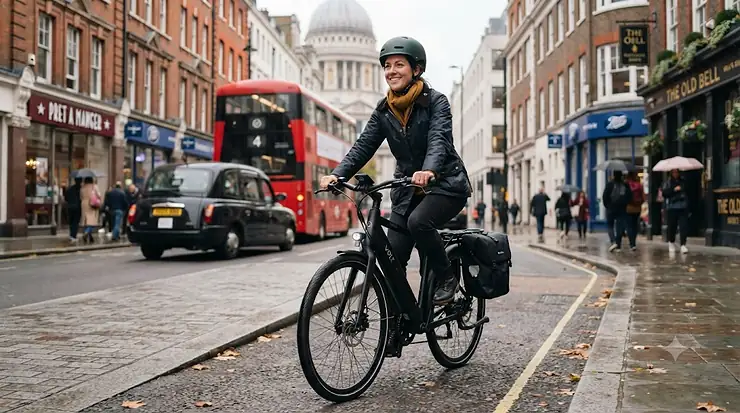
An electric bike with Apple Find My tracking is, in plain terms, an e-bike that can be located through Apple’s Find My app using either a factory-fitted chip or a bolted-on tracker, without needing a separate subscription or SIM card. Sounds simple. It isn’t, not entirely, because “supports Find My” can mean three very different things depending on who’s selling you the bike.
Here’s the bit nobody tells you at the till: a lock only slows a thief down, but a tracker tells you (and, crucially, the police) where the bike actually went. That distinction matters more than most spec sheets let on. British roads see a bike stolen roughly every seven minutes, and recovery rates without any tracking device hover in single digits. Add a Find My-compatible chip, and the odds shift meaningfully in your favour, because you’re suddenly borrowing the locational muscle of every nearby iPhone, iPad and Mac in Apple’s crowdsourced network, rather than relying on your own signal alone.
This guide has done the legwork so you don’t have to trawl seventeen open tabs at midnight. We’ve dug into seven real products, from flagship e-bikes with the tech baked into the frame to humble battery-powered trackers you can slap under any saddle, and we’ve weighed up what the tracking actually does once your bike is out of Bluetooth range. Whether you’re commuting through Manchester traffic, doing the school run on a cargo bike, or just paranoid about your shiny new purchase (fair enough, given what these things cost), there’s a sensible option below. We’ve also flagged, honestly, where a brand’s claims outrun what’s currently confirmed for UK buyers, because a puffed-up spec sheet helps nobody.
Quick Comparison Table
| Product | Type | Tracking Method | Price Range | Best For |
|---|---|---|---|---|
| VanMoof S6 | Built-in e-bike | Apple Find My (native chip) | £3,000-£3,150 range | Design-led commuters wanting factory tracking |
| Segway Myon | Built-in e-bike | Apple Find My + GPS | £1,600-£1,800 range* | Tech-forward city riders |
| Velotric GoMad | Built-in e-bike | Apple Find My + Find Hub | £1,600-£1,800 range* | Families needing cargo capacity |
| Segway Muxi | Built-in e-bike | Apple Find My + AirLock | £1,350-£1,500 range* | Budget-conscious utility riders |
| VanMoof S6 Open | Built-in e-bike | Apple Find My (native chip) | £3,000-£3,150 range | Shorter riders wanting step-through access |
| Apple AirTag | Retrofit tracker | Apple Find My (U1 chip) | Under £40 | Anyone bolting Find My onto an existing bike |
| Freego BikeTracker | Retrofit tracker | Apple Find My (dedicated) | Under £40 | Riders wanting a purpose-built, hidden tag |
*US pricing converted loosely for illustration; UK availability and local pricing weren’t fully confirmed at the time of research, so always check current price and stock before buying.
Look at that table long enough and a pattern emerges: the built-in systems on VanMoof S6, VanMoof S6 Open, Segway Myon, Segway Muxi and Velotric GoMad all lean on the same underlying Apple Find My network, but they bolt it onto wildly different price points and use cases. Meanwhile, the retrofit options, the Apple AirTag and the Freego BikeTracker, prove you don’t need a four-figure bike to get four-figure peace of mind. The real decision isn’t “which tracker is best” so much as “do I want tracking as a factory feature I never think about, or as a £30 add-on I choose myself.”
💬 Just one click — help others make better buying decisions too!😊
Top 7 Electric Bikes and Trackers with Apple Find My Tracking: Expert Analysis
Right, the main event. Below are seven genuinely available products that either build Apple Find My straight into the bike or let you add native tracking to any bike you already own. We’ve mixed built-in systems with standalone trackers deliberately, because “electric bike with Apple Find My tracking” covers both camps, and pretending it doesn’t would leave out some of the smartest, cheapest options on this list.
1. VanMoof S6 — factory-fitted Apple Find My with a genuine anti-theft system behind it
The standout here isn’t just that the VanMoof S6 talks to Find My; it’s that the tracking sits inside a much bigger security stack, so losing the bike is meant to be a rare event in the first place. VanMoof relaunched in the UK in 2026 under new ownership (McLaren Applied’s Lavoie division bought the brand out of administration), and the S6 is the first bike the reborn company designed from scratch.
Under the skin sits a 487Wh battery and a 68Nm motor, giving a claimed range of roughly 37 miles on full assistance, stretching to the low 90s in economy mode. In practice, that spread matters: the motor’s punchy enough for hill starts around Sheffield, but dial it back and you’ve got a genuinely long-legged commuter. The Gen 6 Kick Lock arms with a tap of your heel, and Apple Find My runs continuously in the background, not as a bolted-on afterthought.
Based on the spec comparison with rivals in this price band, the S6 is aimed squarely at riders who want their theft protection baked in rather than assembled from third-party parts. Reviewers consistently note that the automatic three-speed hub and Halo Ring interface (two LED rings replacing a conventional display) feel genuinely premium, though a few flag that VanMoof’s post-bankruptcy service network is still rebuilding trust after 2023’s collapse left earlier owners stranded.
Pros:
- ✅ Apple Find My built in from the factory, no extra hardware
- ✅ Kick Lock arms and disarms automatically as you approach
- ✅ Backed by a 3-year warranty under the new ownership
Cons:
- ❌ Recovery-focused Ride Pro tracking features are still rolling out
- ❌ Premium price puts it well above budget commuter bikes
In the £3,000-£3,150 range at the time of research, the S6 is a considered buy rather than an impulse one, but for riders who’ve been burned by a stolen bike before, the layered security arguably earns its keep.
2. Segway Myon — the most tech-dense commuter with dual Apple Find My and GPS
What most buyers overlook about the Segway Myon is that it’s really two security systems stacked on top of each other: continuous GPS through the Segway app, and Apple Find My as the offline backstop when the bike’s own connection drops. Segway unveiled it at CES 2026 as part of its push beyond scooters, and the tech suite is genuinely dense for the price.
A 500W hub motor (750W peak) delivers 85Nm of torque, and Segway claims up to 80 miles of range from the 722Wh battery, helped along by electronic Shimano CUES shifting that removes the guesswork from gear changes. The AirLock feature unlocks the bike as your phone approaches, and a “Lost Mode” lets you remotely disable a stolen bike’s motor, turning a getaway into a very slow, very embarrassing walk.
Here’s what the spec sheet won’t tell you, but reviewers note: the 2.4-inch colour display with turn-by-turn navigation is genuinely handy for unfamiliar routes, and the over-the-air update pipeline means the bike’s software has kept improving since launch. The trade-off is complexity; more electronics generally means more that can eventually need attention.
Pros:
- ✅ Dual-layer tracking with both Apple Find My and live GPS
- ✅ AirLock proximity unlocking plus remote motor disable
- ✅ Electronic Shimano CUES shifting reduces missed gear changes
Cons:
- ❌ UK availability and local pricing weren’t confirmed at research time
- ❌ Heavier feature set means more components that could need servicing
At around $1,999 in the US market (UK pricing and stock should be checked directly with Segway before ordering), the Myon positions itself as the tech-obsessed rider’s commuter of choice.
3. Velotric GoMad — a cargo hauler with Apple Find My and Android Find Hub side by side
The Velotric GoMad takes a refreshingly pragmatic approach: it doesn’t pick a side in the Apple-versus-Android argument, supporting both Find My and Google’s Find Hub simultaneously. For households split between iPhones and Android phones, that alone solves an argument that would otherwise rumble on for years.
This is a genuine short-tail cargo bike, built around a 750W hub motor (1,300W peak) and 85Nm of torque, with a 500lb total payload rating and a rear rack alone good for 176lb, enough for a child seat or a proper grocery run. The 802Wh battery is UL2271 certified, and the whole bike carries an IPX6 rating with an IPX7-rated battery, so British drizzle isn’t a concern.
Based on the spec comparison, what most buyers overlook is that the GoMad’s dual-sensor SensorSwap system lets you flip between torque and cadence sensing on the fly, a feature usually reserved for pricier bikes. Aggregated review sentiment from early testers is broadly positive on ride quality and hauling capability, though several note the saddle needs upgrading for longer rides.
Pros:
- ✅ Supports both Apple Find My and Google Find Hub natively
- ✅ 500lb payload capacity with MIK-HD compatible racks
- ✅ Dual UL certification and IPX6/IPX7 weatherproofing
Cons:
- ❌ Stock saddle draws complaints on longer journeys
- ❌ UK retail availability wasn’t confirmed at the time of research
Priced around $1,999 in its home US market, the GoMad is worth watching closely for UK stockists if you need a cargo-capable bike with cross-platform tracking.
4. Segway Muxi — the budget-friendly entry into Apple Find My-equipped e-bikes
If the Myon is Segway showing off, the Segway Muxi is Segway being sensible. It’s the brand’s first short-tail utility e-bike, and it undercuts its sibling by a meaningful margin while keeping the same core security features: Apple Find My integration and AirLock proximity unlocking.
A 750W motor (Segway also markets this as a Class 1/2 selectable bike) pairs with a 716Wh battery for a claimed 80-mile range, which is a genuinely useful figure for a bike at this price. What most buyers overlook about the Muxi is that “budget” here is relative; it’s still a well-equipped, connected e-bike, just without the Myon’s electronic shifting and full-colour navigation display.
The spec sheet won’t tell you this, but user reports from early adopters suggest the Muxi’s smaller footprint makes it noticeably easier to lift over kerbs and up front-door steps than most cargo-style bikes, which matters more than people expect if you live in a flat.
Pros:
- ✅ Apple Find My and AirLock at a genuinely lower price point
- ✅ 80-mile claimed range from a 716Wh battery
- ✅ Compact utility frame is easier to manoeuvre than larger cargo bikes
Cons:
- ❌ Drops the Myon’s electronic shifting and premium display
- ❌ UK pricing and shipping weren’t confirmed at research time
Around $1,699.99 in the US, the Muxi is the value pick of Segway’s connected e-bike range for riders who want Find My tracking without the flagship price tag.
5. VanMoof S6 Open — the step-through variant built for smaller riders
The VanMoof S6 Open is mechanically identical to the standard S6 under the bonnet, so the standout feature here is entirely about who can actually swing a leg over it. Where the S6 uses a straight top-tube frame, the S6 Open drops the frame low for an easy step-through mount, aimed at the same audience the old A5 served before VanMoof’s 2023 collapse.
Specs carry over directly: the same 487Wh battery, the same 68Nm motor, the same Apple Find My integration running continuously in the background, and the same Gen 6 Kick Lock system. What changes is fit, riders between roughly 155cm and 200cm will find the Open considerably more comfortable to mount and dismount than the standard frame, particularly if cycling in work clothes or with panniers loaded.
Honestly, the analytical case for choosing the Open over the standard S6 comes down entirely to body height and mounting style rather than any difference in the tracking or security tech, which stays identical across both frames.
Pros:
- ✅ Identical Apple Find My tracking and Kick Lock security to the S6
- ✅ Step-through frame suits a wider range of rider heights
- ✅ Available through the same 42-partner UK retail network
Cons:
- ❌ No performance or range advantage over the standard S6
- ❌ Same premium price band as the flagship model
Also in the £3,000-£3,150 range, the S6 Open is simply the more accessible shape of the same well-tracked bike.
6. Apple AirTag — the cheapest, most flexible way to make any electric bike Find My-compatible
You don’t need to buy a new bike at all. The Apple AirTag turns literally any electric bike, or ordinary pedal bike, into a Find My-tracked object, and it’s the product most people should seriously consider before spending thousands on a “smart” e-bike purely for the tracking feature.
Inside is Apple’s U1 chip, using ultra-wideband technology, which is the bit that enables Precision Finding: point your iPhone in the AirTag’s general direction and it’ll guide you, step by step, with distance readouts and haptic buzzes, rather than leaving you squinting at a vague blob on a map. The coin-sized tag runs on a replaceable CR2032 battery lasting roughly a year, and it taps into hundreds of millions of Apple devices worldwide for offline location finding, meaning your bike can be pinpointed even somewhere with no mobile signal of its own, as long as another iPhone wanders nearby.
What the marketing won’t stress is that an AirTag needs a discreet mounting spot to be useful against a determined thief; velcro to the underside of a bottle cage and a moderately observant criminal will find and bin it in seconds. Tucked inside a hollow frame tube, under a seat post, or inside a pannier lining, it becomes a genuinely stealthy addition. Reviewers consistently rate the setup process (hold it near an iPhone, tap “Connect”) as close to foolproof.
Pros:
- ✅ Works with any bike, electric or otherwise, no bike purchase needed
- ✅ U1 chip enables precise, walk-you-there Precision Finding
- ✅ No subscription fees, ever, for core Find My functionality
Cons:
- ❌ Requires careful, discreet mounting to avoid easy removal
- ❌ Android riders and their friends can’t help relay its location
At around £35 for a single AirTag, or under £120 for a four-pack RRP (regularly discounted lower), this is the lowest-cost entry point on this entire list, and arguably the smartest first purchase for anyone asking “can I just add Find My to my existing bike?”
7. Freego BikeTracker — a purpose-built, hidden Find My tag designed specifically for bikes and scooters
Where the AirTag is a general-purpose object finder pressed into bike-tracking duty, the Freego BikeTracker was designed from day one to live on a bike frame. It pairs with the native Find My app exactly like an AirTag, but its housing and mounting hardware are shaped around motor housings and frame cavities rather than keychains and wallets.
Setup mirrors Apple’s own tags: bring it near an iPhone, iPad or Mac, and it appears in the Find My app ready to pair. Once connected, Precision Finding works the same way it does for any Find My accessory, guiding you in via Bluetooth when you’re close, and relying on the broader Find My network to relay location when you’re not. Freego markets this specifically at e-bike and e-scooter owners who want a tag that looks like it belongs on the vehicle rather than an obvious circular disc stuck on with tape.
Aggregated customer sentiment (drawn from the product’s own review section, which should be read with the usual grain of salt for brand-hosted reviews) leans positive on discretion and battery life, with a handful of buyers noting shipping delays around initial launch stock.
Pros:
- ✅ Purpose-built housing designed to hide on bike frames
- ✅ Full native Apple Find My integration, no companion app required
- ✅ No subscription costs beyond the one-off purchase
Cons:
- ❌ Smaller brand with a shorter track record than Apple’s own hardware
- ❌ Stock and shipping timelines have fluctuated at launch
Priced similarly to an AirTag, roughly £30-£35, the Freego BikeTracker is worth comparing directly against the AirTag if a bike-specific shape and mounting kit matters more to you than brand recognition.
✨ Don’t Miss These Exclusive Deals!
🔍 Take your electric bike security to the next level with these carefully selected products. Click on any highlighted item to check current pricing and availability. These tools will help you create genuine peace of mind your family will love!
How to Choose an Electric Bike with Apple Find My Tracking
Picking between a factory-fitted system and a bolt-on tracker isn’t as obvious as it first looks. Here’s the reasoning we’d actually apply if we were spending our own money:
- Decide whether you’re buying a bike or buying tracking. If your current bike is fine and you just want an electric bike with Apple Find My tracking, an AirTag or a Freego BikeTracker gets you there for under £40, no new bike required.
- Check whether the tracking runs on the Find My network or a proprietary app. Some “smart” e-bikes, Cowboy’s models among them, use their own GPS and app rather than Apple’s Find My network specifically, which means no crowdsourced offline coverage from nearby iPhones.
- Weigh subscription costs against one-off hardware. VanMoof’s advanced Ride Pro tools and Segway’s live GPS layer sit alongside free Find My tracking, so read the fine print on what’s included versus what needs a subscription.
- Match battery range to your actual commute, not the marketing figure. Manufacturer-claimed ranges (VanMoof’s 37-93 miles, Segway’s 80 miles) are best-case numbers; British weather, hills and cold snaps eat into them.
- Confirm UK stock and pricing before you fall for a US-first launch. Several products on this list, the Segway and Velotric bikes especially, were confirmed for the US market at the time of research, with UK availability still catching up.
- Think about mounting discretion for retrofit trackers. A visible AirTag strapped to a handlebar is a five-second removal job for a thief; one hidden inside a frame tube is a different proposition entirely.
- Factor in the theft-recovery ecosystem, not just the locate feature. VanMoof’s Bike Hunter recovery service and Segway’s Lost Mode motor-disable add real teeth beyond simply seeing a dot on a map.
Features That Actually Matter (And Those That Don’t)
Marketing copy loves throwing around “smart,” “connected” and “AI-powered,” and honestly, most of it is filler. What genuinely earns its place on a spec sheet is narrower.
The U1 chip and its ultra-wideband Precision Finding genuinely matter, because the difference between “somewhere in this street” and “six metres north, turn left” is the difference between recovering your bike in two minutes and giving up after twenty. Offline location finding through the Apple Find My network matters too; a tracker that only works when your bike’s own SIM has signal is a tracker that fails exactly when you need it most, in a basement car park or a rural lay-by.
What matters less than the marketing suggests: built-in fitness syncing to Apple Health, turn-by-turn navigation displays, and colour-customisable LED rings are pleasant, but they’re comfort features, not security features. The spec sheet won’t tell you this, but reviewers consistently note that a cheap, well-hidden AirTag beats an expensive, poorly concealed proprietary tracker every single time a bike actually goes missing.
Common Mistakes When Buying a Find My-Enabled Electric Bike
Based on the spec comparison across every product in this guide, a handful of buying mistakes crop up repeatedly.
The first is assuming “smart tracking” automatically means Apple Find My. Plenty of e-bikes ship with proprietary GPS and their own app, which can be excellent, but doesn’t tap into the crowdsourced Find My network or Precision Finding. The second is mounting a retrofit tracker somewhere obvious, a saddlebag, a visible bottle-cage clip, then being surprised when a thief spots and binns it inside seconds. The third is skipping the setup step entirely; an AirTag or BikeTracker only works once it’s actually paired to your Apple ID, and it’s an easy step to forget in the excitement of a new purchase.
Bike theft remains chronically under-reported and under-prosecuted in the UK, with formal sanctions following only a tiny fraction of cases, so relying purely on police recovery without any tracking hardware is, frankly, optimistic. The final mistake is buying the flashiest bike on this list without checking UK availability first; several of the products here launched in the US ahead of any confirmed UK rollout, so always verify current stock and pricing before you commit.
Apple Find My Tracking vs Traditional GPS Trackers
| Factor | Apple Find My | Traditional GPS Tracker |
|---|---|---|
| Subscription | None required for core tracking | Often £5-£15/month |
| Coverage | Relies on nearby Apple devices | Relies on cellular signal |
| Best For | AirTag, Freego BikeTracker, city riding | Rural areas with weak Apple-device density |
| Precision | U1 chip enables metre-level guidance (select tags) | Typically 5-10 metre GPS accuracy |
| Battery Life | Up to a year (replaceable coin cell) | Often weeks, rechargeable |
Looking at the table above, Find My wins decisively on ongoing cost, since none of the products here charge a monthly fee for basic location tracking, while a traditional cellular GPS tracker can rack up £60-£180 a year in subscriptions alone. The trade-off is coverage density: in a busy UK city, Find My’s crowdsourced network is genuinely excellent, but out on a remote bridleway with few iPhones passing by, a traditional GPS tracker with its own SIM card may report your location more reliably. For most British commuters riding in towns and cities, though, Find My’s device density more than compensates.
What to Expect: Real-World Performance of Offline Location Finding
Here’s what actually happens when your bike goes missing and there’s no phone signal to speak of, whether it’s stashed in a basement, wheeled into a lock-up, or simply parked somewhere with poor mobile coverage.
Offline location finding through Apple’s Find My network doesn’t need your bike to have its own SIM or data connection at all. Instead, the AirTag, BikeTracker, or built-in chip in your VanMoof or Segway broadcasts a rotating, encrypted Bluetooth signal. Any nearby iPhone, iPad or Mac, belonging to a total stranger who has no idea your bike exists, picks up that signal, encrypts the location, and relays it anonymously to Apple’s servers. You then see the result in your own Find My app. Neither Apple nor the stranger’s device ever learns what they found.
Based on the spec comparison across products, this system performs best in exactly the environments where a cellular tracker often struggles: underground car parks, densely packed housing estates, and areas with patchy mobile signal but plenty of iPhone-carrying passers-by. What the spec sheet won’t tell you, but real-world reports suggest, is that in sparsely populated areas, the reverse is true; a Find My tag sitting in a rural barn with nobody walking past for days will simply show its last-known location until someone with an Apple device eventually comes within Bluetooth range.
Long-Term Cost & Maintenance
| Cost Factor | Built-In E-Bike (e.g. VanMoof S6) | Retrofit Tracker (e.g. Apple AirTag) |
|---|---|---|
| Upfront Cost | £1,350-£3,150 range | Under £40 |
| Subscription | Optional premium tiers on some brands | None |
| Battery Replacement | Rechargeable, integrated | CR2032 coin cell, roughly annual |
| Best For | VanMoof S6, Segway Myon, all-in-one buyers | AirTag, Freego BikeTracker, existing-bike owners |
The analysis here is fairly blunt: over a three-year ownership period, a retrofit AirTag or Freego BikeTracker costs a fraction of what any built-in system does, simply because you’re not also paying for motor, battery and frame. That said, a built-in system like the VanMoof S6‘s Kick Lock or Segway Myon‘s AirLock bundles tracking with active deterrence, arming and disarming automatically, which a passive tracker alone can’t replicate. If you already own a decent bike, retrofitting is almost always the better-value route; if you’re buying a new bike anyway, the built-in tracking is effectively free.
Safety, Regulations & UK Compliance Guide
Before any tracking chat matters, your bike needs to be legal in the first place. Under UK law, an e-bike must qualify as an Electrically Assisted Pedal Cycle (EAPC) to be ridden without a licence, tax or insurance: it needs working pedals, a motor capped at 250 watts of continuous rated power, and assistance that cuts out above 15.5mph. Every bike featured in this guide, the VanMoof S6, VanMoof S6 Open, Segway Myon, Segway Muxi and Velotric GoMad alike, is sold in configurations designed to meet EAPC-equivalent limits, though it’s always worth double-checking the specific UK-spec model before buying, since US listings sometimes describe higher-power variants.
On the privacy side, Apple builds anti-stalking protections directly into the Find My network: if an unknown AirTag or Find My accessory travels with you for an extended period without its owner nearby, both iPhone and Android users receive an alert. That’s worth knowing if you’re on the receiving end of an alert about someone else’s bike tag, and it’s a reasonable reassurance that the same technology protecting your bike can’t easily be weaponised against you.
Setting Up Find My Tracking on Your Electric Bike
Getting tracking properly configured takes about ten minutes, but the details matter more than the marketing suggests.
Start by choosing your mounting spot before you do anything else. For an Apple AirTag or Freego BikeTracker, look for a genuinely hidden cavity: inside a hollow top tube (many bikes have an access port under the bottom bracket), tucked into the battery compartment housing, or wedged inside a saddle bag lining rather than clipped to the outside. Built-in systems like those on the VanMoof S6 or Segway Myon skip this step entirely, since the chip ships integrated into the frame or motor housing.
Next, open the Find My app, tap the plus icon, and select “Add Item” for a standalone tracker, or follow the bike manufacturer’s specific pairing flow for a built-in chip, usually triggered from within their own companion app first. Name the item something identifiable but not obviously valuable (“Blue Bike” beats “Expensive E-Bike,” for reasons that should be obvious. Enable “Notify When Left Behind” if your model supports it, so you get an alert if you walk away from a locked bike without realising.
In the first 30 days, the most common mistake is forgetting to test Precision Finding while you still have the bike in sight, so you know what the guidance experience actually feels like before you ever need it under stress. Check the battery indicator monthly for standalone trackers, and mark a rough date a year out to swap the CR2032 cell before it dies quietly.
Which Tracking Solution Suits Your Riding Life?
Three quick profiles, because abstract advice is less useful than seeing yourself in the scenario.
The daily commuter cycling into a city centre and locking up in a busy bike rack is generally best served by a built-in system like the Segway Muxi or Velotric GoMad, where AirLock-style proximity unlocking and continuous tracking work together without any extra thought. The budget-conscious student or occasional rider, someone who already owns a perfectly good bike and just wants insurance against a bad day, is almost always better off with an Apple AirTag tucked discreetly into the frame; it’s the cheapest meaningful upgrade on this entire list. The parent doing school runs and grocery hauls on a cargo-capable bike should look hardest at the Velotric GoMad, where the payload capacity and dual Find My/Find Hub support matter as much as the tracking itself, particularly in a household split between iPhone and Android users.
Common Electric Bike Tracking Problems, Solved
Problem: my tracker shows a location from three days ago. This usually means the bike’s been somewhere with genuinely low iPhone density, a locked garage, a rural spot, or simply out of Bluetooth range of any Apple device. There’s no fix beyond waiting for another device to pass by, which is the one honest limitation of relying purely on offline location finding.
Problem: I can’t tell if my retrofit tracker is still attached. Set a calendar reminder to physically check discreet mountings monthly; adhesive and velcro solutions can work loose over time, particularly in wet British weather.
Problem: my built-in bike tracking and Apple Find My seem to conflict. On VanMoof’s newer models, the brand’s own Ride Pro theft-tracking and Apple Find My can’t run simultaneously; check Find My’s last-known location before activating VanMoof’s own theft mode, as the help documentation explicitly recommends.
Problem: I’m getting an unknown-tracker alert and I’m not sure why. This is Apple’s anti-stalking safeguard working as intended; if you’ve recently borrowed a friend’s bike or bag, it may simply be their tracker travelling with you legitimately.
Problem: the battery died and I didn’t notice. Enable low-battery notifications in the Find My app for any standalone tracker, and treat that alert with the same urgency as a low-fuel warning.
Frequently Asked Questions
❓ Does an electric bike with Apple Find My tracking need a monthly subscription?
❓ Can I add Apple Find My to an ebike I already own?
❓ How accurate is Find My network tracking for a stolen electric bike?
❓ Does offline location finding work if my electric bike has no signal of its own?
❓ Is an AirTag compatible ebike setup legal and private in the UK?
Conclusion
Choosing between a built-in system and a bolt-on tracker really comes down to one honest question: are you buying a bike, or are you buying peace of mind? If it’s the former, the VanMoof S6, VanMoof S6 Open, Segway Myon, Segway Muxi and Velotric GoMad all fold Apple Find My tracking into a genuinely well-built machine, with the VanMoof pair leading on design polish and the Segway models leading on raw tech density. If it’s the latter, and your current bike is perfectly fine, an Apple AirTag or the purpose-built Freego BikeTracker delivers most of the same peace of mind for a fraction of the outlay.
What ties every option together is the same underlying network: hundreds of millions of Apple devices, quietly doing a stranger a favour without either party ever knowing it happened. That’s not a small thing in a country where bike theft remains stubbornly common and prosecution rates remain stubbornly low. Whichever route you take, the sensible move is the same: check current prices and UK stock before buying, mount any retrofit tracker somewhere genuinely hidden, and actually test Precision Finding once, while the bike’s still safely in your own driveway.
Recommended for You
- Keyless Entry Electric Bike Locks 2026: 7 Fob-Free Picks
- Fully Insured Electric Bike: 7 Best Picks for 2026
- Ebike Light Legal Requirements: 7 Essential UK Picks for 2026
Disclaimer: This article contains affiliate links. As an Amazon Associate, I earn from qualifying purchases. If you purchase products through these links, we may earn a small commission at no additional cost to you.
✨ Found this helpful? Share it with your friends! 💬🤗
